When You Mess Up Brand Consistency, AI Won’t Recognize You An
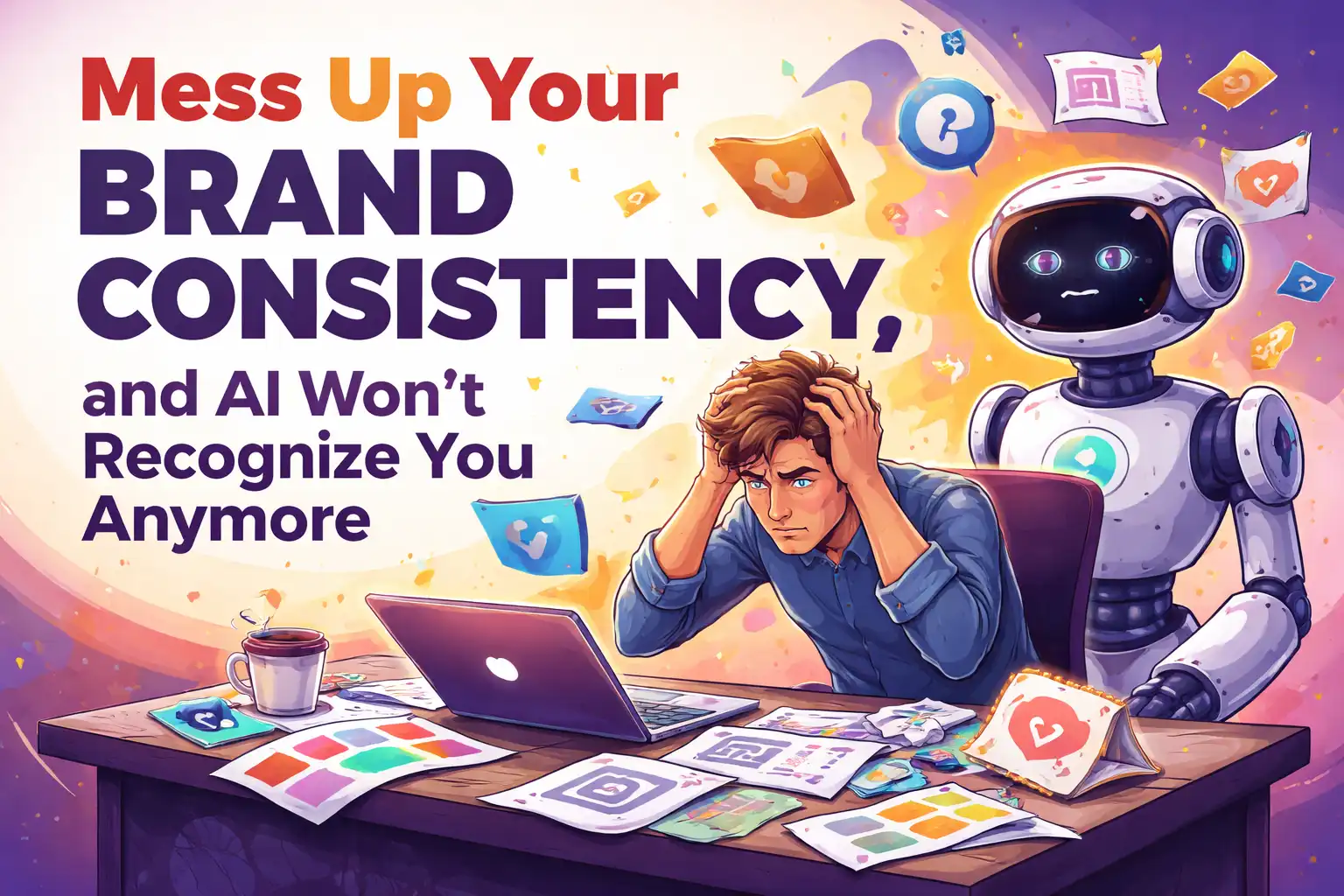
In Q1 2026 we did an internal product relaunch. It wasn’t a earth‑shattering version upgrade, just the routine v2.5. The team spent two weeks rewriting the product description page, the homepage slogan, and the copy for three landing pages. Everyone was happy and thought “this finally unifies the brand tone.” Then we launched. A month later I checked Search Console—traffic didn’t increase, but what was worse was that impressions for brand‑related queries dropped by almost 40 %. It wasn’t the rankings; people simply stopped searching for us. I kept wondering whether our keyword strategy was at fault. The problem turned out not to be keywords but AI search.
AI search—I’m talking about Google AI Overviews, Perplexity, ChatGPT Search, etc.—no longer looks only at what your page says. It looks at your whole web identity—homepage, blog, social media, even user reviews. If your brand says contradictory things in different places, AI deems you “unreliable” and skips you. Brand consistency is no longer just an aesthetic issue for marketers; it’s a hard prerequisite for AI search to decide “whether to mention you.”
Three details are especially interesting:
First, AI’s “consensus signal” is more sensitive than you think. Our homepage says “next‑generation data analytics platform,” but a blog title from last year was “Legacy BI Tool Upgrade Guide.” AI sees these two signals and tries to reconcile them. It usually chooses not to emphasize us and instead recommends competitors whose pages all say the same thing.
Second, the cost of zero‑click search is underestimated. A 2025 McKinsey study noted that more than half of consumers already use AI search to make purchase decisions, and they rarely click the source links. If you don’t appear in the AI summary, you’re effectively invisible to that segment of users.
Third, 91 % of marketing teams use AI to scale content, but output quality is the second biggest pain point. That’s because AI can write, but it’s not good at “maintaining consistency.” Each article reads like it was written by a different person—tone, word choice, even the phrasing of the call‑to‑action vary. This fragmentation might have been tolerable in the traditional search era, but in an AI‑search environment it gets you ignored.
What We Did Wrong During That Chaotic Period
During the chaos, the most typical mistake we made was not creating a “multiformat brand voice document.” We thought staying consistent meant “using the same logo and tagline.” What we actually needed were finer‑grained rules—e.g., “We never use the word ‘empower’ in any content format,” or “Always use the verb ‘discover’ instead of mixing ‘analyze, insight, diagnose.’”
Later we spent about a quarter of a year combing through all public content from the past two years—blogs, help center articles, social media posts, external presentations—marking inconsistencies. Then we wrote a three‑page brand voice guideline, each rule accompanied by a “right vs. wrong” example. Those details matter: if AI sees “intuitive interface” on your homepage and “simple user experience” in a Medium article, it won’t treat them as equivalent; it will see you as unreliable.
Another rarely mentioned trick: submit your brand content to Google Merchant Center and DataCommons so AI has more authoritative structured references to understand you. This isn’t emphasized in SEO guides, but it made a noticeable difference for us.
Traffic Gradually Returned After That
Traffic didn’t bounce back overnight. Roughly three months after the updates, brand‑search CTR recovered to its previous level and began a modest rise. The key turning point was a forgotten detail—we turned the FAQ section on the homepage into a structured‑data‑supported rich result. Two months later, AI Overviews started quoting sentences directly from our FAQ.
Another trap I later realized: when you use AI‑generated content to maintain publishing frequency, the cost of maintaining brand consistency doesn’t go down—it goes up. It’s not AI’s fault; it’s the lack of a “consistency proofread” step in the automation pipeline. Every AI‑generated article needs a human to verify it follows the brand guidelines. Skipping that step means that three months later your content pool becomes a mishmash—AI search can’t make sense of you, and users don’t see a single cohesive team behind the content.
The process lasted about six months, during which we pulled four articles for complete rewrite—two because the tone was off despite decent quality, and two because the viewpoints conflicted with the updated brand positioning. Those seemingly minor actions added up to a clear dividing line: either you actively manage consistency, or AI search will ignore you.
New Issues After Automation
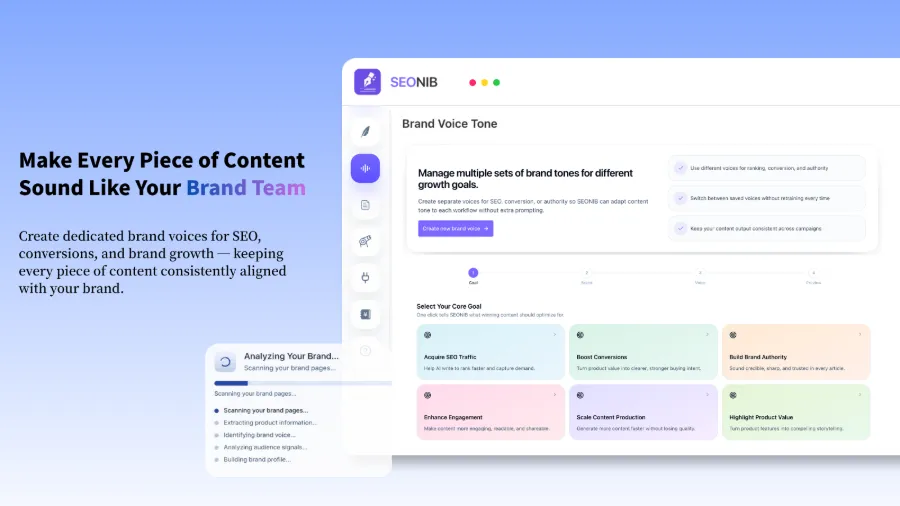
We later started using automation tools to manage the workflow. SEONIB was one of the solutions I found—it can automatically generate content and check output consistency against the rules you set. I’m not endorsing it; I’m just describing the reality we faced: when the team went from two articles per week to ten, consistency maintenance became an engineering problem, not an editorial one. You need a proofread layer that can be embedded in the pipeline, not two editors scrambling on Friday afternoon to edit articles.
Brand consistency isn’t just a “unify the writing style” task for artistic types. In an AI‑search‑driven era, it’s a signal‑engineering problem. If every trace of your brand online says the same thing, AI will mention you in its summary. One mismatch and you’re likely to be skipped.
So I later learned one thing: never underestimate the weight of consistency in AI search. It’s not that it’s more important than backlinks or authority; it’s a hard condition that, if unmet, leads to outright exclusion—similar to how a multilingual site without hreflang tags is disqualified in Google’s eyes.
I haven’t completely solved the problem either. We still occasionally discover old blog titles that clash with the current brand positioning. Some of those conflicts involve content we were once proud of. Deleting or keeping them isn’t straightforward; we just leave them in limbo. Brand consistency is never a “set‑and‑forget” task; it requires ongoing maintenance, especially in the world of AI search.
FAQ
What impact does brand consistency have on AI search?
AI search engines look for consensus signals across multiple sources to decide which brand to cite. If a brand’s tone, terminology, or claims differ across channels, AI deems the brand unreliable and skips it, opting for competitors instead.
How do I check if my brand is consistent?
Regularly scan all public content—website, blog, social media, user reviews, help center. Flag any word‑choice conflicts, contradictory statements, or content that deviates from the current brand positioning. A simple “tone template per content type” is far more useful than a vague “stay lively.” Aim for at least a quarterly comprehensive audit rather than waiting for traffic to drop before investigating.
Do AI content‑generation tools break brand consistency?
Yes, if you don’t set guidelines. Most AI tools generate each piece as if a different person wrote it. You need a “pre‑norm layer” that clearly defines prohibited words, required tone patterns, and a uniform output structure. The maintenance cost of that layer must be anticipated.
Is the investment in brand consistency worth it?
If we measure by “brand‑search impression count” and “AI summary appearances,” our two‑month effort yielded nearly a 30 % lift. In monetary terms, that translates to saving roughly the SEM budget of a small team. More directly, when users mention you in Perplexity or ChatGPT, AI won’t start describing your product from a wrong premise. That silent loss is far harder to recover than ad spend.
Share Article