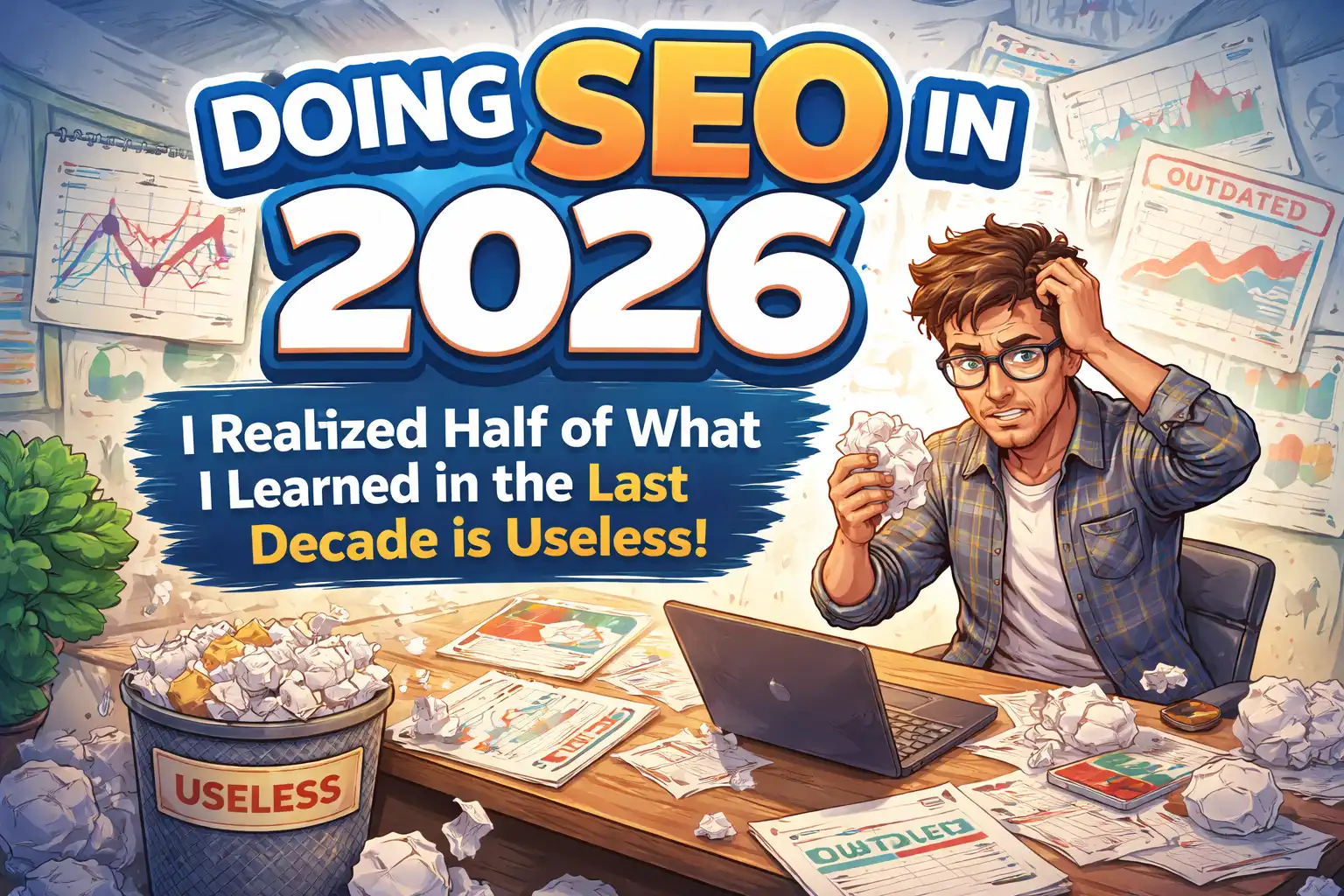
Doing SEO in 2026, I Found That Half of What I Learned Over the Past Decade Is Useless
If you’re just starting to learn SEO now, honestly, you picked a good time.
Not because SEO has become simpler. Quite the opposite—it has become a mess. But it’s precisely because of the chaos that new talent has a chance. Those who have been living off old methods for ten years are now, like me, rewriting the manual.
Let me start with my own situation. I’ve done SEO for six years, managed traffic teams for three companies, and handled dozens of domains. I thought I knew a thing or two. Then, from the second half of 2025 to early 2026, Google seemed to have changed its operating model. AI Overviews rolled out far faster than anyone imagined, and the layout of the search results homepage changed completely. One of the sites we manage saw a 40% increase in impressions but a 22% drop in clicks. My boss looked at the data and asked what was happening. I said, “Google is giving the answer directly to people, so no one clicks through.” He stared at me for three seconds; I still remember that expression.
That Tuesday Afternoon That Gave Me Insomnia
There was an article about “Python virtual environment setup” that had been ranking near the top for almost two years, consistently bringing about 8 000 visits per month. It was a complete tutorial, from basic concepts to pitfall recordings, over 5 000 words. I always considered it our benchmark content.
Then one day I opened Search Console as usual and saw that the article’s clicks fell from over 200 per day to around 80. The ranking didn’t move, but impressions were still rising. My first reaction was that the code had an error, so I spent two hours debugging. Then I manually searched the keyword and realized—Google was now showing a three‑step configuration code snippet at the top of the search results, extracted from our page. Users saw those three lines, got what they needed, and didn’t click through to the full version.
I stared at that screenshot for a long time. It wasn’t anger, it was a kind of helplessness that’s hard to describe. You spend two days polishing content, and the search engine summarizes it into three lines, and users stop coming.
This isn’t an algorithmic penalty. It’s a more fundamental shift—Google is no longer just an indexing tool; it’s becoming an answer provider itself. And we, content creators, have moved from being the “destination” to being the “source material.”
What Actually Changed in SEO in 2026
If I had to sum it up in one sentence, it’s that the boundaries of search engines are blurring.
Fifteen years ago, SEO was synonymous with Google optimization. There was no YouTube search ranking, no Amazon internal search weight, no Reddit dominating Google results. But now you have to consider whether your content can be found on YouTube, rank on Amazon, or be quoted in ChatGPT answers. According to the latest SEO guide from SEONIB, the core of 2026 SEO has shifted from keyword matching to “demonstrating real expertise (E‑E‑A‑T)”, while also “earning citations in AI‑generated answers.” In plain language: your content must be so good that AI wants to copy it.
But there’s a catch—when AI copies you, users stop clicking you.
That creates a magical phenomenon: your impressions go up, but your traffic goes down. A third‑place ranking used to get about a 10% click‑through rate; now it may be only 4%. It’s not that your content got worse; users are being intercepted. Data shows that organic search still accounts for roughly 53% of total search traffic (BrightEdge), but the click concentration on top results is declining. In other words, the traffic pool is still there, but the water is being diverted into various SERP features.
The Silly Tactics I Tried and the Path I Found
My initial response was especially stupid.
I tried to fight for user attention against Google. I made the article longer and hid the answer deeper, hoping users would “have to click in.” The result? Page dwell time actually dropped because users couldn’t see what they wanted in the search results and clicked the next result. I spent three months creating a dozen “super‑content” pieces, each about 8 000 words, with no noticeable traffic lift. A colleague politely told me I was “fighting the search engine.”
Then I realized one thing: instead of battling SERP features, better to leverage them.
I changed my strategy. Take my article “WordPress Site Speed Optimization” as an example. The old structure was: 500‑word problem analysis, then ten optimization steps, then code examples. The revised structure starts with a diagnostic tool entry (users input a URL to generate a report), then recommends different optimization paths based on the report. Each path is deliberately designed to make the user think, “I need to click to see the full plan.” The “answer completeness” of a single article decreased, but overall site engagement—dwell time and page views—rose by 40%.
Another direction was to create value that SERPs can’t summarize: interactive tools (SEO scorecards, code formatters), deep case studies (long reads that require contextual continuity), and multimedia combos (video + text + download bundles). Google can’t steal those. Our “React component lifecycle” page had its main methods stripped by Google; we added a line at the top: “The excerpt shows the basics, but click to learn 16 real‑world use cases, performance tips, and common pitfalls.” That simple sentence lifted the click‑through rate from 8% to 22%.
Tools Aren’t a Savior, but They Can Reduce Overtime
Honestly, I’m not a tool‑fanatic. I’ve seen many people spend a few hundred dollars on a stack of SEO tool subscriptions, only to let them sit idle after a month. But 2026 is indeed different—AI tools have changed the underlying logic of content production.
In the past, writing a rank‑worthy article involved: two to three hours of keyword research, four to five hours of writing, and one to two hours of structural optimization. You could barely push out a dozen articles a month, and quality wasn’t guaranteed. Now, with AI assistance, the time from topic discovery to draft generation is compressed to minutes. However, a crucial point—don’t let AI finish the whole piece automatically and publish it. I tried that and got a bunch of content that “looks right but reads like plain water,” which Google simply ignores.
My current workflow: use AI for trend discovery and topic suggestions, let AI generate the draft and SEO fields, then I do a round of human polishing and case‑study additions. For publishing, I now use SEONIB for bulk generation and multi‑platform synchronization. What makes it most reassuring isn’t that it can write—many tools can—but that it strings together the whole pipeline from trend discovery to automatic publishing across platforms. I used to waste at least fifteen minutes copying and pasting between WordPress and several content platforms. Now I set a schedule, and AI generates and publishes on time; I just need to periodically review content quality.
That said, it’s not perfect. Bulk‑generated content still has tone‑consistency issues; sometimes the tone flips between articles, making it feel like different authors. If the target audience demands high expertise (e.g., finance, law), AI‑generated depth still falls short and needs human editorial review. We once bulk‑published a batch of e‑commerce SEO articles, and one misspelled “Shopify” as “Shopifyy”; a user screenshot it and posted it on Twitter. That week wasn’t pleasant.
What I Still Don’t Fully Understand About Zero‑Click
Having written all this, I must admit there are many things I haven’t fully figured out.
For example, do long‑tail keyword strategies still work in a zero‑click environment? In theory, long‑tail terms have low competition and high conversion, but ultra‑specific queries (e.g., “2026 iPhone battery replacement cost”) are more likely to be answered directly in a Google snippet. Users see the price and don’t click. This has caused some of our previously high‑ranking long‑tail terms to lose actual traffic. We now split our keyword pool into two categories: high zero‑click risk (simple facts, direct questions) for which we only create brand‑exposure content without expecting traffic, and medium‑specific, depth‑required queries that we invest real resources in.
Another puzzling issue is structured data. It helps search engines understand your content better and can boost rankings, but it also makes it easier for them to extract your content for snippet displays. Should we make our content structure as clear as possible, or leave some “fuzzy zones” to protect clicks? Our current compromise is: use standard Schema for basic info, and custom structures for deep analysis and case studies, ensuring the core commercial value isn’t over‑structured.
A side effect of zero‑click is that users who do click have extremely low tolerance. If a page loads in more than three seconds, the bounce rate is almost 70% higher than for traditional search results. The unspoken user mantra is: “I already got the gist from the snippet; if the page can’t give me more value instantly, I’m leaving.” So before publishing any article now, I run it through PageSpeed Insights for mobile load speed.
But zero‑click isn’t fatal for every industry. Our comparative review piece (“Best SEO Tools in 2026”) actually performed better in a zero‑click environment because users saw the conclusion in the snippet and wanted to click for the full comparison table and real‑time pricing. Therefore, our content strategy now focuses more on “cannot be summed up in one sentence” types.
In Closing
SEO has a characteristic—you always feel like you just learned the rules, and then the rules change.
The biggest change in 2026 isn’t technology; it’s mindset. Before, you could win by writing longer and getting more backlinks than competitors. Now you have to accept a fact: search engines no longer owe you traffic. Even if your content ranks first, users may get the answer right in the search results. You have to learn to balance “being excerpted” and “being clicked.”
I still haven’t found that balance point. Every month when I review the data, something makes me doubt my previous judgments. That’s probably the most honest reality of this industry—no standard answer, only incremental improvements after endless trial and error. You get some things right, traffic rises a bit; you get other things wrong, traffic drops back. Then you keep going next month.
If my experience resonates with you, you might be hitting a similar bottleneck. You can try the automatic generation and multi‑platform publishing features of SEONIB—at least it will save you from repetitive copy‑pasting and free up mental bandwidth for the truly important work. But don’t expect a tool to solve everything. Tools can handle 80% of the grunt work; the remaining 20%—strategic decisions, tone, brand differentiation—still belongs to you.
FAQ
Q: In 2026, should I still focus most of my effort on Google?
Don’t just stare at Google. YouTube is the second‑largest search engine, and Amazon, Reddit, and even citations in ChatGPT answers are worth attention. Google remains the biggest traffic source (about 53% of overall organic search), so it should be the core front, but not the only one.
Q: Will AI‑generated content be penalized by Google?
Google’s official stance is that quality matters, not the source. AI‑generated content that demonstrates genuine E‑E‑A‑T (experience, expertise, authority, trustworthiness) won’t be penalized. The problem is that most AI content is generic, lacking depth and first‑hand experience. The key is to use AI for drafting, then add human expertise and real case studies.
Q: In a zero‑click trend, is it still necessary to optimize for featured snippets?
Yes, but the strategy must adjust. Getting a featured snippet still means your content is recognized as an authoritative source, which is a brand‑exposure and trust signal. The goal is to design the snippet as a “trailer” rather than a “full movie”—so users see the gist but still want more details.
Q: How can I tell if a keyword has entered zero‑click mode?
Open Google Search Console and look at the keyword’s impressions and click‑through‑rate trends. If impressions are stable or rising while CTR is steadily falling and the ranking position hasn’t changed much, the query likely now has a direct‑answer SERP feature (AI overview, featured snippet, etc.). You can also manually search and observe.
Q: As a solo‑person team, where should I start?
First, fix the technical foundation (site speed, mobile friendliness, crawlability). Then focus on 10‑20 long‑tail keywords with clear commercial intent, creating deep, case‑rich content for each. Don’t try to cover everything. Use AI tools to assist with generation and publishing to cut time, but concentrate your effort on expertise and uniqueness. A one‑ or two‑person team with the right strategy can see stable organic traffic within three months.
Share Article