Why I No Longer Write Every Blog Post Personally
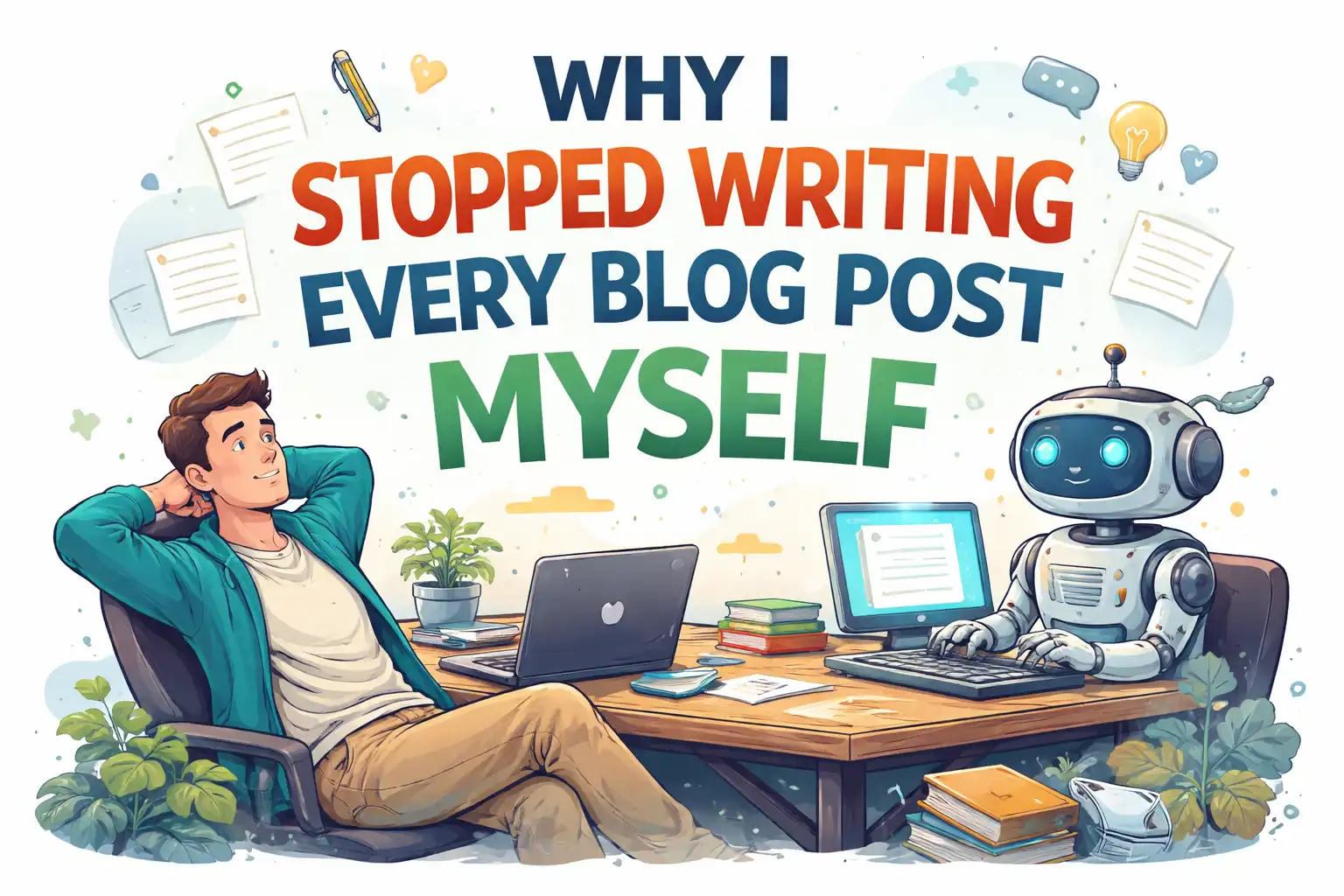
As a solo operator of a cross‑border independent site, I once firmly believed a principle: blogs must be written by hand, every sentence and paragraph painstakingly crafted, because that gives them soul and uniqueness. This belief kept me grinding in the first year of my startup, opening Google Docs after 11 p.m. each night to brainstorm the next day’s article topic for “One Platform Three AI Growth Modes.” What happened? After six months, the content library had fewer than 50 blogs, and several were just half‑baked filler pieces. In my niche, top competitors publish 5–8 articles per week and receive more than ten times my traffic. Every time I opened Google Search Console and saw their rankings soar while my content library remained fragmented, I couldn’t help but ask: maybe my very approach was wrong?
The biggest contradiction of manually writing blogs is that the more time you spend, the lower your publishing frequency, yet SEO demands a steady stream of content to build authority. Spending 10–15 hours a week on writing ultimately yields only one or two decent but poorly scheduled articles. This isn’t a skill issue; it’s a structural bottleneck that a solo operator can’t escape.
The answer is simple: manually writing blogs is detrimental to growth. It’s not an option; it’s a barrier.
The Dilemma of Manual Blogging: Dual Pressure of Time and Quality
When I first started my independent site, I chose a long‑tail niche that wasn’t fiercely competitive. In theory, the content dividend should have been sizable, but reality was very different.
Every morning, the first thing I did was scan industry news, check Google Trends, and see what competitors had posted. That alone ate 40 minutes to an hour. The next step was topic selection—not every idea is worth writing; I had to consider search volume, competition, and relevance to my product line. By the time I finally settled on a topic and started writing, it was already past 10 a.m.
Writing a 1,500‑word blog—from first draft through revisions, inserting screenshots, adding internal links, setting meta descriptions and keyword density—averaged 4–5 hours. If the article required product comparisons, data citations, or personal experience, six hours became common. Adding formatting, uploading images, and checking mobile rendering meant a whole day’s energy was spent on a single post.
The most draining part wasn’t the time itself, but the unsustainable intensity. After three weeks of continuous writing, I started cutting corners: paragraphs got shorter, arguments shallower, and images were just random stock photos. The quality curve became a roller coaster, and some articles made me cringe when I reread them.
It got even worse after integrating Shopify, WordPress, and other platforms. Finishing a blog wasn’t just “throw it into a backend”—you had to upload, adjust formatting, replace image URLs, and fix internal links on each platform. Even with WooCommerce content sync, many manual steps remained unavoidable.
I later tried using ChatGPT for assistance, but the drafts it produced were highly homogeneous. The same prompt yielded near‑identical templates with only keyword swaps. After publishing a few such posts, the “indexed but not crawled” rate in Google Search Console rose noticeably. Searching the opening paragraphs of my articles often returned almost identical phrasing on other sites. Data proved this method failed: Google’s algorithm updates increasingly reward “useful, unique” content, and templated articles not only fail to rank but can also drag down a site’s overall authority.
During that period I spent 3–4 days a week on content, yet the publishing rhythm fell from a planned four posts per week to an actual average of 1.5. Watching the 14‑day impression curve in Search Console flatten, I realized the manual mode had hit its ceiling.
First Attempts at Automated Writing: From Skepticism to Trust
The turning point came from a random search. While looking for content ideas for an Etsy store, I landed on the SEONIB page. My first reaction was, “Another AI gimmick.” I had previously been burned by so‑called “one‑click SEO blog” tools that produced unreadable output with no logical paragraph flow, let alone SEO optimization.
But I signed up for a trial. The reason was simple: I had no better options at the time. Continuing to write manually meant my content library would never grow; reverting to ChatGPT’s templated writing would inevitably lead to de‑ranking. Compared side‑by‑side, SEONIB did two things that convinced me to give it a serious try: it could ingest multiple content sources (keywords, product links, social media posts) to generate articles—not just plain text generation; and it came with a built‑in SEO structure layer, eliminating the need for post‑hoc user tweaks.
What truly lowered my guard was the first topic it suggested. I run a pet‑supplies independent site, and manually I struggled to break through high‑frequency, ultra‑competitive keywords like “cat litter comparison” or “dog bed recommendation.” SEONIB’s AI detected rising search volume for “pet sleep health optimization” and pushed it into my topic queue. Honestly, I never thought of writing about that because it seemed niche. I generated an article with a trial‑and‑error mindset, and two weeks later it was consistently showing up on the third page of Google results. That signal made me realize: manual topic selection relies on personal bias and experience, whereas machines can make probabilistic recommendations based on statistical data, often with higher accuracy.
After I started using it seriously, the data shift was stark. Previously, a blog took at least four hours from topic to publish. On SEONIB, switching to “keyword blog” mode, entering a long‑tail term, and clicking generate gave me a fully structured draft with images, internal links, and meta description in about ten minutes. Sometimes the AI’s structure was even better than my own—hooky introductions, data‑backed body, natural product‑linking conclusions. Human review and tonal fine‑tuning took a stable 20–30 minutes.
I hit a snag early on. When I first set up bulk generation, I fed ten keywords at once and the AI produced ten articles, several of which had duplicated paragraphs and identical data sources. I wondered if I’d slipped back into templated content. After configuring brand context—loading niche terminology, product features, and differentiating statements into the knowledge base—the subsequent drafts showed markedly higher originality and differentiation. The whole adjustment took about a month, a reasonable trial‑and‑error period.
If you’re also stuck with limited content capacity and exhausted manual effort, check out SEONIB’s three growth modes and how they match different stages. My experience taught me that AI tools don’t replace creators; they lift productivity to a level a solo operator can’t reach.
Also worth noting is SEONIB’s deep feature breakdown of the content pipeline, especially its “human‑machine collaboration” taxonomy in the editing workflow—essential reading for anyone planning to adopt an AI writing tool.
End‑to‑End Automation: Re‑architecting the Workflow from Topic to Publication
When I decided to hand over the entire content pipeline to SEONIB, rebuilding the workflow took roughly two weeks. The new process felt a completely different level of operation.
Step 1: Automated Topic Selection
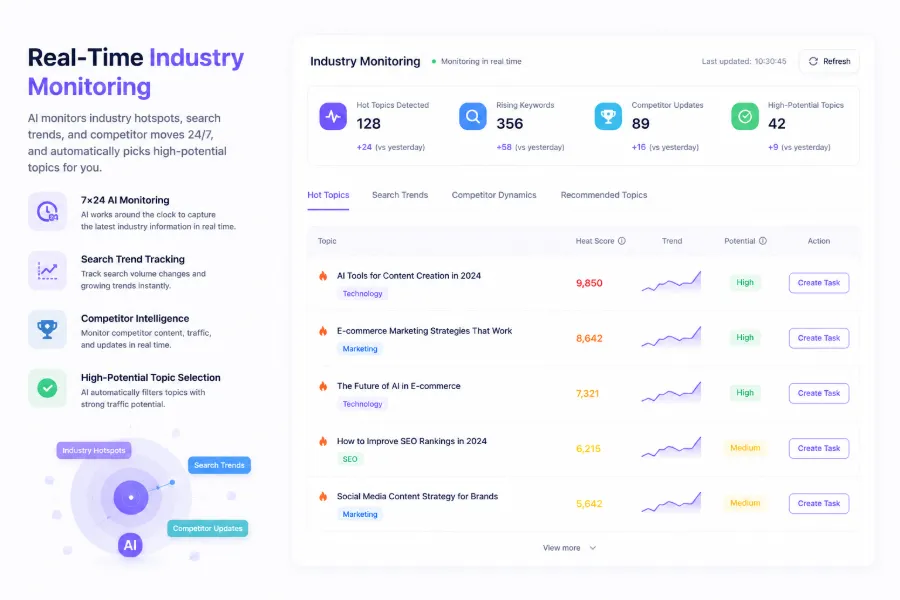
SEONIB’s AI trend‑monitoring runs continuously in the background, scanning industry news, Google Trends fluctuations, and competitor updates to automatically spot high‑search‑volume, low‑coverage topics. Each morning I open the dashboard and see 3–5 hot topics with search data already waiting for my approval—no more juggling three data sources.
Step 2: Content Generation
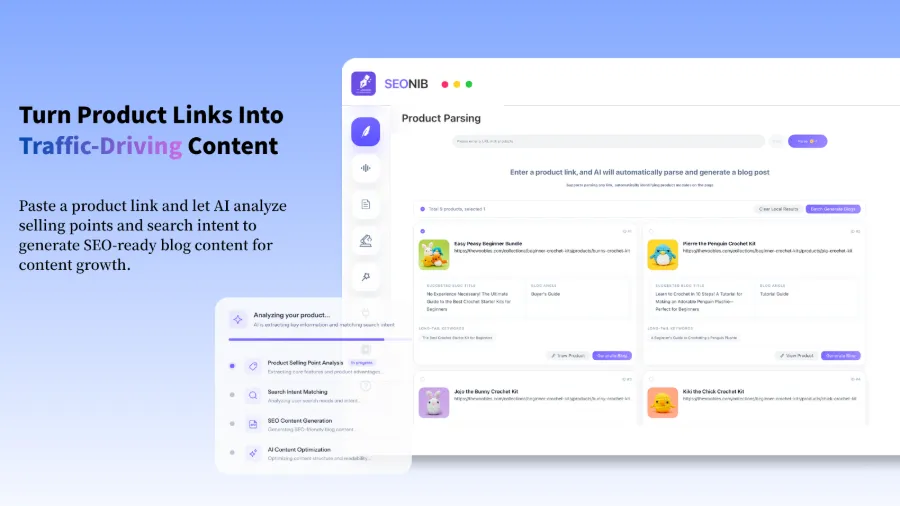
Flexibility here is high—keyword input is the basics, but the “product‑to‑blog” feature surprised me. Paste a product link, and the AI breaks down specs, use cases, and comparison dimensions, then creates buyer guides, tutorials, and review‑style articles. For a site with 50 SKUs, each new product can instantly generate 3–5 related pieces without writing a single word of draft. The output already includes SEO factors: H‑tag hierarchy, internal article entrances, estimated reading time, and mobile‑friendly formatting.
Step 3: Publishing Schedule
This solved my previous pain point: a will‑driven update cadence. When I wrote manually, frequency depended on daily energy levels. SEONIB’s content calendar lets me set a weekly publishing frequency (I chose one post per weekday). The AI generates and schedules automatically. I only need to spend about ten minutes each week reviewing the upcoming queue, tweaking titles, swapping a few phrases, and confirming internal links. After enabling daily auto‑publish, monthly output jumped from 5 to 30 posts, expanding the library from ~30 to nearly 200 articles in three months.
Step 4: Multi‑Platform Sync
This is my favorite module because I maintain both a Shopify independent site and a WordPress knowledge base. Previously, I had to log into each backend, adjust formatting, and upload manually. Now SEONIB generates once and pushes to Shopify and WordPress, with TinyPNG compression and Alt‑text auto‑filled. It also supports SHOPLINE, Medium, WooCommerce, and other major platforms, completely eliminating duplicate manual labor.
The “product‑to‑blog” feature proved far more frequent than I expected. For example, when launching a smart collar, I used the product link to generate three posts: “Smart Collar vs. Pet GPS Tracker,” “How to Choose Collar Size Based on Dog Weight,” and “Smart Collar Waterproof Rating Explained,” each placed in different categories. Writing those manually would have taken three hours just to gather specs and draft comparison sections.
At this stage, SEONIB handled the entire pipeline; my human involvement shrank to “human review + tonal control.” I now spend only 1–2 hours per week scanning the production queue.
SEONIB’s documentation includes a step‑by‑step guide for building this workflow from scratch, covering brand context configuration to content calendar setup—ideal for newcomers to automated content systems.
Additionally, SEONIB’s announcement in the SHOPLINE App Store details the integration logic; if you use SHOPLINE, just search and install the app—parameters are pre‑configured.
Results and Reflections: Traffic Growth and Time Liberation
Six months after the automated system stabilized, I finally saw data that convinced me.
Organic traffic grew about 150 % compared to the pre‑automation baseline. The boost wasn’t just from more articles; the breadth of content coverage changed. In the manual era, my articles focused on “product reviews” and “how‑to tutorials”—high‑intent, low‑search‑volume, highly competitive keywords. Automation filled gaps with top‑level and informational long‑tails like “when to wash a pet’s ears” and “10 signs of dog anxiety,” which have sizable search volume and higher informational demand weight. Google lifted many pages from single‑digit weekly impressions to triple‑digit.
Keyword rankings visibly improved. In the fourth month after automation, the brand‑specific keyword “smart pet collar” rose from position 23 to 7, and eight generic terms entered the top 20. These shifts saved ad spend and, more importantly, strengthened brand presence in the search ecosystem.
Time savings were even more striking. The 10–12 hours reclaimed each week were redirected to product pricing strategy, logistics optimization, and on‑site conversion testing—core growth levers that never got priority during the manual blogging phase.
I don’t claim automation is a magic switch. Core strategy, brand tone, and compliance still require human judgment. AI excels at execution and scale but cannot create differentiation. For example, I asked the AI to write an opinion piece on “Is pet insurance worth it?” The output was factually sound but sounded too neutral and lacked a seller’s stance. I rewrote the intro and conclusion manually, keeping the AI’s arguments in the middle. That 12‑minute tweak boosted engagement and dwell time far beyond a purely AI‑generated article.
If you want to dive deeper into the underlying logic of building content authority, read this article: “How Content Builds Brand Authority”—it explains why frequent updates are just a prerequisite and why the real ranking lever is dual coverage of breadth and depth.
In hindsight, the biggest change wasn’t that the tool replaced me, but that my role shifted from “content line worker” to “content strategy analyst.” The clearer you understand the production process, the better you know where to hand off to machines and where to invest your own effort.
Six months later, I no longer write any blog manually, yet every published piece still passes through my review and strategic breakdown. This model sacrifices no quality; it simply moves my effort from the keyboard to higher‑level decisions.
FAQ
Will Google penalize blogs generated with automation tools?
Google’s official stance focuses on content quality, not the generation method. As long as the content is original, adds informational value, and is well‑structured, search engines won’t treat AI‑generated pages differently from human‑written ones. Beware of bulk low‑quality generation—any tool that produces such content will be de‑ranked. It’s recommended to manually review and fine‑tune each AI‑generated article to ensure tone and factual accuracy.
Do I still need to edit AI‑generated articles manually?
Yes, but the intensity varies. In my experience, the AI draft’s accuracy is about 80 %; the structure, SEO factors, and images usually need little touch‑up. For brand terminology, niche context, and emotional nuance, a quick human edit yields a much higher completion rate. Typical adjustment time is 10–20 minutes per article, far less than the four hours required for a fully manual write.
Which e‑commerce platforms does SEONIB support?
It supports Shopify, WordPress, SHOPLINE, Medium, WooCommerce, and other major site‑building and content platforms. Once configured, you can push content with a single click, no need to upload manually to each backend.
How does automated publishing ensure originality?
Originality depends on two factors: (1) the depth of brand context configuration—richer product features and industry terminology lead to more differentiated AI output; (2) source diversity—relying on a single keyword template yields repetition, but combining keywords, product links, trend monitoring, and social media posts creates multi‑source input that makes collisions with other sites unlikely. After configuration, run a tool like Screaming Frog or any plagiarism checker to verify uniqueness.
Is SEO strategy still important after adopting automation?
Even more so, and it must be finer‑grained. The tool handles execution; the SEO strategy—keyword hierarchy, competitor gap analysis, internal linking topology—sets the growth ceiling. Before automation you needed manual execution; after automation you must act like a traffic manager: know which topics to write, which to drop, and prioritize based on data rather than intuition.
Share Article