
From Manual Fixes to Automated Pipelines: Where Are the Real Bottlenecks in Shopify Blog Content
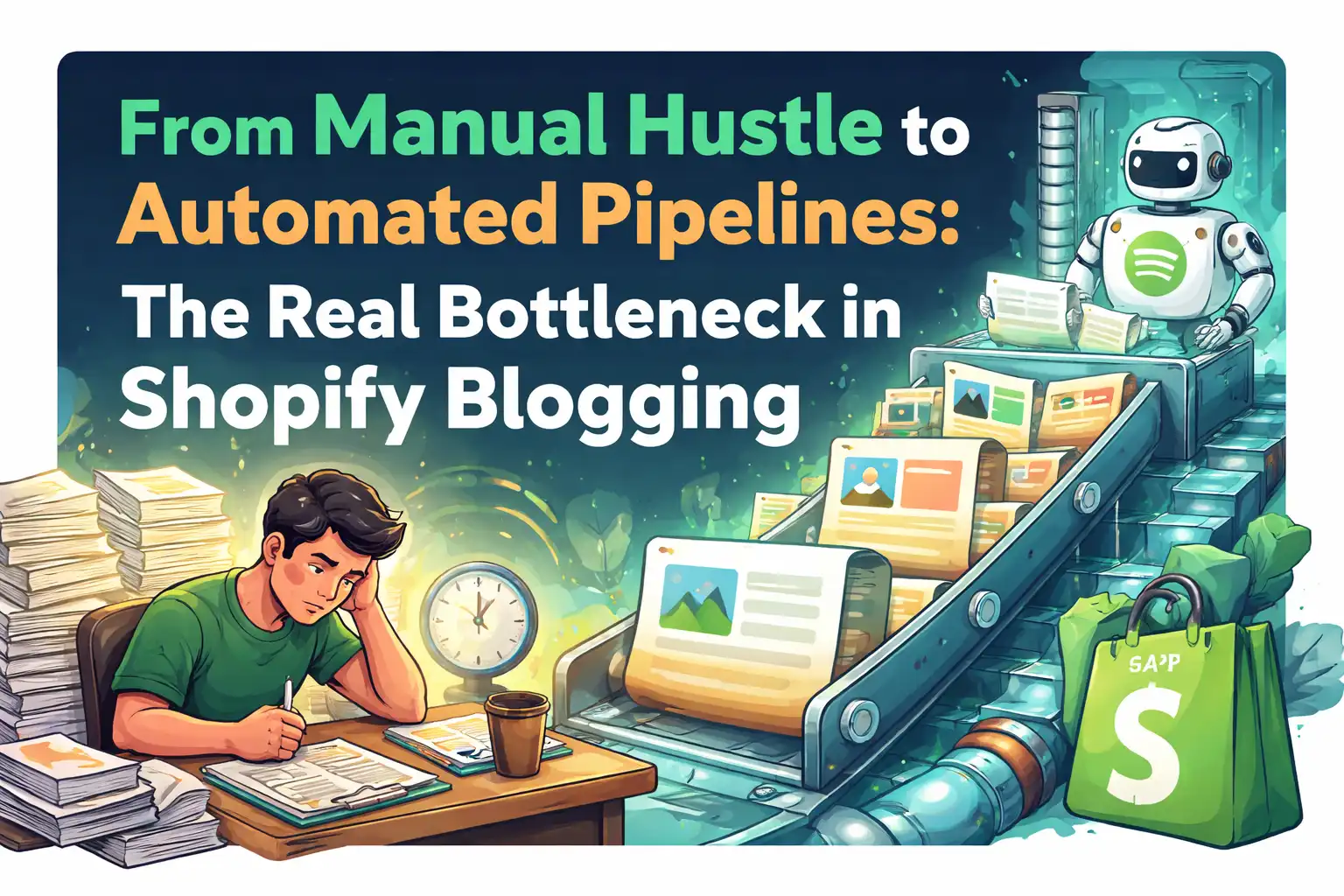
There’s an unspoken secret in the cross‑border e‑commerce community: every Shopify store has at least one underutilized blog section. It’s not that owners don’t want to write; it’s that they don’t see results when they do, and they feel they’re losing out when they don’t. I’ve seen countless scenarios—enthusiastic planning at the start of the month with ten topics, three posts written by mid‑month and then a stall, and by the end of the month the last piece still stuck in drafts. This isn’t a matter of execution; the whole workflow is fundamentally flawed.
After a few years of running traffic operations for Shopify stores, I gradually realized that the significance of blog content for cross‑border e‑commerce is completely different from domestic e‑commerce. It’s a slow‑burn asset, but you can’t ignore it. Google’s crawler favors regularly updated sites, which is why many DTC brand owners, even knowing that blog conversion rates are low, still grind out posts.
But the problem is—when you’re busy handling orders, supply chains, and ad campaigns daily, where do you find time to brainstorm topics, write, source images, format, and publish?
Three Real Pitfalls in Content Production
First, topic selection. Many think AI can solve the “don’t know what to write” problem, but AI‑generated topics are usually generic—“10 Tips for Shopify SEO”. That title was written a decade ago; AI can still spit it out today, but ranking for it is almost impossible. The issue isn’t the title itself, but whether you’ve analyzed your store’s data: which product pages have search traffic but low conversion? Which articles have high impressions in Search Console but low click‑through rates? Those are the true sources for topics.
I tried feeding AI directly with topics and letting writers follow. The result: the article went live, and three months later it was still outside the top 100 on Google. The content wasn’t bad; the topic didn’t match user search intent. Later I changed the approach: export query data from Google Search Console, find long‑tail terms with “high impressions, low CTR”, then feed those terms to AI to generate a content framework. The results improved, but the process remained manual—export, clean, fill prompts, adjust structure—taking at least four to five hours a week.
The second pitfall is the publishing workflow. Even if you write a perfect article with ChatGPT, the next steps will drive you crazy: copy into the Shopify editor, manually add heading tags (H1, H2, H3), insert images, adjust alt text, write meta description, fill the slug, set the publish time, click publish. One standard long article takes fifteen to twenty minutes. If you aim to publish fifteen articles a month, that’s five to six hours of pure “copy‑pasting” work.
Third, and most often overlooked, is content consistency. Many overestimate their self‑discipline. You might keep a three‑articles‑a‑week rhythm for the first two weeks, then drop to two, then “when I have time”. Content marketing’s biggest fear isn’t poor writing; it’s gaps. Google perceives update frequency cumulatively; once you stop updating for more than two weeks, the accumulated authority slowly erodes. You can’t see this decline like an ad stop‑and‑drop, but it gradually eats away at your organic traffic.
What a Real Automated Workstation Looks Like
About a year ago I started seriously researching Shopify content automation. The initial idea was simple: can AI write the article and post it directly to the store, eliminating all intermediate steps?
I tried a few so‑called automation tools, but most just wrapped the ChatGPT API and the output quality was hit‑or‑miss. More common issues: generated article structures were identical, tone was stiff, image styles were chaotic—Google’s AI‑content detection is far stronger now than two years ago, and content without any human oversight, especially with obvious template footprints, almost never ranks well.
Then I switched to a different mindset: instead of aiming for total “no‑human” operation, I broke the workflow into stages, letting AI handle what it does best at each stage, and involving humans only at critical points.
Example—topic stage. I don’t let AI generate titles directly; instead I use a tool that monitors industry trends and competitor activity, then pushes a summary to me. I spend half an hour each week reviewing, picking three to five promising directions, and filling a content planning sheet. The sheet contains target keywords, article structure, core arguments, and product link points. This human input is valuable because it directly determines whether the article hits the search intent.
Next is the writing and publishing stage. Here I use SEONIB to connect the whole chain. Honestly, what attracted me at first was that it links trend discovery to multi‑platform publishing in four steps, so I don’t have to log into different back‑ends daily. Its workflow is roughly: I drop the planning sheet info into it, it automatically generates the article, images, and SEO metadata according to a set cadence, then pushes it to Shopify and schedules publication. I only need a quick preview before publishing to confirm the core arguments haven’t drifted.
After about two months, I realized the real benefit wasn’t “saving time” but eliminating the anxiety of missed updates. Previously, every Wednesday I’d wonder “Do I have a post ready today?” now that thought is gone. The system outputs on schedule; I periodically check data and adjust, turning the rhythm from “chasing content” to “content running itself”.
That said, it’s not a silver bullet. The initial setup, especially defining brand voice and content standards, is labor‑intensive. If you can’t articulate your store’s tone of voice, no tool can help you. Also, for deep‑research or highly specialized content (e.g., technical whitepapers, industry trend analyses), AI still struggles; I still prefer human writers for those.
Publishing Is the Bottleneck, but Scheduling Is the Real Noose
Many focus on “how to write a good article”, but in cross‑border e‑commerce operations, producing a qualified article is actually the easiest step. The real bottleneck is the friction in the publishing process—one login, one copy, one format, one publish. Multiply that by twenty articles a month, and a ops team can get exhausted.
I noticed that SEONIB handles publishing in a meaningful way: it automatically syncs the article to multiple platforms. This is especially handy for those running both Shopify and a standalone site—you don’t have to publish separately on each platform. More useful is its built‑in scheduling. You can set publishing on Mondays, Wednesdays, and Fridays; the system advances the timeline automatically, so you don’t have to check daily “Did I publish today?”. This seemingly small feature solves the biggest problem in practice: content output won’t be interrupted by your busyness.
Of course, automated scheduling has side effects. Once I set up a promotional series to go out over five days. The system followed the plan, but by the third article the linked product was sold out, and I’d forgotten to update the planning sheet. Readers clicked to a “out of stock” page. This is a classic automation mishap—once you get used to the system running on its own, you may relax vigilance over content timeliness.
Since then I’ve adopted a habit: every Monday I quickly check the next three days’ articles to confirm product status, pricing, and promotions. It takes about ten minutes, but it avoids most automation embarrassments.
Traffic Isn’t Instant, but Trends Speak
This article isn’t selling a tool. In fact, I’ve seen many store owners pour money into content automation, only to quit after three months when they don’t see traffic growth. Their expectations were wrong—SEO content marketing isn’t a “spend $100, earn $200” game; it’s more like saving money: you see little return in the first few months, but by month six you start to see long‑tail articles climbing, and by month twelve natural search traffic can account for over 30 % of total traffic.
My own test store started using an automation solution in September 2025. The first three months showed almost no change in natural search traffic. In the fourth month, an article titled “Setting Up Multilingual Shopify Stores” began ranking, and thereafter two to three new articles entered the top twenty each month. By February 2026, the store’s natural search traffic had grown about 180 % compared to before the automation. The growth isn’t linear; it accelerates because new articles’ authority supports each other.
These traffic gains don’t always translate directly into orders, but they cover more search paths. A user might first search “Shopify SEO”, read your blog, two weeks later search “Shopify product page optimization” and see another article, and a month later search your brand name and purchase. The chain is long, but without content covering the first and second steps, the third step is almost impossible.
For deeper issues in scaling content production—like why many AI content strategies seem fast but gradually fail at scale—I’ve written an analysis you can check out: The Illusion of Velocity: Why Most AI Content Strategies Fail at Scale in 2026. That piece explores a different angle: it’s not about insufficient content volume, but about the decay of depth and relevance as you scale.
Some Unanswered Questions
I’m a bit embarrassed to admit that after a year of automated content ops I still don’t have satisfactory answers to some problems. For example, quality control of AI‑generated content in multilingual scenarios. When your store targets multiple markets (Japanese, German, French, etc.), current AI translation or localized generation can get the information right, but it’s hard to make it read like a native writer. I haven’t found a perfect solution yet; my current practice is to generate English and Chinese versions with AI, then hire freelance localizers for a polishing pass in other languages.
Also, Google’s long‑term stance on AI‑generated content isn’t completely clear. While it now emphasizes “judging content quality, not production method”, the algorithm keeps evolving. Will there ever be a day when sites that mass‑produce with AI are treated differently? It’s possible. I try to leave some “human fingerprints” in my articles—actual failure cases, specific numbers, even a slightly less polished narrative style. Those details may be the key to distinguishing “valuable content” from “filler pages”.
Content automation is a continual balancing act—between efficiency and quality, speed and depth, automation and human oversight. It’s not a “set‑and‑forget” task; it’s a “set‑up‑then‑regularly‑adjust” ongoing process.
FAQ
Q: If I use AI to automatically generate blog posts, will Google penalize my site?
A: Google’s current official stance is to focus on content quality rather than production method. The prerequisite is that the content must genuinely provide value to users. Purely filler content generated by AI without substantive information is unsuitable for SEO, regardless of the tool used. Each article should contain concrete operational experience or data support, avoiding vague generalities.
Q: How expensive are content‑automation tools? Can small sellers afford them?
A: Solutions on the market range from a few hundred to several thousand dollars. The key is to evaluate your content volume—if you publish only 2–3 articles a month, manual effort isn’t high, and automation may add more initial setup time. Generally, consider automation when you regularly publish 10 or more articles per month.
Q: How long does it take to review an AI‑generated article?
A: In my experience, a 1,500‑word Chinese article takes about 5–10 minutes for a quick preview and adjustments. The focus is on verifying core arguments, product relevance, and that data or citations aren’t outdated. You don’t need line‑by‑line edits, but factual and logical errors must be eliminated.
Q: How soon can I see traffic effects from content automation?
A: Most Shopify stores need 3–6 months to notice noticeable changes in organic search. The exact timeline depends on site authority, competition intensity, content quality, and update frequency. It’s normal for the first three months to show little growth—consistent updates matter more than optimizing a single article.
Share Article