
Advertising Money Burns Like Water, Why I Still Spend My Budget on Content
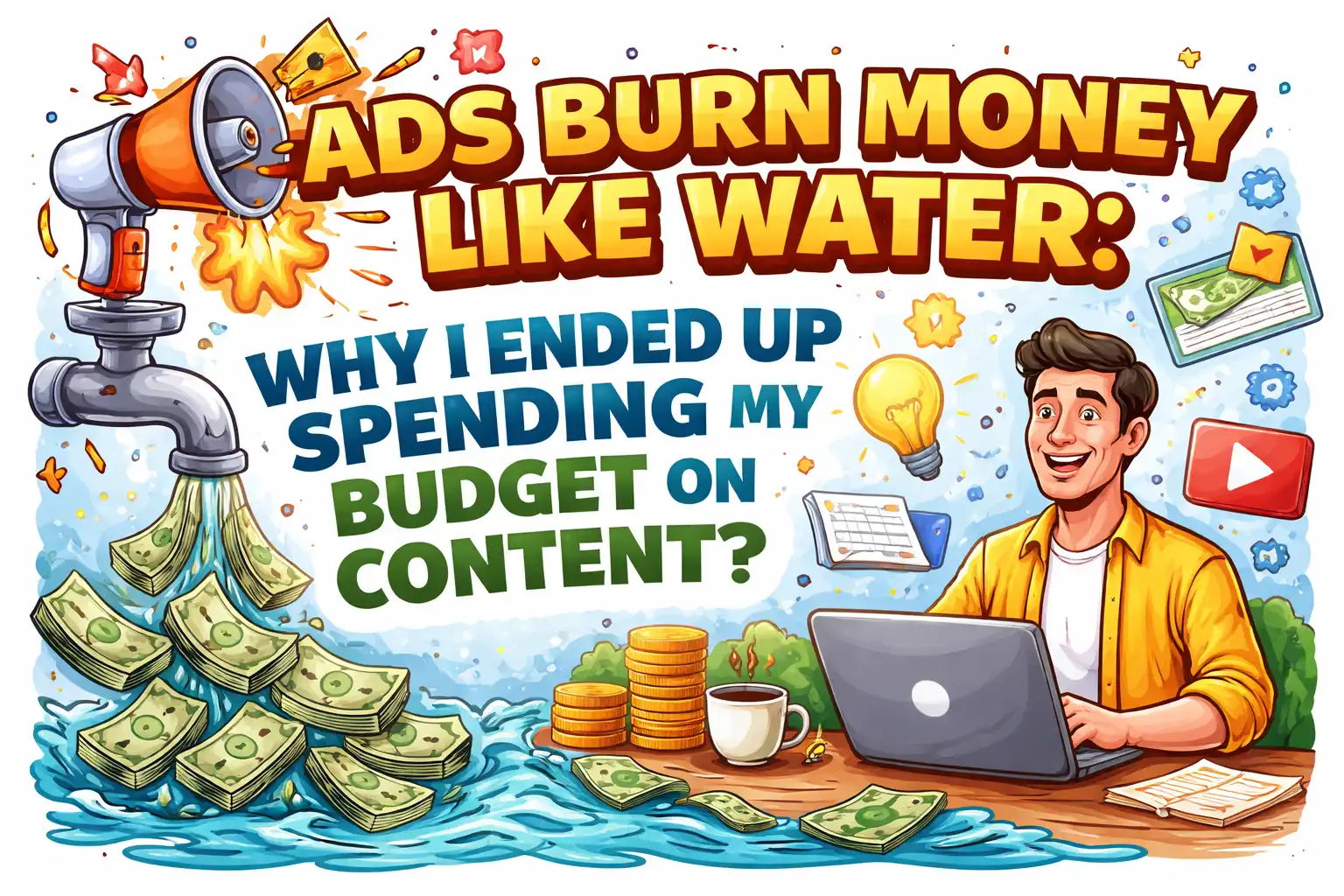
Every year at the start, I open the annual marketing plan and look at the advertising budget line, feeling an indescribable absurdity. Every penny spent seems to buy only a fleeting moment of attention; turn off the ads and it’s all gone. But when I started to focus seriously on content instead of throwing the budget into bidding systems, I realized I was finally investing in something that can appreciate over time, rather than in perpetual renewals.
Advertising is a rented house, content is the land you buy. When the lease ends, even the nails in the wall aren’t yours.
The Most Expensive “Rent” I’ve Paid Was Advertising
The basic logic of advertising is simple: spend money for exposure, and when the exposure stops, the traffic drops to zero. I’ve run Facebook Ads and a quarter of Google Ads, watching CPI and CPC numbers climb each month. In 2023, Facebook ad CPM rose about 18% year‑over‑year, according to industry data. What hurt even more was that three months later I stopped the ads, and the traffic curve plunged as if the power had been pulled.
At the same time, a casual SEO article I wrote only began to creep onto the second page of search results in the third month, and its curve kept rising slowly. Two years later, that article still brings dozens of visits each month. Comparing ads and content side by side makes the gap crystal clear:
| Dimension | Advertising | Content Marketing |
|---|---|---|
| Cost Model | Pay per click/exposure | One‑time creation cost, long‑term distribution |
| Traffic Continuity | Stops when paused | Continuous accumulation, growth after months |
| Asset Ownership | Platform asset | Own asset |
| Compound Effect | None | Significant |
A particular experience made me completely abandon my advertising fantasies. It was a Q4 promotion season; I was watching ROI in the Facebook Ads dashboard daily, and the ROAS had dropped to 1.2. I couldn’t bring myself to shut it down—because turning it off meant losing all traffic. Anyone who’s been there knows the feeling of being hijacked by the platform.
What Actually Makes Content Take Off Is “Compound Interest,” Not “Budget”
Why does content marketing have a compound effect? Because after a good article is published, Google Search Console starts indexing it, backlinks accumulate slowly, and social shares keep spreading for months. Every search request adds weight to that article instead of resetting it.
I once ran a blog that started with only a few hundred words per post, and for the first two months there was virtually no organic traffic. I refreshed Google Search Console daily and always saw “0 impressions.” I never thought about giving up, but I did open the Facebook Ads dashboard several times to add more money.
But I held on. In the third month, the first article broke into the top 10 rankings. Then the second, the third—not a sudden explosion on a single day, but a gradual accumulation. A blog post that ranks in the top three can still generate over 400 organic visits per month after 12 months, a stability that outperformed any ad campaign I ran.
What surprised me more wasn’t the performance of a single article, but the “authority map” that formed among them. Google sees that your blog consistently discusses deep topics in a specific field, and topical authority builds slowly. Each new article indexes and ranks faster than the previous one—this is the real cumulative advantage.
If you want to dive deeper into this selection mindset, check out this Analyze Your Content SEO Tool Selection comparison. Also, someone documented a Real Story of One Person Gaining Search Traffic by Writing a Blog, which mirrors many of my own experiences. If you’re just starting with content, I recommend reviewing the Complete Content Strategy Help Document to avoid some of the detours I took.
When AI Search Engines Start Answering Questions, Ads Become Even Harder to See
Last year I discovered a frightening fact. I tested industry‑specific questions on ChatGPT and Perplexity and found that their answers came entirely from knowledge‑base articles and structured content—no ad slots at all. After Google AI Overviews launched, it became even clearer—users see a consolidated answer at the top of the search results and never scroll down to an ad list.
A 2025 survey reported that about 73% of “search behavior” happens outside the traditional Google page—on TikTok, Reddit, AI platforms, etc. That means if I only buy Google Ads and Facebook Ads, I can reach less than a third of my target audience. The rest get their answers directly from AI conversation interfaces, and my product information isn’t in those knowledge bases.
This makes the situation for traditional ads even more awkward. You pay for exposure, but users bypass the ad path entirely. Content becomes the only asset that can be “cited” in AI search scenarios. If your article is used as a source for Google AI Overviews or appears in ChatGPT’s training data, that’s genuine free exposure. For more insight on this shift, see the article 2026 SEO Strategy Can No Longer Focus Solely on Google.
I also recommend bookmarking the View More Free SEO Tools page; it’s very helpful for daily operations.
The Hardest Part of Content Marketing Isn’t Writing, It’s Persistently Writing — So I Let AI Do It for Me
Manually updating a blog post takes about 90 minutes: 30 minutes for topic selection, 40 minutes for writing, and another 20 minutes for formatting, adding images, and filling in SEO meta. I persisted for a few months, publishing two posts per week, and only saw the first natural ranking in the third month. There were countless moments when I wanted to quit and dump the budget back into Google Ads.
But do you know where the problem lies? When ads stop, they stop completely—no money left. Content, though painful at first, becomes a “writing faster as you go” process. Your accumulated topic knowledge speeds up ideation, and the structures you’ve built make formatting easier. The only question is whether I can survive that “two‑month nothing‑happens” window.
What helped me get through that window was an experimental automation. I needed a tool that could run the whole workflow—from discovering hot topics to generating articles, publishing, and syncing across platforms. If you run a Shopify or Shopline store, see this Why Every SHOPLINE Store Should Run a Blog for detailed implementation logic.
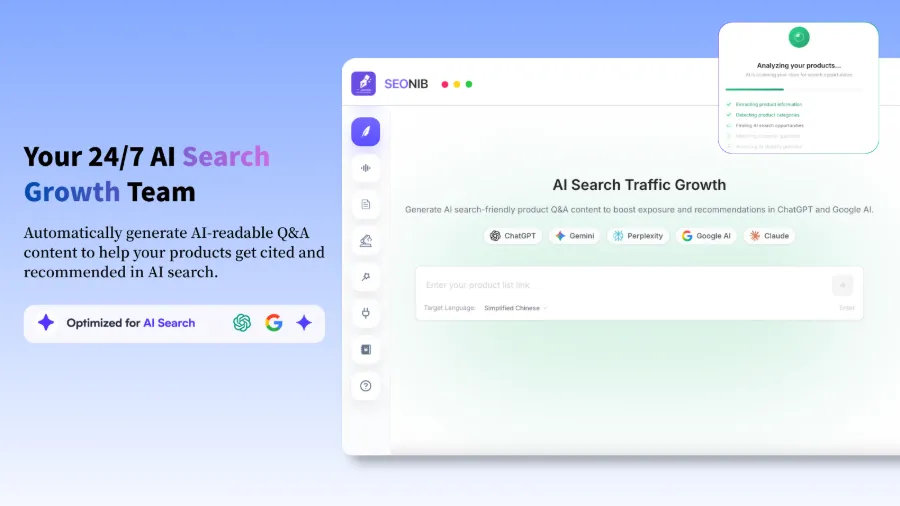
I happened to try SEONIB; you input a keyword, and the system automatically generates a complete SEO article, schedules it, and syncs it to all my platforms. The whole process went from 90 minutes to about 5 minutes of setup. I no longer need daily willpower to update; I just review trend topics weekly and let the automation handle the rest.
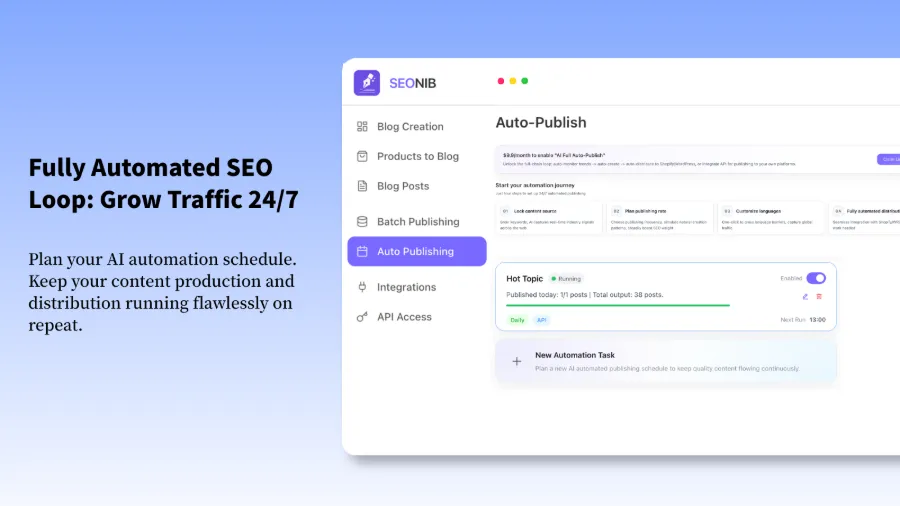
After watching the video, you’ll see that entering a keyword triggers the system to create and publish content automatically, with no human intervention needed. Three months later, my blog’s organic traffic grew steadily, and I barely ever worried about publishing frequency again.
Of course, the tool can’t solve everything. It helped me survive “the hardest persistence phase,” but you still need to oversee topic selection, content quality, and user experience optimization. Still, I no longer have to wake up at 3 a.m. to manually post articles. If you use WordPress, check out the WordPress Recommended SEO Tools Comparison to aid your decision.
SEONIB solved my core problem: turning “manually updating one post per week” into “setting rules and letting AI handle the whole process.” Now I spend five minutes a day reviewing the topics the system suggests, confirming they’re fine, and letting scheduled publishing and multi‑platform sync take care of the rest. Content continues to accumulate, and rankings keep climbing.
In Closing: Advertising Is the Rent You Pay the Platform, Content Is the Real Estate You Own
Advertising traffic is borrowed. Content assets are owned.
It sounds like a cliché, but anyone who’s spent money knows it’s true. Content marketing delivers four irreplaceable long‑term values: continuous exposure—an article still generates traffic a year after publishing; trust accumulation—each read deepens brand perception; multi‑platform reuse—one article can be shared across all channels; AI search compatibility—your content becomes part of the knowledge base.
I still run some ads, but my mindset has completely changed. Ads are for testing and scaling, not for long‑term engines. The real engine is the dozens of pieces that become easier to write and more stable over time.
If Google Ads ever become unaffordable, my blog will still be there. Search engines will still index it. AI will still cite it.
FAQ
Q1: Is content marketing really cheaper than advertising?
From a single‑acquisition‑cost perspective, not necessarily at first. Content takes months to show results, while ads can generate sales the next day. Over a 12‑ to 24‑month horizon, content CPA is usually far lower because ads cost money per exposure, whereas content costs once and continues to generate exposure.
Q2: How long does it usually take to see results from content marketing?
Most people see their first natural ranking around the third month. The first two months are almost zero feedback—that’s the toughest part. If you keep publishing weekly, by the sixth month you’ll typically notice a clear traffic climb. Don’t expect any data movement in the first two months.
Q3: My industry is niche; is content marketing still worth it?
Niche industries are actually a natural advantage for content marketing. With little competition, a single article covering a core topic can rank in the top three easily. Moreover, search demand in niche markets tends to be more precise and have higher conversion rates. You don’t need to compete for traffic with broad categories; just serve the few thousand people who truly need you.
Q4: What’s the difference between content marketing and SEO?
SEO is the methodology for getting content found by search engines—keywords, backlinks, technical optimization, etc. Content marketing is the higher‑level discipline: deciding what to write, why, and for whom. A good content marketing strategy must be paired with SEO execution to be effective, but they are not the same thing.
Share Article