
2026: I Use AI to Automate Content and Catch Up with Taiwan's E‑Commerce Trends

The day I first saw the 2026 Taiwan e‑commerce trend report, I was excited at my computer for a full five minutes—CoolPeng search volume 237,000 times/month, on par with PChome; Jiika search heat 246,000 times; PuFa 10K driving a consumer‑search wave; cross‑border shopping becoming routine from iHerb to 1688. Every number seemed to say: this wave of trends will bring profits to anyone who produces content. Then I opened my standalone‑site backend and sat in front of a blank editor for twenty minutes. It wasn’t a lack of ideas; I had too many ideas and didn’t know which article to write first.
The trend report isn’t the content itself; it’s a mineral‑vein map. The problem is you only have one pair of hands and a pickaxe, while there are thirty‑plus veins. Manually chasing them results in either exhaustion or giving up—so I chose a third path.
2026 Taiwan E‑Commerce Landscape: Trends Are Clear, Content Lags Behind
At the beginning of 2026, four changes happened simultaneously in Taiwan’s e‑commerce market: platform reshuffling (CoolPeng entered quickly with low‑price daily goods, threatening momo and PChome), subsidy‑driven traffic (PuFa 10K and cultural coins directly pulling search and purchase), cross‑border dailyization (steady growth in searches for iHerb, Mercari, 1688), and an IP‑economy explosion (Jiika and Labubu driving blind‑box and licensed‑product searches beyond 100,000 times).
Each trend demands a large amount of content to capture the search traffic. Price‑comparison guides, new‑product recommendations, cross‑border shopping tutorials, IP product reviews… the hot window for these article types may be only one to two months. By the time you finish writing manually, competitors are already on the first three pages of search results.
Most standalone‑site operators face the same dilemma: one person can’t write enough, and outsourced quality is uncontrollable. I tried hiring part‑time writers, only to spend two weeks communicating product details, and the resulting pieces went off‑topic and even ended up in Singapore. Worse, outsourcing can’t switch topics quickly—today you write about CoolPeng discounts, tomorrow about a Jiika collaboration, and you still need to insert a cross‑border logistics tool intro. Human brains can’t keep up, but search engines require continuous updates to maintain ranking.
The “Time Black Hole” of Manual Blogging: 8 Steps from Idea to Publication
I broke down my own process for writing a 2,000‑word blog post: topic decision (15 min), research and price comparison (40 min), draft writing (45 min), finding images (15 min), SEO optimization and keyword placement (20 min), editing and polishing (15 min), backend formatting and publishing (10 min), syncing to social media (5 min). That totals an average of 2.5 hours, not counting the attention loss from interruptions.
When the trend tracker shows at least five new, worth‑writing topics each week, I did the math: writing two articles a week costs 5 hours, 20 hours a month. Meanwhile I also have to select products, handle logistics, and respond to customer service. The result—every time I publish an article, a new trend dies. By the time the article is live, its search heat is already declining.
I later tried using ChatGPT for assistance, but it remained a semi‑automatic workflow: generate, copy into the backend, adjust formatting, add images, and apply SEO tags. It saved writing time but not operational time. What really broke me was one morning at 7 a.m. I started a CoolPeng discount guide, only to discover halfway through that someone had already published the same topic yesterday with over 2,000 views. It felt like discovering the start line is behind you in the final kilometer of a marathon.
I Handed Content Production Over to AI: A Fully Automated Workflow
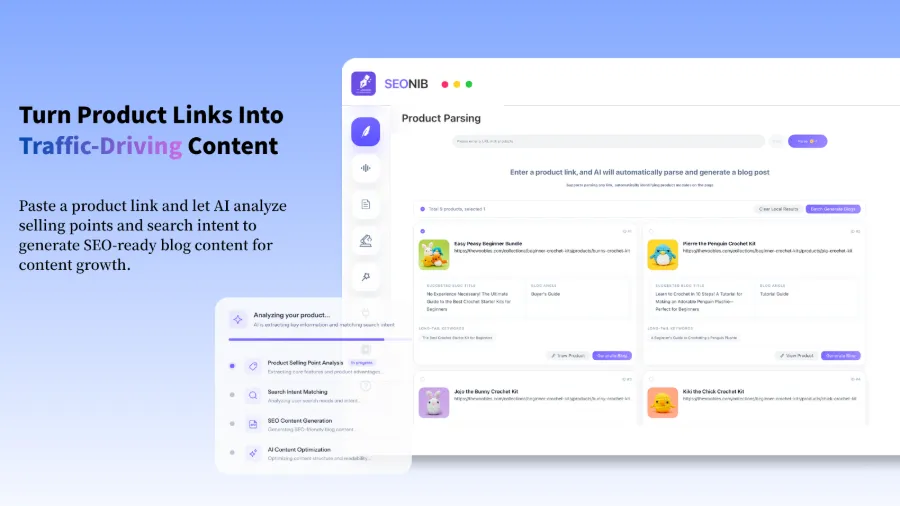
After abandoning manual chasing, I began researching a fully automated content pipeline. Initially I worried about quality, but after testing several tools I realized the real issue isn’t whether AI can write well, but whether the process can close the loop. I eventually built a “trend monitoring → automatic generation → scheduled publishing → multi‑platform sync” system, powered by the platform built on SEONIB.
The method is simple: I set a weekly frequency of five articles, then input the keywords I care about (e.g., “CoolPeng discount”, “Jiika blind box”, “2026 cross‑border shopping guide”) and product links (the items on my standalone site). The tool automatically fetches trend data, generates SEO‑optimized articles, and embeds images, internal links, and meta descriptions. I just confirm the entry in the content calendar, and it publishes on Shopify and WordPress according to the schedule I set.
During the first week I was still uneasy and checked the backend daily for article quality. In the second week I found that almost no edits were needed—the generated content was logically complete and even more search‑engine‑friendly than what I write. By the third week I stopped daily checks; the system ran for a month on its own, publishing 22 articles with zero manual intervention.
If you’re using WordPress or Shopify, you can follow this guide on bulk publishing to other platforms: Bulk Publish to WordPress with SEONIB. For deeper configuration details, the official help docs will get you up to speed quickly: SEONIB Help Documentation.
Results After Three Months: Not Just Time Saved, but Unexpected Traffic Growth
After three months of the automated content strategy, the data surprised me. The standalone site originally had 15 articles; after three months it grew to 65. Organic search traffic, starting from zero, climbed to about a 180 % increase by the end of the third month. Most of the traffic came from long‑tail keywords—those small, precise search terms like “CoolPeng first‑time purchase discount code” and “Jiika still available now”.
I ran an A/B test: the same topic “CoolPeng vs. Shopee daily‑goods price comparison” was published twice—once manually written, once automatically generated. Two weeks later, Search Console showed the manual version with 120 impressions, while the automated version had 340 impressions—its title structure and paragraph summaries aligned better with Google’s preferences. Click‑through rates were similar, but the automated version indexed noticeably faster.
What surprised me even more was that automation saved more than just writing time. The real advantage was shifting time from “production” to “strategy”. Previously I spent 2.5 hours per article; now I spend only 15 minutes on topic selection and direction confirmation. I have energy to think about how to combine hot IPs with product lines, embed price‑comparison tools in cross‑border guides, and even explore other content formats. This shift is hard to quantify but directly impacts the overall operational rhythm.
For acquiring search traffic on a brand‑new site with zero backlinks, this article offers a solid recap: How a Zero‑Backlink New Site Can Win Search Traffic. It confirms the view that in 2026, sustained content output outweighs a single viral post. What SEONIB helped me achieve is essentially turning “continuous” from a burden into a default state.
If you also run a standalone site and want more concrete automation strategies, I recommend reading this practical summary of daily automatic publishing: How Independent Sites Can Publish SEO Content Daily on Autopilot.
FAQ
I’m just starting a standalone site—does this approach suit me?
Absolutely. New sites lack rapid content accumulation. Writing one article a day manually is exhausting, but automating five articles a week can give you over 60 indexed pages within three months. Google has no hard threshold for content volume; the more, the more relevant, and the earlier, the faster the ranking weight builds.
Do I need to understand SEO to use AI automation tools effectively?
You don’t need to be an expert, but basic concepts help. You should at least know what keywords, long‑tail terms, and meta descriptions are. The tool handles technical aspects (H tags, internal links, structured data), but you still decide the topic direction. If you’re completely new to SEO, spend a weekend on the Search Console beginner tutorial.
How much does a content automation platform usually cost?
Mainstream AI content platforms charge a monthly fee of roughly 300–1,500 CNY, depending on article volume and features. SEONIB’s pricing falls in the lower‑mid range, with a free tier for trial runs. A subscription for 30 articles per month can be cheaper than a single outsourced article.
Can I control the AI’s tone and brand voice?
Yes. Modern AI tools support brand‑context configuration, including industry terminology, product info, and tone examples. I once set a “conversational, data‑driven, first‑person” style, and all subsequent articles followed that style. If a result isn’t satisfactory, you can tweak the prompt and regenerate at no extra cost.
Share Article