
Cookie‑less Marketing in the Era of Generative Search: No User Data, What Do You Rely on for Advertising?

Cross‑border sellers have probably felt the same these past few years: the old advertising logic that relied on pixel tracking, user profiles, and remarketing ads is being dismantled by privacy policies and generative search. Ad platforms can’t get user data, interest‑based targeting and look‑alike audiences become vague, and consumers turn to AI engines such as ChatGPT and Perplexity to ask questions directly. The anchor point for ad‑placement decisions is shifting from “who the user is” to “how AI understands my content”.
This is not a problem you can wait to solve. As third‑party cookies phase out and AI search starts to siphon query traffic from traditional search engines, sellers who still depend on user‑data targeting will find they have almost no usable basis for placement. Content structure, entity coverage, and multi‑platform distribution are becoming the new anchors for ad placement.
The Cookie‑less Era: The Collapse and Reconstruction of the Underlying Placement Logic
The disappearance of third‑party cookies did not happen overnight. From Safari’s ITP to Firefox’s Enhanced Tracking Protection, and now Google’s Privacy Sandbox, browsers have long been limiting cross‑site tracking. For cross‑border sellers, the most immediate feeling is that audience targeting in ad dashboards becomes increasingly fuzzy, remarketing list sizes shrink, and GA4’s data scopes change.
What truly changes the game, however, is the migration of search behavior itself. About 73 % of modern “search” happens outside Google, scattered across TikTok, Reddit, Amazon, and AI Q&A platforms. Users search product reviews on TikTok, read real‑world feedback on Reddit, compare prices directly on Amazon, and ask ChatGPT “Which coffee machine is suitable for a small apartment?” These decision‑making scenarios are almost unreachable by traditional ad placement.
The recommendation mechanism of generative search is completely different from that of traditional search engines. Traditional search ranks by backlinks and click data; AI search relies on content understanding and trust assessment. An AI engine won’t recommend you just because your ad budget is high; it only cites sources it deems reliable, well‑structured, and information‑complete. This is the so‑called “trust is traffic”—being cited in an AI answer is more valuable than being displayed on an ad slot. For more analysis of search‑behavior migration, see the discussion “Don’t Focus Only on Google—SEO in 2026 Needs to Be Everywhere”.
For cross‑border sellers, this means a fundamental shift: instead of paying for exposure, you now need content that earns the right to be cited.
How Generative Search Decides Who to Recommend: From “User Profiles” to “Entities and Structure”
The way AI search obtains answers determines which content gets recommended. Take ChatGPT Search and Perplexity as examples: they do not scrape whole pages directly; they first understand the query intent, then extract information from candidate sources and combine it into an answer. In this process, the AI must decide which source is more authoritative, which page is more relevant, and which content structure is easier to extract answers from.
Several key mechanisms are involved. Entity Recognition lets the AI understand relationships between brands, products, and people; Topical Authority lets the AI judge whether a site consistently produces deep content in a particular field; Structured content (structured Q&A, clear heading hierarchies, FAQ blocks) makes it easier for the AI to pull information snippets from a page.
A very practical observation is that AI search tends to cite pages that have clear entity tags, structured Q&A formats, and deep topical coverage; such pages are cited far more often than ordinary blog posts. In other words, a brand blog that has written 20 in‑depth articles about a product is more likely to be cited than a generic industry overview. Brands need a clear entity profile in the eyes of AI, and the content is the carrier of that entity information.
Cross‑border sellers can run a simple test: use Perplexity or ChatGPT to search core questions in their category and see which websites are cited in the answers. Most likely, the cited sites are not the brands with the biggest ad spend, but the pages with the clearest structure and the most complete entity information. For a detailed breakdown of how to keep AI engines continuously citing your site, see “Let ChatGPT Treat Your Site Like a Treasure”.
Knowledge Bases and entity pages also shine here. A complete knowledge base containing brand introductions, product specs, FAQs, and usage scenarios is essentially an “instruction manual” for AI to understand your brand. Without these structured entity data, AI can only guess from fragmented content what your brand is, what it sells, and what its advantages are.
Leveraging “Content Signals”: Three Pillars for Securing Position in AI Search Results
Understanding AI’s recommendation mechanism gives practical direction. The implementation framework for cookie‑less marketing can be broken into three pillars.
Pillar 1: Generate content in Q&A form and FAQ structure to directly match AI queries. The typical use case for AI search is asking questions; if your content directly answers a question, the probability of being cited is high. This means shifting from “article‑style” to “Q&A‑style” structures—each paragraph answers a specific question, FAQ blocks cover long‑tail queries, and headings are phrased as questions. A coffee‑machine brand, instead of writing a “Coffee‑Machine Buying Guide”, could break it into Q&A such as “How to Choose Between Semi‑Automatic and Fully Automatic Espresso Machines?”, “What Budget Is Appropriate for a Home Coffee Machine?”, “How Often Should a Coffee Machine Be Descaled?”.
Pillar 2: Build product knowledge bases and entity pages so AI can reliably recognize brand information. Every product should have its own entity page containing specs, usage scenarios, comparison info, and common questions. These pages are the foundational material for AI to understand your product. Cross‑border sellers especially need multilingual versions of these entity pages—AI search users are global, and missing English, German, or Japanese entity information means you are virtually invisible in those markets’ AI search results.
Pillar 3: Automate content production and updates to keep topics active and timely. AI search cares about freshness; a brand blog that hasn’t been updated for six months will see its credibility decline in AI’s eyes. Manual updates are costly—topic selection, writing, imaging, SEO optimization, multi‑platform publishing—so a workflow that can produce two articles per week per person is already impressive. Supporting content generation and publishing in 40 languages lets cross‑border brands cover global markets; one‑click sync to Shopify, WordPress, Shopline, etc., eliminates the repetitive task of logging into each backend. For concrete batch‑publishing steps, see “Batch Publishing and Data Source Settings Guide”.
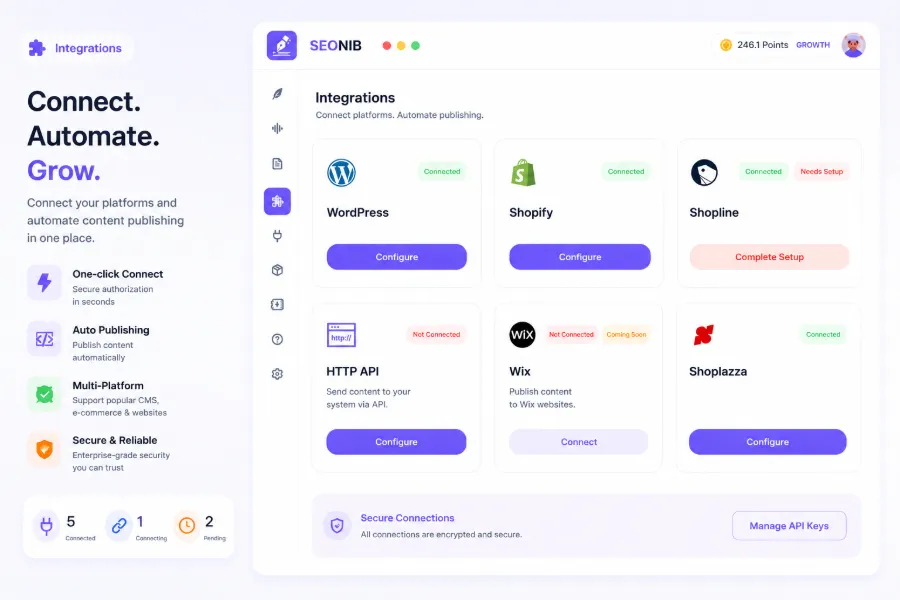
Automation’s value is not just time‑saving; it stabilizes content output. AI search crawlers and indexing mechanisms continuously monitor content update frequency; a site that publishes new content daily enjoys higher activity and credibility scores in AI’s view than a site that updates once a month. The video below demonstrates the full workflow from keyword input to automated content generation and publishing, showing a pipeline that requires no human intervention:
From “Targeting Audiences” to “Targeting Content”: Redefining Placement Metrics
In the cookie‑less era, the way we evaluate placement effectiveness must change. Instead of looking at impression and click precision, we now need to see whether content is being cited by AI and whether it gains exposure on new channels. Content coverage, AI citation rate, and multi‑platform search visibility become the new KPIs.
Here’s a real failure case. A cross‑border seller of home goods relied on Google SEO and remarketing ads for traffic before 2023, ranking in the top five for his category and maintaining roughly 80 k monthly organic visits. Early 2024, he noticed traffic declining, but Google Search Console rankings hadn’t changed much, so he didn’t worry. By mid‑2024, organic traffic fell to 30 k per month and conversion rates plummeted—because consumer decision paths had shifted, with more people completing “search‑compare‑decide” on ChatGPT and TikTok, where his brand had almost no content presence.
Worse, he had spent the past two years only on Google ranking optimization and had not built the content assets required for AI search—no FAQ pages, no product knowledge base, no multilingual content. When he finally tried to catch up, building those assets from scratch would take at least three to six months, by which time the traffic window had already closed. This is the “Google traffic trap”: high Google rankings do not guarantee traffic when decisions happen elsewhere, leading to a traffic gap that cannot be quickly fixed.
This case illustrates two points. First, content assets need time to accumulate; last‑minute efforts are insufficient. Second, placement effectiveness cannot be judged solely by Google ranking data; you must look at content coverage across the entire search ecosystem. For a systematic way to analyze content coverage, see “Function Decomposition with SEONIB”.
Topic selection also needs rethinking. Previously, topics were chosen around keyword search volume; now AI must consider demand in AI Q&A scenarios. Determining whether a product has search demand cannot rely solely on Google keyword tools; you must also see how users phrase questions in AI search. For specific validation methods, refer to “How to Quickly Validate Product Search Demand”.
In the cookie‑less era, “placement” essentially becomes a content‑coverage race. Whoever’s content is cited in more AI answers controls the traffic entry points. This is not a metaphor but a mechanistic reality—AI answer space is limited, and a typical answer cites only three to five sources; being cited means gaining that question’s traffic entry.
Automated Workflow: Keeping Content Assets Valuable in a Cookie‑less Era
Manual content updates cannot meet AI search’s demands for timeliness and freshness. A brand that wants to be continuously cited by AI must maintain a stable content production cadence, which is a huge human burden. Automation is not optional here; it is a prerequisite for sustaining strong content signals.
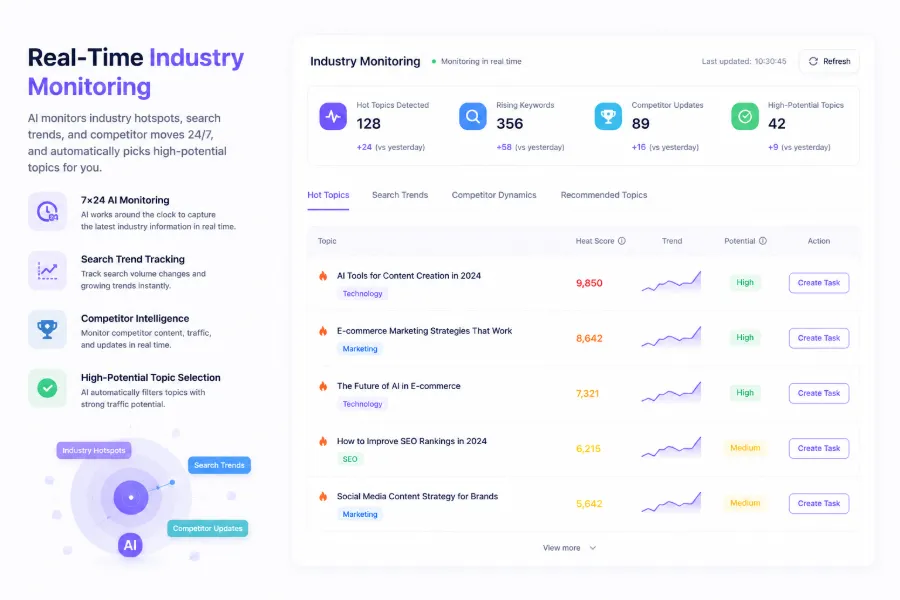
A complete automated loop includes several stages: AI‑driven topic discovery, content generation, scheduled publishing, and multi‑platform sync. In the topic stage, AI continuously monitors industry hotspots and search trends, automatically filtering high‑potential directions into a topic pool. In the content stage, entering a keyword or product link generates a structured SEO article. In the publishing stage, once a frequency is set, AI executes the schedule automatically. In the sync stage, each article is automatically pushed to all connected platforms.

The value of this “content pipeline” lies in hedging against traffic uncertainty. In a cookie‑less environment, ad and targeted traffic shrink, but content‑driven traffic is cumulative—each published article adds another citation opportunity in AI’s knowledge graph. Continuous output is placement; content accumulation is asset.
The technical stack required for an automated workflow is modest. Besides using built‑in platform features, you can push content via API into existing publishing systems such as Replit, Webflow, Ghost, or Contentful. For specific integration methods, see the “HTTP API Push and Integration Guide”. For sellers new to automated content production, the full “SEONIB Help Documentation” covers every step from site building to content publishing.
A noteworthy observation: many sellers equate automation with “mass‑producing low‑quality content”, but the reality is the opposite. Automation solves the problems of publishing frequency and coverage breadth; content quality still depends on the completeness of the brand knowledge base and the accuracy of entity information. The richer the knowledge base, the more precise the AI‑generated content, and the higher the probability of AI citation.
Marketing in the cookie‑less era is essentially a race of content and time. After user data disappears, content becomes the only communication language between brands and AI search. Starting to accumulate content assets early means occupying a more advantageous position in AI’s answer space; waiting and watching only narrows the window of opportunity.
FAQ
Q1: In a cookie‑less era, what data can cross‑border e‑commerce still use for placement optimization?
First‑party data remains usable, including on‑site search behavior, email subscription data, and CRM customer information. Query data from Google Search Console, indexing reports from Bing Webmaster Tools, and search‑term reports from various platforms all reflect user demand. The key is to shift thinking from “who the user is” to “what the user asks”, using search query data to guide content topics and structural optimization.
Q2: How do the content requirements of generative (AI) search differ from traditional Google search?
Traditional Google search values backlinks, domain authority, and keyword matching; AI search places more weight on clear entity definition, structured format, and topical depth. AI search tends to cite pages that can directly answer a question, provide complete information, and have a clear structure. A page that simultaneously has clear entity tags, FAQ blocks, and deep content has a markedly higher chance of AI citation than a regular blog post.
Q3: Without user profiles, how can you judge whether content is effective?
Look at three metrics: whether the content is cited by AI search, whether it gains exposure on non‑Google channels, and whether it drives internal site search and direct visits. Use Perplexity and ChatGPT to search core questions in your category and check if your content appears in the answers. Content coverage is more important than a single ranking—100 articles spread across 10 channels are more risk‑resistant than 10 articles concentrated on one Google channel.
Q4: Does multilingual content help obtain AI‑search recommendations?
Yes, significantly. AI search users are global; lacking content in English, German, Japanese, or Spanish means you are completely invisible in those markets’ AI answers. Multilingual content also builds cross‑language entity relationships, allowing AI to understand your brand more comprehensively. Prioritize covering the core languages of your target markets, and create a product knowledge base and FAQ pages for each language.
Share Article