When Hyperlinks Are No Longer the Only Traffic Source, What Value Remains for Websites?
At the end of 2024, an independent site operator selling home goods reviewed almost a year of data with me. He spent six months on link building, updating content daily, and swapping dozens of reciprocal links, yet the organic traffic curve in Google Search Console was almost a straight line. What truly puzzled him wasn’t that traffic didn’t increase, but that AI‑generated search recommendation traffic remained zero—none of the links he built were ever cited in AI‑generated answers.
This case is not isolated. Search behavior is shifting from “browsing a list of links” to “getting an answer directly.” Users no longer need to click through ten pages to compare specs; AI places the conclusion in front of them. Hyperlinks, as a fundamental Internet protocol, will not disappear, but their role as “traffic allocation rights” is being restructured by AI retrieval mechanisms. A website’s value is moving from “being linked to” toward “being understood and cited by AI.”
From PageRank to AI Retrieval: The Underlying Logic of Search Engines Has Changed Once
The PageRank patent was published in 1998, establishing the logic that “external links equal weight.” The more high‑quality pages point to a page, the higher it ranks in search results. This mechanism dominated the search industry for about 25 years, until Google AI Overviews were rolled out at scale in 2024, marking the true end of links as the core ranking signal.
Link signals have not been removed; their weight has simply been diluted. AI retrieval systems no longer rely solely on the voting relationship between pages; they first understand “what this entity is,” then judge “whether this content is trustworthy.” Entity recognition and semantic search are replacing link voting as the new ranking foundation. For the same brand, if its name, product specs, and contact information are expressed inconsistently across pages, the AI system’s confidence in recognizing the entity drops, and its recommendation probability follows suit.
| Dimension | PageRank Era | Semantic Search Era | AI Retrieval Era |
|---|---|---|---|
| Core ranking signal | Number and quality of external links | Content relevance and semantic matching | Entity recognition and information credibility |
| Site optimization focus | Link building | Keyword placement and content quality | Structured data and entity consistency |
| Traffic acquisition method | Being linked to | High ranking | Being cited by AI and generating answers |
“Being cited by AI” is becoming the new traffic allocation standard. This means website optimization must shift focus from “getting others to link to me” to “ensuring AI accurately understands me.”
Websites Aren’t Dead; They’ve Adopted a New Life—From “Link Nodes” to “Information Entities”
A website’s status as a brand’s proprietary asset remains unchanged. Social media accounts may be suspended, third‑party platform rules may change abruptly, but control over the domain name and server stays in your hands. The issue is that a website’s value used to lie in “being linked to,” and now lies in “being recognized by AI as a trustworthy information entity.”
Entity transformation involves three concrete steps: structured data annotation, knowledge graph integration, and AEO (AI Engine Optimization) optimization. When a page’s core entities—brand, product, specs—are accurately recognized and cited by AI, its recommendation probability far exceeds that of a similarly themed page without entity treatment. E‑E‑A‑T signals remain effective in the AI retrieval era, but evaluation shifts from “manual review” to “system judgment.”
In practice, Q&A‑style pages are the easiest content format for AI to cite. When AI generates answers, it tends to reference pages that are clearly structured and directly answer the question, rather than long‑form product introductions.
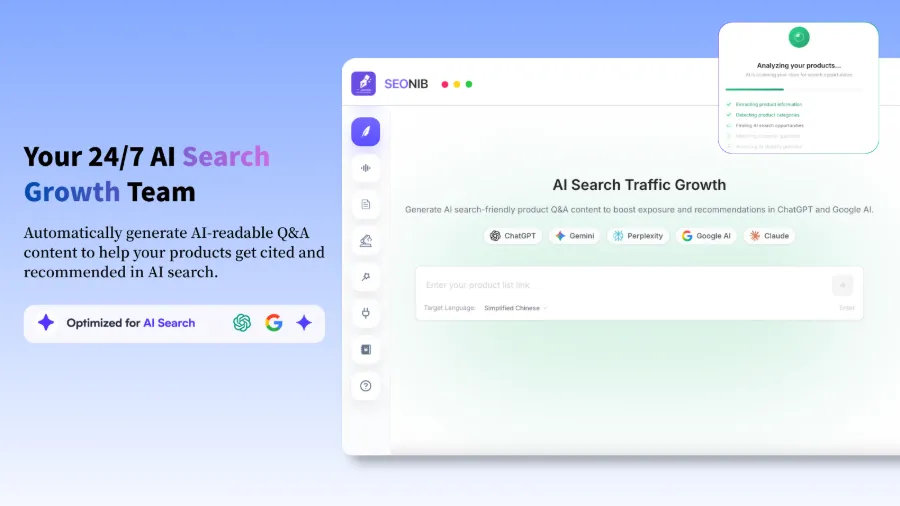
The complete methodology for the AEO content support framework centers on organizing content into factual units that AI can extract directly. This transformation is not complicated, but it requires maintaining brand information, product specs, and industry terminology in a unified content knowledge base, then having all pages pull data from that base. Tools already exist on the market for this purpose, such as the AI SEO platform SEONIB, which centralizes brand context and batch‑generates content that meets entity consistency requirements. Official updates from AI search platforms also show that Google and OpenAI are increasingly favoring structured, entity‑based content.
For detailed configuration, please visit the SEONIB Help Center.
How Content Supports AEO
Official updates from AI search platforms also show that Google and OpenAI are increasingly favoring structured, entity‑based content.
Explore more AI generation tools, see Google Gemini AI.
Without Hyperlinks, What Do Independent Sites Rely on for Continuous Traffic?
In the AI retrieval era, independent sites have three pathways to acquire natural traffic: covering long‑tail questions, creating Q&A‑style pages for AI summaries, and delivering consistent brand entity output. All three paths depend on content quality and information structure, not on external links.
Cover long‑tail questions. Users no longer search “best coffee maker”; they ask “which coffee maker is best for a small kitchen.” These queries have dispersed but massive total search volume. AI‑generated answers pull facts from multiple sources, so the more comprehensively you cover the topic, the higher the chance of being cited.
Q&A‑style pages. AI summaries tend to cite pages that directly provide answers, not round‑about soft articles. Writing product specs, usage scenarios, and comparison conclusions as structured Q&A greatly increases citation chances compared to ordinary blogs.
Consistent brand entity output. Maintaining the same brand entity information across platforms significantly boosts AI systems’ confidence in entity recognition. If the official site, Shopify store, and WordPress blog each describe the same product differently, the AI system will doubt whether they refer to the same entity.
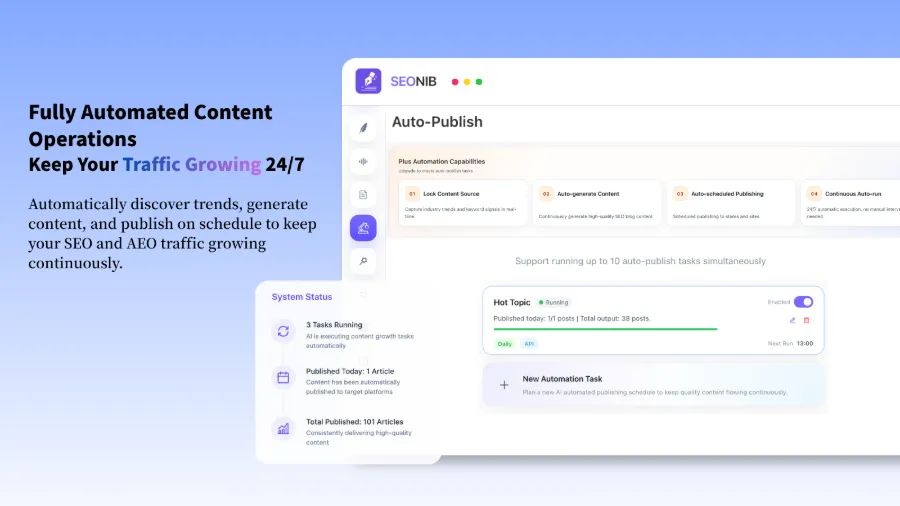
The common denominator of these three paths is: content automation + entity consistency, replacing past “link building” as the new growth lever. Multi‑platform synchronization plays a key role here—publishing the same content to the official site, Shopify, WordPress, etc., reinforces the same set of entity signals across multiple independent domains. Consult the SEONIB Help Center for configuration details and see how multi‑platform sync is implemented. AI search engines’ judgment of high‑quality sites essentially looks for sites that continuously output clearly structured, entity‑consistent content.
This pipeline is suitable for small‑scale testing before scaling. Start with a niche category, run two weeks of content, monitor Search Visibility changes, then decide whether to expand to the full product line. Detailed documentation is available in the SEONIB pricing page.
FAQ
In the AI search era, is link building still necessary?
Link weight is decreasing, but it isn’t completely useless. High‑quality external links still boost site credibility, though they are no longer the primary traffic source. It’s advisable to shift part of the link‑building budget to entity transformation, which yields a higher ROI.
If a site doesn’t undergo AEO transformation, will AI search completely ignore it?
It won’t be completely ignored, but the probability of being cited will drop significantly. AI‑generated answers favor pages that are clearly structured and have explicit entities. Pages without AEO may still be indexed, but they rarely appear in AI answer citations.
How should independent sites adjust their content update frequency?
Frequency matters more than the quality of a single piece. AI systems favor sites that update continuously; a steady output of 2–3 pieces per week outperforms a massive monthly release. The key is maintaining a rhythm, not chasing a one‑off viral hit.
How much does multilingual content help AI search indexing?
A lot. AI search systems cross‑verify the consistency of an entity’s information across different language pages. Multilingual coverage not only expands audience reach but also reinforces entity recognition signals.
Share Article