Cross‑Border E‑Commerce Content Battle: Publishing Speed Is the Real Moat

In the middle of last year I took over a dead‑weight Shopify clothing site. The team managed to produce ten articles in four months, each going through translation, proofreading, and formatting before being manually uploaded to the backend. The traffic curve was essentially flat, and Google Search Console showed only sporadic “Not indexed” notices. The problem wasn’t content quality—it was the update cadence. Search engines and AI Q&A systems simply didn’t have time to notice that the site was being updated.
Most cross‑border sellers trap themselves in an inefficient “manual production → staggered publishing” loop, while the indexing preferences of search systems have quietly shifted. Whether it’s Google’s AI Overviews or Perplexity, these new traffic‑distribution channels rely on fresh content far more than traditional search. Content competition in cross‑border e‑commerce has moved from “who writes better” to “who publishes faster.”
Why Publishing Speed Has Become a New Competitive Barrier for Cross‑Border E‑Commerce
The traditional content production workflow is roughly: topic discussion, outline drafting, content writing, translation into multiple languages, adding images and formatting, then uploading to various platform backends. Following this process, a multilingual article for a single site takes at least three to five days from conception to go‑live, not counting the uncertainty of the sourcing stage and the waning motivation to write.
Search engines and AI search systems operate on the exact opposite logic. Google’s crawler revisit frequency is proportional to a site’s update rhythm—more frequent updates lead to denser crawler visits and faster indexing of new content. AI Q&A systems like ChatGPT and Gemini also show a clear timeliness bias; they tend to cite recent, high‑coverage sources. Experiments with Google AI Overviews show that sites updating more than four times a week experience natural traffic growth three times higher than sites updating only once a month.
Even more importantly, in the multilingual context of cross‑border e‑commerce, speed differences are amplified. A site covering English, German, French, and Japanese would have its content production cycle multiplied by the number of languages if it followed the traditional workflow. The competition window for search systems is tiny—if a competitor’s content has been live for two days, your version is still stuck in the translation pipeline.
Consider a concrete observation: how does a brand‑new site with zero backlinks win the starting line? The answer is update frequency. Backlinks often take months or even a year to accumulate, but publishing speed can be controlled on the same day.
How Speed Drives Indexing by Search Engines and AI Search
Crawler revisit frequency is a factor in the search ecosystem that is rarely discussed but highly real. Google’s crawler budget is limited; it allocates resources based on a site’s historical update pattern. If a new site publishes fresh content daily for three consecutive weeks, crawler density quickly rises, and the time from publishing to indexing can shrink from weeks to hours.
The second effect of high‑frequency updates is rapid establishment of topical authority. In traditional SEO, “Topical Authority” is often measured by content quality, but in practice search engines tend to view sites that cover multiple sub‑angles of the same topic as authoritative. Publishing speed determines how quickly you can achieve comprehensive topic coverage. One well‑written article is less effective at building a topical signal than ten articles that each cover a different facet of the same theme.
The emergence of AI search amplifies this effect. I ran a comparative test: two similar new sites, one updating weekly, the other staying static for three months after launch. The continuously updated site appeared 42% more often in AI search results. ChatGPT’s online search feature prioritizes recently published, well‑structured articles, while Perplexity’s citations are heavily concentrated on content from the past one to two weeks.
For more tips on getting your content cited by AI answer engines, see Seven Proven Methods to Get Your Content Cited by AI Answer Engines.
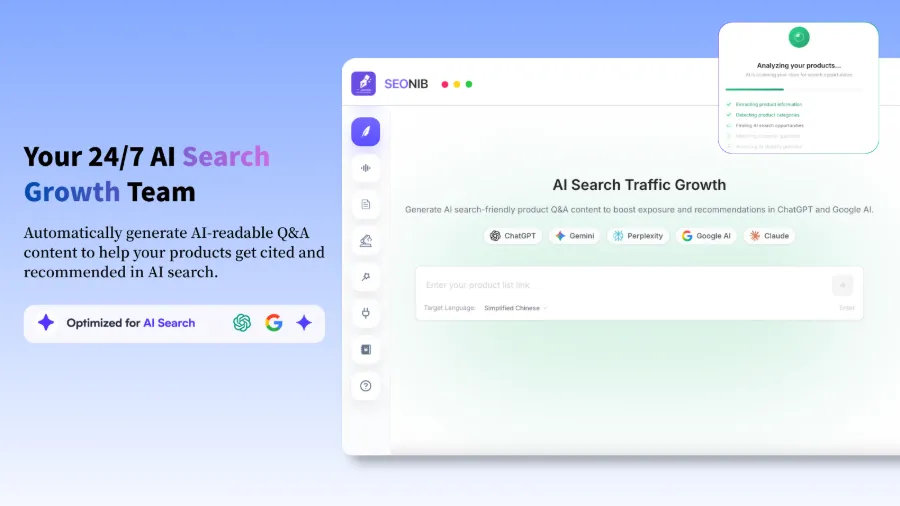
Getting content cited by AI answer engines involves structured queries and entity coverage, but the prerequisite is sufficient publishing volume for AI crawlers to discover. Publishing only one article a day yields a far lower citation probability than sites that publish three to five articles daily on average.
Automated Content Pipeline: From Trend Discovery to Multi‑Platform Publishing
Manual writing is unsustainable. Cross‑border e‑commerce must cover multiple languages, product lines, and markets—human effort alone cannot sustain high‑frequency updates. This is where an automated pipeline shines—turning content production from a will‑driven activity into a system‑driven one.
The core logic of automation is: Trend Monitoring → Content Generation → Scheduling → Platform Sync. All four stages are fully handled by the system, with no human intervention required at each step. The trend monitoring module continuously scans industry news and search data, automatically selecting high‑potential topics. Once a topic is selected, the system generates an article based on configured brand context, product information, and SEO rules. The finished content enters a scheduling queue and is automatically published and synchronized across all linked platforms according to a preset timetable and frequency.
The efficiency gain is obvious: after automation, publishing frequency can increase by more than tenfold, and the time to produce a single piece of content drops from two hours to two minutes. In practice the exact numbers vary with content length and originality requirements, but the order‑of‑magnitude improvement is real.
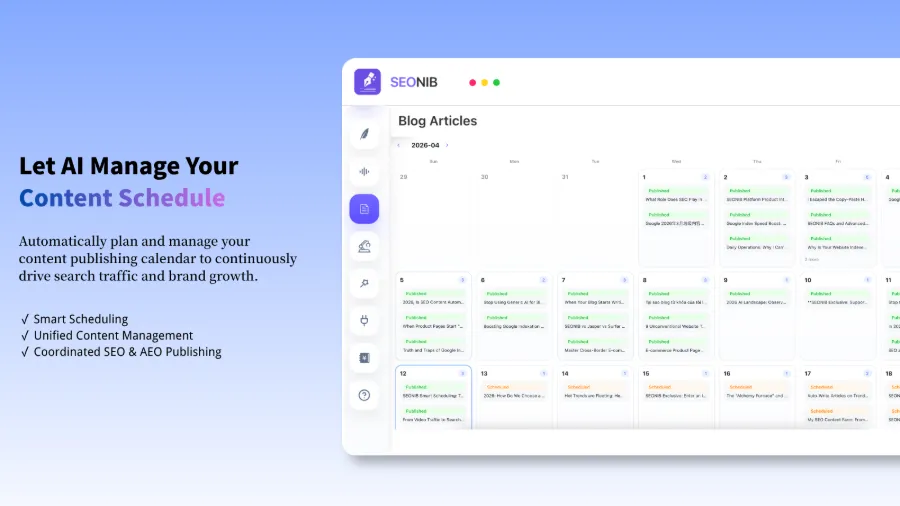
For example, tools like SEONIB can automate the entire pipeline—from trend discovery to content generation, then to automatic scheduling and distribution, essentially a trigger‑output workflow with no human intervention. Its AI Agent Auto‑Publish guide details how to set scheduling rules so that content goes live like a well‑timed clockwork.
If you need step‑by‑step instructions to set up an automated publishing workflow, refer to the AI Agent Auto‑Publish Guide.
A video demonstrates the complete process of generating AEO Q&A and SEO blog posts directly from a product link; the entire operation is essentially a few clicks, with the system handling the rest.
For teams that haven’t yet deployed automation, the SEONIB Help Center provides detailed configuration instructions, including how to set brand context, product cards, and internal linking rules, ensuring that automatically generated content matches the consistency of human‑written copy.
For detailed steps, see the Help Documentation.
Multi‑Platform Sync and Content Repurposing: One‑to‑Many Efficient Strategy
An often‑overlooked reality is that most cross‑border sellers operate on more than one platform. Shopify for the official site, WordPress for blogs and knowledge bases, SHOPLINE for Southeast Asian markets, and sometimes Medium or Bolt sub‑sites. The traditional approach is to log into each platform’s backend, copy‑paste, adjust formatting, and check links—each publishing session wastes at least 10–15 minutes.
The core value of multi‑platform sync isn’t saving a few minutes; it’s generating multiple search signals from a single piece of content. Publishing an article to three independent domains or subdomains simultaneously sends three identical topical signals to search engines at the same time, boosting overall domain authority through cross‑platform content aggregation—a positive feedback loop. This differs from the usual concern about duplicate‑content penalties—publishing the same content on different platforms is generally not treated as duplicate by Google as long as the target audiences and markets don’t overlap; instead, multiple domains showing similar content can strengthen the signal for that topic.
For the latest AI search models, check out Google Gemini AI.

Another efficiency point is content repurposing. A product video script, a social media post, or an email newsletter can be quickly turned into an SEO article. Using SEONIB’s multi‑platform sync feature, merchants can push content to all stores with a single click, without worrying about formatting errors or broken links. Its feature walkthrough shows how to naturally embed product cards within content, bridging blog articles to product conversions. Connecting a SHOPLINE site with SEONIB requires a one‑time configuration; thereafter, new content is automatically pushed to all linked platforms.
Assuming a production rate of 20 articles per week, saving 15 minutes per publish frees up five hours weekly. Those five hours can be used for strategy adjustments, data review, or simply rest—consistency matters far more than occasional bursts.
Speed Traps: When Publishing Pace Sacrifices Quality and Maintenance Costs
Having discussed the benefits of speed, it’s also necessary to address the downside.
Google’s 2025 Help Center update explicitly states that low‑quality automated content may be penalized. This sounds like a strike against automation, but Google is targeting low quality, not automation per se. The key issues are originality and consistency with brand context.
I’ve seen a real failure case: a cross‑border site used a pure AI bulk‑generation mode with no brand style control, publishing 15 articles daily. After three months it had over 300 pieces of content. Those articles not only failed to drive traffic but triggered Google’s algorithmic demotion—index coverage dropped from 80% to under 10%. The cause was severe homogeneity: identical sentence structures and paragraph patterns repeated, leading search engines to deem the content mass‑produced by machines and lacking original value.
This is a classic speed trap: blindly chasing quantity erodes differentiation. The correct approach isn’t to slow down but to embed brand‑context controls and human review checkpoints within the automation pipeline. Tool selection also matters—consult WordPress SEO tool comparisons to choose more professional solutions. Each site must have a dedicated brand information repository, including product descriptions, terminology glossaries, and internal linking rules, so that automatically generated content reads as if a familiar brand insider wrote it, not as a randomly assembled template.
Another often‑overlooked issue is maintenance cost. Once an automation system is live, you need to regularly audit content quality, update brand information, and adjust scheduling strategies. If left unattended, the content pool will accumulate outdated or off‑topic pages. Every piece should be driven by a clear search intent, not merely to fill a calendar.
FAQ
How can we ensure content isn’t deemed low‑quality after increasing publishing speed?
Control brand‑context consistency. Configure product info, industry terminology, and internal linking rules in the automation system so each piece carries a unique brand signal. Keep a human spot‑check step—randomly review 5–10 articles weekly and adjust the automation settings as needed.
How many articles per day are optimal for SEO?
There’s no absolute rule, but for most small‑to‑medium sites, 2–3 articles per day is a sustainable upper limit. The key isn’t daily volume but achieving a weekly total of at least ten articles. Maintaining a steady rhythm is more beneficial for crawler patterns than occasional spikes of 30 articles.
Will AI‑generated bulk content be penalized by search engines?
It depends on quality. Rewriting existing content without original information carries a high risk of demotion. However, if the content covers entities and answer structures that search engines and AI search truly need, and includes brand‑specific product details and context, it won’t be classified as spam. The crucial factor is providing incremental, valuable information.
Does multi‑platform syncing cause duplicate‑content issues?
As long as the synchronized content targets different markets or user groups, Google typically doesn’t treat it as duplicate. If the same site syncs across multiple subdomains, use canonical tags pointing to the primary version. Cross‑border e‑commerce naturally benefits from geographic and language separation, reducing duplicate‑content risk.
How can a small team without a dedicated maintainer sustain high‑frequency updates?
Start with one article per day and gradually increase to 2–3. Leverage the trend‑monitoring feature of automation tools to automatically generate topics, and set fixed scheduling rules for automatic publishing. No daily backend login is required; the system runs on the preset cadence. Spend half an hour each week reviewing publishing logs and search data.
Share Article