The Real Watershed in Choosing GEO Tools: Dashboard or Closed‑Loop Publishing

At the end of last year the team prepared a set of “AI visibility tools.” Over two weeks we reviewed seven or eight products on the market, compared feature lists, watched demos, and calculated prices, finally picking the one that tracked the most dimensions. After six weeks of use, the result was a weekly report email that arrived every Friday on time; opening it showed unchanged rankings, no new content, and AI citation counts that stayed flat. The problem wasn’t inaccurate data—it was that we stayed at the “view data” step, and no tool pushed the measurement results back into content creation.
The vast majority of products in the GEO space stop at the measurement layer. They can tell you “where I’m mentioned,” but they won’t generate the next piece of content for you or schedule its release. The real watershed in selection isn’t the number of features, but how far the tool can travel in your workflow—does it stop at the dashboard, or can it go all the way to a closed‑loop publishing process?
The Zero‑Click Era: Citations Are Traffic
When I ran independent sites, I used to judge content quality by search rankings. Over the past two years that method has become increasingly unreliable. Users open ChatGPT, Perplexity, or Gemini and get answers directly inside the app, never visiting a search results page. The answer itself is the endpoint; only brands that appear inside that answer get exposure.
Third‑party click‑stream analysis shows that from January to April 2026, about 68 % of Google searches in the U.S. generated no clicks at all. This means the traditional value of “ranking on the first page” is being diluted—users leave with an answer before ever seeing the first page.
GEO (Generative Engine Optimization) and AEO aim to solve exactly this: have AI cite your content when generating answers, instead of citing competitors. New sites without any backlinks can still be indexed by AI if they pick the right topics; the logic is explained in the article “Zero‑Backlink New Site Content Launch Strategy.” The core idea is that the topic itself must fill a gap in AI’s training data.
A consequence that’s easy to overlook: AI answers drift as the training corpus changes. Content that was cited last month may be displaced by new data this month. Therefore GEO is not a one‑off optimization; content must be continuously updated, or citation share will silently erode.
Measurement, Optimization, and Publishing: The Real Gap Between Three Types of Tools
When comparing those seven or eight tools, I realized a more practical classification: by workflow depth rather than by feature count.
- Measurement tools answer “where am I mentioned?” and deliver a dashboard; the workflow ends once the report is read, with no follow‑up actions.
- Optimization tools add diagnostic suggestions on top of measurement, telling you which pages lose citations or which sections aren’t cite‑worthy, but the suggestions must be manually transferred to other tools for execution.
- Publishing tools bring measurement, generation, publishing, and review into a single loop, eliminating the need to switch back and forth from topic selection to release.
Most vendors start with tracking and can accomplish “measurement → optimization” for about half of the market; only a few provide the full publish‑and‑review loop. In my testing, the cost of selection is often underestimated; the “SEO and GEO service value” calculation usually ends up including the hours spent manually moving recommendations.
| Workflow Level | Deliverable | Typical Bottleneck |
|---|---|---|
| Measurement | AI citation monitoring & brand visibility reports | Ends after reading the report; no follow‑up |
| Optimization | Page‑level diagnostics & edit suggestions | Suggestions must be manually moved to other tools |
| Publishing | Full closed loop from topic selection to scheduling and review | Higher initial configuration cost, but no later manual intervention |
Identifying which level a tool belongs to is far more useful than counting its features. Features can be added slowly; workflow depth is dictated by product architecture and can’t be changed easily.
Post‑Publish Review: The Weakest Link in Most GEO Workflows
The biggest difference between GEO and traditional SEO isn’t the “object of optimization” but the fact that AI answers update frequently, so published content must be continuously reviewed. In traditional SEO, an article goes live and then sits passively, waiting for indexing and ranking. GEO is different: AI training data changes weekly, and your content that was in an answer last week may be replaced by a competitor this week.
Thus “post‑publish review” is more important than “pre‑publish scoring.” Scoring before publishing only guarantees quality at launch; review protects the long‑term citation share of already published content.
To judge whether a tool can support long‑term operations, I look at three checkpoints: does it automatically track the performance of published pages in AI engines? Can it identify which content has been overtaken by competitors? Does it provide a content calendar or scheduling mechanism to ensure update frequency? The third checkpoint is the most often ignored—many teams aren’t unable to write content; they can’t sustain a steady output.
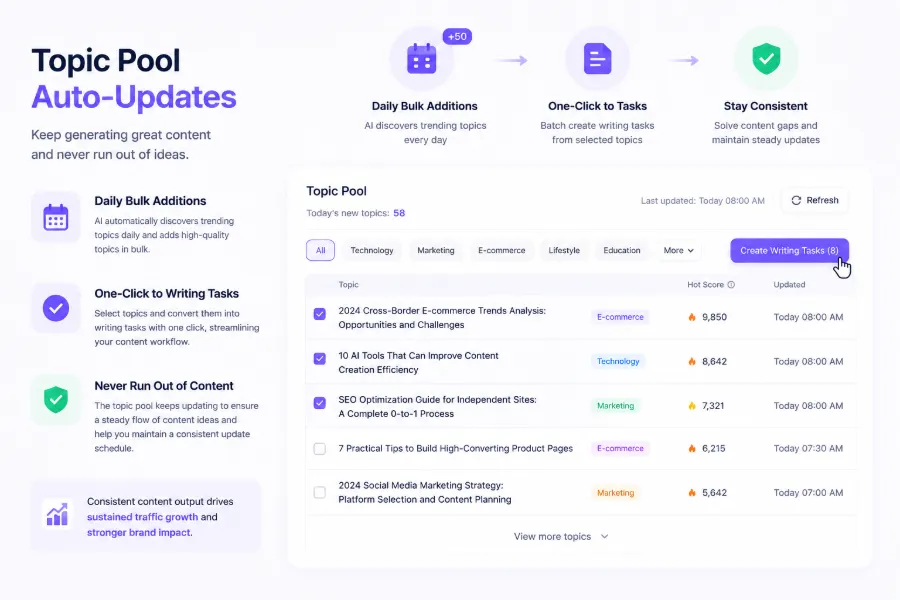
A multilingual content system supporting over 40 languages cannot be maintained by manual checks alone; it must rely on scheduling and automated review. For detailed steps on scheduling and frequency management, see the guide “Complete Playbook for Automatically Publishing SEO Content on Independent Sites.” The core idea is to make update frequency independent of human willpower.
From Product Link to Published Page: A One‑Person Closed Loop
At the beginning of 2026 I switched workflows. I set aside the AI visibility tracking tool that had been my go‑to because it stayed at the “tell me the problem” stage. I moved to SEONIB, dropped a product link into it, and the system automatically generated buyer guides and tutorial content, scheduled them for publishing, and required no copy‑paste into a CMS or manual image/SEO entry.
The configuration and scheduling steps are covered in the SEONIB Help Docs. I set a publishing frequency of three pieces per week; within a week there was no manual intervention, and the content was continuously produced and synced to multiple platforms. The old “look at the dashboard once a week and do nothing else” pattern was broken.
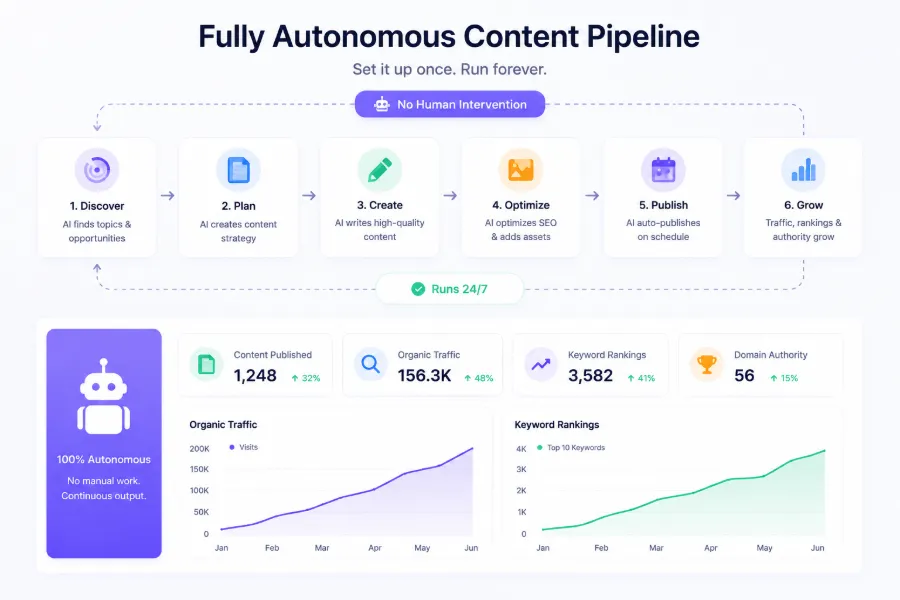
In the fourth week, AI citations began to fluctuate—not a surge, but at least movement. This closed loop turned “measurement → generation → publishing → review” into a weekly automated rhythm, rather than relying on my own reminders to “update content.” For independent site owners without a dedicated content team, the question “which SEO tool is right for beginners?” can be reframed: it’s not about the number of features, but how far the tool can push your workflow.
I still manually spot‑check quality after publishing; automation isn’t a hands‑off approach. I’m also working on cross‑format transformations, such as a “video‑to‑blog integrated SEO loop,” which repurposes a single output into multiple formats—ideal for sites with high content volume needs.
When evaluating tools, the most valuable question isn’t “how many features?” but “what step can your team reliably execute each week?” Many tools fail at the execution stage, not the feature stage. Measurement tools suit teams that already have stable content output and only need monitoring; publishing tools suit teams whose bottleneck is content creation itself. First identify which layer is your bottleneck, then choose the appropriate tool class.
FAQ
What’s the difference between GEO tools and traditional AI visibility tracking tools?
AI visibility tracking tools only answer “where am I mentioned” and deliver monitoring reports. GEO tools add diagnostics and content generation capabilities, aiming for continuous AI citation. The distinction lies in workflow depth: tracking is an input; GEO is a full loop.
If a team has only one person, is a measurement tool or a publishing tool more practical?
For a solo operator, the bottleneck is usually content creation, not monitoring. A measurement tool just adds time spent reading reports each week, whereas a publishing tool automates topic selection, writing, and scheduling, saving the most time‑consuming steps. The prerequisite is a willingness to spend a few days on initial setup.
After launching a GEO workflow, how long does it take to see changes in AI citation counts?
In my experience, after content starts publishing consistently, observable citation fluctuations appear in about three to four weeks. The speed depends on content quality and update frequency—publishing one article per week versus three per week yields noticeably different timelines. AI training data updates have latency, so don’t expect changes within a single week.
Will content generated by a publishing‑type GEO tool be considered low‑quality by search engines?
Whether it’s deemed low‑quality depends on whether the content provides incremental information, not on its AI origin. Built‑in SEO modules handle keyword density, meta tags, and other basics, but the ultimate citation value hinges on topic selection and information uniqueness. Post‑publish manual reviews remain necessary.
Share Article