
I spent more than half a year on GEO, and discovered that the most useful approach is the one I call “copying homework”
The first time I heard the term “Generative Engine Optimization,” I thought it was a new alien race from some interstellar war. Later a colleague told me, “It’s just the thing that makes ChatGPT and Perplexity cite your article.” I nodded, thinking, “Oh great, another SEO‑style job title.”
So I started tinkering. Over four months I tried stuffing articles with “authoritative citations,” branding myself as an expert, and even writing “suggested citation paragraphs” for the AI—only to crash harder than the succulents my wife keeps.
In short, GEO is about optimizing your content so that AI platforms (like ChatGPT, Perplexity, Google AI Overviews) list you as a source when they generate answers. Its biggest difference from traditional SEO is that SEO chases rankings and clicks, while GEO chases being “mentioned” by AI—even if users never click your link.
But anyone who’s actually done it knows it isn’t as mystical as it sounds. It’s more like an upgraded “structured content” format; you just have to adapt to AI’s reading habits. And AI’s habits are, in some ways, more rigid than humans’—it prefers standard answers and hates fluff.
The stupid things I did in the first few months
I happily took the wrong path at first.
First experiment: I bolded every keyword related to “competitive analysis” and added “Expert Opinion” at the start of each paragraph, assuming ChatGPT would see my article as authoritative. When I searched my own page on Perplexity, it cited a three‑year‑old tutorial by the neighbor “Old Wang”—poor formatting, garbled sentences, but each paragraph was a self‑contained “answer block.”
Second crash: Chasing trends. I saw the “AI assistant writing” topic was hot, so I wrote a 3,000‑word deep dive with a dozen data citations. The next day, ChatGPT cited a 600‑word news release that was published the same day. I later realized AI platforms value “freshness” far more than “depth”—about 50 % of AI citations are from content published within the last 13 weeks, so fresh material can easily out‑rank older articles.
Third pain: I deliberately stuffed an FAQ with many questions, thinking the more the better for extraction. That content never showed up in Google AI Overviews; instead it appeared in an unrelated answer because my FAQ questions were too broad, and the AI thought the answers weren’t specific enough and skipped them.
These failures taught me that GEO isn’t “write well and you’re done”; it’s “write in the right format to be effective.” AI won’t be moved by clever metaphors like a human. It only cares whether a sentence can stand on its own, whether it’s backed by data, and whether it directly answers the question.
The patterns that finally showed results
Later I became obsessive, dissecting pages that AI had actually cited. I boiled it down to three most effective patterns:
1. Answer Capsule
Under each H2 heading, place a 40‑60‑word direct answer immediately. No preamble, no “first, let’s look at…”. The blue paragraph at the start of this article is an example. When AI sees this structure, it can almost copy it verbatim. I added such capsules after every H2 on my site, and three months later Perplexity citations rose from 0 to 5‑8 per week (the base was tiny, but it stopped being zero).
2. FAQ as H3
Don’t hide FAQs at the end as decorative accordions. Write each FAQ question as an H3 title, the title being a complete natural‑language question, and give the answer in the first sentence (with numbers, dates, etc.). That’s how I’m writing FAQs now. Traditional SEO likes to tuck FAQs into accordions to save space, but AI crawlers don’t click to expand; they prefer fixed content where the answer is immediately visible. After switching FAQs to plain text, the citation rate in Google AI Overviews visibly increased.
3. Data citations with source and context
I used to write “Data shows GEO exposure increased by 40 %,” which AI never cited. I changed it to “According to the Princeton GEO study (2024), applying statistical data and expert citations can boost AI visibility by 27 %–43 %,” and added a sentence explaining the scenario where the data applies. AI prefers sentences that include a “research source + variable range” because it can adjust the numbers across different answers.
These tricks sound simple, but it took me months of filtering out failures to isolate them. And honestly, I still can’t reproduce them 100 %—luck always plays a role.
Tools helped me lazy‑load, but also tripped me up once
Writing answer capsules, FAQs, and data citations manually is exhausting, especially when you need weekly updates to keep freshness. I quickly looked for automation.
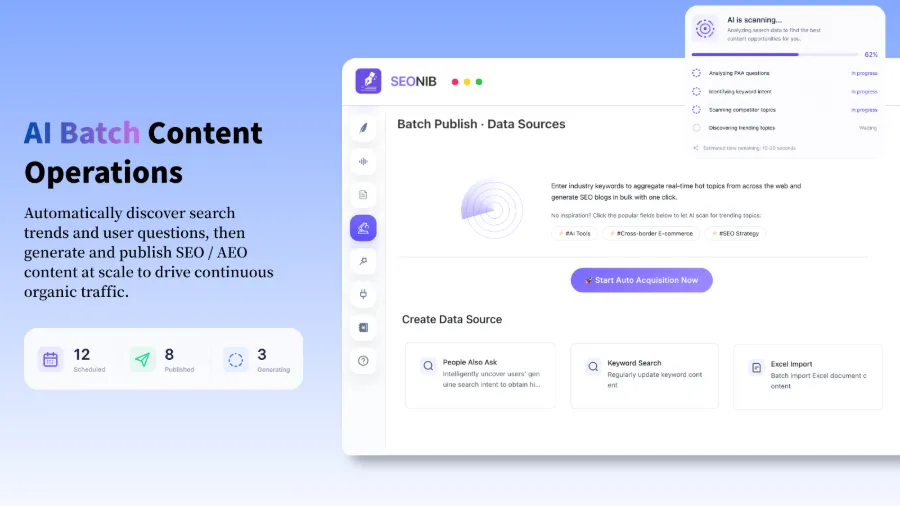
I tried SEONIB—a tool that discovers trends, generates content, and schedules publishing. I set up a task to “automatically publish 5 SEO‑optimized articles each week,” hoping to lie back and let AI cite me. In the first month it auto‑published 20 articles about “2026’s latest SEO trends,” each using the same template and outdated data citations. The next day I saw zero traffic in Search Console and realized that AI‑generated content without human review becomes garbage, and both search engines and AI platforms notice duplicate templates.
After two evenings tweaking the config, I made SEONIB pull independent topics from different news sources, assign a unique data source to each article, and force the generated FAQ section to retain a few of my manually written core questions. The results improved dramatically; the content no longer felt like a robot conference. I still manually review the publishing queue each month, deleting the obviously off‑track pieces. The tool handles about 80 % of the grunt work, but the remaining 20 % of decisions and reviews still require a human.
Problems I still can’t solve
Even if you get the above right, GEO still has a few headache‑inducing issues.
First, citation decay. As mentioned, 50 % of AI citations come from content published within the last 13 weeks. That means an answer capsule you painstakingly optimized can become useless after four months. I don’t have the bandwidth to refresh hundreds of articles each quarter. My compromise: only regularly update the top‑30 traffic pages; let the rest drift.
Second, zero‑click dilemma. When ChatGPT cites your article, the user gets the answer directly in the conversation and never clicks the link. There’s no “AI exposure” metric in Google Search Console, and ChatGPT doesn’t return a referrer. My only monitoring method is to manually search for my brand name or main keywords on multiple platforms and see if I’m mentioned. This is clumsy, and every citation requires a screenshot as proof—hard to scale.
Third, trade‑off issue. GEO and traditional SEO can conflict. To be extracted by AI you need short, standalone answers; to rank on Google you need long, in‑depth content. I have an article ranking #3 on Google, but its answer capsule is so brief that ChatGPT never cites it. When I added a “click to expand” interaction to the capsule, the Google ranking fell to #8 because the content was collapsed. I haven’t found a perfect solution yet; I have to balance based on traffic source.
FAQ
Do I need a dedicated website to do GEO?
No. Just add answer capsules and FAQs to existing blog or product pages; you’ll usually see results within two weeks. I first changed the FAQ section on my homepage, and by the third week Perplexity cited it twice.
Should I do GEO before traditional SEO, or vice versa?
Most people should do both, but priority depends on traffic source. If your site relies mainly on Google search, preserve SEO first and gradually add GEO structure. If users already habitually search via ChatGPT or Perplexity (e.g., SaaS sector), prioritize GEO. My own site is SaaS‑focused; direct ChatGPT traffic is low, but AI overviews boosted brand exposure two‑fold in early 2026.
How many FAQ questions should I write?
At least three, at most six. Each question should be an H3 title, and the answer should be 50‑150 words, containing a concrete number or time frame. For example, “We recommend updating quarterly” rather than “regular updates.” I always pair each FAQ with an example from my own data, so AI citations are more likely to include my brand name.
AI cites my data but gives me no traffic—what can I do?
There’s no perfect fix; it’s an inherent GEO trait. I ran an experiment: after the data, I added “For the full methodology, visit the original article.” ChatGPT sometimes retains that intent, directing users to my site. The conversion rate is low, but it’s better than nothing. A more practical approach is to embed brand terms naturally in the answer capsule—e.g., “According to SEONIB’s 2026 content automation report” instead of “According to a report.”
What’s the quickest first step for a beginner doing GEO?
Identify your three highest‑traffic articles, and under each H2 heading write a 40‑60‑word direct answer (an answer capsule), then update the publication date. Freshness plus structured signals usually yields new citations in Perplexity or Google AI Overviews within two weeks. That’s how I started from zero.
Share Article