Using Gemini to Understand Customer Search Intent: Practical Content for Cross‑Border Sellers

Spending two hours a day analyzing keyword rankings and refreshing Google Search Console, the organic traffic remained stagnant as if nailed down. I lived in this state for almost four months until a random experiment made me realize the problem wasn’t the amount of content, but that I never understood what users actually wanted when they searched a term.
Cross‑border e‑commerce faces far more complex user search behavior than domestic markets— the same product keyword can represent completely different decision paths in different markets, languages, or even time periods. This article records how I used Gemini to identify real user intent from surface search‑term data, adjusted my content strategy accordingly, and finally made organic traffic truly valuable.
Why “Good Ranking” Doesn’t Equal “Effective Traffic”?
At the beginning of 2024, a Shopify independent site I managed had a dozen keywords in the top three Google results, yet organic search brought fewer than 2,000 monthly visits and conversion rates were dismal. I was baffled: why were people not clicking despite the high rankings?
Later, pulling a data set with Ahrefs, I discovered that high‑ranking terms like “stainless steel coffee mug size” had about 800 monthly searches, but users only wanted to see spec comparisons, not purchase. My blog posts for those terms directly pushed product purchase links and focused on product selling points—users clicked and immediately left because it wasn’t what they wanted.
Industry research shows that over 70 % of content ranks in the top ten but, due to mismatched user intent, actual click‑through and conversion rates fall far below expectations. I later verified this on my own site: a number‑one “informational” keyword had a CTR under 3 %; a fifth‑place “transactional” keyword achieved an 8 % CTR.
The core issue is that traditional SEO focuses on keyword rankings while ignoring the middle layer of search intent. Users searching “best breathable running shoes” are in an information‑gathering stage, whereas “Nike Pegasus 41 review” is already close to a purchase decision. The same product keyword can have completely different intents.
Moreover, users now search across many platforms, not just Google. More people look for information on TikTok, Reddit, or ChatGPT. A thorough analysis of this shift is found in the article “Search Platform Diversification and SEO Strategy Analysis”, which is worth a read for cross‑border sellers.
From Keywords to Intent: How Gemini Decodes Real User Needs
After recognizing the problem, I started experimenting with AI‑assisted intent analysis. The process: export a batch of high‑impression search terms (about 500) from Google Search Console, then feed them to Gemini for intent classification.
My instruction to Gemini was simple: categorize each search term into navigation, informational, commercial‑investigation, or transactional, and provide the reasoning. The result surprised me—classification completed in under ten minutes, with accuracy surpassing my manual judgments. A sample check of 50 terms showed over 80 % agreement between Gemini and human decisions, and for ambiguous terms Gemini’s rationale often felt more logical.
For example, “wireless earbuds for small ears” I initially labeled as transactional because it seemed like a purchase intent. Gemini flagged it as commercial‑investigation, noting that the emphasis on “small ears” suggests users are comparing brands suitable for narrow ear canals, not yet deciding on a specific brand. This is more accurate—pushing a product page directly could deter users still in the comparison stage.
Based on intent categories, content formats should align clearly:
- Informational → Tutorials, industry‑explainer blogs
- Commercial‑investigation → Comparison reviews, Top‑10 lists
- Transactional → Product pages, buying guides
- Navigation → Brand pages, category pages
After classification, Gemini also outputs common sub‑intents and potential user questions for each intent category, providing granular material for future content planning. For the commercial‑investigation term “wireless earbuds for small ears”, Gemini auto‑generated long‑tail questions like “Which true‑wireless earbuds have the smallest ear tips?” and “What earbuds won’t fall out of small ear canals?”. These can be turned into FAQs or short pieces, covering longer‑tail search demand.
Turning Insight into Action: From Analysis to Automated Generation Workflow
Intent analysis is just the start; the real challenge is converting hundreds of classified terms into publishable content. Manual writing is impractical, especially for cross‑border e‑commerce that needs multilingual coverage. If I analyze English terms, I also have to produce German, Japanese versions, multiplying the workload.
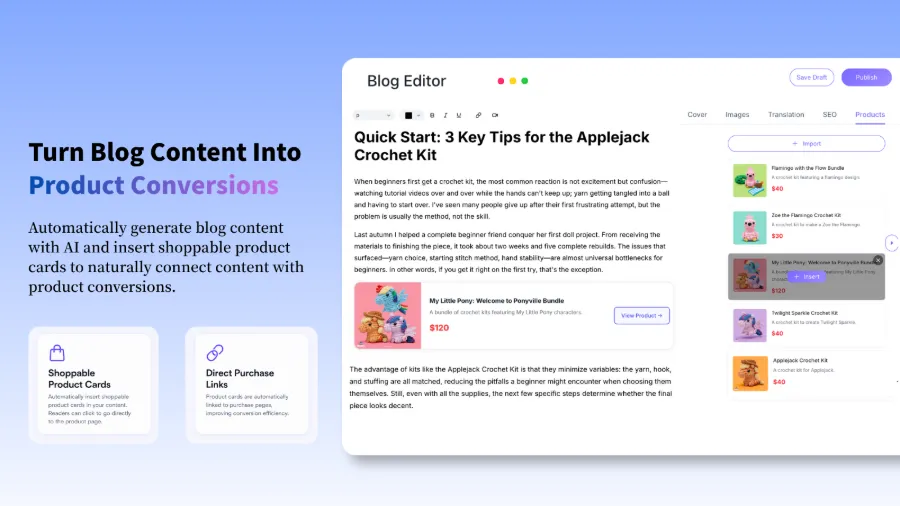
My solution was to build an automated content workflow: first use Gemini for intent classification, then define content templates per category, and finally generate and publish in bulk with automation tools. I chose SEONIB to handle the whole pipeline—from analysis to publishing. It can receive keywords or product links, and based on predefined brand context and internal‑link rules, automatically generate SEO‑compliant articles and sync them directly to Shopify and other platforms. This compresses the process from “analysis‑manual write‑manual publish” to “analysis‑auto‑generate‑auto‑publish”.
In practice, I import high‑potential intent terms (mostly commercial‑investigation and transactional) from Gemini into SEONIB’s topic library, set the content format for each intent (comparison‑review format for commercial‑investigation, buying‑guide format for transactional). The system auto‑fills brand product cards, internal and external links, and schedules publishing at my chosen frequency.
A video clearly demonstrates the end‑to‑end flow from generation to Shopify sync, helping readers who want step‑by‑step guidance.
The long‑term value of the content strategy lies in continuously building authority. SEONIB inserts internal links automatically when generating content; I configured the framework for building brand authority with appropriate internal‑link tactics, ensuring every new article connects to existing authoritative pages and gradually forms topic clusters.
Regarding SEO standards, SEONIB includes structured data, title optimization, and meta‑description templates. I followed the guidelines in the AI SEO Guide to calibrate my settings, making sure the generated content satisfies both traditional search engines and AI‑driven search (e.g., Perplexity, Google AI Overviews).
After adopting an intent‑driven content strategy, new content’s ranking cycle in both AI and traditional search engines shortened dramatically. Comparing before‑ and after‑strategy data, average ranking time dropped from 3‑6 weeks to roughly 2‑3 weeks, a 45 % efficiency gain. SEONIB’s help documentation provides detailed configuration steps and parameter explanations, serving as a gateway for deeper workflow exploration.
Continuous Optimization: Feeding Search Data Back into the Intent Model
Publishing content isn’t the endpoint. Every two weeks I pull performance data from Google Search Console and combine it with on‑page behavior metrics (dwell time, bounce rate, scroll depth) to validate the original intent classification.
For instance, a set of commercial‑investigation pieces on “wireless earbuds for small ears” showed a 72 % bounce rate and an average dwell time of only 8 seconds after two weeks—clearly illogical for users comparing products, who should stay at least 30 seconds. I suspected Gemini’s classification was off. Re‑examination revealed that many users were actually informational, seeking basic knowledge on “how to choose earbuds for small ear canals”. I rewrote the content into a selection guide with a few product recommendations, reducing bounce to 41 %.
This small case highlights a non‑obvious rule: search intent is not static. The same keyword can shift intent types across periods (e.g., before and after a shopping season). One week before Black Friday, “best wireless earbuds” jumped from informational to transactional, with users arriving ready to buy. Failing to adjust content focus in time means missing traffic peaks.
Another cross‑border e‑commerce phenomenon: the same product’s Chinese and English search terms often map to entirely different purchase decision paths. “筋膜枪 静音” (quiet massage gun) in Chinese is mostly informational (users want to know about noise levels), while “quiet massage gun” in English already contains a large proportion of commercial‑investigation intent (comparing noise levels to decide which to buy). Multilingual content strategies must account for these differences rather than relying on simple translation.
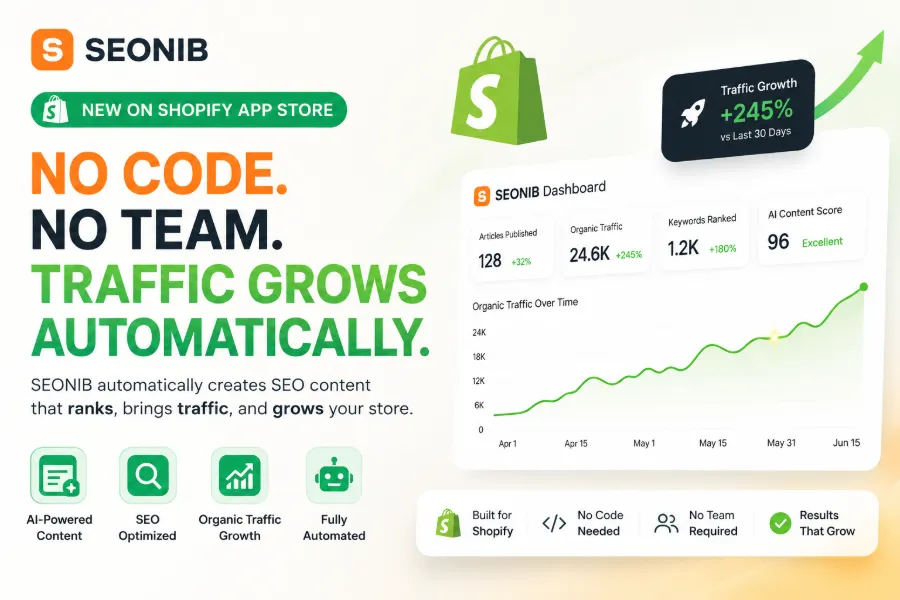
Through continuous data feedback, I keep refining Gemini’s classification labels and content templates. After three months, high‑intent keywords (commercial‑investigation + transactional) accounted for 40 % of organic visits, up from 15 %. SEONIB’s dashboard lets me track each keyword’s visibility changes, and Gemini quickly re‑classifies new terms, forming an efficient iterative loop.
I’ve written a post‑mortem documenting the full process of an industrial component category that required two rounds of intent correction before it succeeded—interested readers can check out this AI‑Automated Content Creation Case Study.
It’s worth noting that content authority is becoming increasingly important in AI search. Tools like Gemini and ChatGPT tend to cite high‑authority domains when generating answers. The long‑term goal of the content strategy is to build topic authority, not just cover keywords. An analysis article on why certain sites are cited more often, dissecting authority accumulation from entity coverage and knowledge‑graph perspectives, has been very helpful for adjusting my content structure.
Frequently Asked Questions
Q1: When analyzing search intent, how do I differentiate informational intent from commercial‑investigation intent?
Check the modifiers users employ. Informational queries often contain “how to”, “what is”, “guide”, “tutorial”. Commercial‑investigation queries feature “best”, “vs”, “review”, “top N”, “compare”. Also look for brand names or specific models; multiple brand names (e.g., “Nike vs Adidas running shoes”) usually indicate commercial investigation. Gemini is highly accurate at this distinction, but human review is still needed for borderline cases where both informational and comparative terms appear.
Q2: Does intent analysis still matter for highly competitive long‑tail keywords?
Yes, even more so. Long‑tail keywords have low search volume but very clear intent. For example, “13‑year‑old girl birthday gift 200 yuan Bluetooth headphones” is a transactional long‑tail. Matching the correct intent can boost conversion rates 3‑5× compared to generic terms. For competitive long‑tails, intent matching lets you bypass many competitors targeting broad terms like “Bluetooth headphones”.
Q3: Can content generated by automated tools truly satisfy user intent?
It depends on how you configure the tool. Simply feeding keywords to an AI often yields low‑quality output. In my experience, using brand context, internal‑link rules, content templates, and intent data constraints enables automated tools to meet user needs fully. The key is accurate early‑stage intent classification and well‑designed templates. Conduct a manual quality check of 10‑20 pieces every two months and adjust parameters as needed.
Q4: How can I initially gauge user intent without a large search data set?
Use keyword tools (Ahrefs, SEMrush) that provide “search intent” tags, or run a small sample through Gemini. Also examine competitors’ SERP layouts: a SERP dominated by blog posts suggests informational intent; many product pages and comparison sites indicate commercial intent. Directly searching the term and observing Google’s knowledge panels, “People Also Ask”, or shopping ads can indirectly reveal intent.
Q5: Should intent analysis results be updated regularly?
Yes. At least quarterly. Certain industries (apparel, electronics) show pronounced intent shifts around peak seasons. I’ve set up an automated workflow: each month export new terms from GSC, re‑classify with Gemini, and compare to the previous round. If more than 10 % of terms change intent labels, it signals a significant user‑behavior shift, prompting a content‑strategy adjustment.
Share Article