Why My Website Has No Organic Traffic
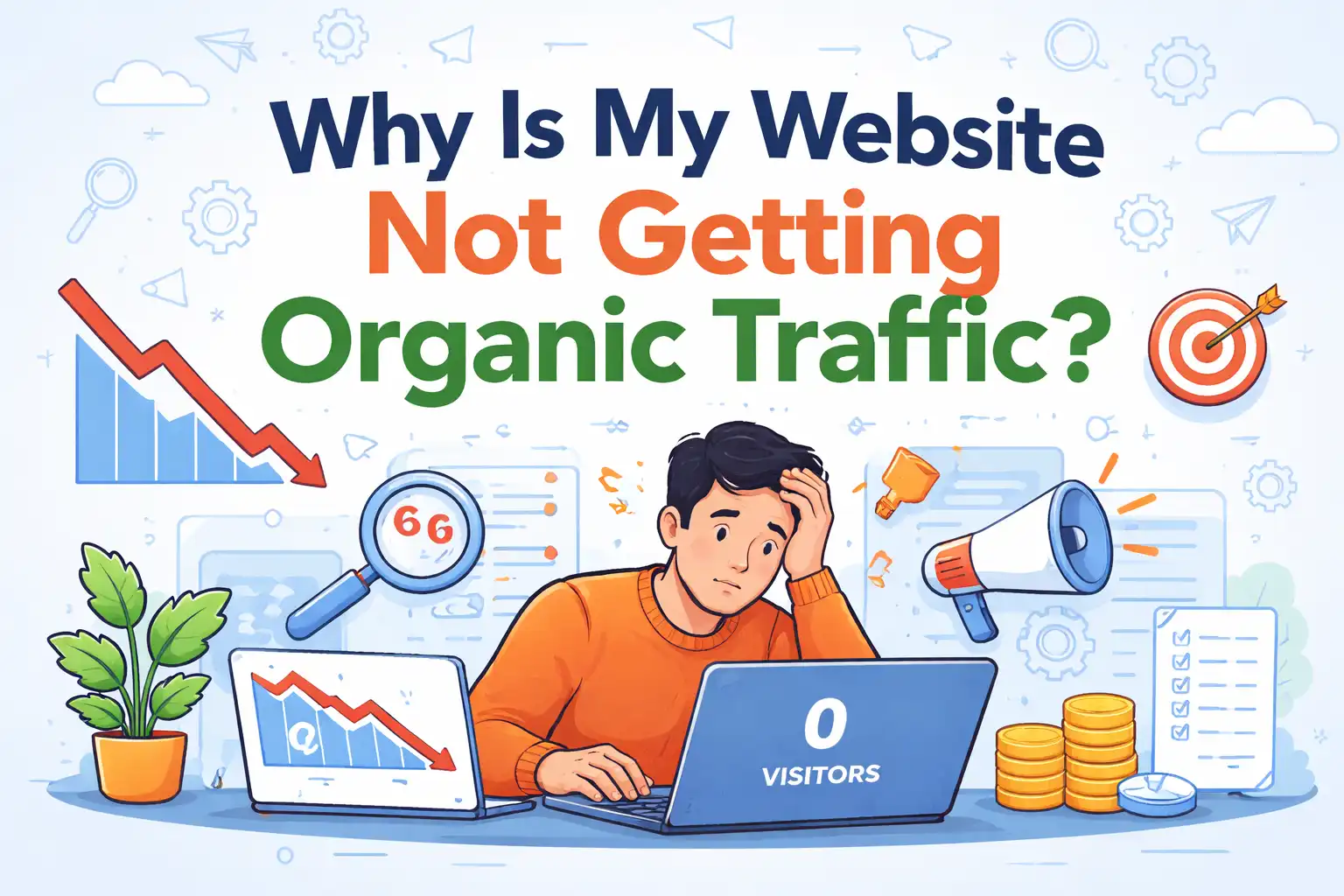
For more than three months I have been publishing three blog posts every week without fail. I did keyword research, set up internal links, and swapped external links a few times. I spend at least forty hours a month on content. The result? The “Total Clicks” curve in Google Search Console stopped moving after the second week. I briefly wondered if I had been penalized and repeatedly checked for noindex tags and robots.txt, but none of those were the issue. Then I realized the problem wasn’t the articles themselves; it was that my “hand‑crafted workshop” simply couldn’t satisfy the search engine’s appetite for freshness and depth.
You’re Facing a “Content Island” Problem – The Article Is Written, but Search Engines Can’t See It
The first stupid mistake I made was to publish an article and then ignore it. I thought that submitting a sitemap would make Google obediently crawl everything. In reality, when I looked at Search Console, the “Covered” pages were only the homepage and two or three old posts. The newly published content lingered in “Discovered – not yet crawled,” and some didn’t even appear in the index report at all. After a thorough audit I discovered that several articles had automatically received a noindex tag from the theme template—something I completely missed.
A more common issue is “orphan pages.” If an article is published without any inbound links from other pages, search engine crawlers may never find it. I once wrote a “Shopify Product Description Optimization” post with no internal links, and three months later, when I searched for its URL in Search Console, the status was “Not indexed.” Ahrefs reports that about 25 % of published pages are never indexed within the first 90 days after publication. In my case the number is even higher.
Later I started to plan internal linking deliberately—linking from existing articles to new content and retroactively adding links to older pages. This at least guarantees that crawlers can follow a path to the new pages. But another problem quickly followed—I could not keep it up.
If you’re also stuck at the stage where your content isn’t being indexed, check out this article about the best SEO tools for beginners. It explains how to let the system automatically add internal links and submit indexes.
Content Alone Isn’t Enough; You Also Need Frequency and Consistency
After solving the content‑island issue, I fell into a second trap—irregular publishing frequency. Humans aren’t machines; when you get busy you forget to write. I worked overtime last weekend, traveled the following week, and missed two weeks in between. Search engines favor sites that are updated regularly, especially when you consistently produce content on a particular topic; they gradually treat your domain as a “Topical Authority.” My erratic “three‑day‑on, two‑day‑off” rhythm made Google think I was just gambling.
HubSpot’s research is stark: sites that publish more than 16 blog posts per month receive 3.5 × the traffic of sites that publish 0–4 posts per month. Achieving that volume manually is almost impossible. I tried a content calendar—listing three months of topics in Notion. The first two weeks I could stick to the plan, but by the third week I fell behind. By the fifth week the calendar was a useless scrap of paper.
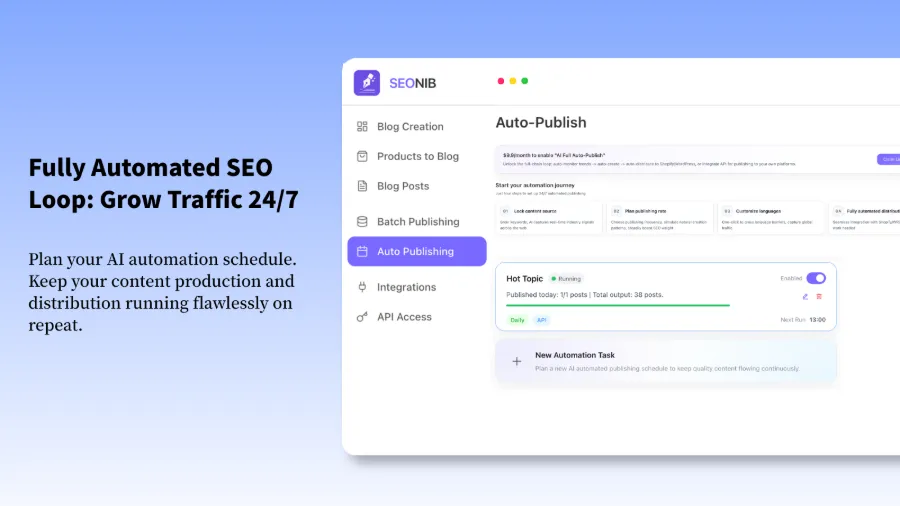
Three months of failure made me realize it wasn’t a lack of effort; “manual persistence” is inherently counter‑human. So I started using SEONIB to automate generation and scheduled publishing. I set a cadence of three posts per week; the AI picks topics, writes drafts, formats them, and publishes on schedule. After a month, the “Newly Added” pages in Search Console finally lit up.
You Only Play on Google, but Users Have Already Started Asking AI Search Engines for Answers
The third frustrating discovery was that traffic wasn’t rising not because Google couldn’t see me, but because a portion of users no longer search on Google at all. A 2024 user‑behavior report said that 73 % of “searches” happen outside traditional search engines. People ask questions, look for answers, and read reviews directly on ChatGPT, Perplexity, Douyin, and Xiaohongshu. The articles I painstakingly optimized for Google simply don’t exist in AI‑search results.
This pushed me to explore “AEO” (AI Engine Optimization). In short, it means structuring content, entities, and Q&A so that large models can directly recognize and cite it. The original blog style—large narrative blocks, no clear Q&A sections, lacking structured data—fails to produce snippets in AI summaries. I changed my approach: each article now starts with an FAQ‑style direct answer, organizes information with lists and tables, and embeds Schema.org’s FAQPage. The results are there, but manually updating dozens of old posts is far too slow.
If you’re also wrestling with getting your content captured by AI search, check out this external share—Let AI Run the Trend Hotspots First. It shows how a creator uses automation to keep up with the AI era’s content pace.
The Hand‑Crafted Workshop Model for Content Production Is the Root Cause of Stagnant Traffic
Looking back on the three‑month pitfall journey, every problem traces back to one word: workshop. Here’s a breakdown of the full manual production chain:
- Topic Discovery – Scan industry news, check competitors, use keyword tools; start with half an hour a day.
- Writing – Open a document, write a 1,500‑word article; average 1.5 hours.
- Formatting – Add images, adjust heading hierarchy, fill in meta description; another half hour.
- Publishing – Log into WordPress, paste the content, select categories, click Publish; about 10 minutes.
- Cross‑Platform Sync – Copy the same content to Shopline, Medium, LinkedIn, each requiring format tweaks; another 40 minutes.
All together, a decent article takes at least three hours. At three posts per week, that’s nine hours spent on repetitive tasks. The hidden cost is that you have no energy left to deepen content quality or cover more topics.
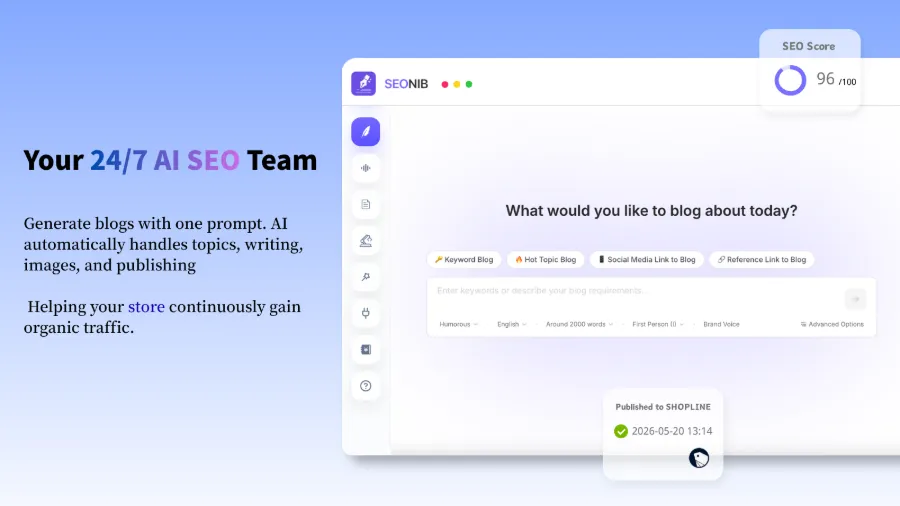
Later I tried to bundle the entire chain with automation. For example, SEONIB can generate a complete blog from a keyword, product link, or even a single tweet, then push it to multiple platforms with one click. Below is a time‑comparison between manual and automated workflows—feel the gap:
| Stage | Manual Time | Automated Time |
|---|---|---|
| Topic Selection | ~30 minutes | 0 (AI auto‑suggested) |
| Writing | ~1.5 hours | 0 (AI generated) |
| Formatting | ~30 minutes | 0 (auto template) |
| Publishing | ~10 minutes | 0 (scheduled automatically) |
| Cross‑Platform Sync | ~40 minutes | 0 (single sync) |
At first I was biased against “machine‑written” quality, but testing showed that with proper inputs (keywords, reference links, brand background), AI‑generated structure and information density are actually more consistent than my manual work—not to mention it never repeats a verbose intro. Of course, you need a little time upfront to fine‑tune topic direction and brand tone, but that cost is far lower than nine hours of weekly repetitive labor.
If you want to see how the automation is set up, check the SEONIB Help Documentation; the steps are clearly written.
FAQ
Q1: My site has a lot of articles, yet there’s still no organic traffic. What should I check first?
Start by verifying whether pages are indexed. In Google Search Console, search site:yourdomain.com and see how many pages appear in the index. If the indexing rate is below 30 %, it’s usually a technical issue: no‑index tags, missing sitemap submission, or a complete lack of internal links. Also, sheer quantity isn’t enough—if the articles don’t form topical clusters, search engines won’t view you as an authority in that niche.
Q2: How can I tell if I need an automated content tool?
Two signs: (1) you spend more than three hours per week on formatting and publishing, and (2) your publishing frequency is unstable, unable to maintain 2‑3 posts per week for three consecutive months. If either applies, the manual workflow has become a growth bottleneck, and automation is worth considering.
Q3: Besides content volume, what other factors affect organic traffic?
Technical performance, mobile friendliness, backlink quality, site architecture, and—most importantly—whether the content truly answers users’ real search intent. Sometimes a concise 500‑word answer outranks a generic 3,000‑word piece. Also, don’t ignore AI‑search traffic; many AEO‑optimized pages get cited in ChatGPT, which can indirectly boost Google rankings.
Share Article