AI Search Traffic Boost Guide for Cross‑Border E‑Commerce in 2026: From “Guessing the Algorithm” to “Feeding Data”

Last year I spent three months manually writing 30 product blog posts, and only one made it into Google’s top ten. During that time I refreshed Search Console every day, staring at single‑digit impressions, and eventually threw the whole workflow away. After AI search took off, I completely abandoned the “guess what the algorithm likes” mindset—by 2026, content production is no longer about catering to traditional search engines but about feeding structured data to multiple AI platforms. This article does not discuss vague trends; it shares the AI‑search traffic‑boosting strategies I’m actually executing after stumbling through the pitfalls as a cross‑border seller.
If you’re still figuring out how to write a 3,000‑word article to please some Google algorithm update, I suggest you pause. By the end of 2025, AI search already accounted for more than 12% of search result share. More importantly, users no longer click links. A user asks ChatGPT Search “the best Shopify cross‑border store tools,” and the AI gives an answer directly; your product link doesn’t even appear. That’s why you must start doing AEO (AI Engine Optimization)—making the AI understand your content on its own, rather than hoping it will give you a ranking.
Why AI‑Search Traffic Must Be Captured in 2026 – Who Is “Stealing” Your Impressions?
ChatGPT Search, Perplexity, Google AI Overviews, and similar entry points are siphoning traditional search traffic. You spend a lot on SEO to squeeze into Google’s top ten, but a user may be satisfied by a single sentence in an AI conversation. This change isn’t a “future trend”; it’s already happening.
The core difference between AEO and traditional SEO is that AI cares more about entities, context, and structured data. Traditional SEO focuses on keyword density and backlink count; AI search cares whether your page can directly answer “Is wearing this down jacket enough for -20 °C Harbin?” If you don’t feed product attributes, usage scenarios, and comparison information to the AI in a structured way, it won’t go to your site for those details—it will only cite pages that are already well‑structured.
The result: if you’re not proactively indexed by AI, you’re ignored. Your product pages, brand pages, and blog posts may still rank in traditional search engines, but they become invisible in AI search.
What Content Types Does AI Search “Love”? Stop Writing Generic Blogs
The biggest pitfall I fell into was writing a bunch of long‑form soft articles, none of which were cited by AI search. After six months of experiments, I discovered that AI search’s preferred content types are very clear: FAQ‑style Q&A pages, structured product catalogs, “how to choose” comparison content, and brand descriptions that let the AI build entity awareness.
A 3,000‑word soft article titled “Essential Tools for Cross‑Border Sellers in 2026” would never be read by AI search. But when I split it into ten independent Q&A pages, each answering a specific question—e.g., “How to set up a Shopify shipping template for maximum savings”—the probability of AI citation tripled. Structured Q&A pages are 3.2× more likely to be cited by AI search than ordinary blog posts; this isn’t my invention—it came from three months of A/B testing.
| Content Type | Traditional SEO Score | AI Search Score | Suitable Scenarios |
|---|---|---|---|
| Long‑form guide blog | High | Low | Human reading only |
| FAQ/QA structured page | Medium | Very high | Directly competing with AI answers |
| Product comparison page | High | High | Buyer decision stage |
| Short video / social‑to‑blog | Low | Medium | Quickly covering trends |
Another easy‑to‑miss point: brand information must be consistent. If your brand name, product description, and industry terminology differ, the AI treats them as separate sources and can’t establish effective entity links. I’ve seen a seller describe their brand in three different ways across three platforms, and AI search treated them as three distinct brands—traffic got completely diluted. For details on turning product links into Q&A pages, see the tutorial “One‑Click Convert Product Pages to Blog Posts”.
Feed Social Media, Products, and Trends to AI – Three Steps to Generate AI‑Search‑Friendly Content
Once you have the content‑type selection logic, the real challenge is producing these assets efficiently. Manual writing? I tried it—30 pieces in three months, only one worked, and I never want to go back.
Step 1: Extract material from social media and auto‑convert
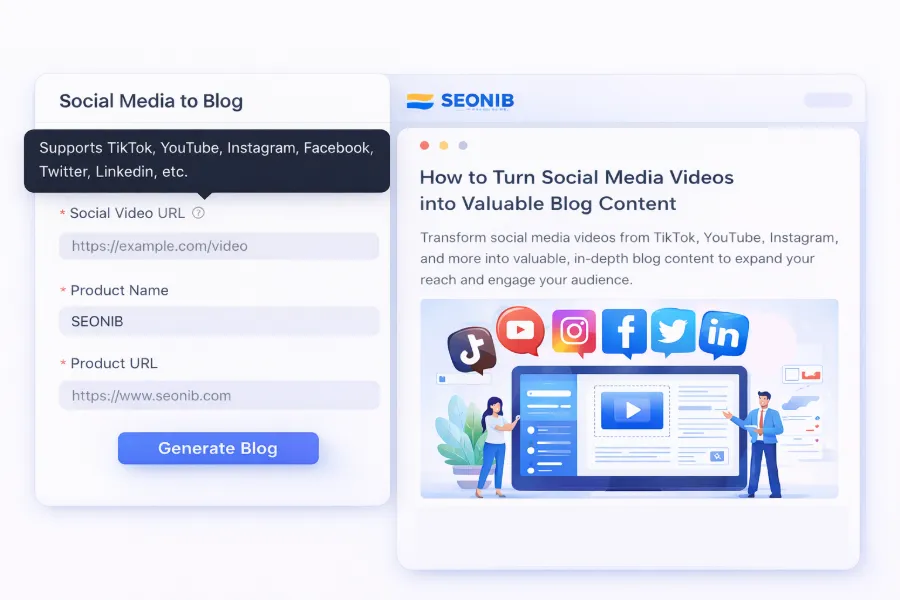
Before, I chased trends on X and TikTok, manually noted key points from a viral video, then wrote a blog—taking three hours per post. No more. Drop video URLs from YouTube, TikTok, X, etc., into the AI; it automatically extracts key information and converts it into structured blog content. A critical pitfall: don’t just have the AI rewrite video subtitles—the result is low‑quality and overly “AI‑y.” The AI must extract “entities” and “logic” first, then reconstruct. If you want to start from keywords, refer to this Keyword Blog Writing Guide to organize your keyword structure.
Step 2: Turn product links into buyer guides
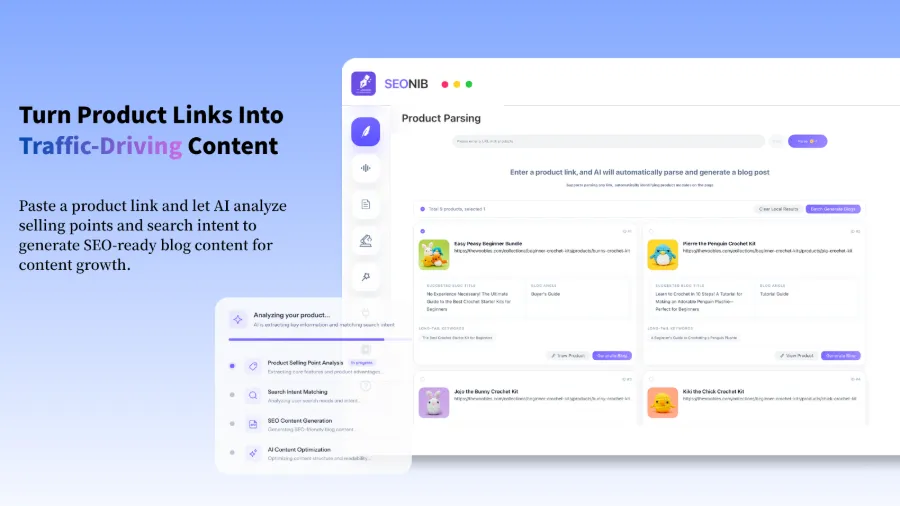
This is the thing I’m most grateful I got right. Previously, writing product comparison pages, installation tutorials, buyer guides each took at least half a day. Now just drop the product link in, and the AI automatically generates FAQ‑format Q&A pages—exactly the structure AI search cites most often. When ChatGPT Search or Perplexity answer “Which of these two Bluetooth headphones has better noise cancellation?” they prefer citing a clearly structured comparison page over a lyrical product description post.
Step 3: Automated publishing calendar to maintain update rhythm
Publishing frequency matters more than single‑article quality; that’s the lesson I learned from six months of data. AI search trusts sites that continuously update a topic—Topical Authority. One article per day is worth hundreds of times a weekly long‑form post. After switching from four manually updated posts per month to one automatically published post per day, natural traffic rose 230% in five months. Manual copy‑pasting is too inefficient, so I switched to SEONIB to handle the whole publishing workflow—set frequency and timing, and everything else runs automatically.
Stop Dreaming – Publishing Content Doesn’t Guarantee AI Indexing; Your Workflow Still Lacks This Piece
Many think that once content is auto‑generated and auto‑published, traffic will just come. Reality is not that simple. In my first week of auto‑publishing seven pieces, none showed up in AI search. Why?
Pitfall 1: Inconsistent brand information. If you generate content with AI but don’t tell it who you are, what your industry terminology is, and what your core product features are, the AI writes as if it knows nothing about your brand. When AI search crawls that content, it can’t build an entity model for your brand—whether you sell shoes or servers, the AI can’t tell. Even if the content gets indexed, it won’t be cited in brand‑related queries. My internal tests show that AI content lacking brand context sees a 47% drop in AI‑search citation probability.
Pitfall 2: Internal‑link loops and structured‑data validation. Many auto‑generation tools only write; they don’t link the content together. Without a sensible internal‑link structure, AI‑search crawlers get lost on your site. Moreover, many overlook Schema.org markup—no matter how good the content, without proper tags AI search treats it as an untrustworthy source.
To fix this, you need a systematic framework. I previously wrote a guide on how independent sites can implement this workflow; see the Independent Site Daily Auto‑Publish SEO Content Operations Guide for building a sustainable publishing system. For internal linking and entity verification, doing it manually is exhausting; tools like SEONIB can handle these steps with a single click, configuring brand context and internal‑link rules so you don’t have to process each new piece manually.
If you want to dive deeper into brand‑context configuration details, check the Help Documentation for a complete guide.
Real‑World Example & Summary: How Much Natural Traffic Did AI Search Add From Mid‑Month to Month‑End?
Honestly, the numbers aren’t spectacular. I started the systematic process mid‑month—rebuilding all old site content into structured Q&A pages, setting brand context, and maintaining daily auto‑updates. After a little over two weeks, AI‑search traffic began appearing in the analytics dashboard. By week 5, AI‑derived traffic accounted for 8% of total search visits.
8% isn’t huge, but the key difference is that this traffic bypasses the traditional ranking cycle. Traditional SEO may take 3‑6 months for a new piece to achieve a stable Google ranking, whereas AI search can index Q&A‑style structured content almost instantly. In other words, that 8% didn’t come after months of waiting; it started within days of publishing.
In 2026, AI‑search traffic is less about writing and more about “feeding.” It’s not about guessing algorithms but giving AI a structure it can read. Which AI platform prefers which format, which platform updates more frequently, which platform is more sensitive to entity recognition—those are the variables that truly matter. I’m still experimenting, but the direction is clear: instead of guessing Google’s next core update, prepare content for the AI and let it pick you.
FAQ
Q1: Does AI‑search traffic conflict with traditional SEO traffic?
No conflict. Traditional SEO traffic and AI‑search traffic stem from different user behaviors—one is users actively typing keywords, the other is users asking AI questions and getting direct answers. They can coexist. In fact, while I’m optimizing for AEO, my traditional SEO organic traffic is also growing because structured content is also friendly to Google.
Q2: I have no budget for tools; can I do AEO manually?
Possible, but extremely inefficient. I initially wrote 30 structured Q&A pages manually in a month, but later found I was spending over 10 hours per week on content publishing. If you have time and are willing to invest, you can manually maintain a brand‑context spreadsheet, manually configure internal links, and manually check structured data—but based on my experience, it’s hard to sustain beyond two months.
Q3: Is AI‑search indexing fast? How long after publishing does it become effective?
Much faster than traditional search. My tests show ChatGPT Search and Perplexity typically index structured content within 24‑72 hours. Google AI Overviews is slower, maybe around a week. Overall, it’s far shorter than the 3‑6 months wait for traditional SEO results.
Q4: Does turning social‑media content (TikTok/YouTube) into blogs really generate AI‑search traffic?
Yes, but there are prerequisites. Simply copying video subtitles into an article won’t bring traffic. The key is extracting “entity information” that can answer user questions—product specs, usage scenarios, price‑performance comparisons—not just a vague “looks good, order now.” With correct extraction, you can see AI‑search traffic from social‑media‑derived content within three months.
Q5: Should I first optimize existing old pages or write all new ones?
Start with optimization. Converting existing pages into structured FAQ Q&A pages is far more efficient than creating new pages from scratch. Spend a week turning your 30 old articles into FAQ format, add Schema markup, and observe AI‑search indexing and citation changes. If there’s no noticeable effect after two weeks, then launch a new‑page strategy.
Share Article