The Best AI Tool Isn't ChatGPT, It's the One You Actually Use Every Day

If you join any cross‑border e‑commerce seller group, you’ll always see people asking “Which version of ChatGPT is the best?” or “Which AI writing tool works best?” The group recommends everything from Jasper to Claude, from Copy.ai to Writesonic – the longer the list, the harder the choice. Yet a few months later, most people admit the same fact: after buying, they barely use it before it gathers dust. Why Every SHOPLINE Store Should Run a Blog
A Shopify furniture seller once talked to me. He spent two months comparing various AI writing tools and finally chose ChatGPT Plus. In the first month he diligently wrote a dozen or so blog posts, the second month dropped to three, and the third month none at all. “It’s not the tool; before I open it each day I have to decide what to write, the tone, the word count, then copy it into the backend, adjust formatting, add images—by the time I finish one post I’m almost out of work time.” He said this not with nostalgia but with fatigue. ShopLINE Help Center
The real bottleneck is never the model’s capability. The real issue is: how many manual steps separate the tool you bought from your daily workflow? Trending Topics Can’t Catch Me
Why ChatGPT May Not Fit Your Content Workflow
ChatGPT’s capabilities are strong – that’s a consensus. It can write product descriptions, generate blog outlines, translate, and polish copy. But between functionality and sustained execution lies an entire neglected friction zone.
Each time you open ChatGPT, you must re‑describe the brand background, restate industry terminology, and provide the writing direction. The same seller, the same product type, the same brand tone – you have to say it all over again each time. Over a week you repeat this at least seven times, not counting weekend updates. Worse, the generated text lacks any structured implementation support – no SEO metadata, no internal linking strategy, no image matching; when you finally paste it into your site backend, everything must be manually completed.
Industry research shows that over 60% of paid marketing AI tools sit idle within three months of purchase. This isn’t a quality issue; it’s a workflow friction issue. You overestimate the tool’s intelligence and underestimate the power of habit. A tool doesn’t need to be the smartest; it just needs to be triggered daily. ChatGPT’s core flaw isn’t its writing quality, but that it never integrates into anyone’s daily pipeline.
“Daily Use” Is the Real Winner in Content Marketing
For cross‑border e‑commerce independent‑site sellers, few lack SEO awareness. Most know blogs are valuable, need regular updates, and organic traffic is a long‑term profit source. Yet between “knowing” and “executing” lies a time‑management gap.
The truth of content marketing: consistency outweighs individual article quality. A 90‑point article posted once every six months yields almost zero cumulative effect. But publishing four 75‑point articles each month for twelve months makes search engines view your site as active, deep, and worth regular crawling. According to Backlinko, sites publishing more than four blogs per month receive about 3.5× the organic traffic of stagnant sites.
The most typical case I’ve seen is a SHOPLINE seller of outdoor goods. In the first year he spent a lot of time polishing five “premium” articles, each over three thousand words, researching, finding images, revising repeatedly. After five months, total organic traffic was under two hundred. He then changed his approach – publish one piece daily, not chasing perfection, just stability. Within six months, monthly traffic rose from under a hundred to just over two thousand. No single piece was a “masterpiece,” but search engines value the update rhythm, not individual quality.
If you have a SHOPLINE store and haven’t started a blog, the gap will only widen. SEO’s cumulative effect needs time; the later you start, the harder it is to catch up.
Integrating AI Tools into Daily Life: From “Occasionally Remembering” to “Automatic Execution”
Solving the awareness issue of “need to use,” the next question is “how to keep using it.”
Reducing usage friction is the only viable path. If your workflow requires opening three back‑ends daily, manually copying six times, adjusting formatting, inserting images, setting SEO tags—you won’t last a month. This isn’t a willpower issue; it’s a system design issue.
A process that can run long‑term must meet one condition: aside from topic selection and content review, no human intervention is needed for the intermediate steps. One‑click publishing, scheduled tasks, multi‑platform auto‑sync are not just nice‑to‑have features; they are the infrastructure that determines whether you can keep using it.
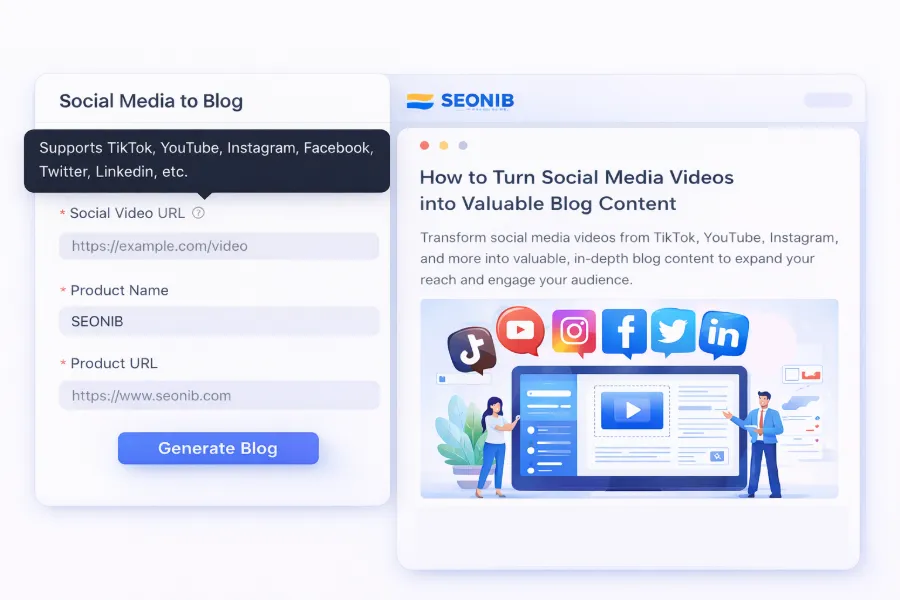
Take the real scenario of a cross‑border e‑commerce seller: daily needs are fixed – blogs need updates, product pages need continuous optimization, social media needs coordinated publishing. If each task is handled separately, the day is fragmented. But if you can streamline a content pipeline where one input automatically triggers multiple outputs, the situation changes completely.
For a concrete example: platforms like SEONIB have achieved full automation from trend discovery to multi‑platform publishing, requiring no daily manual operation from sellers. You just set the publishing frequency and brand context; the system handles the rest. Some teams, after adopting automated publishing, saw a ~60% increase in organic traffic within six months. This is not just efficiency gain, but a qualitative shift in execution – from “occasionally remembering to write” to “the system automatically helps you run daily.”
You might ask, is setup complicated? Actually, the hardest part isn’t technology, but the initial time spent calibrating the brand knowledge base and asset library. This calibration phase typically takes one to two weeks; traffic growth may not be noticeable during it, but this investment determines whether the subsequent automation system can consistently produce brand‑aligned content.
If you want to compare SEO tools for a specific store platform further, refer to this Shopify SEO tools comparison, which can help you quickly identify your automation entry point.
Real‑World Case: When a Cross‑Border E‑Commerce Seller Actually “Uses It”
No matter how much theory, seeing a real case is better.
A Shopify seller of home décor items had a two‑person company – he handled operations, the other part‑time handled customer service. No dedicated SEO team, no content experience. He tried ChatGPT, wrote six articles, then didn’t want to touch it again because “each article starts from scratch, it’s exhausting.”
Later he integrated a system that automatically handles the content pipeline. He set up daily automatic blog generation synced directly to Shopify. He only does three things: spend a few minutes each week confirming topic direction, review the system‑generated content preview for the upcoming Tuesday‑Thursday, and check the weekly traffic report. Everything else – content generation, SEO optimization, multilingual adaptation, publishing schedule – is fully automated.
Three months later, the store’s blog organic traffic grew by over 200%. Note that this figure is an individual result; different categories and competition levels can vary widely, but the core change isn’t the number itself – it’s that he no longer has to rely on willpower to force updates. SEONIB handled the entire middle process from topic selection to publishing; he only needed to spend a small amount of time on decision‑making.
The real bottleneck in content marketing isn’t “can’t write,” but “decision fatigue.” Deciding daily what to write, when to publish, and on which platform – these micro‑decisions are too many, each consuming willpower. Automated scheduling removes this bottleneck. When content generation no longer requires daily decisions, your energy can focus on more important tasks. That’s why more sellers are turning product links directly into SEO blogs, making daily content generation a sustainable system rather than a solo effort.
(caption: AEO Q&A style article example display)
Note that the 2026 SEO landscape is no longer limited to Google. Multi‑platform coverage is increasingly evident, and focusing solely on a single search channel is riskier. An under‑appreciated advantage of automation tools is their native multi‑platform sync: generate once, push to multiple channels, no need to repeat actions per platform.
If you want to dive deeper into the full operational details, SEONIB’s help documentation contains more specific configuration guides and FAQs for reference. SEONIB pricing plans
FAQ
Q1: Why, after writing many articles with ChatGPT, does my site’s traffic still not change?
The most likely reason is inconsistent publishing. Search engine rankings depend on a long‑term stable update rhythm, not occasional bulk output. Writing ten articles with ChatGPT and publishing them all at once, then going two months without updates, leads search engines to think your site is no longer maintained.
Q2: How do you determine if an AI content tool is truly suitable for daily use?
Look at two points: first, does it support scheduled tasks and automatic publishing without daily manual triggers? Second, can it retain your brand information and industry context without reconfiguration each time? Tools that rely on willpower to use are not good tools.
Q3: Will automatically generated content be low quality and penalized by search engines?
The key is how much time you invest in calibrating the brand knowledge base and asset library. An initial 1‑2‑week calibration period is necessary; during this phase, system‑generated content may lack industry precision. Once stable, automated content quality can even surpass intermittent manual updates because consistency itself is a quality signal valued by search engines.
Q4: Do small independent sites need automated content tools?
Small sites actually need automation more, because your time is even more precious. Large teams have dedicated content editors; small sites often have only one person, and manual updates can’t keep up with competition. Automation tools let one person achieve a team’s output volume.
Q5: What is the core difference between automation tools and generic AI writing tools (like ChatGPT)?
General AI tools require you to repeatedly set up, manually copy results, and manually publish each piece, with no connection between contents. Automation tools package the whole process into a pipeline – after a single setup, the system automatically discovers topics, generates content, completes SEO optimization, and schedules publishing across all platforms. The content quality may be similar, but execution efficiency differs by an order of magnitude.
Share Article