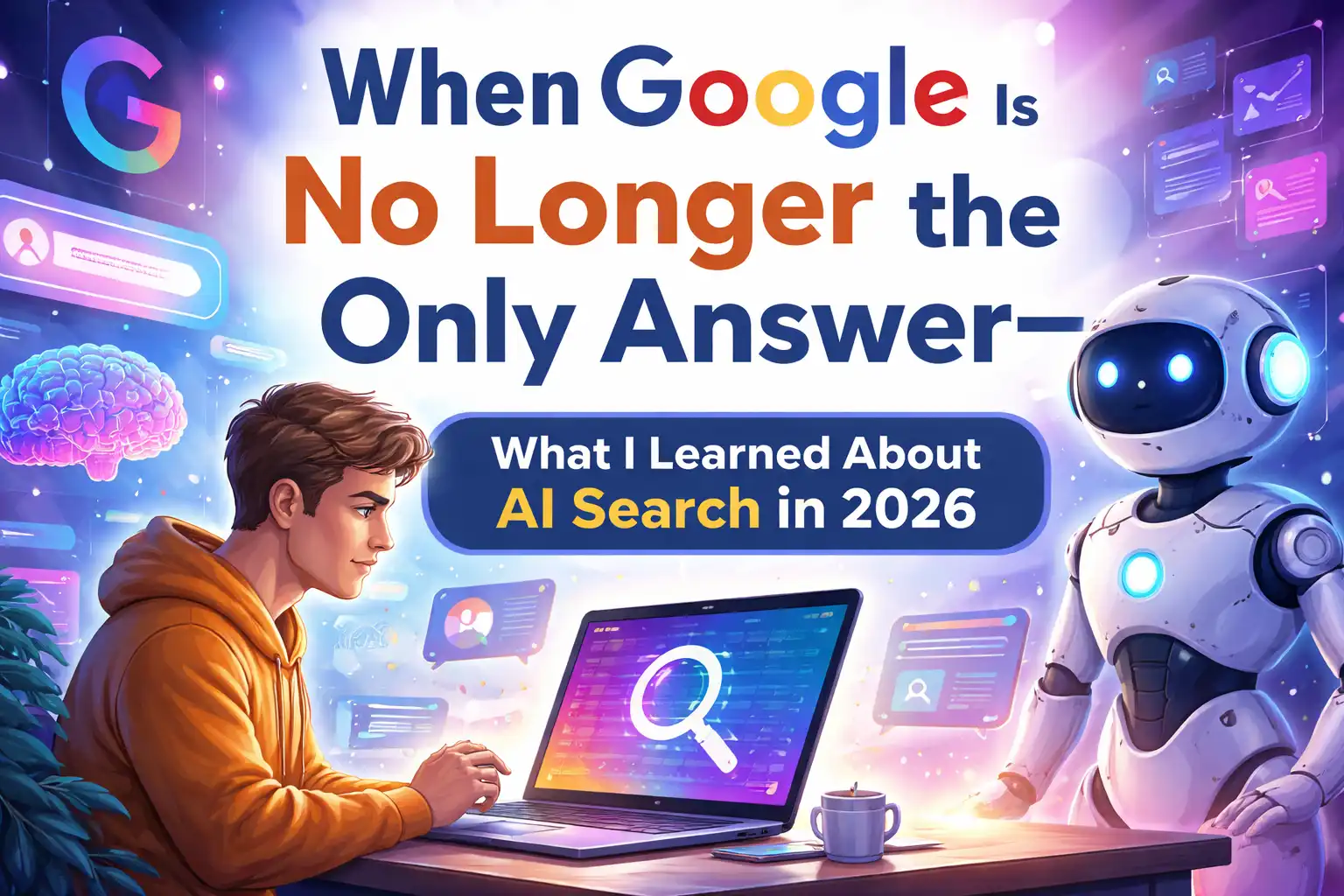
When Google Is No Longer the Only Answer — What I Learned About AI Search in 2026
I realized something was off on a Tuesday in March.
That morning I opened Google Search Console as usual to check how a few core keywords performed last week. The data looked fine, some terms even rose a bit. Then I casually clicked into a source analysis report and saw a mysterious surge in the “referral” column. Clicking it, the source was all chat.openai.com.
My first reaction was that someone had put my site into a GPT response. Later I found it wasn’t a coincidence—several long articles I’d written over the past months were being cited as information sources by ChatGPT when answering user questions. This traffic was barely captured by Google Analytics.
That’s the search reality in 2026. You no longer deal only with algorithmic rankings; you also have to converse with language models—these are quietly becoming a more important traffic source than you might imagine.
AI‑driven search interactions accounted for less than 10 % of total queries in 2023; by 2026 they have surged to 30 %. User behavior is changing: for the same research task, they might first search a keyword on Google, then ask ChatGPT the same thing, and finally check Perplexity. This isn’t substitution; it’s stacking—total interaction volume already exceeds 100 %.
Google still controls 89.87 % of the traditional search market. But the definition of “traditional search” is narrowing. That huge number looks safe, but the margin is loosening.
Two Types of Search, Two Optimization Logics
My earliest mistake was assuming AI search optimization meant shortening existing SEO content, adding some structured data, and waiting for the AI engine to crawl it. That’s not how it works. Google’s ranking system still relies on index, links, page quality, and user signals. If you write good H‑tags, fill in meta descriptions, and build solid internal links, the right traffic will eventually come. ChatGPT, Claude, Perplexity, and similar services work completely differently. They don’t crawl your page rankings; they extract snippets from your content—if your content isn’t structured for “extraction,” you’re invisible.
It took me about two months to truly grasp this difference. I was optimizing a long article on SaaS pricing strategy, about 12,000 words, with a complete logical chain and plenty of examples. On Google, the article landed near the top of the third page and performed decently. In ChatGPT, however, when I asked it to summarize SaaS pricing strategy, it cited a 600‑word blog summary that was more up‑to‑date than my piece. That short article had an extremely clear structure—bulleted lists, a table, and each paragraph no longer than two sentences.
My own article felt more like a small book, while the AI engine wanted a sticky note.
That isn’t to say long content has no value. It means that in 2026 you can’t rely on just one type of content. You need to produce both “human‑readable details” and “AI‑digestible structure.”
The 30 % Share That Gives Me a Headache
A report last year noted that users aged 18‑34 conduct product research on AI engines at a rate above 60 %. I was skeptical until I found myself doing the same.
I wanted to buy a project‑management tool. My first instinct wasn’t to Google “best project management software 2026,” but to open ChatGPT and ask for recommendations. I didn’t realize there was an issue until one afternoon it hit me: if I’m consuming information this way, the SEO content I write may never be seen by younger people.
According to the latest data, Gen Z and Millennials have an adoption rate of over 70 % for AI‑first search. That means if your target audience is this group and you’re not being quoted by AI engines, you may already be losing them.
The problem is, how do you know if you’re being quoted?
The answer is uncertain. There’s no Search Console‑like tool that tells you “ChatGPT cited your page 7 times, each at the third position.” You can only guess from clues—occasionally spotting a strange referral source in analytics, or seeing someone on social media mention “ChatGPT says…” when discussing your article.
In April I did something: I reformatted all twenty core articles on my site. Not a rewrite, but adding an “AI extraction layer”—a summary bullet point at the start of each paragraph, standardized tables, and key data wrapped in structured markup. I didn’t use any AI‑SEO tool (later I learned about a platform called SEONIB that can automate this, but I was still doing it manually), and it took about three weeks of pure hand‑editing.
The result? Two months later, a table comparing API pricing was quoted by Perplexity in a long response. The article’s traffic didn’t increase much, but the citation itself generated downstream links and inquiries. Honestly, I’m not sure if that counts as a “success,” but it made me realize that AI engines are becoming a new indexing system, with standards completely different from Google’s.
The Fractured Platform Era and the Poor Man’s Solution
Another 2026 reality: traffic is no longer concentrated in one place.
Google still dominates, but ChatGPT holds 68 % of AI‑chat‑bot traffic—a share that can’t be ignored. Google Gemini has 15 %, Microsoft Copilot 13 %, and the rest is split among Perplexity (5.8 %) and Claude (4.1 %). Individually these numbers seem small, but together they represent an entirely independent traffic distribution system.
Moreover, the behavior across these platforms varies widely. ChatGPT tends to answer with longer, complete paragraphs. Perplexity likes to stitch together multiple sources. Claude offers better table support than the other two. In theory, you’d need to fine‑tune for each platform.
In practice? No one has that energy.
Most people, including myself, can only pick one main battlefield and do the most basic structured protection. My current approach is simple: every article must contain at least one extractable list or table, core data points must be wrapped in Schema markup, and the first 150 words must be able to stand alone as a complete answer. This way, regardless of which AI engine crawls the page, it won’t end up with a pile of junk.
The method isn’t elegant, nor is it perfect. But with limited resources, it at least prevents me from disappearing from the map.
The Awkward Yet Necessary Content Automation
Speaking of limited resources—I think this is the most genuine dilemma for content creation in 2026.
Manually adjusting content for each platform is unrealistic. There are so many pieces to update daily, so many articles to publish, and you still need to cater to AI extraction formats and multi‑platform synchronization. I used to have a habit: write a blog post, manually copy it into WordPress, then manually copy it into Medium, adjust formatting, add images, fill SEO fields. Doing that once or twice is okay; doing it every week drives you crazy.
So I turned to automation tools. Honestly, most AI writing tools I tried felt off—they produced content that was too “clean,” like plastic parts stamped out of a template factory, lacking operational details, failure stories, and the “I’ve done this before, so I know” vibe. However, automating the publishing workflow is essential. I now use SEONIB for content scheduling and multi‑platform sync because it actually handles the repetitive tasks I’m lazy to do: scheduled publishing, cross‑platform pushes, automatic SEO metadata filling. Its biggest advantage is eliminating those “I know I should do this but just don’t feel like it” mechanical steps.
But there’s a balance. I’ve automated publishing, yet I still write the content myself. It’s not that I disdain AI‑generated text—sometimes AI writes surprisingly well—but if your content lacks operational details and the “unimportant” nuances only someone who’s actually done the work would know, AI engines will eventually flag you as an untrustworthy source. Once labeled “unreliable,” you disappear from this new extraction‑index system.
FAQ
Q: Do I still need to care about Google for SEO in 2026?
A: Absolutely. The 89 % share of traditional search isn’t a joke; if your Google traffic drops, it’s real. But you can’t focus solely on Google. My advice: keep about 70 % of your effort on Google optimization, and devote the remaining 30 % to structuring content and adapting it for multiple platforms. Adjust the ratio as you see results.
Q: How can I tell if my content is being cited by AI engines?
A: It’s hard. There’s no unified tool for tracking this. You can regularly check analytics for odd referral sources, or ask ChatGPT, Perplexity in various ways to see if your content appears in the answers. Occasionally, someone on social media will mention “ChatGPT says…”—that’s a signal. But honestly, this still relies more on intuition than data.
Q: Will content automation tools make my site look “fake”?
A: It depends on how you use them. If you use them to generate generic articles without any operational details, then yes. If you use them for publishing, scheduling, multi‑platform syncing, and SEO field filling—mechanical labor—then they won’t make your site fake; they’ll free you up to write truly valuable content. The key is: automation should handle the “workflow,” not the “thinking process.”
Share Article