AI Summaries Provide Only One Citation Spot – How to Make AI Absolutely Cite You?
I wrote eighty high‑quality product reviews over six months. When I searched my own niche keywords in ChatGPT, the AI summary gave me just one citation, linking to a generic article on the official Shopify blog. I’ve seen that feeling all too often.
Traditional SEO tackles the “what rank” problem, while the AEO era focuses on “who cites you and whom you cite.” AI summaries usually have only one citation slot, occasionally two or three in rare cases, and this slot essentially monopolizes traffic entry—it far outperforms the traditional top‑organic result in click‑through rate. Being cited by AI isn’t mystical; it can be achieved through deliberately designed structured information architecture and entity content.
Why Does an AI Summary Only Want to Cite One Source?
LLM‑driven search summaries differ fundamentally from traditional search scraping. Traditional search presents ten blue links for you to choose from; AI search gives you a compressed answer directly. When generating that answer, the model performs “information compression”—selecting one to three high‑confidence sources from a massive web pool and synthesizing a paragraph.
Three core factors determine the “single citation slot”: information uniqueness, entity matching degree, and content structure parseability. Information uniqueness means your page contains content that cannot be pieced together elsewhere; entity matching degree means AI can recognize your page as discussing the same thing; content structure parseability means AI can extract the answer from your page at low cost.
The source of anxiety often lies not in content quality but in information architecture. No matter how well you write, if AI must read the entire article to infer what question you’re answering, it won’t pick you. When generating a summary, AI prefers pages that require minimal computational effort and little secondary processing—this logic is largely independent of page weight.
Three Content Strategies to Get AI to Choose You Over Others
Strategy 1: Provide deeper information on the same entity than all competing pages. This isn’t about writing longer; it’s about covering more dimensions for a single entity. For example, for “Shopify SEO,” competitors may only discuss keyword placement, while you cover technical optimization, content strategy, AI search visibility, and common pitfalls. When AI needs to answer related questions, it will have to come to you.
Strategy 2: Use a four‑part “definition‑mechanism‑comparison‑Q&A” structure so AI can parse at low cost. AI parses structured content far more successfully than flat narrative. Pages that contain clear definition sentences see a significant boost in citation probability. Each H2 should answer a specific user question, and key arguments should state a clear stance—no ambiguity.
Strategy 3: At key argumentative points, provide exclusive data, case studies, or definitive positions that create an “information island” that cannot be assembled elsewhere. Citation is not a reward; it’s the inevitable choice for AI when minimizing computational cost. Analyses of how a brand‑new site with zero backlinks can win the starting line through the topic selection illustrate how topic choice and information architecture compensate for low authority. The same logic applies under the AEO framework for content supporting AI crawling.
Upgrade “Human‑Readable” to “Machine‑Citable” – Structured Writing Checklist
Cross‑reference this checklist line by line; missing any item may cost you the citation slot:
- H1 must contain the main entity and modifiers, e.g., “Complete Guide to Shopify SEO” instead of “How to Do SEO.”
- The first 100 characters of the body must be a pure definition sentence: “X refers to …”. Pages whose opening 100 characters are definition sentences are far more likely to be directly excerpted by AI than those with narrative openings.
- Each H2 should answer a clear user question, like a FAQ with self‑Q&A.
- Key data must include year and source; data points with years have a higher citation probability.
- Entity frequency and relationships must be explicitly stated: “A is a subset of B” or “A achieves B through C.”
Rewrite and compare. Ordinary paragraph: “Many merchants running independent sites encounter traffic problems; they write content but no one reads it.” AI‑citable paragraph: “Independent‑site traffic acquisition refers to the process of attracting target visitors to a self‑hosted e‑commerce website through SEO, content marketing, and social media channels, with core metrics including the share of organic search traffic and conversion rate.”
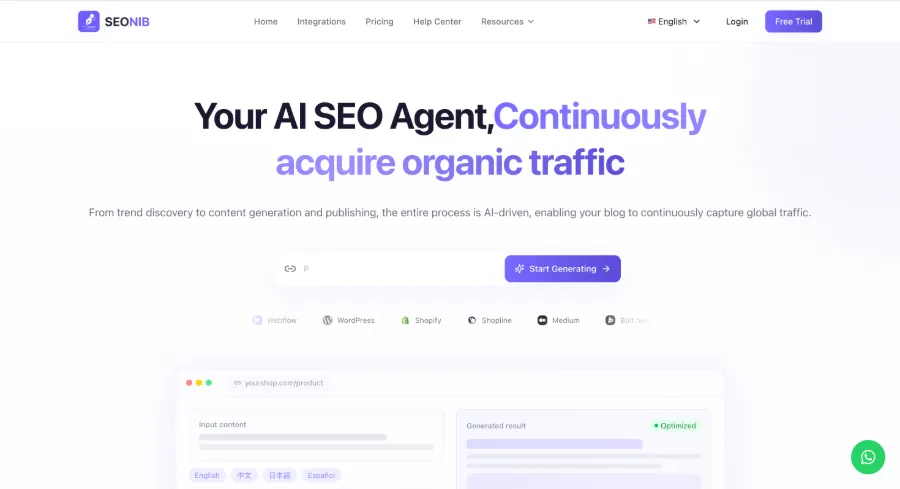
After writing, such content still needs continuous production. Manually applying this standard to every article is easy to forget or shortcut. Recommended internal SEO tools: a low‑maintenance, zero‑manual‑monitoring solution that automates this repetitive work.
Learn how structured content boosts AI citation rates by consulting our full framework: How Content Supports AEO.
Want to get started quickly with SEO tools? See the detailed guide “What Is the Best SEO Tool for Beginners?.”
For topic‑selection strategies for brand‑new sites with zero backlinks, refer to this analysis: How a Zero‑Backlink New Site Can Win at the Starting Line with the Right Idea.
For platform‑specific details, see the Help Documentation.
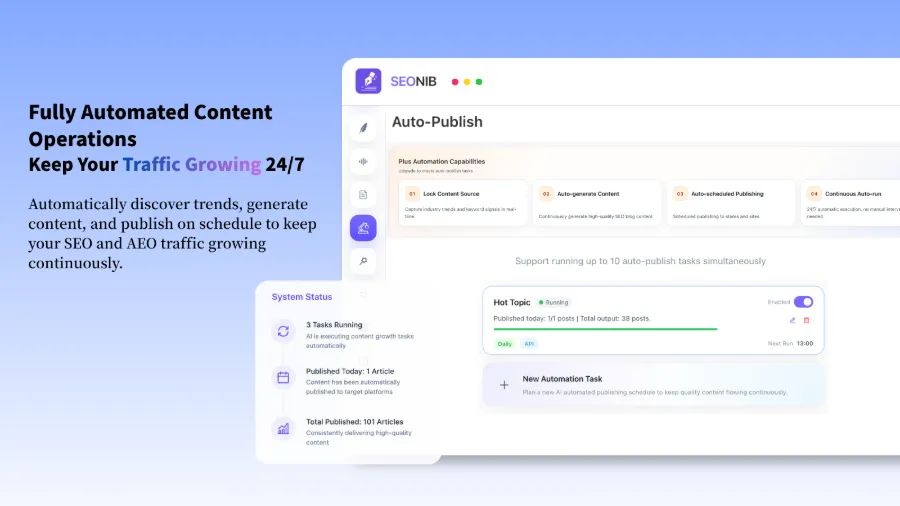
Feed Brand Information to AI via a Knowledge Base – Don’t Let AI Skip You Because It “Doesn’t Know You”
There’s an overlooked fact: AI sometimes doesn’t cite you not because of content issues, but because its knowledge base lacks any entity information about you. AI’s trust in unfamiliar entities is naturally low; if it can’t confirm “who you are, what you sell, and your position in the industry,” it won’t risk citing you.
A brand knowledge base solves this: organize brand terminology, product definitions, and industry vocabularies so AI can recognize, understand, and trust you when generating summaries. Consistency of brand information across the web—Wikipedia, official site, social media, storefront—directly impacts AI’s entity‑recognition confidence; multi‑channel synchronization accelerates this process.
Manually maintaining a knowledge base is costly and quickly becomes outdated. When product definitions change, prices adjust, or new categories launch, an out‑of‑date knowledge base feeds AI stale information. Tools like SEONIB automate this: configure brand assets, industry terms, and product info, and the tool automatically injects this context into generated content.
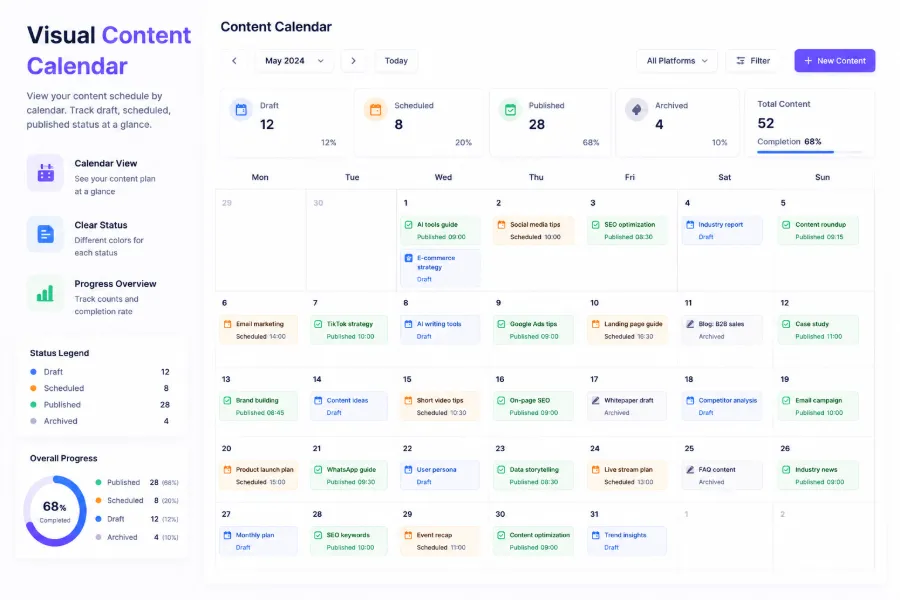
A knowledge base combined with scheduling and auto‑publishing forms an industrial‑grade content pipeline. A visual content calendar lets you instantly see what’s pending generation, what’s scheduled for publishing, and what’s already live.
If you want to explore the full capability boundaries of such tools, consult the automation tool’s help docs, which include integration configuration for various platforms. The method for connecting a Shopify store to an automation tool is also worth reviewing.
Publishing Is Just the Start – How Content Gets Indexed, Synced, and Continuously Cited
After content goes live, three factors truly affect AI citation: rapid search‑engine indexing, cross‑platform synchronization, and ongoing updates. Pages indexed within 24 hours of publishing have a higher chance of appearing in AI summaries; consistent entity information across multiple platforms significantly raises confidence scores.
Manually syncing to several platforms is friction‑filled and error‑prone. Copy‑pasting from Shopify to WordPress, then reformatting on Shopline—any missed update makes entity information inconsistent. AI sees inconsistent entity data across platforms and lowers its confidence.
An automated “generate once, sync everywhere” workflow solves this. Tools like SEONIB automatically push published content to Shopify, WordPress, Shopline, and other platforms without logging into each backend. Shopify merchants can learn about the ecosystem on the official Shopify site or find the SEONIB app directly in the Shopify App Store and connect it to their backend. Specific connection steps are detailed in the help documentation.
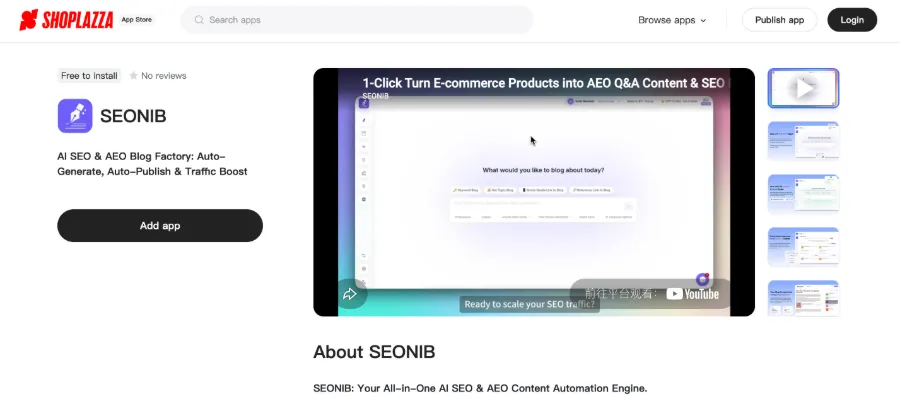
Beyond multi‑platform support, there’s the issue of unattended operation. Relying on willpower to maintain publishing frequency will eventually break. Scheduled tasks automate execution, ensuring continuous content output, ongoing entity updates, and sustained AI trust in your material. An AI agent that automatically handles publishing and syncing is exactly how these tools run in the background.
Returning to the opening case: the independent‑site operator spent six months writing eighty reviews, focusing all effort on long‑tail keywords and backlinks, while neglecting entity consistency and definition sentence structure. Content volume alone doesn’t solve the “being cited” problem; information architecture does.
FAQ
Does the AI summary cite the whole article or just a paragraph? Do I need to put keywords in the title for my article to be cited?
AI summaries usually cite a specific paragraph or definition sentence, not the entire article. Having keywords in the title helps, but the crucial factor is that the first 100 characters of the body are a pure definition sentence, enabling AI to excerpt it directly. I’ve seen pages without any keyword in the title get cited because their definition sentences were clear enough.
My website’s content is already great, but AI search still doesn’t cite me. Where could the problem be?
It’s most likely an issue with information architecture and entity recognition. Check three things: does the first 100 characters contain a definition sentence? Does each H2 answer a clear question? Is brand information consistent across the web? Content quality solves “how readable it is for users”; information architecture solves “whether AI can cite you at low cost.”
Is there a way to proactively tell AI that my site is an authority in a field? Does submitting a sitemap help?
Submitting a sitemap only speeds up indexing; it doesn’t boost authority. The real lever is a brand knowledge base and consistent entity information: make AI able to recognize, understand, and trust you. AI’s trust in unknown entities is naturally low, so providing authoritative brand definitions markedly raises confidence.
I write “What is Shopify SEO”; why does AI always cite that old article instead of my new one?
Older articles typically have higher entity coverage and deeper information, so AI prefers them when minimizing computational cost. If your new article merely repeats the same content, AI has no reason to switch sources. To break through, you must provide dimensions the old article lacks on the same entity—such as AI search visibility, latest data, or exclusive case studies.
Share Article