How AI Workflows Reshape Cross‑Border Content Automation: A Systematic Framework
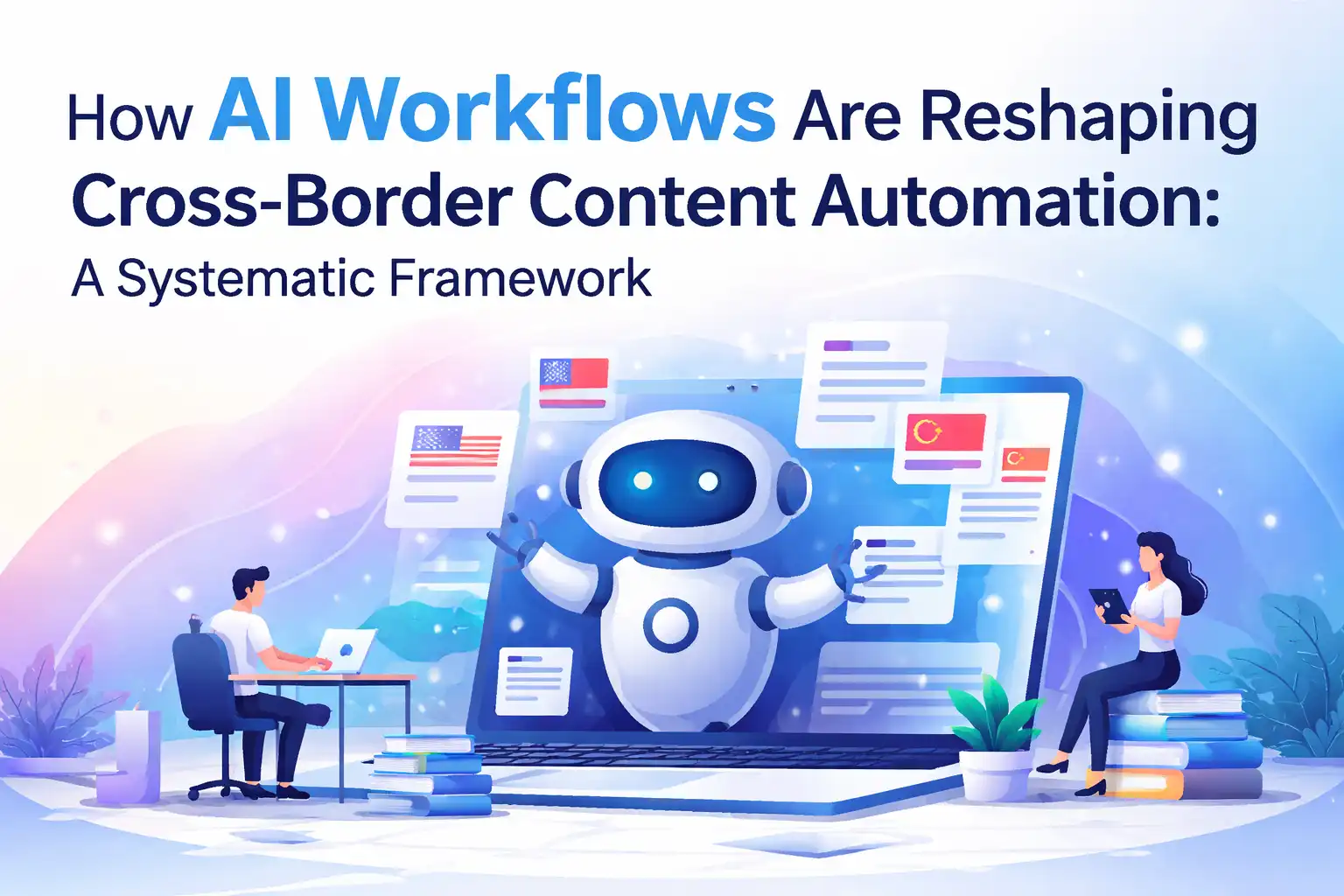
The daily routine of cross‑border content operations always looks the same. On Monday morning you open the topic list and see that three of the five topics you listed last week are still empty. You skim industry news, manually compare competitors, manually search trends, spending one or two hours cobbling together two or three barely viable directions. Then you generate each piece in ChatGPT or Claude, copy‑paste into an editor, adjust formatting, add images, fill in SEO metadata, and finally log into each platform’s backend to publish one by one. If you manage three or four store sites, you easily spend ten to fifteen hours a week on content production, yet you only output three or four articles.
This isn’t a capability issue; it’s a process issue. AI writing tools are already widespread, but most people only use them to replace the “typing” step—other steps in the workflow remain manual, and the bottleneck shifts from writing itself to topic selection, editing, publishing, and ongoing updates. A complete automated workflow isn’t about faster writing; it’s about eliminating human involvement in those steps.
The Fundamental Divide Between Old and New Workflows
Where are the key bottlenecks in manual content management? You’ve probably experienced this: not knowing what to write, lacking discipline to publish continuously after writing, and missing cross‑platform synchronization and maintenance after publishing. If any of these three breaks, the content pipeline stalls.
Manual teams spend an average of 10–20 hours per week on content production, with topic selection and publishing preparation taking up most of that time. A hidden problem is decision fatigue—daily repetitive decisions like “what to write today,” “which image to pair,” “how to craft the SEO title,” and “which platform to publish on” consume far more willpower than the writing itself. By the third week, many people start skipping a publishing day; by the fourth week it becomes every other day, and after two months the content plan is essentially abandoned.
The new workflow thinking is completely different: let a system take over the human judgments in topic selection, generation, scheduling, and publishing. Topics are replaced by trend monitoring and keyword analysis instead of manual browsing; generation is driven by input sources rather than a blank document; publishing is triggered by a scheduler instead of logging into a backend; synchronization is done via API pushes instead of manual uploads. Human role shifts from “executor” to “reviewer”—checking that content meets standards and doing a small amount of quality control during the automation gaps.
A detailed breakdown of this end‑to‑end process from idea to distribution can be found in the SEONIB Complete Creation Guide: From Inspiration to Global Distribution (https://seonib.com/help/22/SEONIB%27s%20Complete%20Guide%20to%20Creation%3A%20From%20Inspiration%20to%20Global%20Distribution). The core change is that the rhythm of content output no longer depends on personal willpower and sustained effort, but on a pre‑set system.
Automating Trend Discovery and Topic Decision
A Shopify home‑goods operator once tried to build a manual content pipeline. In the first month she spent 45 minutes each day browsing industry forums, Google Trends, and competitor blogs, selecting two or three potential topics and recording them in an Excel sheet. In the second month the sheet accumulated four unwritten topics—new topics were being generated far faster than she could write and publish. By week six she hadn’t opened that sheet for ten consecutive days.
Without automated topic pushes, content plans often naturally break between weeks 4 and 6. This isn’t a matter of execution—facing dozens of potential topics each day without a system to prioritize them quickly overwhelms normal workload.
The core of AI trend monitoring is to replace the “active search” process. The system continuously scans industry news, social‑media hotspots, and competitor content updates, instantly identifying blank topics with search demand. It doesn’t just tell you “AI SEO is hot”; it evaluates each topic’s average monthly search volume, difficulty score, and timeliness, then pushes it into your topic queue.
In an internal test, a medium‑size cross‑border e‑commerce account using the trend‑monitoring feature received more than 24 new topics per day for selection—three times the manual screening capacity of a three‑person content team. More importantly, these topics weren’t random; they were validated by keyword search volume, dramatically reducing the chance of “spending time writing content no one searches for.”
In the industry today, platforms like SEONIB (https://seonib.com) have embedded this trend‑monitoring step into the content workflow, turning topic discovery into a daily, system‑driven task. Once the bridge between the topic library and writing tasks is automated, the “don’t know what to write” problem disappears, replaced by “choose which of the system‑pushed topics to write today.”
Why SEO in 2026 must broaden its view beyond Google rankings is explained well in the article “2026 SEO Can’t Focus Only on Google” (https://telegra.ph/Stop-Only-Focusing-on-Google-In-2026-SEO-You-Need-to-Be-Everywhere-06-05). Single‑search‑visibility strategies are losing effectiveness; the breadth of content distribution and continuous updates are more resilient than chasing a single keyword rank.
From Input Source to Publish‑Ready: Pipelining Generation and Scheduling
After trend monitoring pushes topics to you, the next bottleneck is content generation itself. Most teams follow this flow: have a topic → open ChatGPT to draft → manually copy to editor → add images → fill SEO title and description → set categories and tags → finally publish. In this flow AI only participates in the third step; the rest remain manual.
Automation’s hierarchy lies in the diversity of input sources. Keywords, product links, social‑media posts, hot topics, reference links—different input types should map to different content formats, all of which can directly generate SEO‑optimized articles. For example, a product link can become a buyer’s guide or review blog; a tweet can expand into a trend analysis; a competitor’s popular page can generate alternative content from a different angle.
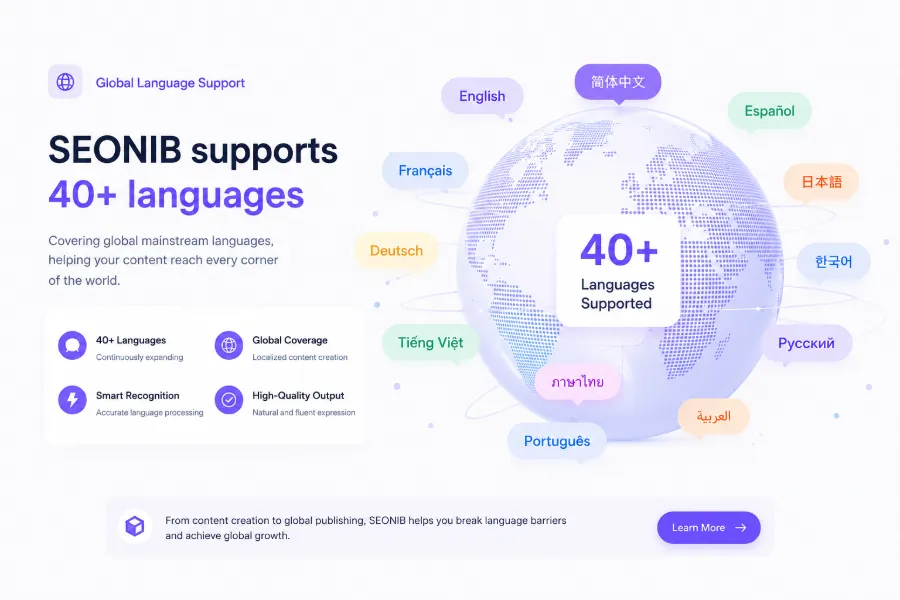
The system currently supports automatic generation in more than 40 languages. If you manage multilingual sites, you don’t need to write or translate each language version separately—once generated, the system can output the target language versions directly.
Generating AEO Q&A content and SEO blogs automatically from e‑commerce product links is a very typical scenario. The demo “One‑Click Turn E‑Commerce Products Into AEO Q&A Content and SEO Blogs” (https://seonib.com/c/insights/1-click-turn-e-commerce-products-into-aeo-q-a-content-seo-blogs-seonib-demo) shows the concrete results.
After generation comes scheduling. Many people’s problem isn’t a lack of content but “having content but no time to publish.” Manual timed publishing sounds simple, but in practice managing content calendars for four or five sites each day—setting release times per article, adjusting tags or thumbnails—becomes chaotic if you slack.
SEONIB’s approach is to make scheduling a preset mechanism: set a weekly cadence of three posts or a daily cadence of one post, and the system automatically pushes content to the publishing queue at the defined rhythm. You don’t need to log in daily; just preview and confirm before the scheduled time. Content production continuity is no longer driven by human effort but by a timer.
One operator reported that before switching to this model he averaged eight articles per month—writing a batch in the first few days of the month, then a three‑week pause. After enabling automatic scheduling, the publishing rhythm became a stable three articles per week, raising monthly output from eight to fourteen, with more consistent format and quality. The difference isn’t about writing speed but about turning “publish one article a day” into a non‑thinking system behavior.
One‑Click, Multi‑Platform: Synchronization and Long‑Term Ranking
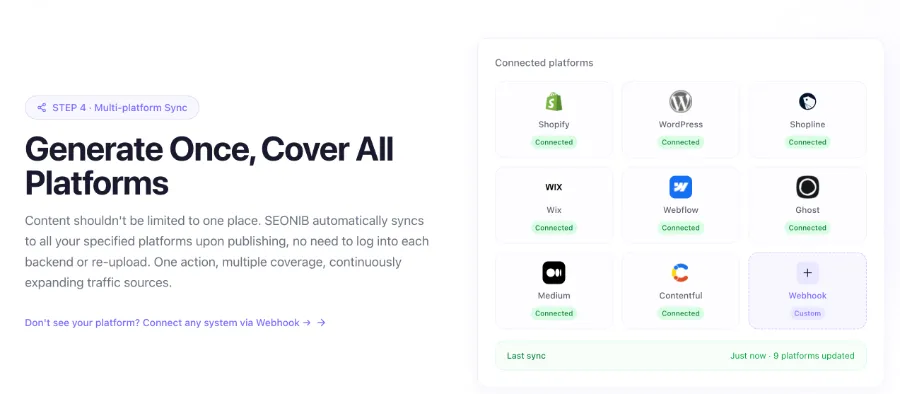
After generation and scheduling are complete, the final step is distribution. A frequently underestimated issue is that even if content is published on the main site, you still need to manually log into each backend—Shopify store, WordPress blog, SHOPLINE site, etc.—copy content and formatting, upload images, set categories.
Manual synchronization not only wastes time but also leads to content decay—missing posts on some platforms, broken formatting, broken image links, or publication times out of sync with the main site. These seemingly minor problems accumulate, causing indexing history on specific platforms to break. Search engines see intermittent update records, marking the site as “inactive,” which reduces crawl frequency.
Automation solves more than “fewer clicks”; it ensures each platform’s indexing record is consistent and continuous. Publish once, and the system automatically pushes the content to all bound platforms—Shopify, WordPress, SHOPLINE, Bolt, and other major CMSs. The system handles format adaptation for platform differences during synchronization.
For long‑term ranking, a case study “I Got Search Traffic by Writing a Blog” (https://telegra.ph/I-Got-Search-Traffic-by-Writing-a-Blog-06-05) shows how an entrepreneur grew monthly search traffic from zero to several thousand visits in six months by consistently publishing blog content. The key factor wasn’t a single viral post but steady output and meticulous SEO optimization.
Multi‑platform synchronization also yields a long‑term benefit: accumulated search visibility. Content on each platform continues to be indexed, creating multi‑node coverage. Even if algorithm changes on one platform cause traffic fluctuations, other platforms maintain overall organic traffic. This redundancy isn’t wasteful—discussions about the AI SEO Guide 2026 (https://seonib.com/guide/ai-seo) note that AI search engines prioritize entity coverage over single‑page authority, and multi‑platform content coverage aligns perfectly with this trend. For SHOPLINE sellers, the methodology in “Shopify Store Best SEO Tools Recommendation” (https://seonib.com/c/landing-pages/ecommerce/best-seo-tool-for-shopline-stores-2026-comparison) is equally applicable.
Before deploying this workflow in production, assess the scale of investment. If you’re considering building an automated content pipeline, reviewing the SEONIB pricing plans (https://seonib.com/pricing) helps you determine the functional depth needed at each stage. Start with the minimal configuration to run the full process, then expand as content volume grows.
Frequently Asked Questions
Does an AI workflow mean content quality will drop?
It doesn’t automatically drop, but you need to set quality standards. The quality of automatically generated content depends on input material and prompt framework—if the source keywords, product info, and trend data are high‑quality, the generated content is usually more factually accurate and structurally complete than a hastily handwritten article. The key is to reserve a preview and editing stage, not to hand everything over to the system.
I only have an independent site and no social platforms—does this workflow still help?
Yes. The core value of an automated workflow lies in continuous publishing and SEO optimization, independent of social distribution channels. A single standalone site can still reap the main benefits—saving time on topic discovery and publishing preparation, and increasing update frequency.
After setting up automatic scheduling, can I still preview and edit content before publishing?
Yes. Automatic scheduling typically includes a preview stage—the system places generated content into a pending queue, allowing you to review and edit before the scheduled time. In emergencies you can also manually pause or adjust the schedule.
How are format differences across platforms handled during multi‑platform sync?
The sync process automatically detects each target platform’s content specifications and adapts formatting—image sizes, category mapping, tag systems, SEO meta fields, etc. You only need to configure field mapping once when initially binding a platform; subsequent synchronizations reuse those rules.
How much initial configuration work does this automated pipeline require?
Basic setup usually takes 40–60 minutes: bind content sources (keywords, product links, social accounts, etc.), connect publishing platforms, set scheduling frequency and topic preferences. Deeper configurations such as brand style, terminology libraries, and internal linking rules can be refined gradually during operation without affecting the initial rollout.
Share Article