Things ChatGPT Doesn't Do Well: The Content Automation Dilemma for Cross‑Border E‑Commerce Sellers
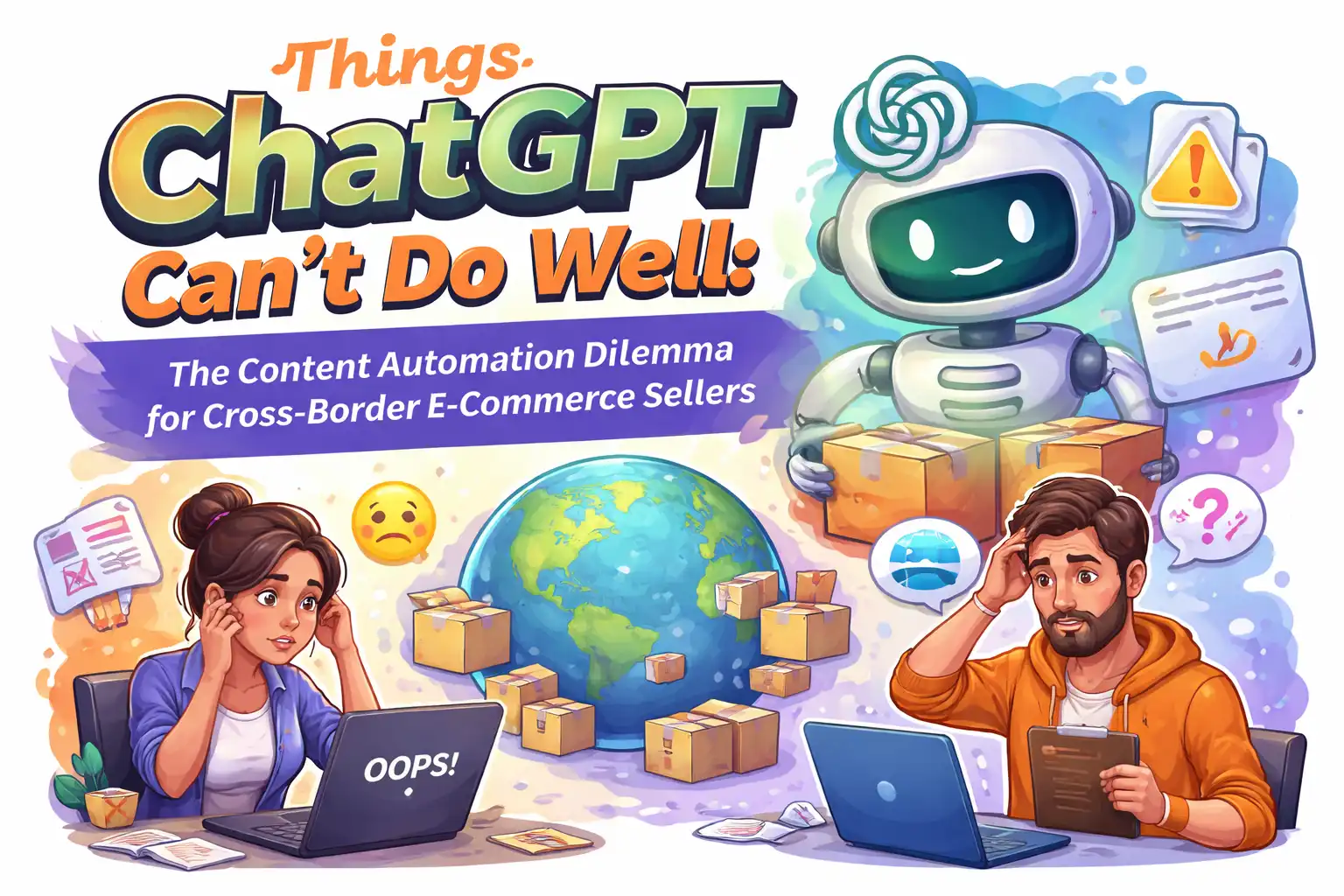
How many hours per week do you spend on ChatGPT generating blogs, product descriptions, and social posts? Input prompts, copy to an editor, manually adjust formatting, then publish on each platform—this workflow looks “AI‑driven,” but it still requires a lot of manual intervention. A small seller operating three sites tallied the time: at least 12 hours a week are spent on these mechanical tasks, and more than half of that time isn’t “creative” at all—it’s copy‑pasting. ChatGPT can produce a structurally complete draft, but that’s far from the whole of content marketing. The real problem isn’t writing quality; it’s the automation gap it can’t bridge.
Over the past two years, many e‑commerce sellers have integrated ChatGPT into their content production pipelines, only to find that the final output efficiency fell far short of expectations. The reason is simple: ChatGPT is a one‑off conversational tool, not a true content automation system. It has no scheduled tasks, doesn’t automatically monitor trends, and can’t push a finished article directly to your Shopify backend. The result is that the time saved on brainstorming is completely wasted on subsequent manual operations.
Lack of Continuous Automation Capability—Content Can’t Be “Unattended”
The core of content marketing isn’t writing a single good article; it’s sustained output. This is especially true for cross‑border e‑commerce—multiple languages, sites, and platforms require fresh content daily to maintain search‑engine crawl frequency and keyword coverage. ChatGPT can’t independently complete this loop. Every content generation requires manual prompt input; every publication requires human intervention. It has no sense of time, doesn’t know what to post tomorrow, and won’t automatically fill gaps during traffic lulls.
A survey of over 200 small‑ and medium‑sized sellers showed that manual content management takes 10–15 hours per week, with 60 % of that time spent on repetitive copy‑pasting and publishing. This isn’t an exaggeration: copying text from the ChatGPT dialog, pasting into an editor, adjusting formatting, adding images, filling SEO metadata, and publishing—one article typically takes 10–15 minutes. Publishing 10 articles per week equals roughly two and a half workdays.
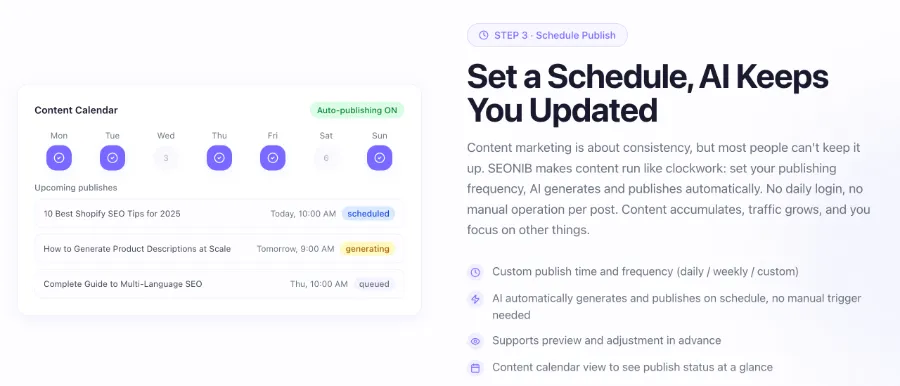
In contrast, once a publishing schedule is set, AI can automatically discover trends, generate content, and push it according to the plan. Take SEONIB as an example: it can automatically fetch industry news, identify high‑potential keywords, generate structured articles, and publish them directly to connected platforms on a predefined timetable. Users don’t need to log into a dialog box daily, manually adjust layouts, or even open an editor.
For sellers who have already started operating a store but are unsure of the promotion direction, see this guide on how to quickly validate product search demand to first confirm whether there’s genuine search demand before planning content.
Limits in Understanding Brand Context and Product Knowledge
ChatGPT has no memory and cannot store your brand rules. It doesn’t know which tone to use for your products, which terms are industry conventions versus internal usage, nor can it automatically insert product links or internal linking strategies. Every conversation starts from scratch.
E‑commerce sellers feel this most acutely. A home‑goods team once complained: they asked ChatGPT to write a product description for a “smart desk lamp,” and it produced “a lamp with adjustable brightness”—failing to highlight color‑temperature adjustment, eye‑care certification, and e‑commerce platform compatibility. Because ChatGPT doesn’t know these are selling points, it can only rely on generic expressions from its training data.
Data shows that e‑commerce sellers report that ChatGPT‑generated content requires on average 40 % edits before it can be published, with brand consistency issues being the main part. Those 40 % edits aren’t just wording tweaks; they include correcting product specs, adding inventory info, swapping terminology, and inserting correct links—essentially writing half a manual draft.
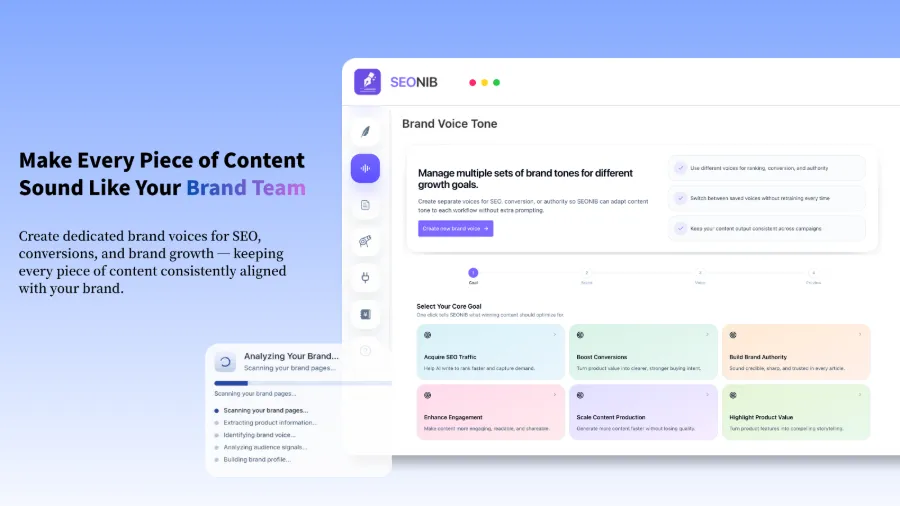
Brand context management tools can solve this layer of the problem. By pre‑loading brand terminology, tone rules, product knowledge bases, and internal/external linking strategies into the system, AI can follow these rules when generating content, eliminating the need for post‑generation,‑by‑article corrections.
Content Distribution and Platform Adaptation Gap
ChatGPT only outputs plain text. A blog post needs images, tags, categories, excerpts, SEO metadata—none of which exist in the text generated by ChatGPT. Once the text is obtained, sellers must manually log into Shopify, WordPress, or SHOPLINE backends, create a new article, upload images, fill SEO fields, and set categories. The whole process is virtually identical to manually posting articles a decade ago.
Manually publishing a blog with images and SEO metadata takes an average of 12 minutes; across three platforms this doubles to over 30 minutes. A team publishing 15 articles per week spends 7–8 hours just on the publishing step. This means a large portion of content production cost is consumed by “publishing” rather than “creating.”
SEONIB can push generated content to multiple platforms—including Shopify, WordPress, SHOPLINE, Medium, etc.—in one go, automatically handling format conversion, metadata filling, and image embedding. Users don’t need to repeatedly log into different backends. For SHOPLINE users, SEONIB is already listed in the SHOPLINE App Store and can be installed and configured directly within the platform.
Missing Deep SEO Optimization Capability
ChatGPT‑generated text is semantically smooth but still falls short of true SEO‑ready articles. It doesn’t automatically add internal links—each article you write must be manually linked to existing product pages, category pages, and older blogs. It doesn’t understand keyword clustering and won’t automatically select secondary or long‑tail keywords based on the main keyword. Its content lacks structured data markup, so it can’t directly improve search‑engine comprehension efficiency.
Articles with proper internal linking strategies see an average click‑through rate increase of over 30 % in Google rankings. This figure comes from Backlinko’s 2024 study, whose core logic is simple: internal links help Google understand entity relationships and content hierarchy between pages; articles lacking these links are naturally at a authority disadvantage.
Teams looking to systematize SEO output can consult the latest AI SEO Guide to learn current mainstream automation strategies and implementation methods. For specific configuration issues, SEONIB’s help documentation provides a complete guide from site binding to internal linking rule setup.
Multilingual Content Quality and Localization Gap
Cross‑border e‑commerce content marketing inevitably involves multiple languages. ChatGPT’s translation ability works well in everyday conversational scenarios, but it shows clear shortcomings in product descriptions, industry terminology, and cultural adaptation. A Chinese “收纳神器” directly translated to English loses its semantic nuance; “性价比高” varies in expression across countries—Japan prefers the subtle “コストパフォーマンス,” while Southeast Asian markets may simply say “cheap but good.”
Pure machine‑translated e‑commerce content has a 35 % higher bounce rate in target markets compared to localized content. This data comes from a Common Sense Advisory study tracking over 3,000 consumers, concluding that users can tell when content is translated rather than originally written for them, and they leave the page much faster than expected.
ChatGPT’s limitation is that it can only handle one language at a time, unable to manage multiple language versions within a single content ecosystem simultaneously. After publishing an English blog, you must run a separate generation process for each language market, manually adjust terminology and phrasing, and then publish each version. The time and consistency costs become hard to control. Teams that frequently convert social media content into blog posts can refer to this guide on converting social media content into blog articles to learn how to cover multilingual scenarios from a single content entry point.
Frequently Asked Questions (FAQ)
Can ChatGPT automatically discover trending topics?
No. ChatGPT relies on user‑provided prompts and does not actively monitor industry trends or competitor activity. It cannot tell you whether a keyword’s search volume is rising or whether an old piece of content is outdated and needs updating. To gain topic discovery capabilities, you need dedicated trend‑monitoring tools or a content automation platform.
Can ChatGPT‑generated content be published directly to Shopify?
No. ChatGPT only outputs plain text and provides no API or integration capabilities. Users must manually copy the text, log into Shopify’s backend, create a new article, and manually add images, tags, metadata, and internal links. This adds an extra 10–15 minutes per article.
Why does SEO content generated by ChatGPT rank poorly?
While semantically reasonable, ChatGPT‑generated content lacks deep SEO optimization elements: no internal linking strategy, no keyword clustering, no structured data, and no entity optimization. These technical factors are core to ranking; plain‑text fluency alone is insufficient to achieve good rankings for competitive keywords.
How can the shortcomings of ChatGPT in content automation be compensated?
The most direct approach is to treat ChatGPT as a “draft generator” rather than an “end‑to‑end tool.” Subsequent editing, adaptation, distribution, and optimization steps still require human effort. If you want to completely skip these steps, consider specialized content automation tools that typically integrate topic discovery, brand management, multi‑platform distribution, and SEO optimization.
Do multilingual contents generated by ChatGPT require extra review?
Yes. ChatGPT’s multilingual output is essentially translation plus re‑expression, which can introduce deviations in industry terminology, brand language, and culturally specific expressions. It is recommended that every non‑native‑language piece be reviewed by a native speaker, focusing on terminology accuracy and tone adaptation; a two‑round review is the minimum requirement.
Share Article