
E‑Commerce SEO in 2026: Stop Focusing Only on Rankings; Getting AI to Cite You Is the Real Goal
At the end of last year I reviewed my own independent store and found one frustrating thing: traffic wasn’t collapsing, but conversion kept drifting. After some tinkering I realized that the old tricks of keyword stuffing and hijacking “blue links” are basically invisible to AI search.
In 2026, e‑commerce SEO’s core has shifted from “what rank I am” to “whether AI will cite me.” If Google AI Overviews, ChatGPT, or Perplexity use your product page as a reference when answering a user query, you win. Otherwise, even ranking first is like opening a shop on an empty street.
If you’re also seeing “rankings stay high but nobody clicks,” this article is for you—discussing the direction truly worth working on in 2026: how to move from a traffic harvester to an information source that AI systems want to reference.
When Search Becomes “Zero‑Click,” Is Your Store Still on the Track?
While you’re watching Search Console ranking fluctuations, AI Overviews are already slapping the answer directly in front of users. Users don’t scroll down, let alone click through to your site. A 2026 industry forecast predicts AI search will occupy over 80 % of commercial query real—meaning that if AI doesn’t cite you, grabbing the top spot is useless.
I once wrote a headphone page packed with “3000 mAh battery, AI noise‑cancellation,” but Google AI Overviews didn’t pull any of my content and instead promoted an Amazon page. The reason is simple: my page only had marketing copy, no structured data, no genuine experience description—AI deemed it advertising junk. Throw away the traffic‑centric mindset; the new battlefield is “being cited” rather than “being clicked.”
Not Bringing People In, but Making AI Understand and Recommend
To make AI take your page seriously, you must feed it clean data. Adding a single Product Schema is no longer enough: you also need Review Schema, FAQ Schema, and PriceSpecification, all marked up with JSON‑LD.
I changed a product description from “water‑repellent jacket” to “suitable for 5‑10 °C drizzle mountain hikes, 5000 mm waterproof rating, breathable mesh design,” while honestly noting “not suitable for extreme downpours.” The AI citation rate jumped noticeably. Studies show that pages using advanced schemas see a 300 % increase in AI citations.
Many sellers fear that listing drawbacks will deter customers, but AI prefers balanced information—it makes you look more trustworthy. That’s why some sites get cited more often while your page appears to AI as just a bundle of ad copy. If you want to dig into the logic, check out this analysis on why some sites get cited more.
The differences between traditional SEO product pages and 2026 AI‑driven product pages are summarized in the table below:
| Dimension | Traditional SEO Product Page | 2026 AI‑Driven Product Page | Benefits |
|---|---|---|---|
| Use case | Vague “suitable for everyday” | Detailed “wear for commuter rainy days” | AI matches intent precisely |
| Weakness presentation | Hidden or avoided | Honestly note “not suitable for heavy rain” | Boosts E‑E‑A‑T trust |
| Policy transparency | Buried at the bottom | Structured display of shipping, returns | AI shopping assistants filter quickly |
| Content depth | Keyword stuffing | Multi‑dimensional validation + tables | Gains GEO citations |
Instead of Chasing Big Keywords, Turn the Search Box Into Your Product Manual
I used to write “running shoes,” now I write “what shoes to wear for slippery commuter rain.” Big keywords are dominated by Amazon and Shopee; small sellers can’t compete. AI search prefers answering specific questions—build a Topic Cluster around a product, e.g., under “running gear” expand to “morning run shoe recommendations,” “wide‑foot running shoes.” AI will see you as an authority in that niche.
Forecasts predict that e‑commerce sites ignoring this shift will lose 30 % of AI‑driven exposure. A friend of mine rewrote product pages with question‑style titles; traffic dropped a bit, but conversion doubled. Stop fighting for big keywords; occupy the question boxes AI will quote directly.
Technical SEO Is Not a Back‑Office Task; It’s the Front‑Desk Menu—Make AI Decide Instantly
Technical SEO isn’t just about page speed; it’s about making AI read your product info at a glance: price, stock, reviews, delivery time. After real‑time updates and JSON‑LD markup, AI shopping agents (like ChatGPT’s shopping feature) can fetch and recommend your data instantly.
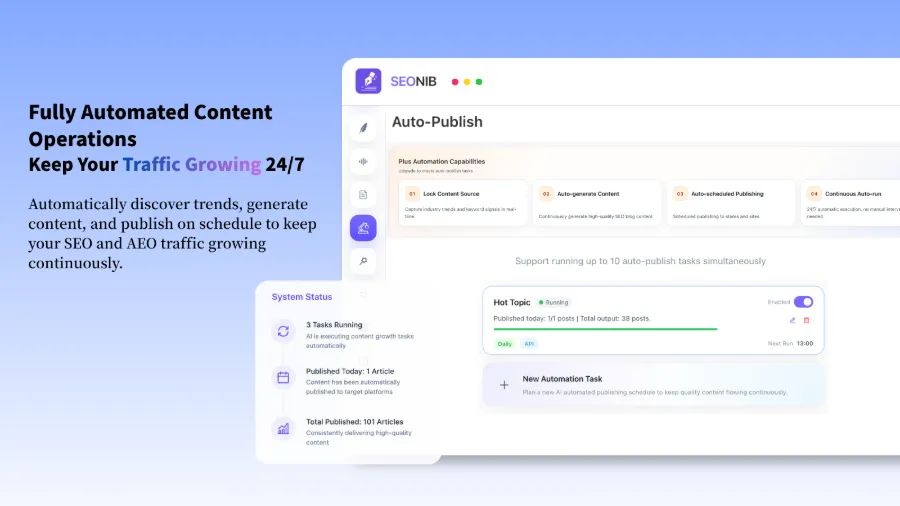
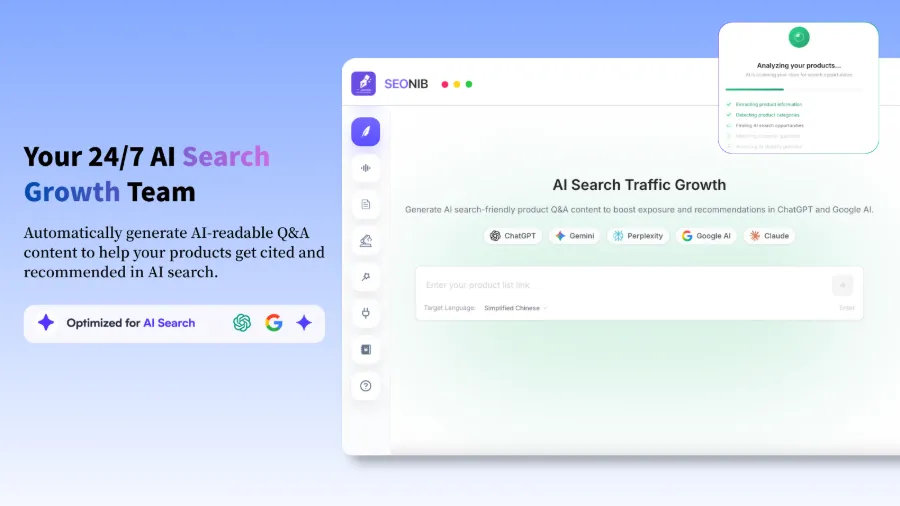
I tried connecting a Shopify store to an automated publishing tool that syncs product info to a blog daily, eliminating manual updates. With SEONIB rules set up, new products automatically generate SEO‑optimized buying guides, with price and stock updating in real time. Configure once and it runs 24 hours a day.
If you want a systematic AI SEO education, see the AI SEO Guide (2026). If you haven’t opened a store yet, first validate your idea with a quick website prototype. For technical configuration details, SEONIB’s help documentation contains a complete checklist.
After trying it, you’ll see that zero‑click search isn’t the end of traffic. Users may not click, but brand name, price, and reviews appear directly in the search list; next time they might search your brand directly—mindshare is far more valuable than a single click.
Use Automation to Cover the Entire AI Ecosystem, Let AI Agents Sell for You
Future shopping scenarios look like this: a user tells an AI, “Find me a long‑run shoe under $500,” and the AI agent automatically matches parameters and recommends. If your product data isn’t structured and synced in real time, the AI agent won’t even notice you.
To cover this ecosystem, you need an automated content pipeline: trend discovery → content generation → multi‑platform publishing → data sync. SEONIB covers this flow—from monitoring hot industry terms to auto‑generating blogs, then syncing with Shopify, SHOPLINE, all without human intervention. For how to turn product links into blogs automatically, see this guide: How to Turn Product Links into SEO Blogs. There’s also a detailed tutorial on CSDN: https://blog.csdn.net/SEONIB_Explorer/article/details/159613242—follow the steps to launch.
Consistently outputting content builds trust in the AI ecosystem. Set your push frequency, let the system post daily, and only occasionally review topic quality.
FAQ
Q1: AI search feels abstract—should a small seller start acting now?
Yes. The earlier you start, the more advantage you’ll have. AI’s citation mechanism favors long‑term, well‑structured pages. Optimizing product pages and structured data now can show results in three months.
Q2: If I’m not after AI citations and only want Google rankings, does this shift affect me?
It’s significant. Google’s own AI Overviews already dominate the top of many commercial queries, dramatically lowering click‑through rates. Even if you rank first, AI summaries can capture the traffic. AI citations and Google rankings are not opposing; they stack.
Q3: Does listing product drawbacks really not hurt sales? Won’t consumers run away?
Practical tests show that honest, balanced descriptions actually boost conversion. AI search prefers recommending products with real reviews and balanced descriptions. Consumers seeing “drawbacks” in AI recommendations perceive the product as more trustworthy, leading to stronger purchase decisions.
Q4: Zero‑click search means even if I’m first, no one clicks—why bother optimizing?
Zero‑click search still displays brand information in the results, creating brand impressions. The next time a user searches related products, they may type your brand name directly—mindshare is the payoff. Optimization remains necessary; the goal shifts from click‑through rate to brand exposure.
Q5: What is an AI shopping agent? Does it affect me?
An AI shopping agent is an intelligent assistant that users delegate price comparison and ordering to, such as ChatGPT’s shopping feature. It will become increasingly common. If your product data isn’t structured and synced, the AI agent can’t recognize you and will recommend competitors. Prepare your APIs and data now.
Share Article