Which GEO Tools Besides Writesonic Are Worth Trying?
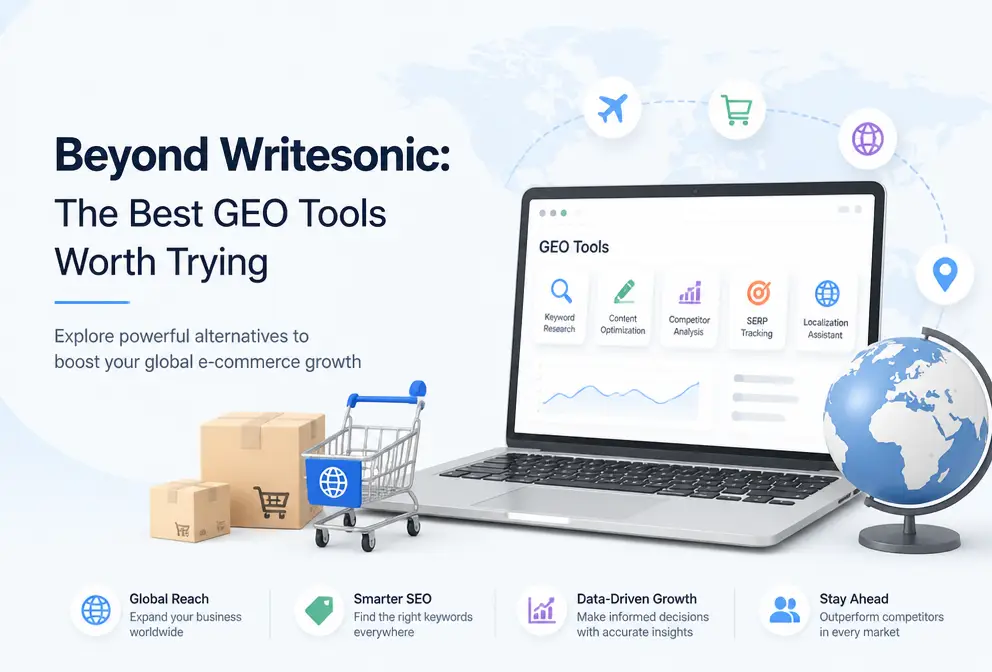
You spent thousands of words polishing product content, checking rankings daily, yet the brand’s mentions in ChatGPT and Gemini remain scarce. Writesonic can indeed tell you whether AI engines cite you, but monitoring alone isn’t enough—content lags, and exposure stays a pipe dream. Last year I tried Writesonic for three months; the $199/month bill hurt, and the real headache was that after each “competitor has taken your spot” alert, I still had to stop and write a new article, schedule it manually, and copy it to three platforms. This “monitor‑only, no promotion” loop lasted half a year, moving the ranking only a few spots while adding a lot of duplicate work.
Why Should You Consider Alternatives to Writesonic?
Writesonic starts at $199/month, which is pricey for solo site owners and small teams. Its monitoring dimensions are indeed comprehensive—it can track brand mentions on ChatGPT, Gemini, and Perplexity, and even show which pages AI crawlers have visited. But it lacks content generation and publishing capabilities. After receiving a suggestion like “add an explanation about entity X,” users still have to write the article, schedule it, and sync across platforms manually. At least three teams I know gave up on such tools: 52% of brands get squeezed out of the top‑10 AI search results each quarter, and manual responses can’t keep up with that rotation speed. What you need isn’t a more expensive dashboard, but a system that turns monitoring results directly into publishing actions.
Core Criteria for Evaluating GEO Tools
Before picking a replacement, set a few baselines. First, look at the number of AI engines covered—ChatGPT, Gemini, Perplexity, Claude, and AI Overviews are the basics; missing any could cause you to miss a lot of potential exposure. Second, consider the granularity of citation tracking: URL‑level tracking tells you exactly which article was cited, while prompt‑level tracking shows the user query that mentioned you. Third, the ability to compare competitors—knowing you’re mentioned isn’t enough; you also need to know why competitors rank ahead. Finally, a realization I came to later: the specificity of content optimization suggestions—just saying “the content isn’t deep enough” is meaningless; a good tool should give structured revision directions. An industry survey shows 73% of modern “search” happens outside traditional search engines, meaning AI visibility relies less on external links and more on content structure. If you’re just starting, read the article on how a topic‑selection strategy can give you an early advantage to understand content‑first principles.
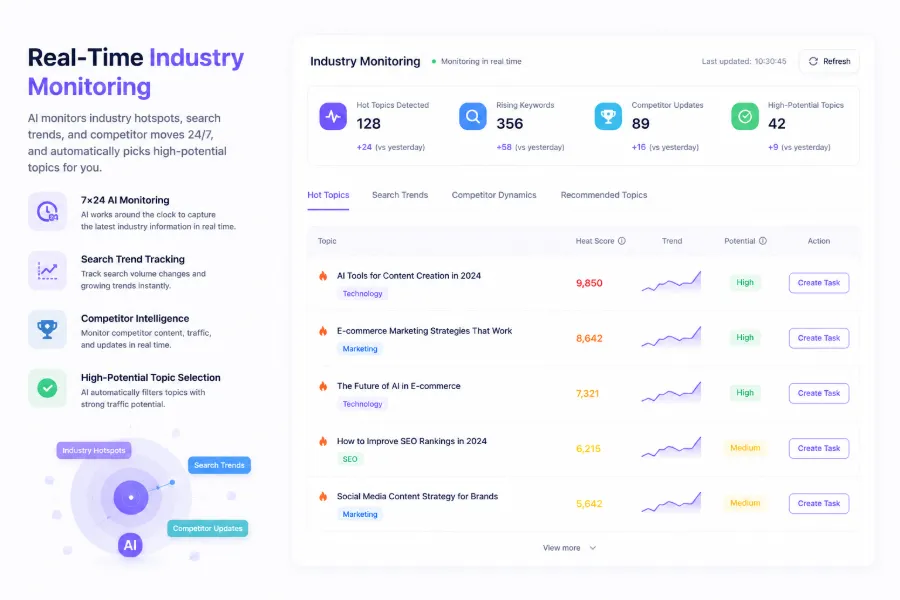
8 Noteworthy Writesonic Alternatives at a Glance
A quick comparison of mainstream options shows prices ranging from $29 to $300/month, each with clear drawbacks:
| Tool | Starting Price | Use Cases | Main Drawbacks |
|---|---|---|---|
| AthenaHQ | $295/month | Data‑driven AI recommendations | Expensive, no free tier |
| Otterly AI | $29/month | Entry‑level AI visibility monitoring | Low prompt limit, weak multilingual support |
| Peec AI | €89/month | Multilingual GEO insights | Limited functionality |
| Surfer AI | $89/month | SEO‑first GEO approach | Basic GEO features |
| Nightwatch | $32/month | Hybrid visibility checks | Skewed toward traditional SEO |
| Profound | $199/month | AI summary tracking | Lacks content generation |
| Ahrefs Brand Radar | $129/month | Brand citation benchmark | No content optimization suggestions |
| Scrunch AI | $300/month | Brand safety & misinformation monitoring | Highest price, security‑focused |
These tools share a common flaw: they only solve the “monitoring” problem, leaving implementation to you. The real time‑saver is the gap between “knowing” and “publishing.”
Focus on Automated Publishing: Let GEO Tools Actually Save You Time
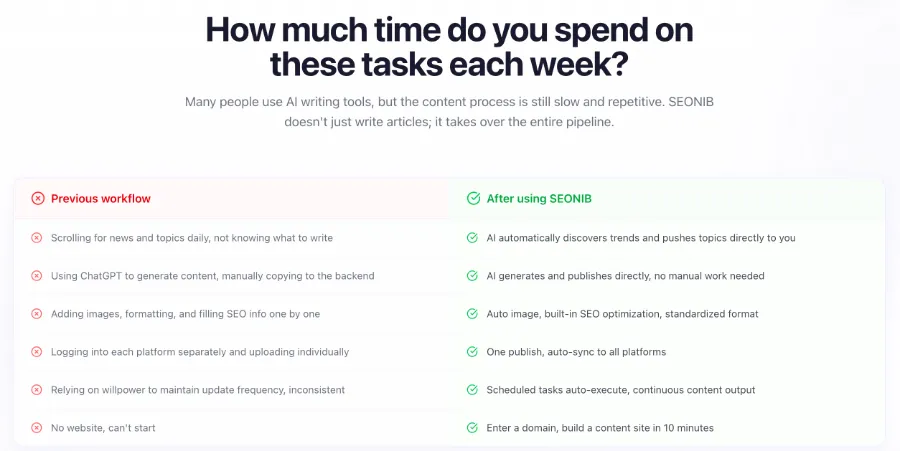
Most GEO tools give you monitoring data and then dump a list of suggestions—“add entity X,” “optimize internal linking”—and then disappear. You still have to write articles, schedule them, and sync to Shopify, WordPress, and more. This middle‑stage friction is the main reason teams see limited efficiency gains. For example, Otterly AI’s basic plan supports only a limited number of prompts and doesn’t cover multilingual sites well; to monitor bilingual brand mentions you must upgrade—but even then there’s no content generation.
SEONIB takes the whole production line over. It not only monitors AI visibility but also integrates blog generation, translation, SEO optimization, automatic scheduling, and cross‑platform publishing into a single pipeline. Starting from a product link, AI automatically creates buyer guides, tutorials, and review articles, then publishes them at a set frequency to the connected store backend. Compared with the tools listed above, SEONIB fills the critical gap in “content automation.” Watch the demo video: generating AEO content from a product link takes only seconds.
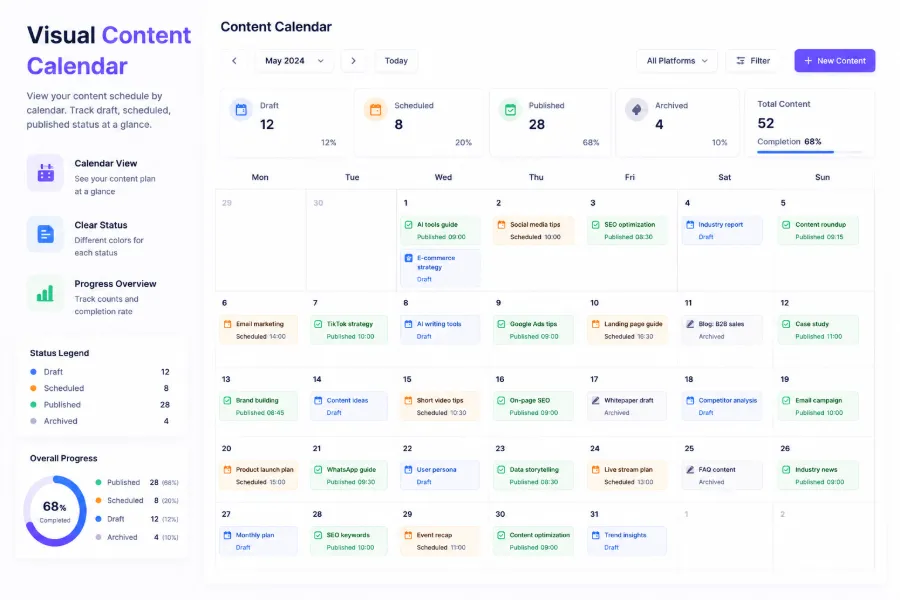
SEONIB’s automated workflow includes trend discovery, content creation, scheduling, and multi‑platform sync. You no longer need to log into different backends daily; once configured, AI publishes on schedule. If you run an independent site, see this guide on how to auto‑publish SEO content daily. SEONIB also supports HTTP API pushes and integrations, so you can embed it into your existing tech stack without rebuilding. For cross‑border e‑commerce sellers, automated content is easier for AI engines to recognize—previously I shared how to make ChatGPT treat your site as a treasure trove; the core idea is to improve machine affinity with structured, continuously updated content. For detailed automation setup, check SEONIB’s help documentation.
How to Choose the Right GEO Tool for You
When evaluating, segment by team size and needs. Solo creators care about entry price and simple monitoring—Otterly AI and Peec AI are starter picks, with monthly fees in the tens of dollars to see brand mentions across major engines. Content teams needing deep analysis and recommendations may justify AthenaHQ’s $295/month for prompt‑level insights and large‑team collaboration features. Cross‑border e‑commerce sellers need content automation and multilingual support, so combine the automation solution mentioned earlier to fill the production gap. Enterprises focused on data security might consider Scrunch AI, which excels at brand safety and misinformation monitoring, albeit at the highest price tier.
Regardless of the tool you pick, verify its support for Chinese content. Most GEO platforms are English‑centric, and the accuracy of Chinese prompts and entity recognition varies. If you’re a beginner, start with a set of SEO tools designed for newcomers, grasp the basics of automated traffic acquisition, then gradually introduce GEO‑layer tools.
FAQ
What’s the core difference between Writesonic and SEONIB?
Writesonic focuses on AI visibility monitoring, telling you whether your brand is mentioned in ChatGPT, Gemini, etc., and offers optimization tips. SEONIB goes beyond monitoring with full content generation and publishing capabilities, turning monitoring results directly into live articles and reducing manual steps.
Must GEO tools include content automation?
Not mandatory, but in practice most teams lack the capacity to continuously produce content after receiving optimization suggestions. If one person can only write two high‑quality articles per week, manually executing suggestions is inefficient. Content automation shrinks the production cycle from hours to minutes and keeps publishing frequency consistent.
Which Writesonic alternative offers the best value?
Otterly AI starts at $29/month and suits small‑scale brand visibility testing. For full multi‑engine monitoring plus content production, SEONIB’s automation can save more labor costs. Exact pricing depends on content volume and platform count; compare based on actual needs.
Do these tools support Chinese content optimization?
Most do, but depth varies. Peec AI explicitly supports multiple languages, and SEONIB covers 40 languages, including Chinese. Pay attention to Chinese entity recognition and semantic analysis—test with niche industry terms to verify accuracy.
How long after using a GEO tool will I see results?
Typically 4–8 weeks. AI engines index less frequently than traditional search engines; ChatGPT’s training data updates roughly quarterly. The first two weeks build initial citations; thereafter, brand mention growth stabilizes. Pairing with automated content publishing can surface results 2–3 weeks earlier.
Share Article