
Key Metric for Boosting AI Search Visibility: Citation Share, Not Sentiment — Data Analysis of 4,670 Brands
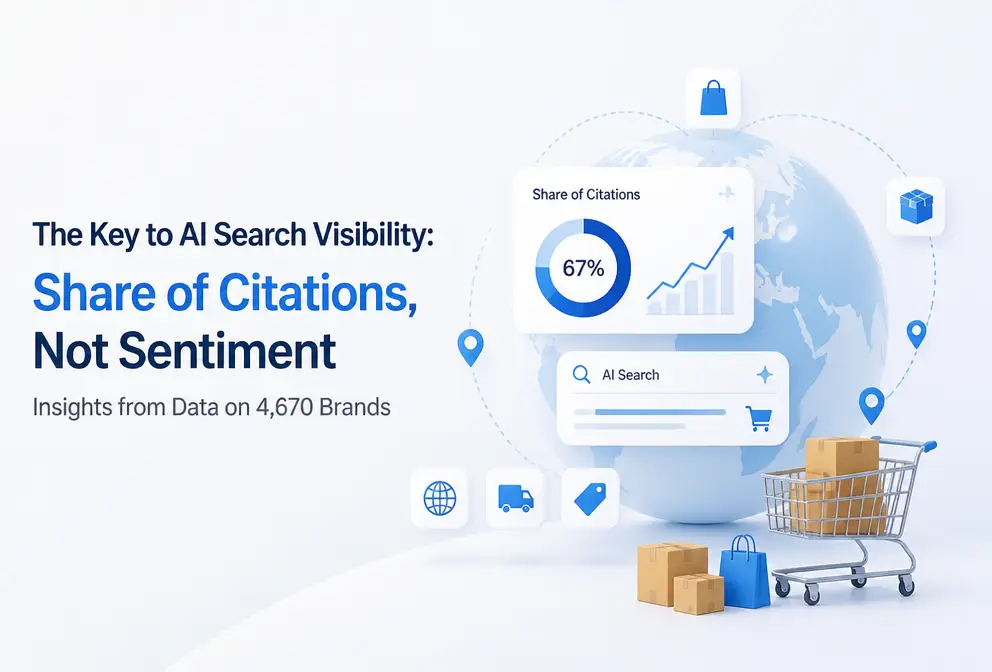
From March to June 2026, I kept an eye on one number: the performance of 4,670 brands in AI answers. Over those four months I tracked each brand’s citation frequency, sentiment score, and overall visibility changes in AI search results. At first I thought sentiment scores would be the main signal—after all, many tell you to “build reputation” and “manage perception,” and that AI would be more willing to recommend you. But the data quickly changed my mind.
The correlation coefficient for citation share is 0.41, while that for sentiment is 0.04—a ten‑fold difference.
Citation share, the proportion of times your domain is cited in AI answers, is the only metric that consistently separates visibility growers from decliners. Sentiment scores have almost no discriminating power. If your GEO strategy is still built around “making AI say nicer things,” this article should save you months of effort.
Research Design: What We Measured
The dataset selection criteria were simple: a brand had to appear in at least 500 AI answers per month to be included. This threshold filtered out noise from low‑traffic fluctuations, leaving 4,670 brands for analysis.
We measured three core variables. AI visibility refers to a brand’s share of mentions across all AI answers—the exposure share within its category. Citation share is the proportion of AI responses that explicitly cite the brand’s domain, i.e., the frequency you are treated as an “information source” rather than just a “mentioned entity.” Sentiment score is a 0‑to‑100 rating that gauges the positivity of AI’s description of the brand.
The time window is March–June 2026; the four‑month change serves as the analysis basis. The method has two layers: first, Pearson correlation to identify signals that move in the same direction as visibility changes; second, quartile comparison—pulling out the top growers and bottom decliners for direct comparison.
This is a typical presentation of brand content when AI answers a user question. Understanding the concrete form of a “citation” is crucial for interpreting the data—being cited is not the same as being merely mentioned; your content is adopted as a source for the answer.
A note: all analyses are correlational, not causal. They tell us which metrics change alongside visibility growth, but they cannot prove that adjusting a metric will drive visibility up. I have repeatedly confirmed this boundary.
Key Finding: Citation Share Correlates with Visibility Ten Times Stronger
When the two correlation numbers are placed side by side, the gap practically speaks for itself.
The Pearson correlation between changes in citation share and AI visibility is 0.41. The correlation between sentiment score changes and visibility changes is 0.04—a ten‑fold difference.
A 0.41 correlation is a moderate‑to‑strong signal in behavioral data, especially over a high‑frequency four‑month window. A 0.04 correlation is essentially negligible. This doesn’t mean sentiment and visibility are completely unrelated—it just means that, across the actual movements of these 4,670 brands, sentiment fluctuations and visibility fluctuations are almost out of sync.
I understand this conclusion may make some practitioners uncomfortable; after all, years of time and budget have been poured into “brand sentiment optimization.” If you’re doing GEO to boost sentiment scores, the effect may be noticeably muted. If you’re aiming for more AI answers to cite your content, you’re on the right track.
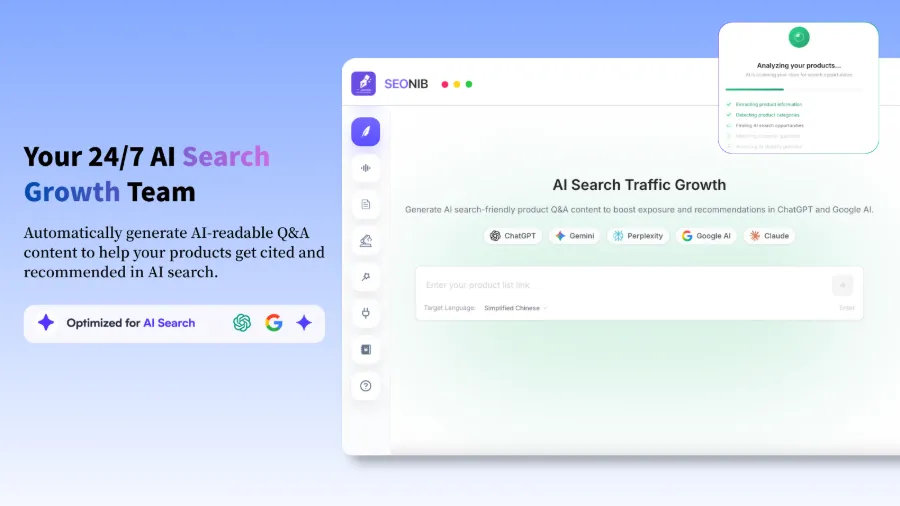
This point also shows up at the tool level. In my research I referenced the SEONIB Feature Overview and Comparison Analysis, whose core content‑generation logic is also built around “citation‑friendliness”—structured, with citation anchors, source‑clear—which aligns with the r = 0.41 direction.
Winners vs. Losers: Direct Comparison Shows Citation Share Is the Only Divider
Correlation numbers illustrate a trend, but the quartile comparison turns that trend into concrete behavioral differences.
Among the top growers—the top 25 % of brands with the fastest AI visibility gains—60 % increased their citation share over the four months. Among the bottom decliners, only 26 % increased their citation share. The average citation‑share change for growers was +1.55 percentage points, versus –1.66 percentage points for decliners—a completely opposite direction.
A more intuitive way to put it: brands that increased citation share were 2.3 times more likely to be top growers than those that didn’t.
| Metric | Top Growers | Bottom Decliners |
|---|---|---|
| Proportion that increased citation share | 60 % | 26 % |
| Average citation‑share change | +1.55 pp | –1.66 pp |
| Relative probability of becoming a top grower | 2.3× | — |
What does this table tell you? If your citation share is rising, you’re more likely to become a top grower; if it’s falling, your performance aligns with the bottom segment. This isn’t a subtle correlation—it’s a signal with real value.
While tracking how growers operate, I saw a concrete case: Seonib Integrates with Veonib for Native Video‑Blog SEO Loops. They automatically convert video content into blog posts and sync distribution, expanding the reach of AI citations. Growers generally distribute across multiple platforms rather than staying confined to a single content channel.
The demo shows how a product link can be turned into AEO content with one click; the core logic is to increase the structural friendliness of content for AI citation. Automation here isn’t about replacing thought; it’s about increasing the supply frequency of usable content.
I also observed tool‑level comparisons. If you’re evaluating content‑tool options, the 2026 Top 10 AI Content Marketing Tools lists the pros and cons of current mainstream solutions and can serve as a reference.
Why Sentiment Scores Failed to Predict Visibility Changes
If you think “AI prefers positively reviewed brands” is common sense, the data gives you a chance to reassess.
The average sentiment score for top growers is 70.2; for bottom decliners it’s 70.1—a 0.1‑point difference, essentially within rounding error. The r = 0.04 correlation confirms this: sentiment scores have virtually no substantive link to AI visibility changes.
That doesn’t mean sentiment scores lack value. In the long run, excessive negative descriptions erode brand trust and can affect conversion. But as a core GEO metric, it’s insufficient. You can raise sentiment from 60 to 80, and AI may talk about you more enthusiastically, but the chance of being cited won’t necessarily rise.
You might think that because AI generates answers, it should “prefer” positively described brands. However, the data shows AI’s citation criteria are closer to “this source is verifiable and can support the answer,” not “this brand is spoken of well online.” Citation share reflects the latter—whether your content is treated as a trustworthy source.
Understanding this, it’s worth examining the specific connection method: How to Connect Your Shopify Site to SEONIB—automatically structuring product page content to reduce manual integration hassle, essentially lowering the barrier for citation.
How to Embed a Citation‑Share Strategy into Daily Work
Now that the data is in, here’s the actionable side. Boosting citation share can’t be achieved by simply “writing more articles”; you need to understand the AI citation mechanism and design content accordingly.
Path 1: Create AI‑Citation‑Friendly Content Structures. This sounds abstract but is very concrete: your content needs clear declarative statements, data backing, and original research—AI tends to cite verifiable information over vague opinions. Structured formats (lists, clear sub‑headings, front‑loaded conclusions) also raise citation likelihood.
Path 2: Multi‑Platform Synchronous Distribution. Many brands publish content only on their own blog; if AI doesn’t index that source, the content won’t be cited regardless of quality. Growers typically push the same content across multiple platforms, increasing both exposure and the chance that AI systems, different indexes will hit the content simultaneously.
Implementing automation tools to maintain publishing frequency and quality is a viable solution. Manual daily updates are too costly for most teams, while AI platforms evaluate content freshness and update frequency when judging reliability.
At this stage you can bring in SEONIB as a full workflow: it generates AEO Q&A content and SEO blogs from product links, automatically pushes them to multiple platforms, and keeps them updated. The value lies not in word count but in standardized structure, citation‑friendliness, continuous publishing, and cross‑platform sync.
For cross‑border merchants, multilingual content is also a lever for citation share. Single‑language content can only be cited by AI answers in that language, whereas multilingual coverage expands citation opportunities across markets. SEONIB supports content generation in 40+ languages—configure once, and it scales automatically.
Automation is truly useful; the SEONIB Help Center compiles all operational details you need as an implementation manual.
Further information about SEONIB’s multilingual capabilities and batch production features can free you from manual upkeep and let you focus on content strategy itself.
FAQ
Does the correlation between citation share and AI visibility imply causation?
No. A correlation of r = 0.41 indicates a co‑movement trend but not causality. Increasing citation share may coincide with other factors—higher content quality, more frequent updates, broader platform coverage—that together drive visibility growth. Using citation share as a diagnostic metric rather than a direct action target is more sensible.
How can I measure my brand’s citation share?
There’s no single standard tool yet. One approach is to use media‑monitoring platforms like Brand24 or Mention to track AI‑search citations of your domain and calculate the proportion against total mentions. Another is to leverage built‑in analytics of AI‑search platforms—some already provide source‑citation reports. Manual sampling works too, but you need at least 300–500 AI answers per month to keep noise low.
Are sentiment scores completely useless?
Not completely; they’re just not predictive of AI visibility growth. Sentiment remains an important brand‑health metric—persistent negative mentions erode long‑term trust. However, if you treat sentiment optimization as the core lever for AI search ranking, the data doesn’t support that assumption. Sentiment is a brand moat, not a growth engine.
Share Article