
The Deployment of Edge‑Side Large Models Means the Traffic Logic of Overseas Content Marketing Must Be Rewritten

Last autumn, I took over a content review for an independent site. The data in Google Search Console looked impressive—core keyword rankings stayed in the top three on the first page, and the organic traffic curve was almost a straight line. However, the sales team reported that inquiries and conversions had shown no improvement for two consecutive quarters. The data from the two sides didn’t match; the problem wasn’t the ranking, but the stage after traffic arrived.
Later, when reviewing user research records, I realized that a considerable portion of existing customers, before repurchasing, would directly ask the AI assistant on their phone, “How does this brand compare to X?” These edge‑side large models perform inference locally and do not perform a web search when providing an answer. In other words, our content never enters the context they cite. The ranking remains, but the place where decisions are made has changed.
When information retrieval shifts from “cloud‑side” to “edge‑side inference,” SEO‑centric content marketing must be recalibrated.
Edge‑Side Large Models: Search and Decision‑Making Now Occur on User Devices
An edge‑side large model refers to an LLM that runs directly on a phone or PC locally, completing inference without an internet connection. The difference from cloud‑based calls is not just the deployment location but a reversal of the entire information‑processing chain. Cloud models must first fetch webpages and build an index before generating an answer on a server; edge models compress knowledge into local parameters, performing inference on the device when a user asks a question, dramatically reducing network requests.
This architectural difference directly changes the fundamental question of “who reads the content.” Traditional SEO logic aims to have webpages indexed and ranked by search engines, but edge models do not necessarily rely on webpage retrieval. They tend to draw information from local knowledge bases, structured data, and predefined entity relationships. Even a deeply written long article, if it lacks a clear Q&A structure and entity annotations, will not be treated as a citable source by an edge model during local inference.
Privacy and low latency are the two prerequisites for user acceptance of edge inference. Data stays on the device, response speed is faster, but the cost is that brand content finds it harder to enter the AI’s “answer context”—you cannot force a local model to cite your webpage by improving its ranking.
Industry observations note that 73% of search behavior occurs outside Google. In edge scenarios, this proportion will only increase, because offline or local decisions do not generate traceable search requests.
| Comparison Dimension | Cloud Large Model | Edge Large Model |
|---|---|---|
| Runtime Location | Data center servers | Phone, PC locally |
| Network Dependency | Strong reliance on network requests | Weak reliance, can run offline |
| Data Privacy | Data must be uploaded for processing | Data stays on device |
| Content Access Method | Webpage crawling and indexing | Local knowledge base and structured data |
For overseas brands, this means that the old workflow of “write good articles, wait for indexing, wait for ranking” may never be triggered at all in edge scenarios.
Consumers’ Decision Paths Have Changed: Traffic Sources Are No Longer Just Search Engines
Consumers’ decision paths have already spread to TikTok, Reddit, ChatGPT, and the AI assistants built into phones. Edge models make this trend even more pronounced—users can obtain locally inferred recommendations on the subway, on a plane, or in areas with poor signal.
In overseas scenarios, product selection and price‑comparison activities increasingly occur in tools like the Accio product research ecosystem and various AI Q&A platforms. The gap between traditional search exposure and the final purchase has widened. A consumer may see your brand on Google, then turn to an AI assistant and ask “How is the quality of this brand?” and that answer may not contain any of your webpage content.
Edge models also make localized recommendations based on user profiles. They know the user’s location, historical preferences, and device usage habits, so the answers they provide naturally carry personalized tones. Brands need to appear at the “decision point,” not just the “search point.”
This video breaks down the shift “ranking does not equal revenue” in detail, mentioning the Google trap—steady traffic but stagnant conversion—which is exactly the stage many independent sites are experiencing. You are optimizing for visibility, but consumers are already making decisions elsewhere.
For independent site operators, the most direct result is the “Google trap”: rankings stay, traffic doesn’t drop, but conversions won’t rise. Because the webpage content never enters the edge model’s answer context, exposure becomes a one‑way monologue.
Three Real Challenges for Overseas Content Marketing
After edge models are deployed, overseas content marketing faces three concrete challenges, each directly affecting traffic outcomes.
Content discoverability is decreasing. Edge models do not rely on webpage retrieval, so traditionally SEO‑ranked content is almost “invisible” to AI assistants. An article you spent three months getting to the top of the homepage may not even be a candidate in edge inference.
Content structure is mismatched. Content lacking a Q&A or knowledge‑base structure is hard for edge models to cite directly. Long paragraphs, prose‑style narratives, and articles without entity annotations are difficult to break down into usable knowledge units in local inference scenarios. When planning for AI search traffic, prioritize improving page structure; you can follow the comprehensive steps for checking page SEO optimization to audit each item.
The organizational bottleneck of continuous production is equally tricky. Multilingual content must maintain a consistent update frequency, yet most teams can’t even guarantee weekly updates in a single language. In edge scenarios, the loss from content gaps is harder to track—during the cloud‑retrieval era, a gap would at least be observable through a drop in rankings; edge models directly cite older knowledge bases, so the consequences of a gap may not appear for months.
Building topical authority relies on continuous output, which in turn depends on content calendars and topic‑selection mechanisms. In most overseas teams, these two things are held up manually.
Adjusting Content Strategy: Make Content Findable Both in the Cloud and on the Edge
In face of these changes, content strategy must shift from “writing articles” to “building a knowledge base.” Organize content with Q&A structures, entity relationships, and brand context so that the same piece can serve both web retrieval and be directly cited by edge models. This is not an either/or choice; both traffic sources must be covered.
Pre‑planning topics is the foundation for maintaining topical authority. Use trend tracking and a topic pool to ensure multilingual content is continuously refreshed, rather than waiting for inspiration. The tool ecosystem has shifted from simple writing assistance to end‑to‑end automation; most products listed in the Top 10 AI Content Marketing Tools of 2026 address “continuous output” rather than “writing a single piece.”
Turning product pages and social media posts into structured articles is a pragmatic way to reduce content production costs. Product links already contain a wealth of usable information; converting them into blogs can cover multilingual markets and sync across platforms. The detailed workflow can be found in the Product Link to Blog conversion tutorial.
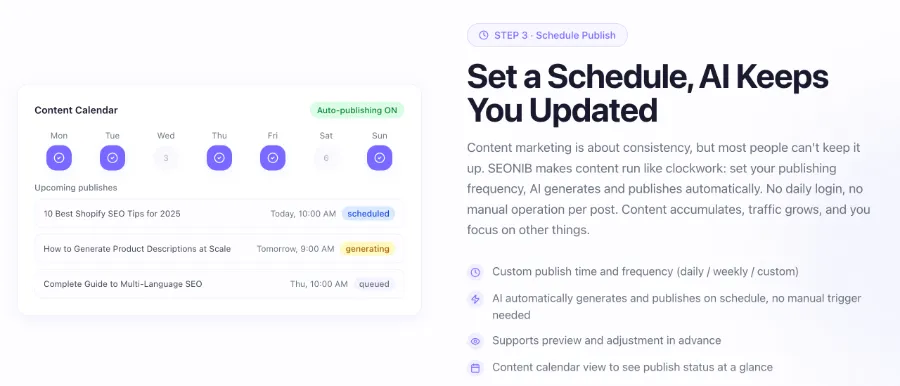
In the publishing stage, automated pipelines like SEONIB handle repetitive manual publishing tasks—automatic topic pool updates, content generation, scheduled publishing, and multi‑platform sync—compressing what used to require daily logins to each backend into a single configuration. The saved time can be devoted to strategic decisions rather than copy‑pasting.
The content generation capability supports 40 languages, meaning overseas brands no longer need to hire local writers one by one to cover multilingual markets. A single publish automatically syncs to multiple platforms, eliminating the repetitive task of logging into each backend; SEONIB addresses the maintenance workload in this workflow.
When automating content around the new tool ecosystem, a pragmatic approach is to launch first and then validate the strategy. Instead of spending months planning a perfect solution, use the quick project idea validation method to run a minimal workflow, then adjust based on the data.
Specific configuration parameters, platform integration methods, and scheduling rules for the automated pipeline can be set item by item by referring to the SEONIB help documentation. The documentation provides detailed parameter explanations for multi‑platform sync and scheduled publishing, which the team can follow directly.
FAQ
After edge‑side large models are deployed, does traditional SEO ranking still matter?
Yes, but its scope is narrowing. Traditional SEO ranking still influences traffic from Google and other cloud search engines, but its share in the overall decision path is decreasing. Edge models do not rely on webpage retrieval, so ranked content is essentially invisible to local inference. Treat SEO as a foundational layer while also adding AEO and knowledge‑base‑structured content.
What existing content structures do overseas sellers need to modify to fit AI Q&A?
Prioritize three areas: Q&A structure, entity annotations, and brand context. Break long articles into a “question + direct answer + supplemental explanation” format, clearly tag entities such as brand names, product names, and industry terms, and maintain consistent brand descriptions throughout the content. The changes are modest but can significantly increase the likelihood of edge models citing the content.
Will edge models completely replace search engines as the sole traffic source?
Not in the short term. Edge models still rely on cloud retrieval for complex queries, long‑tail information, and real‑time data, so the two will coexist for a long time. However, decision‑type queries—such as product selection, price comparison, and brand comparison—are rapidly moving to AI assistants and edge devices. Overseas brands need to cover both pathways.
Is multilingual content more important in edge scenarios than before?
Yes. Edge models typically infer based on the user’s local language and local knowledge base; English content is rarely cited in non‑English markets. Multilingual content is no longer a “nice‑to‑have” but a prerequisite for entering the answer context of local edge models. Maintaining update frequency across languages is also critical; gaps lead to loss of authority.
How can you maintain continuous AI‑readable content output without a dedicated SEO team?
Break the workflow into automatable steps: topic selection, generation, publishing, and synchronization. Use trend‑tracking tools to automatically push topics, let AI writing tools handle generation, and use automated pipelines for publishing and syncing. Humans only handle review and strategic adjustments. This way, even without a dedicated team, you can sustain a stable output of 2–3 pieces per week.
Share Article