From “AI Writing Articles” to “AI Doing SEO”: How Agents Are Changing Content Marketing
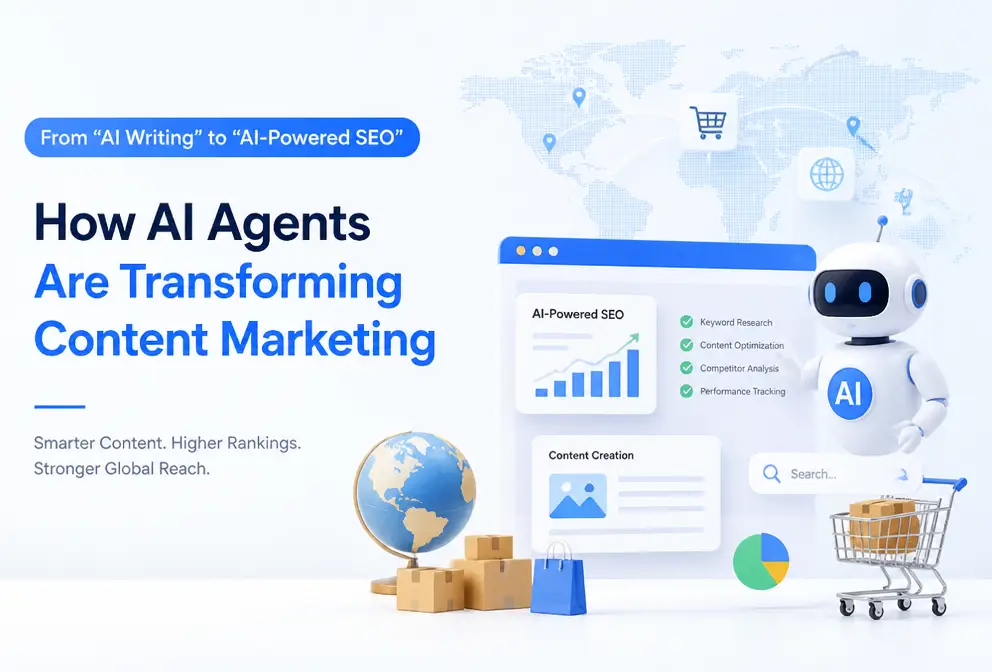
When a cross‑border e‑commerce team releases multilingual product content, it’s not as simple as opening a chat window and typing a prompt. Topic selection must consider trends and keywords, the article must match the search intent of different markets, and then you still need to add meta titles, meta descriptions, image alt text, internal links, and finally publish on Shopify, WordPress, or Shopline. The real bottleneck for teams is often the series of steps that follow writing.
An AI writer mainly delivers a block of text, while an AI SEO Agent attempts to execute the full workflow from search judgment and content generation to publishing and maintenance. It can reduce repetitive tasks, but it cannot decide business goals for the team, nor replace fact‑checking, brand‑tone review, and risk management.
For cross‑border e‑commerce, the impact of an AI SEO Agent is not just “articles are written faster,” but that a single content task is broken into executable, traceable steps. However, automation also amplifies the speed at which errors spread, and manual checkpoints do not disappear.
What AI Writing Solved, and What It Left Behind
Traditional AI writing tools have done a great job with drafting, rewriting, expanding, and translating. Operators provide product features, keywords, and a rough structure, and within minutes they get an editable first draft. The problem is that a draft is not the same as a completed SEO content task.
A content pipeline can be split into four consecutive stages: trend discovery, content generation, scheduled publishing, and multi‑platform synchronization. AI writing tools usually focus on the second stage; the preceding topic selection, keyword volume verification, search‑intent matching, meta‑info filling, image processing, and post‑publish maintenance still require humans to switch between different back‑ends.
Take an outdoor lighting product aimed at the U.S. market as an example. The team might first write a buying guide, then an installation tutorial, and finally a comparison review. The search intent for these three article types differs, and product links, specifications, applicable scenarios, and conversion points cannot be copied verbatim. For German or Japanese sites, the same set of content must be re‑processed for language, units, compliance wording, and page structure.
This is the new friction introduced by AI search. Pages must not only contain keywords but also make the relationships among product, usage, scenario, constraints, and related questions clear enough for search systems to extract answers. For organizing Q&A‑style content, see Content Suitable for Conversational Search, but this does not automatically solve indexing and maintenance after publishing.
| Work Dimension | AI Writing Tool | AI SEO Agent |
|---|---|---|
| Topic Selection | Generate direction from prompts | Read trends, keywords, and competitor gaps |
| Content Generation | Draft, rewrite, translate | Convert multiple sources into content tasks and generate |
| SEO Processing | Rely on manual addition of meta fields | Batch‑process meta info, alt text, and structure |
| Publishing | Manual copy‑paste into CMS | Call platforms or APIs according to schedule |
| Maintenance | Usually not responsible for follow‑up | Track publishing, indexing, and performance feedback |
Thus, smoother grammar is only the starting point. The judgments that ordinary writing tools do not take over are “Is this content worth publishing?”, “Which market should it go to?”, and “Is it being understood correctly after publishing?”
Agent Turns SEO from a Writing Action into an Execution Loop
Typical chat‑style AI waits for a question and then returns an answer. An AI Agent must read context, call tools, execute steps, and continue based on the previous result. For example, it can first examine a product page and keywords, then create a task, write the page, add SEO fields, call the CMS API to publish, and finally log the outcome.
A usable content loop looks roughly like “Discover → Judge → Generate → Publish → Feedback.” In the discovery stage, it reads industry trends, competitor content gaps, and keyword search volume; in the judgment stage, it selects market, page type, and search intent; in the generation stage, it turns at least five source types—product links, keywords, social content, trends, and reference links—into content tasks.
After publishing, the Agent also handles content calendars, scheduling status, and platform responses. Indexing status, ranking performance, click‑through rate, and conversion data flow back into the next round of topic selection. Automatic generation without a feedback loop only creates pages that need to be checked, without forming a content‑operation system.
Many teams use “human‑like writing” as a quality benchmark, but that’s insufficient for SEO. Content must also cover entity relationships, build topical authority, follow entity‑SEO and AEO structures, and be accurately cited by AI search. Improvements in search visibility are not immediate after generation; indexing and display data in Google Search Console often require crawling, processing, and accumulation.
Some case studies attribute natural search traffic to a single article, but the effect of one piece of content is hard to separate from site architecture, internal linking, and publishing timing. A case like Blog Generates Search Traffic can serve as an observation point, but it cannot be used directly as a predictive model for every site.
A counter‑intuitive change is that the bottleneck for AI SEO is often not “can’t write,” but that the team lacks sufficient criteria to decide which content is worth publishing. Going from 2 articles per day to 20 does not guarantee a ten‑fold increase in natural search traffic; if topics misalign with product demand, the extra pages may simply be low‑value.
The First Friction Felt by Cross‑Border E‑Commerce Is Scale
When a cross‑border e‑commerce site expands, repetitive work spreads from language to platform level. A multilingual product catalog may exist simultaneously across multiple country sites, and the content team must update titles, descriptions, images, product links, and category fields in Shopify, Shopline, and WordPress. Field naming, rich‑text rules, permission settings, and image‑handling methods differ across CMSs.
When synchronizing across more than ten platforms, a single generation does not mean a single configuration. One platform may accept HTML snippets, another only retains partial formatting; one platform auto‑processes images, another requires manual alt‑text entry; a webhook success does not guarantee the page is publicly visible, nor that the search engine has indexed it.
A few weeks ago, a content team relied on automatic bulk generation and multi‑platform publishing without setting up fact‑checking, link verification, or indexing monitoring. About two weeks after launch, they discovered that a batch of articles still referenced discontinued products, and some pages had purchase buttons pointing to dead links. Because the same configuration had been synced to multiple sites, troubleshooting went from a single‑page issue to a massive search‑log review, taking nearly three workdays to fix and roll back.
The failure did not occur during writing. Grammar, paragraphs, and translations were fine; the errors lay in product status, link validity, and post‑publish checks. Multi‑platform sync reduced copy‑pasting but also allowed a single misconfiguration to affect many sites—an illustration of the trade‑off between automation efficiency and error‑propagation risk.
In practice, a product link can first become a buying guide, then an installation tutorial, a comparison guide, or a post‑sale troubleshooting article. Different pages serve different search intents; you can’t just swap a title for a product description. Before topic selection, teams usually conduct a quick validation of product search demand (https://seonib.com/cdn/paa/how-to-validate-product-search-demand-fast-seonib-method) to confirm whether users are looking for buying advice, specification answers, or are close to checkout.
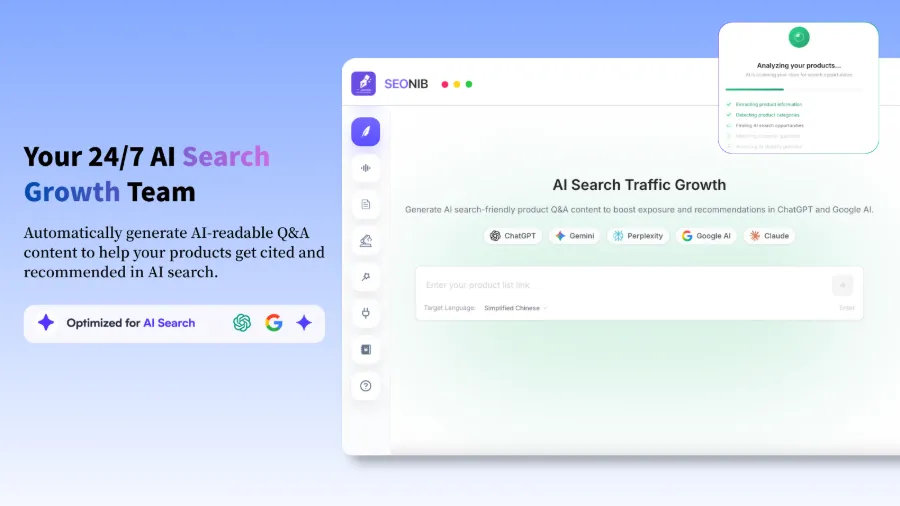
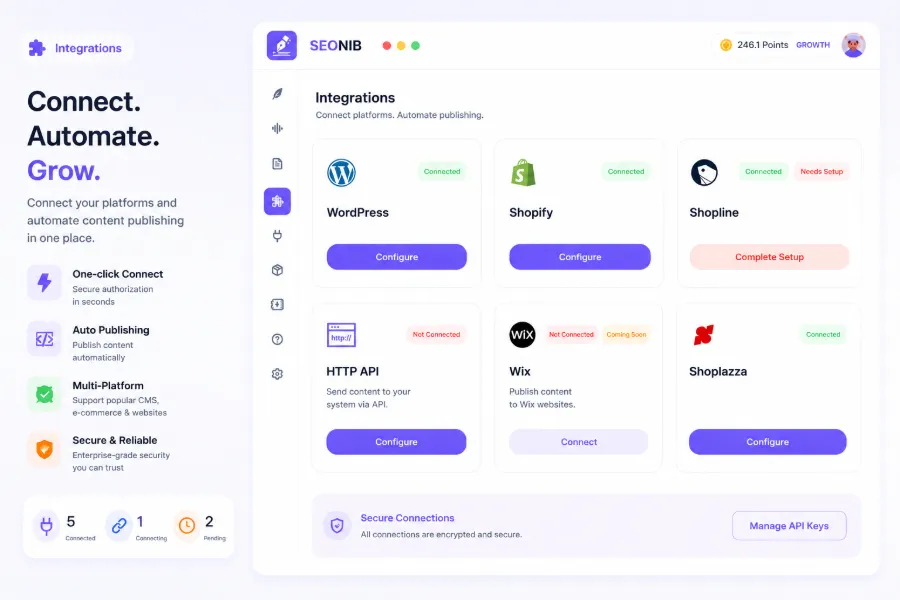
In this scenario where platform sync, scheduling, and maintenance become repetitive tasks, SEONIB’s workflows turn product links, keywords, or trends into article tasks, generate content in 40 languages, and push them to Shopify, WordPress, Shopline, etc., according to settings. The challenge for teams is not just integration but confirming field mapping, permission scopes, and retry rules for each platform.
Before deployment, don’t just look for a green “Connect” button. Determine which pages allow automatic publishing, which fields must be manually overridden, whether a webhook failure triggers page recreation, and how images and canonical tags are handled—these should be written into the configuration boundary. Platform differences can be verified via the Content Publishing and Configuration Help, especially for permissions and publish status, which are not obvious from article previews.
AI Doing SEO Does Not Mean SEO Can Be Unattended
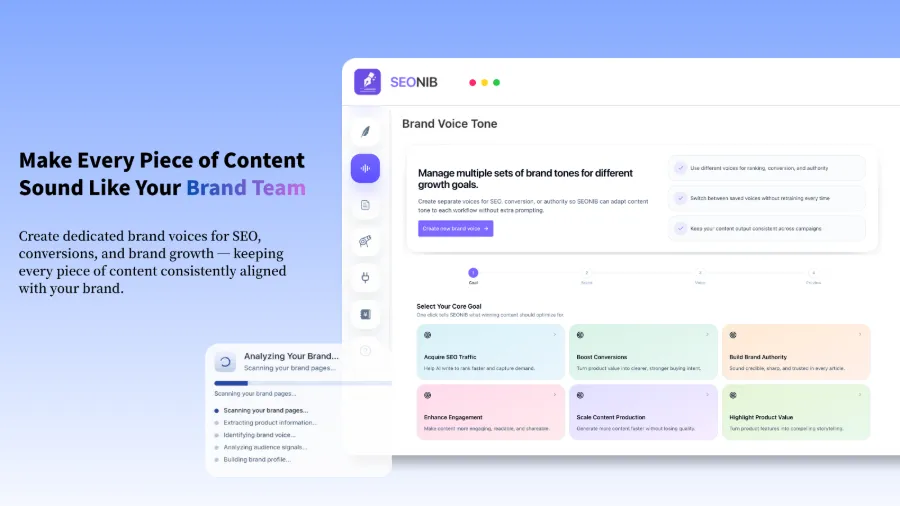
Agents can automate, but they cannot replace business goals, brand voice, fact‑checking, and market priorities. A product that is out of stock may still be flagged by the system as suitable for a buying guide; a specification sold only in the UK may be translated and appear on a U.S. site. Content quality is not a simple sum of word count, keyword density, or fluency.
Automation most easily creates the illusion that “the page is published, so the job is done.” In reality, publishing success, index coverage, search display, and conversion generation four distinct states. The page indexing report in Google Search Console may lag behind CMS publish records, and a drop in click‑through rate could stem from a title change rather than article quality.
Teams should retain three categories of checks:
- Fact & Product Information: Price, stock, specs, applicable market, and product link validity.
- Page SEO Elements: Meta title, meta description, image alt text, canonical tag, and structured data alignment with page intent.
- Publish & Index Status: CMS response, public status, index coverage, click‑through rate, and conversion rate consistency.
During the early phase of bulk content rollout, manual sampling should not only pick the best‑written pages. A more effective approach is to sample by language, platform, content type, and publishing batch, checking edge cases. When the number of pages grows from 20 to 200, reading each page manually becomes unrealistic, but not sampling at all lets errors go unnoticed until natural traffic drops.
For page‑level checks, teams can use the Page SEO Optimizer as a verification path, focusing on the actual output rather than just the preview in the generator. Another often‑overlooked area is link attribution: when the same product link appears on two platforms, UTM parameters, redirect rules, and conversion attribution may differ. Processes like One Product Link Across Two Platforms need validation before launch.
The tasks best suited for an Agent are repetitive and rule‑clear operations, such as topic organization, page structuring, filling meta information, writing image captions, scheduling, and syncing. The least suitable are positioning, priority judgment, and accountability. Error‑propagation speed and execution speed both increase together, making publishing logs, sampling checks, and rollback mechanisms more important than simply increasing output volume.
From Content Team to Content System: Which Step to Change First
When moving from a single‑article pilot to a continuous content pipeline, it’s unwise to start with “integrate every platform.” A more prudent approach is to first define search topics, then limit usable data sources, and finally connect publishing channels. This way, if an automated task fails, you can pinpoint whether the issue lies in demand validation, content generation, or platform publishing.
Topic organization, page structure, meta information, image captions, scheduling, and cross‑platform sync are generally more suitable for early automation than commercial positioning. Teams can start with one market, one content type, and one CMS, observe for a week or two, then gradually add other languages and sites. Integrating all platforms at once may save time on paper but will cause field errors, permission issues, and duplicate content to appear simultaneously, making troubleshooting difficult.
A content calendar should record not only the publish date but also the topic source, target market, content type, owner, and current status. Publishing logs must retain page URLs, platform responses, update timestamps, and failure reasons. Conduct a weekly review of content performance, tracking at least topic selection, publishing, indexing, and conversion stages, to know where natural traffic changes occur.
The work change brought by AI SEO is not about generating more text each day, but about reducing the gaps between search‑demand judgment and post‑publish maintenance. Content teams still need to decide what to write, for whom, based on which facts, and when to stop automatic publishing. Agents can straighten the execution chain, but whether a content system can run long‑term depends on whether those judgments are recorded, reviewed, and continuously refined.
FAQ
What is the core difference between AI writing tools and AI SEO Agents?
The core difference lies in the scope of work: AI writing tools mainly generate text, while AI SEO Agents also read context, invoke tools, and execute subsequent steps. The former may deliver a draft in minutes; the latter must continue handling topic selection, SEO fields, scheduling, publishing, and feedback.
Can an AI SEO Agent completely replace SEO personnel?
No. The Agent can handle clearly defined repetitive tasks, but business goals, brand voice, fact‑checking, and market priorities still require human judgment; the first two weeks after launch should especially monitor indexing coverage, click‑through rate, and conversion changes.
Why are cross‑border e‑commerce sites more susceptible to content automation impacts?
Because they deal with multiple languages, country sites, and CMSs, product information must be repeatedly transformed and published. A single field or link misconfiguration can affect ten or more platforms in one sync, and troubleshooting costs rise with page count.
When using an Agent for bulk content publishing, which issues need the most checking?
The three main categories are product facts, page SEO elements, and publishing/index status. After publishing, don’t just look at CMS success; within 24 hours to a few days, sample pages for public status, links, indexing, and search performance.
How can AI‑generated content balance search traffic and brand voice?
First, lock down product facts, terminology, prohibited expressions, and target markets, then let the Agent handle structured generation and scheduling. After publishing, sample by language and content type for review, and feed click‑through rates, conversion rates, and customer feedback back into the next round of topic selection.
Share Article