From Product Links to Search Traffic: How an AI Agent Automates the Entire Content Chain

Cross‑border e‑commerce teams often receive a batch of product links, then have to manually look up keywords, decide topics, write blogs, add meta tags, upload images, and finally log into Shopify or WordPress to check publishing status. The real bottleneck is usually not the writing itself, but that these steps are not connected: product information stays on the product page, search demand lives in a spreadsheet, and publishing results are scattered across different back‑ends.
The value of an AI Agent is not just generating a piece of text; it parses a product link into a product entity, user questions, and search intent, then sequentially handles topic selection, content generation, SEO checking, scheduling, multi‑platform publishing, and performance review. It can reduce copy‑pasting and repeated logins, but it cannot replace the team’s verification of price, inventory, regulations, and product facts.
Starting Point of the AI Agent Content Chain: First Understand the Product and Search Demand
A product link is an input, not the search demand itself. From a product page you can usually extract product use cases, main selling points, target audience, usage scenarios, specifications, and the questions users might have before purchase, such as installation difficulty, compatibility, shipping restrictions, after‑sales scope, or usage cost.
If the Agent only rephrases the product description, the output will likely still be a longer product page. A workable process first extracts the product entity and attributes, then matches them with keyword search volume, industry trends, and competitor content gaps to determine whether the user is looking for a buying guide, a usage solution, or a product comparison. Only then can the generated content have a chance to build topical authority rather than adding another page of duplicate copy.
This is the difference between turning a product page into an article, a keyword into an article, and a trend into an article. Product pages are suitable for concrete buying guides, usage tutorials, and scenario introductions; keywords are better for explanatory articles with clear search phrasing; trends suit timely industry observations but require extra verification that the trend is relevant to the target market and inventory. Search intent cannot be automatically inferred from the link alone.
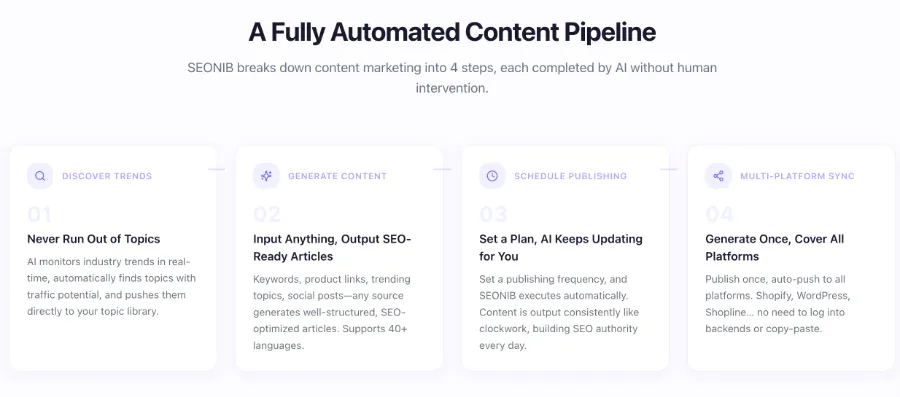
The complete chain can be broken into four stages: trend discovery, content generation, scheduling, and multi‑platform synchronization. The automation boundary differs for each stage, and “automatic writing” should not be called “automatic operation”.
| Stage | AI Agent Tasks | Human Confirmation Needed | Main Risks |
|---|---|---|---|
| Trend discovery | Analyze keywords, trends, and competitor gaps | Market, inventory, product facts | Topic misaligned with business |
| Content generation | Extract entities, organize structure, add SEO fields | Tone, parameters, compliance info | Factual errors or duplication |
| SEO check | Review title, meta tags, alt text, links | Search intent and page relevance | Over‑optimization |
| Publishing sync | Scheduling, platform push, status logging | Preview, permissions, URL rules | Truncation, duplicate publishing, failures |
Human review is best placed at the topic selection and fact‑verification stages, not after the whole article is generated. Prices, inventory, target countries, certifications, and shipping policies change; the Agent can bring them into the draft but should not present uncertain information as definitive conclusions. For how content can support AEO, see the AEO content support guide, but the AEO structure must still be built on real questions and verifiable entities.
Some teams have recorded the process of gaining search traffic from blogs and noticed an uncomfortable fact: increasing the number of posts does not equal a synchronous increase in search traffic. Similar blog search traffic case studies are better suited for observing process metrics rather than promising traffic for any product.
How a Product Link Is Turned into Searchable, Readable Content
In practice, the workflow usually starts by entering a product link. The system first reads the product page’s title, description, specifications, images, and structured fields, extracts brand, category, function, material, size, target audience, and other entities and attributes, then recombines this information with keywords and reader questions. At this point, navigation elements, comment‑section noise, and expired promotional info must be filtered out.
At this stage, content‑automation tools like SEONIB place the product link into the content generation pipeline instead of just providing a chat box for operators to copy the product description. It can convert the input into a buying guide, tutorial, comparison article, FAQ, or scenario‑based content, and then hand it to a human to confirm which search intent the article serves.
A single product link can generate multiple article types, but that does not mean all types should be produced at once. A product for outdoor lighting might correspond to a “how to choose a camping lamp” buying guide or a “how to extend a camping lamp’s battery life” tutorial; the former serves comparison and purchase, the latter serves usage issues. If both articles repeatedly stack the same set of selling points, they will end up as near‑duplicate content.
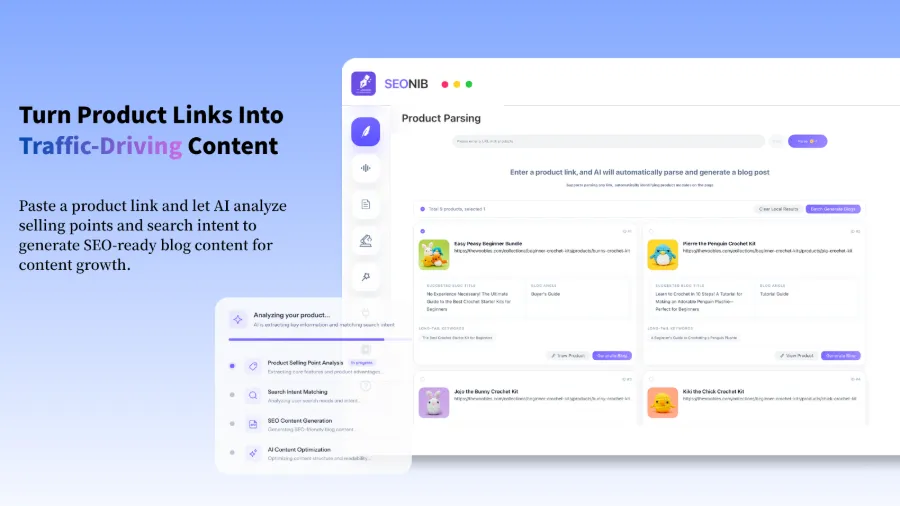
A practical processing sequence usually looks like this:
- Enter the product link, extract product entities, attributes, and verifiable facts.
- Determine a single primary intent based on keywords, trends, and reader questions.
- Generate the article outline, then add product cards, internal links, and Q&A.
- Check title hierarchy, meta tags, image alt text, keyword distribution, and publishing fields.
When generating an article, SEO basics should not focus solely on keyword frequency. Title hierarchy must reflect reading structure, meta tags should accurately describe the page, image alt text must explain the image content, and internal links should help readers continue solving their problems. For AEO, Q&A sections should not merely turn keywords into questions; answers must directly address constraints, usage scenarios, and selection criteria.
A multilingual workflow further splits the review work. The content generation process can support 40 languages, but language switching is more than translation: imperial vs. metric units, regulatory phrasing, product category terminology, currency, return policies, and purchase paths may differ. A “fast delivery” claim that works in the U.S. may not hold in Europe; machine translation may preserve sentences but alter commercial meaning.
Therefore, language review must check at least three layers: product fact consistency, market‑specific expression naturalness, and completeness of publishing platform fields. Content cards, titles, and meta tags often get lost during synchronization, especially because different CMSs handle character limits and HTML fields inconsistently. For examples of converting product Q&A into articles, see the product Q&A content generation sample.
From Generation to Publishing: Scheduling, Platform Sync, and Content Quality Control
After an article is generated, it should not immediately enter the publishing queue. A practical inspection order starts with factual accuracy, then checks search intent, duplicate content, link viability, images, meta information, and platform fields. If the order is reversed, teams may spend time fixing formatting only to discover at the end that the article describes a discontinued product as if it were still on sale.
Scheduling and publishing turn one‑off production into a continuous content loop. A content calendar should at least distinguish “awaiting review”, “scheduled”, “published”, and “failed” states, and retain timestamps for each modification. A weekly review of the publishing queue is a low‑frequency operation; if the queue publishes daily but failures are only examined at month‑end, logs will accumulate a batch of untraceable issues.
Multi‑platform sync may look like a simple reduction of logins and copy‑pasting, but platform differences amplify problems. Shopify’s product association fields, WordPress categories and permalinks, Shopline’s image and editor rules may all require different mappings. In theory, one generation can sync to more than ten content or e‑commerce platforms, but the more platforms, the higher the maintenance cost for field mapping, image formats, URL standards, and indexing status.
Common failures include webhook interruptions, API permission loss, duplicate publishing, image upload failures, and content truncation. The most troublesome situation is not a clear error but a successful API response while the backend lacks the full article, or the article is published but its index status isn’t updated. In such cases, the publishing log is not just an auxiliary record but a content‑operation asset: it should at least capture the input link, generated version, target platform, response status, article ID, retry count, and the last error.
A cross‑border team once discovered after about three weeks of continuous publishing that a batch of articles appeared in WordPress but only the titles were synced to Shopify; the body and images were missing. The issue stemmed from a permission update where the webhook returned a failure status, yet the scheduler still marked the task as completed. The team only realized the problem when Google Search Console showed no exposure for the pages and had to manually compare each backend entry. Ultimately they stopped the queue, deleted duplicate drafts, restored old field mappings, and manually republished; during this time some URLs were briefly crawled, causing duplicate content and indexing chaos.
This incident shows that automatic publishing does not eliminate the need for review. There is always a trade‑off between publishing speed and content credibility: low‑risk tutorials can be auto‑scheduled, while high‑risk price, regulation, medical, or compatibility information should retain human approval. SEONIB in such a workflow acts more like a connector that strings together generation, scheduling, and pushing actions, but permissions, rollbacks, and failure retries still need to be defined by the team.
Before platform sync, content owners should embed failure handling into operating procedures and keep a revertible article version. Publishing help documents can serve as a content publishing reference, rather than being consulted only after an API error occurs. For real‑world examples of product‑page‑to‑blog conversion, see the product‑page‑to‑blog case study to observe which manual judgments remain between generated content and publishing actions.
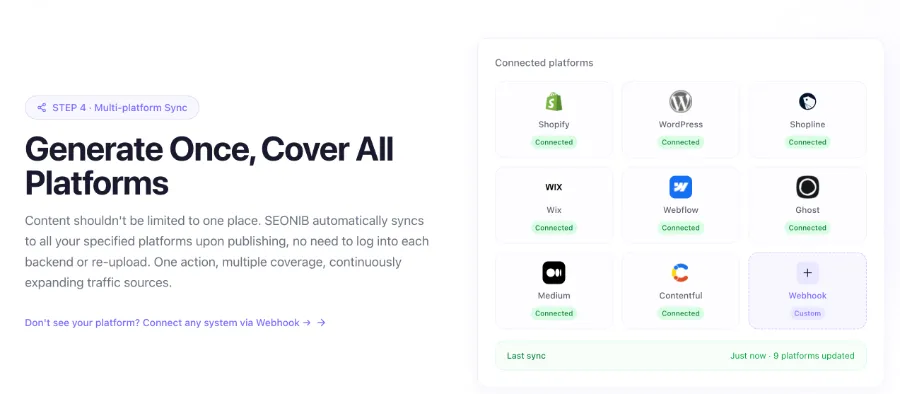
When content needs to be sent simultaneously to Shopify, WordPress, and Shopline, the “published” status in the content calendar should only indicate task completion, not that every platform succeeded. Platform response codes, article IDs, and indexing status should be recorded separately; otherwise a failure on one platform can be hidden by an overall “success” status. Multi‑platform coverage expands reach but also expands the troubleshooting surface; this trade‑off does not disappear when using an Agent.
Search Traffic Is Not “Publish and Done”: How to Review the Whole Automated Chain
A review should trace from input all the way to results, not just count how many articles were published this month. Product link quality determines the factual foundation; topic matching determines search demand; article readability determines whether the page can capture visits; indexing determines whether the page enters the search system; exposure, clicks, and conversions reflect final performance.
Process metrics and outcome metrics must be separated. Input source, generation time, review rejection rate, publishing success rate, and retry count belong to process metrics; Search Visibility, organic search traffic, impressions, organic click‑through rate, rankings, product‑page visits, and conversion rates belong to outcome metrics. An increase in publishing volume with a drop in indexing rate is usually not a content‑production issue; a normal click‑through rate but very few product‑page visits more likely indicates a broken hand‑off path in the article.
At least a weekly review of the publishing queue should record for each article the input source, publish time, indexing status, and search performance changes. Google Search Console’s impressions and clicks can be cross‑checked with internal analytics on product‑page visits, dwell time, and conversion paths; if needed, Ahrefs or Semrush can be used to examine ranking changes. Google’s indexing is not instantaneous after publishing; a page may have no impressions for a few days without implying no demand, but if weeks pass without indexing, check canonical links, internal links, sitemaps, and page quality.
Low traffic can stem from several distinct reasons. The keyword may simply lack sufficient demand, so even a well‑written article gets little exposure; a page not indexed makes body optimization pointless; the article may answer a purchase question while the title reads like a tutorial, indicating a mismatch of search intent; broken internal links make it hard for readers and crawlers to continue; insufficient product‑page hand‑off means the article gets traffic but the product page does not. Imbalanced publishing frequency can also cause problems: a burst of similar pages in a short time makes later maintenance and indexing judgments harder.
Some teams, upon seeing a ranking drop, immediately rewrite the entire article, unintentionally changing the indexed URL, title, and internal links. A safer approach is to first verify the input, intent, indexing, and hand‑off page, then only modify the parts that show evidence of a problem. For how to keep dynamic page copy consistent across touchpoints, see the dynamic page copy synchronization method, but search content should still be judged based on actual query intent.
The automated chain ultimately forms a “automation → monitoring → correction → republish” loop. Each cycle may yield only partial improvements: a title tweak raises click‑through rate, but product‑page visits stay flat; adding internal links improves indexing, but conversion remains stagnant. Such results do not mean the process failed; they indicate the issue lies elsewhere in the chain.
Deciding whether an AI Agent is worth integrating should not be based solely on how many articles it generates per day. More important are factual error rate, review rejection rate, publishing failure rate, indexing coverage, and the amount of effective product‑page traffic generated by organic search. As long as the team can pause the queue, trace logs, roll back versions, and keep human checkpoints for high‑risk information, automation will not amplify a small error into a batch‑wide problem.
FAQ
Can the AI Agent generate a search‑engine‑friendly article from just a single product link?
It can produce a draft, but it cannot guarantee search suitability based on the link alone. The system also needs keywords, user questions, and market information; before publishing, product facts, search intent, and meta data must be verified, and indexing changes should be observed for several days to weeks.
When turning a product page into a blog, how can we avoid the article becoming duplicate product description?
First, define a clear question for the article, then limit the repetition of product selling points. Buying guides, usage tutorials, and comparison content should each answer selection, operation, and differentiation questions respectively. After publishing, use duplicate‑paragraph detection and search‑performance reviews to adjust the structure.
Before automatically publishing to multiple e‑commerce platforms, which content must be manually reviewed?
Price, inventory, regulations, compatibility, delivery promises, and product parameters must be manually confirmed. The first sync should also check images, categories, URLs, and field mappings. Continuous publishing should include at least a week of monitoring failure logs and duplicate pages.
If content is published but receives no search traffic, which stage should be checked first?
First verify whether the page is indexed, then check whether keyword demand and search intent match. If Google Search Console shows no impressions, examine canonical links, sitemaps, and internal links; if there are impressions but no clicks, prioritize reviewing the title and snippet.
In cross‑border e‑commerce multilingual content, how should AI generation and local review be divided?
AI handles initial generation, structural organization, and language conversion; local reviewers handle units, regulations, product terminology, tone, and purchase paths. For each language launch, sample product cards, meta tags, and button copy should be inspected; the body text alone should not be the only focus.
Share Article