Google Antigravity Launch: Which Traditional SEO Actions Have Become Futile?

In November 2025, Google officially opened the Antigravity API to developers, moving proxy‑style search from experimental to production. For operators of cross‑border independent sites, this isn’t a tech news item to watch from the sidelines—rankings that were maintained for months by keyword stuffing and bulk backlink building are now failing to convert into real visits in AI‑driven search results. Search is no longer just a “crawl‑rank” pipeline; it has become a “reason‑aggregate‑cite” process.
This article does not aim to cause panic, nor does it advocate immediately discarding existing strategies. A more practical approach is to break things down item by item: which traditional SEO actions have turned into high‑investment, low‑return activities, which have been reinforced, and how the content production workflow should be adjusted.
What Google Antigravity Really Changes: Search Is No Longer Just “Crawl‑Rank”
The core change of Antigravity is that search shifts from returning a list of links to “proxy reasoning and content aggregation.” When a user asks a question, the system no longer prioritizes showing ten blue links; instead, it directly provides a reasoned conclusion and cites multiple sources within that conclusion. AI Overviews and entity answers further squeeze the space for natural results, turning the search intent from “giving options” into “giving a conclusion.”
This means the way content is consumed has changed. Traditional SEO fought for placement on the SERP, while AI search fights for “being cited.” Whether a page gets cited depends on whether it can provide verifiable entity relationships and structured information for the reasoning process, not on whether it happens to contain a particular keyword.
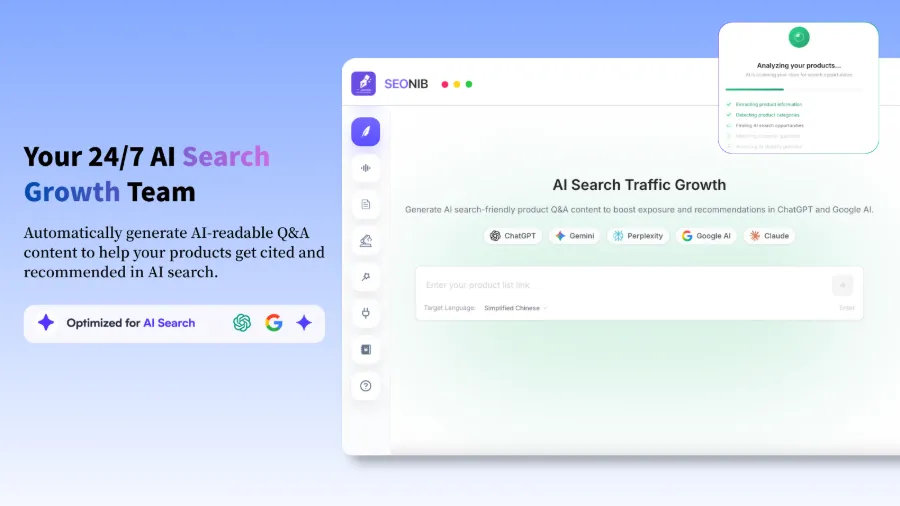
AEO (AI Engine Optimization) is now being mentioned frequently in this context. It focuses not on ranking but on whether the content can be correctly recognized, parsed, and cited by AI search engines. Entity recognition becomes a key step—search engines need to confirm which entities a page is about, the relationships between those entities, and whether the information aligns with other sources.
List of Actions That Are Losing Effectiveness: High‑Investment, Low‑Return Traditional SEO Operations
Some actions didn’t become useless overnight; their ROI has been steadily declining. The table below outlines the real status of four typical actions in the Antigravity era:
| Traditional Action | Value Then | Actual Effect in Antigravity Era |
|---|---|---|
| Keyword density optimization | Determined ranking | Essentially obsolete |
| Bulk backlink acquisition | Quickly boosted authority | No longer translates into AI citations |
| Template‑based titles & descriptions | Increased clicks | Cannot satisfy proxy reasoning |
| Duplicate category pages | Expanded index | Treated as low‑quality noise |
A representative experience from an independent‑site operator: over three months he built大量 low‑quality backlinks and bulk‑produced articles using a keyword‑density strategy. After Antigravity launched, the search exposure of those pages dropped markedly, and natural traffic shrank accordingly. The same strategy still ranks on traditional SERPs, but is completely ignored in AI summaries and proxy answers—high investment turned into low return, with almost no warning.
Exact keyword‑density matching is the first action to become ineffective. AI search understands semantics and no longer relies on term frequency to judge relevance. The problem with massive low‑quality backlinks is even worse: they cannot be turned into AI citations because proxy search validates source credibility, not link count. Titles and descriptions written for spiders rather than users provide no informational gain during reasoning. Fill‑in paragraphs written just to meet word counts and duplicate category pages are directly classified as low‑quality noise.
This does not mean these actions disappear entirely; their ROI simply plummets. The judgment is simple: if an operation’s value depends on “appearing on the SERP,” it has no foothold in AI search. Cross‑border e‑commerce product selection and content‑collaboration platform cases also confirm this—content value increasingly depends on whether it can be understood and cited by other systems, not on how much index space it occupies. To learn how a single system can cover both SEO content and AI‑search scenarios, refer to the usage guide for a system that supports three growth models.
Actions That Have Gained Value: Entities, Authority, and Structured Long‑Term Assets
A class of traditional SEO actions has not only survived but been reinforced. Topical Authority is one example. Antigravity’s answer engine relies on verifiable entity relationships and continuously updated sites, rather than isolated keyword pages. A site that builds comprehensive knowledge coverage around a topic is far more likely to be cited than scattered keyword articles.
Entity and knowledge‑graph construction have become more important than ever. AI search needs to confirm what your brand is, what your product is, and how it relates to other entities. If this information is scattered across disparate pages and inconsistent, the search engine cannot build a reliable entity model. Knowledge bases and structured content play a role here—they enable AI to quickly parse a site’s information architecture.
The value of internal linking is also shifting. Previously, internal links primarily passed authority; now they are crucial for building an entity graph. Through internal links, search engines can understand relationships between pages and assess the depth of a site’s coverage on a given topic. E‑E‑A‑T remains an evaluation standard, but the assessment method has moved from manual review to algorithmic reasoning.
The significance of content update frequency has also changed. Under proxy search, update frequency influences “citation priority” rather than “freshness.” A site that does not update for a long time will be replaced in AI reasoning by more active sources, even if its content quality is good. The cost of not updating is higher than updating slowly— the former means the site gradually “disappears” from AI’s knowledge. To discover a content model that can sustain natural traffic without advertising, see the specific operational paths.
The Next Step for Independent‑Site Content Production: Automate Repetitive Processes
When manual topic selection, rewriting, and multi‑platform publishing dominate most of the time, the bottleneck shifts from writing ability to workflow efficiency. In the AI‑search era, content volume, update frequency, and multi‑platform synchronization become competitive dimensions—sites need to continuously produce new content to maintain citation priority while keeping content consistent across platforms.
Handing repetitive processes over to automation tools is a direct way to reallocate human resources. Tools like SEONIB solve the full pipeline from topic selection to publishing: AI automatically discovers trending topics, generates SEO‑ready articles, publishes them on a set schedule, and syncs to multiple platforms. One set of content generated once can be automatically distributed across all platforms, supporting generation in 40 languages, allowing cross‑border sites to avoid maintaining separate content workflows for each market.
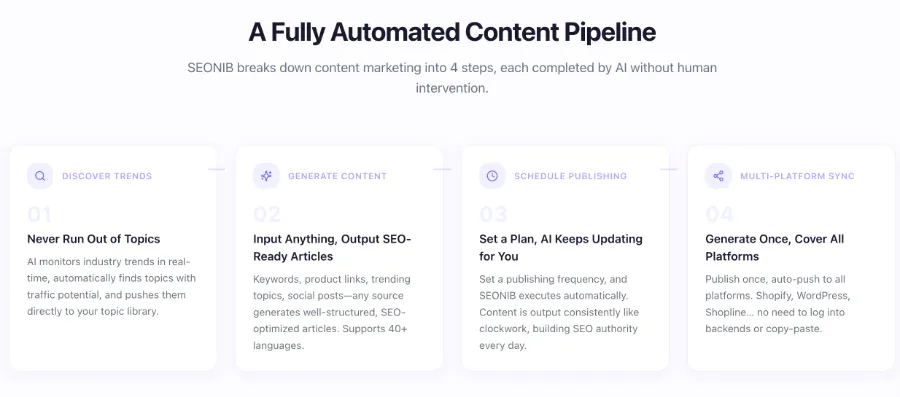
For operators, this means human effort can shift to strategy—analyzing which topics merit deep dives, which content needs manual polishing, and how to build a brand knowledge base. SEONIB’s multi‑platform sync and bulk‑publish capabilities address consistency and update‑frequency challenges. It is already available in the Shoplazza app store, with integration options for Shopify, WordPress, SHOPLINE, and more. Consult the SEONIB help documentation for automatic publishing configuration to quickly assess whether this workflow fits your site. Turning a blog into an automated content factory with bulk‑publish solutions is a path many operators have validated.
For more strategies on growing traffic without ads, see the guide “How to Grow Traffic Without Ads.”
How to Grow Traffic Without Ads
If you want to explore SEONIB’s multi‑mode growth solutions further, read “seonib: One Platform. Three AI Growth Modes. Infinite Possibilities.”
seonib: One Platform. Three AI Growth Modes
External resources such as Accio also offer similar automation solutions worth comparing.
Accio
For detailed operational steps, refer to the official help documentation.
Help Documentation
Automation of content production is not about handing quality over to machines, but about assigning repetitive labor to machines while leaving judgment to humans.
FAQ
Will Google Antigravity make traditional SEO completely obsolete?
No, it won’t be completely obsolete, but it will dramatically alter the ROI. Actions that rely on keyword matching and link quantity will continue to depreciate, while actions centered on entities, authority, and structured content will be reinforced. The criterion is whether your content can be cited by AI search, not just whether it can rank on a SERP.
For industries already covered by AI search, is it still necessary to build backlinks?
Yes, but they must be high‑quality and verifiable. Bulk‑purchased low‑quality backlinks cannot be turned into AI citations because they lack credibility evidence. Valuable backlinks are natural citations from authoritative sites and contextual links that strengthen entity relationships.
Should an independent site prioritize budget for content production or technical optimization?
First address the sustainability of content production, then consider technical optimization. In the AI‑search era, update frequency directly affects citation priority; an unupdated site will be marginalized even if technically perfect. Technical optimization (site speed, structured data, indexing) is foundational, but sustainable content production is the competitive dimension.
How can I tell if my site’s content will be cited by AI search?
Search your covered topics in an AI search engine and see which sources are cited in the answers. If competitors are cited but your site is not, you have gaps in entity relationships or structured information. Another method is to check whether the AI crawler can access your pages and whether the pages provide verifiable data and clear entity descriptions.
Share Article