2026 SEO Core Logic: 18 Practical Points That Determine Traffic Survival
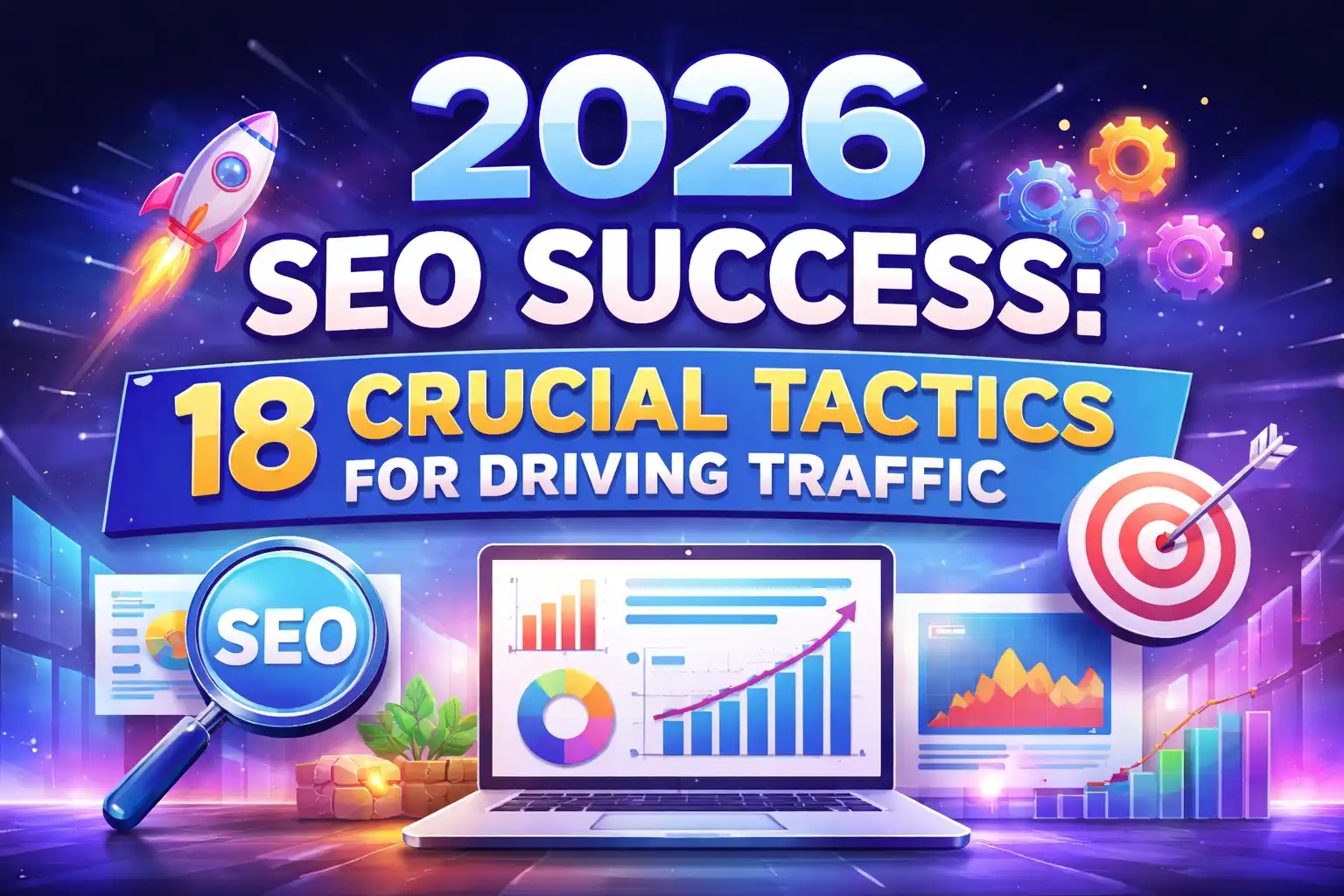
SEO in 2026 has completely changed. Last year you were still studying keyword density and meta description length; this year search engines skip the content summary and feed the answer directly to users. After Google’s core algorithm update in 2026, it directly captured 80% of informational query traffic—those “how to fix,” “what is,” “how much” type questions—so users see the answer at the top of the search results before they even click into your site. Voice search now accounts for over 45% of searches, meaning nearly half of search behavior no longer relies on screen clicks.
For cross‑border sellers, this is not a gradual shift but a sudden cliff. I saw a seller who ran an independent apparel site for three years; in 2025 they still relied on stacking long‑tail keywords and bulk‑generating AI articles to maintain traffic, but after the core algorithm update in January 2026, traffic dropped 60%. It took them a month to discover the reason—search engines no longer rank sites without real operational footprints. In this article I will break down 7 modules and 18 key points, all proven practical methods.
1. Foundational Cognitive Update: 3 Core Logical Changes in 2026 SEO
If you don’t understand what search engines are thinking, all your optimizations may be accelerating in the wrong direction.
The first change is from “keyword matching” to “trust + answer dual‑driven.” Previously, optimizing for “best wireless earphones” meant that as long as the phrase appeared enough times on the page, you had a chance to rank. Now search engines evaluate: does your site have a physical address, authoritative certifications, real customer reviews, and can your content directly answer the user’s question? Trust has become the infrastructure of ranking; without trust assets, even the best technical optimizations are useless.
The second change is AI friendliness as an entry credential. GEO (Generative Engine Optimization) logic is replacing traditional SEO’s core role. Your content must not only be readable by humans but also understood and cited by AI search assistants. When users ask questions on ChatGPT or Perplexity, does your brand information appear in the answer? Is your structured data clear enough for AI to extract key information directly? This is no longer an optional optimization direction but a survival condition.
The third change is a sharp rise in compliance thresholds. The EU Digital Services Act (DSA) has been incorporated into Google’s ranking system. In 2026, cross‑border sellers whose sites lack a clear privacy policy, user data deletion mechanisms, and compliant cookie banners will face display restrictions. Compliance is no longer just a legal issue; it’s an SEO issue.
For basic keyword research methods, see our previous Practical Keyword Research Guide, which details long‑tail keyword mining and search intent matching procedures.
2. Content Strategy: Replace AI Stacking with Real Experience and Multimodal Matrix
The core of 2026 content strategy is a single sentence: search engines can detect whether the content you write is real experience or machine‑assembled.
Pages that include real operational processes, customer problem‑solving records, and market pitfall post‑mortems have an average dwell time 2.3 × that of pure AI‑generated content. This data comes from comparative tests across independent sites in multiple categories; the gap is even larger in high‑barrier B2B fields like mechanical and electronics. When users read “During installation we discovered that the screw hole of model XX was off by 2 mm; we solved it with a spacer,” they know it’s genuine work experience, not copied from an AI template.
That does not mean you should avoid AI entirely. The correct approach is: use AI to generate a structured framework, answer the core question right at the start, then clearly divide sections with H2 and H3 headings, and finally fill in real experience as the body. For example, for the query “industrial robot maintenance cost,” your article should begin with precise numbers—industrial robot maintenance cost mainly consists of parts (40 %), labor (30 %), inspection (20 %), and other expenses (10 %); the exact amount varies widely by model and operating conditions. AI can help write this opening, but the later content such as “We encountered a motor overheating issue in a client’s spray‑painting workshop and spent three days troubleshooting before discovering a clogged cooling pipe” must come from real operational records.
A multimodal content matrix is another mandatory direction. Every core piece should be accompanied by a 2‑3 minute video summary and an audio version optimized for voice search. Product pages should add 3D models for users to rotate and view details. Videos must include second‑accurate transcripts so search engines can understand the video content.
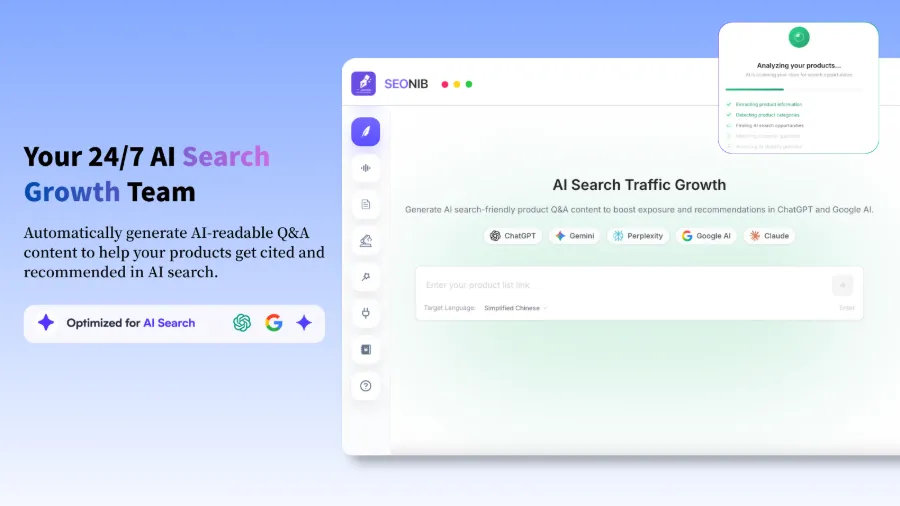
For content production tools, I now use SEONIB to convert product links into SEO blog posts. Just paste a product link, and the system automatically generates buyer guides, tutorial content, and AEO Q&A pages, and can sync them with Shopify, WordPress, and other platforms with one click, eliminating tedious manual copy‑pasting.
For the bulk conversion workflow from product links to blogs, refer to this Turning Product Links into SEO Blogs guide, which includes specific steps for building AEO Q&A pages.
3. Technical Optimization: Load Speed and Structured Markup Set the Ranking Ceiling
Technical optimization has become a hard standard in 2026. No matter how high the content quality, if page load time exceeds 2 seconds, user churn spikes and search engines lower page weight.
Mobile load time must be under 1.8 seconds as a baseline. Common tech stacks include Cloudflare Argo smart routing and WebP or AVIF image compression. An independent C‑electronics accessories site saw a 50 % increase in mobile traffic after implementing these optimizations—no new content was added, just faster loading of existing content.
Structured data markup must cover all core pages. Product pages need price, inventory, and certification markup; FAQ pages add FAQ or QAPage markup; article pages tag author, publish date, and modification date. A medical device independent site saw a 35 % increase in click‑through rate after adding product markup. This boost came not from content quality changes but from search engines being able to display price and certification info directly in results, dramatically increasing user intent to click.
Two easily overlooked mobile details: touch element spacing must be ≥ 48 px (Google’s explicit requirement) to avoid mis‑taps on mobile devices. The above fold must immediately showcase core value—don’t force users to scroll down to learn what your product is. Pages with high bounce rates can consider enabling AMP, which can triple loading speed.
On privacy compliance, cross‑border sellers must focus on GDPR. Cookie banners must be compliant, privacy policies clear and transparent, and a user data deletion mechanism must be provided. Use Google’s DSA compliance detection tool for self‑checks to catch compliance gaps early.
4. Trust Asset Construction: The Hard Currency of 2026 Rankings, 3‑Step Fast Build
With equal content quality, sites with complete trust assets rank 37 % higher. This isn’t an exaggerated figure; it comes from statistical comparisons across multiple industry independent sites.
Step 1: Prove Business Authenticity. The “About Us” page should display real team information, linking founders’ LinkedIn profiles and core members’ years of experience. Physical address must be verifiable; Google Business Profile must pass authenticity verification, and office photos and lease contracts can serve as supporting evidence. Site registration info must match business registration.
Step 2: Product Authority. SGS test reports, ISO certifications, etc., should not be just images, as search engines can’t crawl image content. Convert these certifications into timestamped interactive documents and add verifiable certification number links.
Step 3: Customer Testimonials. Accumulate at least 50 genuine reviews on third‑party platforms like Trustpilot, with a high positive‑review rate. Integrate a review module on product pages and encourage users to upload usage‑scenario videos. This content is not only for potential customers but also for search engines—search engines will crawl it to assess your credibility.
5. Link Building & Brand Operations: From Quantity to Quality, Two Core Directions
Before 2025, many people boosted rankings by buying massive amounts of low‑quality backlinks. In 2026 this method is dead. Search engines now value brand mentions more than sheer backlink count.
Use tools like AuthorityGraph to discover authoritative sites in your industry—association websites, top media outlets, well‑known corporate blogs. Collaborate with them to publish original content or conduct interviews, gaining high‑quality backlinks. These links’ trust signals not only improve rankings but also increase brand appearance in AI‑generated results.
The brand search flywheel is a more efficient strategy. Maintain continuous exposure on LinkedIn, YouTube, etc.; when monthly brand impressions exceed 500 k, core keyword rankings improve significantly. The tactic: at the end of short videos or social media content, guide users to search the brand or product name for detailed information. This converts generic social traffic into brand searches, which in turn boost rankings, creating a virtuous cycle.
For sellers also running Shopify independent sites, SEONIB is now available on the Shoplazza App Store, allowing direct integration configuration within the app store, reducing cross‑platform effort and error risk.
6. Tool Monitoring & Pitfall Guide: Data‑Driven Optimization, Avoid Blind Work
2026 SEO must rely on data, not feeling. Below are essential tool categories and core uses:
| Tool Name | Type | Core Use | Applicable Scenario |
|---|---|---|---|
| Google Search Console | Free | Check rankings, indexing, manual action alerts | Daily ranking monitoring |
| DSA Compliance Detection Tool | Free | Check compliance | Cross‑border site self‑audit |
| Hotjar | Free | Heatmap view of user behavior | Page experience optimization |
| Semrush | Paid | Brand monitoring & keyword tracking | Competitive analysis |
| ClarityAI | Paid | Content gap mining | Topic planning |
| AuthorityGraph | Paid | Authoritative link discovery | Link building |
Three core monitoring metrics: first, citation share—how often your content is cited in AI summaries, the most important GEO metric in 2026, yet most SEO professionals haven’t started tracking it. Second, task completion rate—using heatmaps and behavior analysis to determine if users solved their problem through your content. Third, entity richness—use Google Knowledge Graph API to detect the number of brand‑related attributes.
For detailed tool usage, see the Top 10 Page SEO Analysis Tools of 2026, which provides operation workflows and data interpretation for each tool.
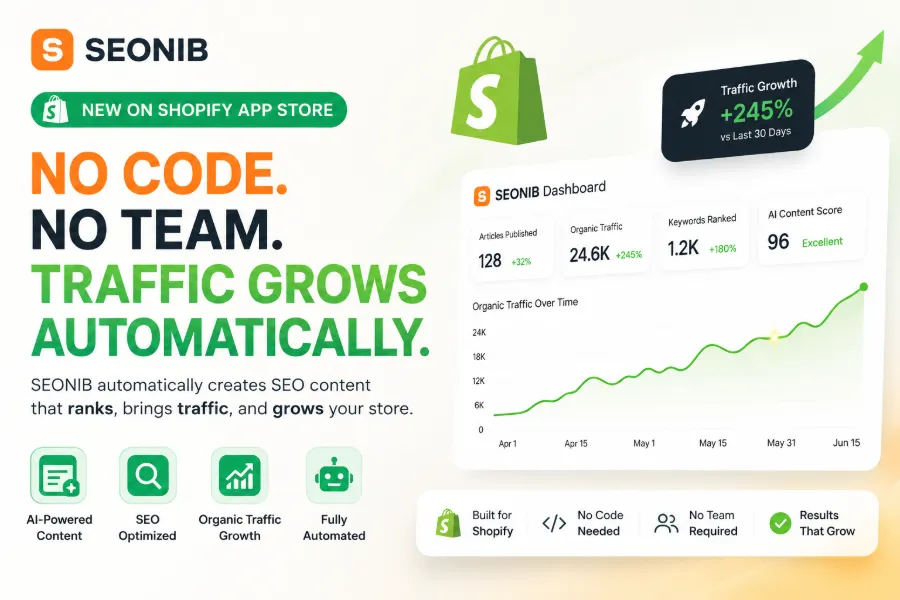
If you encounter unfamiliar features while using tools, the SEONIB Help Documentation offers a complete guide from knowledge‑base creation to multilingual content configuration, serving as a troubleshooting reference.
These five mistakes are the easiest to make in 2026: keyword stuffing (keep density at 2‑3 %), unedited pure AI content (high bounce and poor ranking), ignoring privacy compliance (cross‑border sites are especially prone), only producing text without multimodal assets (missed voice and video search traffic), and not monitoring AI visibility (you don’t know if your content is being cited by AI).
SEONIB, as a link in the automated content production toolchain, handles the automated linking from content generation to multi‑platform synchronization; its core value is reducing repetitive work, not replacing the content strategy itself.
FAQ
Does SEO still require keyword research in 2026?
Yes, but the approach has changed. Traditional keyword research focused on search volume and competition; 2026 keyword research focuses on search intent and the user’s task completion path. You need to understand whether the user searching a term wants information or is ready to purchase, then match content type accordingly. AI’s capture of informational queries forces keyword research toward commercially intent‑heavy queries.
Can pure AI‑generated content still be used in 2026?
It can, but only as an “AI‑generated framework + human‑filled experience” model. Pure AI content performs poorly in rankings because search engines can detect the lack of real operational signals. The correct method is to let AI generate a structured outline and basic information, then fill in real operational cases, data, and problem‑solving details. Dwell time is a direct indicator of this hybrid content’s effectiveness—pages with less than 60 seconds of dwell time need their experience density re‑adjusted.
What compliance issue is most often overlooked in cross‑border SEO?
DSA compliance. Many cross‑border sellers think SEO compliance is just adding a privacy policy page, but DSA requires a user data deletion mechanism, cookie banners that meet local law, and a privacy policy clearly expressed in the target market’s language. Google’s 2026 core algorithm update explicitly includes DSA compliance as a ranking factor. Running a compliance detection tool monthly is far cheaper than fixing issues after they cause penalties.
Can SEO be done without a website?
Yes, but you need a hosted website‑building platform. SEO’s core is a content carrier that search engines can crawl and index. If you lack technical ability to build a site yourself, you can use platforms like Shopify, SHOPLINE, etc., to create an independent site and then use tools to automatically publish content to those platforms. The platform handles structured data, load speed, and mobile experience; you focus on content quality and trust asset building.
How to tell if my content is being cited by AI search?
Monitor the citation share metric. Specifically, check Google Search Console for AI summary appearances, or search your brand and target keywords in AI tools like Perplexity or ChatGPT to see if the answer cites your content. If your content hasn’t appeared in any AI summary for three consecutive months, there’s likely an issue with your page’s structure or trust signals that needs adjustment.
Share Article