
AI Ads Start Reading “Intent” Instead of “Keywords”: How Should Small and Medium‑Sized Sellers Re‑allocate Their Budgets?
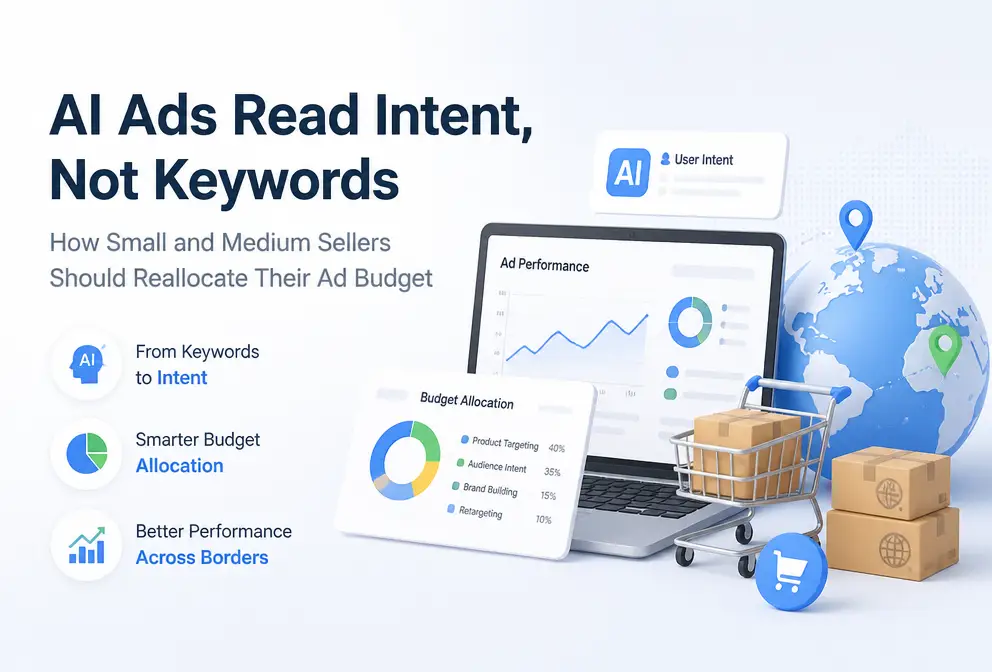
Opening the backend report for the third time, the data looks the same: the exact‑match keyword ads that have been relied on for the past two years have seen CPC rise from just over ¥2 to over ¥5, while CPA has been worsening month‑by‑month since Q3 last year. At the same time, the platform’s “automated exploration” ads are taking up an increasingly large share of the budget, but it’s impossible to see which terms they are targeting or which audiences they are reaching. This isn’t a mistake by any operator; it’s the platform’s underlying logic that is changing.
When products like Google Performance Max and Meta Advantage+ replace “keyword matching” with “intent prediction,” continuing to allocate budget according to the old funnel will only increase losses. The budget should follow the intent—yet many sellers still don’t know where intent is being generated.
The Logic of Advertising Has Changed: From “Keyword Matching” to “Intent Prediction”
The shift to intent prediction isn’t a whim of product managers. Conversational AI and short‑video platforms are eating away the purchase‑decision entry points that used to belong to Google. Consumers watch product reviews on TikTok, read real‑world feedback on Reddit, or ask ChatGPT “Which coffee machine is best for a small apartment?” – none of these scenarios involve traditional keyword searches. Some data say 73 % of modern “searches” happen outside Google; the exact figure may be off, but the direction is clear—decision‑making mindsets are moving to places Google can’t index.
For sellers, the most immediate feeling is loss of control. Previously, you set exact‑match keywords and wrote ad copy; the system matched search terms to those keywords transparently and could be optimized. Now Performance Max and Advantage+ act like black boxes: the system decides who sees the ad, at what price, and with which creative mix, and sellers only see aggregated results. The platform isn’t broken; it’s reading something different—it reads user‑behavior signals and purchase‑intent probabilities, not the few words you input.
Keywords haven’t disappeared; their role has changed. They have gone from “targeting tools” to “prompts for content and creative.” Sellers no longer use keywords to lock in audiences; they feed the system with keywords to tell it what the product is, its selling points, and which demand to fulfill. The algorithm handles the matching. This is why many sellers who cling to exact‑match keywords see their cost structure silently deteriorate.
The full picture of consumer decision‑making outside Google is explained clearly in this video:
The rise of conversational search entrances has changed the meaning of “search.” Conversational search tools like Gemini give direct answers instead of ten links, so users don’t need to click into any website. This means that if your content isn’t referenced by AI, you become invisible in the entire decision chain.
Which Budgets Are Failing: Three “Pitfalls” Under Intent Ads
In the era of intent ads, three types of budgets evaporate silently.
Exploratory spend being inefficiently consumed by the algorithm. The platform’s “exploration” budget is essentially for the algorithm to experiment. Too little budget → insufficient data samples → the algorithm can’t learn; too much budget → early clicks wasted on low‑intent audiences. Many sellers shut down an exploratory campaign after a week of poor ROAS, but the algorithm simply hasn’t converged yet.
Over‑reliance on exact‑match keywords. Exact‑match used to be the core cost‑control tool, but in an intent‑prediction system the pool of traffic for exact‑match keywords is shrinking—users no longer type such precise terms. Clinging to exact‑match is like fishing in an ever‑smaller pond while competition stays the same.
Focusing only on ROAS and ignoring assisted conversions. Intent ads often play a “support” role: users first see the ad, then later search brand terms and convert. If you only count direct conversions, you severely underestimate the value of these ads. One‑week data fluctuations can lead to misjudgment; use a 90‑day window to track CPA trends—a full quarter is needed to capture a complete purchase‑decision cycle.
| Dimension | Keyword‑Targeted Ads | Intent‑Driven Ads |
|---|---|---|
| Targeting Method | User‑entered search terms | Behavioral signals & purchase‑intent predictions |
| Bidding Logic | Keyword‑based bidding | Dynamic bidding based on conversion probability |
| Core Optimization Metrics | CTR, CPC, Quality Score | CPA, ROAS, Assisted Conversions |
| Seller Control | High, fine‑grained adjustments | Low, only set goals and budget |
| Budget Positioning | Capture explicit demand | Explore latent demand |
A typical seller example: He runs a home‑goods standalone site, stubbornly sticks to exact‑match keywords, and refuses to hand budget to the platform’s intent algorithm, arguing “money should be spent where I understand it.” Over a quarter, his CPA rose about 40 %, and the exploratory budget he allocated was inefficiently consumed by the platform—both sides lost money. Exact‑match isn’t useless, but it only covers a tiny slice of the purchase path; the rest of the intent traffic is missed.
Three Directions for Re‑allocating Budgets: Where Should Money Outside Paid Traffic Go?
Re‑allocation isn’t about shifting all paid spend to free channels; it’s about dividing paid budget into “protective spend + intent‑capturing content.” Both are needed to cover the full purchase journey.
Direction 1 – Keep brand‑keyword and core‑conversion ads flowing. Brand terms are the highest‑converting traffic that has already been validated; this budget must stay untouched. Core‑conversion ads are the stable CPA, healthy ROAS campaigns that form the foundation of your paid traffic.
Direction 2 – Redirect exploratory budget to content creation. Instead of letting the platform’s algorithm waste your money on trial‑and‑error, use that budget to produce content that AI search and Google AI Overviews can reference. Exploratory budget’s essence is “buy unknown traffic,” while content creation’s essence is “earn unknown traffic.” The latter is cheaper and builds assets. Move about 20‑30 % of the exploratory budget to content creation and monitor the share of organic traffic.
Direction 3 – Build topical authority with continuously updated, deep‑domain content. When intent traffic arrives, your pages must be ready. It’s not enough to publish a few product descriptions; you need systematic coverage of the category—buyer guides, comparison reviews, tutorials, FAQs—so that both search engines and AI consider you an authority in that field.
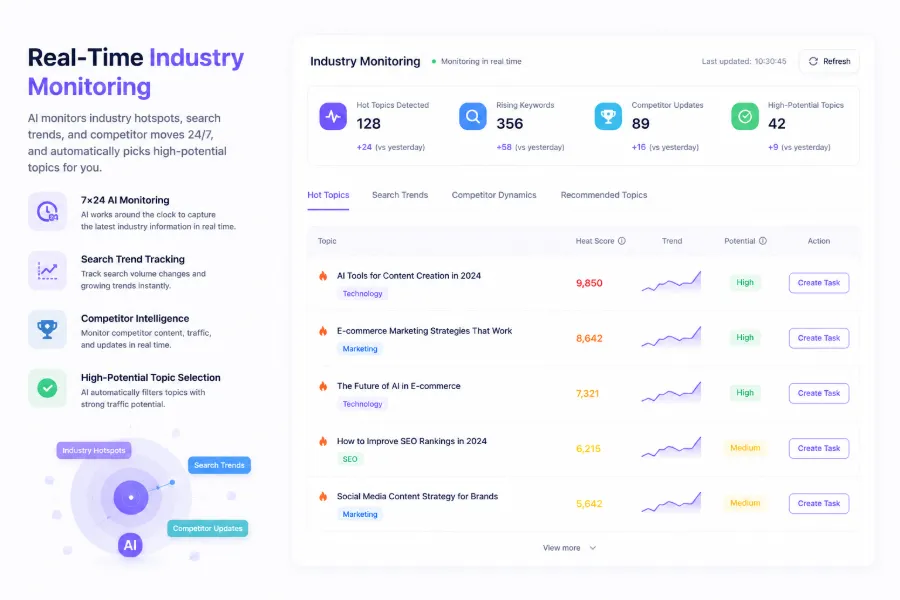
The biggest bottleneck in content creation isn’t writing; it’s sustaining output. Many sellers know content is valuable but can’t keep up. Automated content pipelines solve this: topic discovery, content generation, scheduled publishing, multi‑platform sync—each step handed to the system. When building such a pipeline, operators often compare tools—SEONIB for example—whose platforms not only generate articles but also orchestrate the entire publishing workflow from idea to live page without human intervention. Ordinary AI writing tools give you a draft and leave formatting, images, SEO metadata, and publishing to you; these platforms automate the whole chain.
Content Capture: When Intent Traffic Arrives, Can Your Pages Handle It?
After shifting budget to content, the next question is whether your pages can absorb the traffic.
Expanding product pages into buyer guides, tutorials, and Q&A sections is the lowest‑cost starting point. Product pages already contain specs, features, and use cases; these can be rewritten as guides and tutorials. Many sellers overlook the traffic potential of product pages—an optimized buyer guide can generate organic traffic that exceeds paid ads.
Q&A/AEO pages are another key move. AI search answers are often drawn from structured Q&A content. If your site has clear Q&A pages, AI is far more likely to extract and cite them. This isn’t mysticism; it’s how AI search engines crawl and parse content—structured Q&A is far easier to extract than long‑form text.
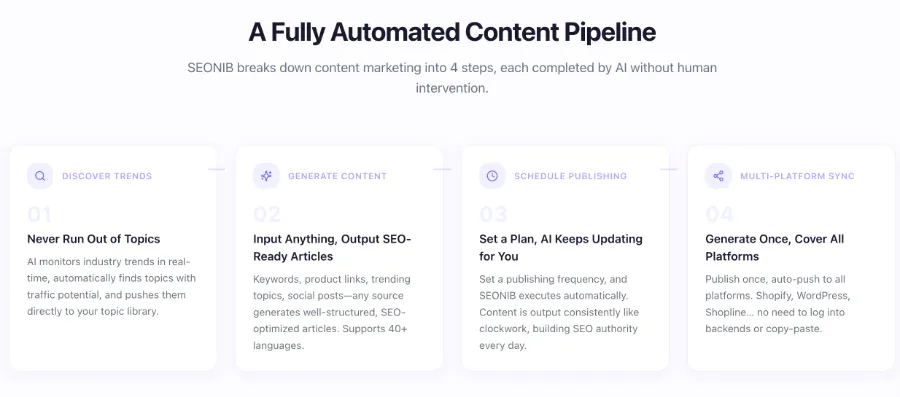
Mass and multilingual publishing maintains update frequency and builds search authority. Cross‑border sellers benefit from multi‑market coverage—content generation in 40 languages means one set of product data can populate many sites across many markets. Update frequency has a tangible impact on search authority; continuously updated sites rank higher than stagnant ones.
On platforms like Shopify and WordPress, implementation paths are mature. Shopify merchants can find content‑automation tools directly in the app store; WordPress can use plugins or APIs. One seller shared a step‑by‑step guide to turning a product page into a blog post in one click. The core idea is to auto‑generate buyer guides and tutorials from product data, then bulk‑publish them. SEONIB’s bulk‑publish capability, combined with Shopify’s product‑listing description feature, essentially enables “product launch = content live.” For detailed operational steps, refer to theSEONIB’s help documentation and guides](https://seonib.com/help).
Implementation: 90‑Day Budget Re‑allocation Checklist
Budget re‑allocation isn’t a one‑off action; it’s recommended to split it into three phases over 90 days.
Days 1‑30: Audit and stop loss. Pull all existing ad campaigns, rank them by 90‑day CPA and ROAS. Immediately shut down losing exploratory campaigns—don’t cling to sunk costs. Meanwhile, increase the budget share for brand terms and core‑conversion ads to keep the base stable. The goal of this phase is to stop bleeding, not to grow.
Days 31‑60: Restructure budget and build the content‑publishing pipeline. Take the 20‑30 % budget freed from exploratory campaigns and invest it in content creation. Set up automated workflows for topic discovery, content generation, and scheduled publishing, so content starts flowing continuously. The focus here is “getting the system running,” not perfecting each piece—first ensure frequency, then improve quality gradually.
Days 61‑90: Review and adjust. Evaluate the re‑allocation using CPA, organic‑traffic share, and assisted‑conversion metrics. CPA shows whether paid‑traffic efficiency improved; organic‑traffic share indicates whether content is gaining traction; assisted conversions reveal the real contribution of intent ads in the purchase path. For specifics on bulk publishing and data‑source configuration, see the batch publishing and data‑source guide.
What signals a successful re‑allocation? Organic‑traffic share rising from below 10 % to above 20 %, overall CPA not worsening over the 90‑day period, and assisted‑conversion contributions beginning to be counted in ad‑performance evaluations—when all three appear, the direction is likely correct.
When to pull back? If after 60 days organic traffic shows no growth while paid‑traffic volume drops sharply due to budget cuts, it means content‑capture capacity isn’t keeping up. In that case, re‑allocate part of the budget back to paid channels and accelerate content production. Budget re‑allocation isn’t a single‑track road; it’s a dynamic adjustment process.
FAQ
All ad platforms are now reading intent—are keywords completely obsolete?
No. Keywords have shifted from “targeting tools” to “content prompts.” You no longer use keywords to lock in audiences; you use them to feed the system and AI about the demand your product should satisfy. The pool for exact‑match keywords is indeed shrinking, but they remain the foundation for brand‑term protection and core‑conversion ads.
Budget is limited—what type of ads should small‑to‑mid‑size sellers cut first?
Prioritize cutting continuously losing exploratory campaigns. Use the 90‑day CPA trend as the criterion, not a single week’s data. If an exploratory campaign runs over 30 days with a steadily worsening CPA and no sign of convergence, shut it down. Brand terms and core‑conversion ads are the base; keep them untouched.
If I move ad budget to content, how long before I see results?
The ramp‑up period for organic traffic is typically 60‑90 days. The first 30 days may show little change; content needs time to be crawled and evaluated by search engines. From day 31‑60 you’ll start seeing occasional organic visits; by day 61‑90, if the publishing frequency is stable, the organic‑traffic share should show observable improvement.
How does AEO content differ from traditional SEO content?
Traditional SEO focuses on keyword rankings to make pages appear higher in search results. AEO (Answer‑Engine Optimization) focuses on the probability of being extracted and cited by AI answers, aiming for AI search to quote your content when answering questions. AEO emphasizes structured Q&A, entity coverage, and clear information hierarchy.
I have no dedicated SEO staff—can I run this whole process with automated tools?
Yes, but you’ll need to spend time setting up the workflow first. Automation solves the “continuous output” problem, but topic selection, brand tone, and quality control still require human input. Start by converting product pages into blogs, let the system generate the basic content volume, then iterate and refine.
Share Article