How Brands Should Allocate Optimization Priorities Between SEO, AEO, and GEO in 2026
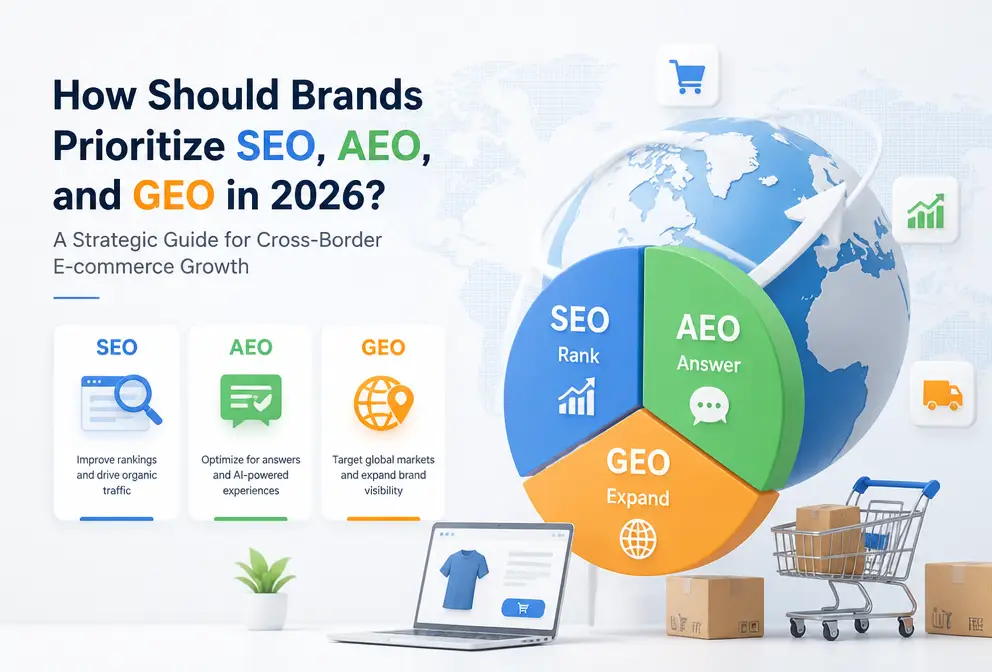
When a cross‑border brand maintains sites in the United States, Germany, and Japan simultaneously, there are often several search entry points: users may search for a product on Google, ask a specific tool directly, or let an AI compare several brands. Teams, however, often focus only on traditional keyword rankings, resulting in more articles but a flattening ranking curve, and brand exposure from answer and generative search isn’t recorded.
SEO handles pages that are crawlable, indexable, and rankable; AEO handles direct answers, featured snippets, and Q&A extractions in search results; GEO handles the AI‑generated search’s understanding of brand entities, content citations, and semantic relationships. In 2026, brands should not pick one of the three, but allocate resources according to search tasks, content assets, and conversion paths.
For cross‑border e‑commerce brands, the usual sequence is to first fix SEO’s technical and page foundations, then supplement the clear answers required for AEO, and finally build the brand entities and trusted content relationships needed for GEO. Without stable product facts, policy pages, and internal links, pursuing exposure only in generative answers is hard to explain and even harder to audit.
What Problems SEO, AEO, and GEO Each Solve
You can view the three optimizations within a “three‑layer search entry” model: traditional search, direct answer, and generative answer. SEO deals with web results in Google search; its objects are crawlable, indexable, and competitively rankable pages, including product pages, category pages, buying guides, and knowledge content.
AEO’s objects are shorter and more precise. When a user searches “Can this fabric be machine‑washed?” or “How to return a Shopify store order?” the search engine may extract a snippet from a page and display it as a featured snippet, Q&A result, or other structured information. Even if the page isn’t ranked first, a clear answer can still gain visibility on the results page.
GEO deals with AI‑generated answers. It’s not just rewriting articles in a more “AI‑like” tone; it’s ensuring that brand names, product specifications, shipping policies, target markets, and use cases remain verifiable and consistent across pages. Generative systems need to establish links from brand entities, knowledge bases, and web content before they can correctly recognize, cite, or recommend a brand.
That’s why the three cannot replace each other. A product page can drive purchase, a category page can cover comparison and filtering, a buying guide can answer selection questions; if these pages use different prices, terminology, or product descriptions, traditional search, direct answers, and AI search will all encounter varying degrees of trust issues. For budget allocation, you can also refer to the SEO vs. GEO Service Investment Assessment, which calculates page assets and business goals together.
| Optimization Target | User Search Behavior | Main Content & Measurement Signals |
|---|---|---|
| SEO | Browsing pages, comparing results, entering site | Product pages, category pages, guides; indexation, ranking, organic clicks |
| AEO | Seeking a clear answer | Question pages, definitions, steps, FAQs; answer hit, featured snippet |
| GEO | Letting the system synthesize multiple sources for an answer | Brand data, product facts, citable paragraphs; brand recognition, citation, and association |
Cross‑border teams also need to accept an uncomfortable fact: GEO results often first appear as correct brand mentions rather than an immediate click‑through rate boost. Users may see the brand name in AI search, then a few days later visit the site via direct access, brand‑term search, or ads. If you only look at the final organic click, this impact is missed.
Backlink quantity also cannot replace information clarity. A new site without many backlinks can still start from clear sub‑topics and complete page relationships. The related Zero‑Backlink Site Startup Method is closer to the real startup problem: first get the search engine to understand what task the page solves, not to pile up links.
Which Layer Should Brands Optimize First in 2026
A budget‑constrained cross‑border brand can follow a simple decision sequence:
If product pages can’t be crawled, canonical tags are misconfigured, or Google Search Console shows consistently low index coverage, start with SEO. If pages are indexed but user questions aren’t directly answered, add AEO. Only when product facts, brand name, market versions, and citations are stably maintained does GEO become suitable for expanded investment.
This does not mean every brand must split the budget equally among the three. A Shopify store that has been live for three months with only a few dozen products may spend most of its time on indexing, variant pages, internal linking, and category structure; a mature brand with stable organic clicks can afford to invest more resources in entity relationships, comparative content, and external citations.
Page priority should also follow search tasks, not keyword volume. The awareness stage needs tutorials, material specs, and Q&A; the comparison stage needs comparison pages, specification explanations, and target audience info; the purchase stage relies on product pages, category pages, price, and inventory; the after‑sales stage depends on return policies, shipping, warranty, and installation instructions. High‑volume keywords that don’t connect to any task often bring traffic that is hard to convert.
Product facts should precede language expansion. A content system may support “40+ languages,” but that only reflects technical scalability, not that every language should be published immediately. German pages need accurate product terminology and return rules; Japanese pages need locally appropriate phrasing and shipping info; English pages must not retain outdated specifications. As language count grows, the cost of review, updates, and version tracking rises in tandem.
Shopify, SHOPLINE, WordPress, and WooCommerce have different page structures; platform‑default meta information, pagination, and variant handling also differ. For example, SHOPLINE store rankings depend not only on article count but also on page quality, product information, and site structure. When troubleshooting, you can refer to the SHOPLINE Store Ranking Factors to check template‑level issues.
A common misconception is treating GEO as a content‑quantity competition. After weeks of bulk publishing multilingual articles, article count rises, but product facts, internal links, and market versions are not synchronized. Six weeks later, the team discovers some pages still use old prices, some article links point to discontinued products, and Search Console’s indexing and traffic data become hard to explain; worse, AI search may cite these outdated passages, reducing answer accuracy. The team then pauses bulk publishing, reorganizes product data and responsibility, and although traffic doesn’t immediately rebound, they can finally identify which pages merit continued maintenance.
Integrating SEO, AEO, and GEO into Content and Publishing Workflows
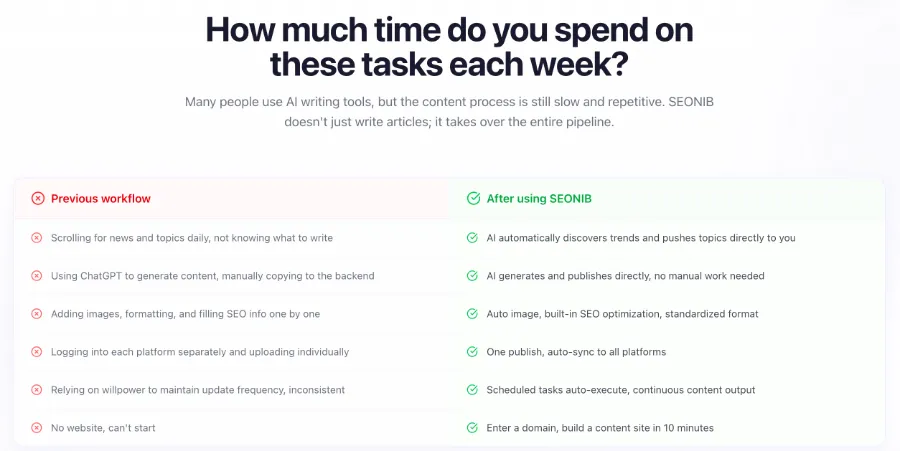
The actual publishing workflow can be broken into four steps: discover trends, generate content, schedule publishing, and synchronize across platforms. The sequence looks simple, but the real time sink is the validation between each step: does the topic match the market, are product details still valid, does the title meet the search task, and are links functional after publishing?
When discovering trends, teams can combine Google Trends, keyword volume, competitor pages, and internal search terms to determine whether users are in the awareness, comparison, purchase, or after‑sales stage. When generating content, SEO needs page structure, titles, meta fields, internal links, and image alt text; AEO needs a clear conclusion, question‑style sub‑headings, and clarified entity relationships; GEO needs stable brand data, product facts, and short, citable paragraphs.
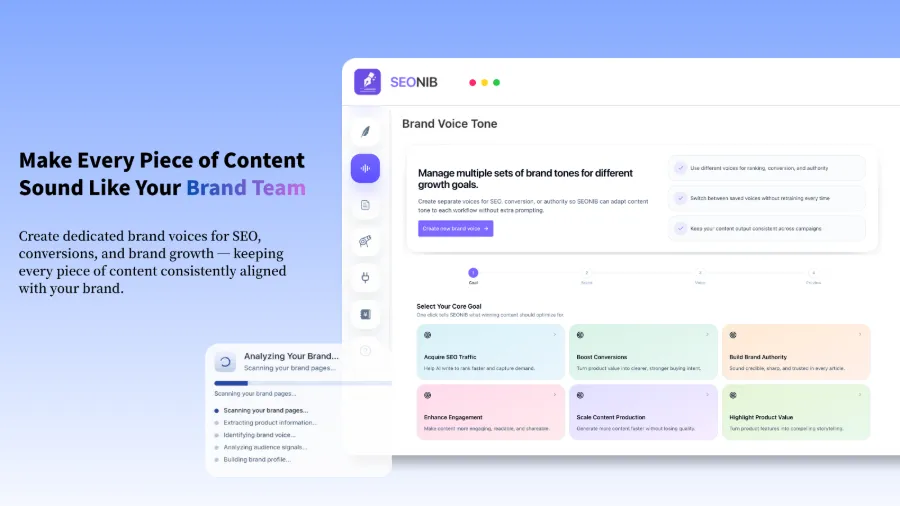
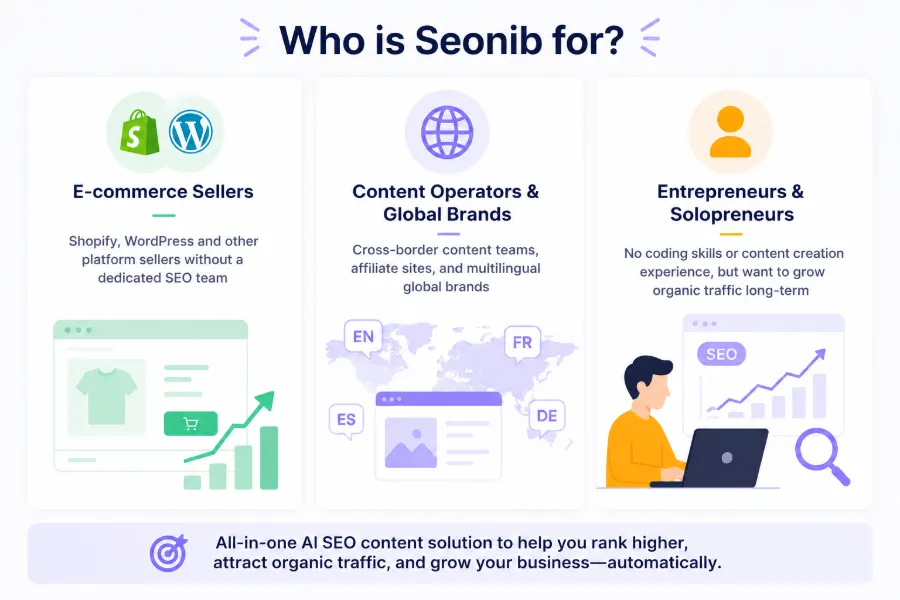
Automation platforms act more like a publishing pipeline than a judgment‑replacing writer. The work scenarios of SEONIB include trend discovery, content generation, SEO field handling, content calendars, scheduled publishing, and synchronization to Shopify, WordPress, SHOPLINE, etc. For teams managing multiple sites, such a process reduces repeated logins and copy‑pasting, but it cannot automatically decide whether a market should promise “two‑day delivery,” nor replace human verification of product specifications.
When connecting to Shopify, field mapping and permission settings are often more error‑prone than article generation. If product links, categories, featured images, SEO fields, and publish dates aren’t correctly aligned, the article may publish successfully but not appear in the intended blog category. Before operating, review the Shopify Connection Guide, then publish a test article on a staging site to confirm links, images, and meta fields are written back correctly.
Multilingual and cross‑platform synchronization also introduces version drift. An English site publishes on Monday, the French site syncs on Wednesday; during that time, product inventory and shipping policies may have changed. A CMS webhook may return 200, but the target page isn’t actually updated; an image retains alt text on one platform while a theme template overwrites it on another. These issues don’t always surface as errors immediately; they often appear only after a re‑crawl or user complaint.
Therefore, manual verification must at least cover facts, market adaptation, product promises, duplicate content, and answer accuracy. Keep a product facts sheet before publishing, and after publishing audit canonicals, internal links, structured data, and image alt text. This reduces rework more effectively than merely increasing article frequency. Teams can also use the Content Publishing Help Documentation as a reference when onboarding a new site, rather than waiting for sync failures to troubleshoot one by one.
Shopify’s official documentation can serve as a baseline for platform fields and site structure: View Shopify Platform Documentation. However, whether a platform can publish content and whether the content can be correctly indexed, cited, and converted are two different matters.
Which Metrics to Use to Judge Whether Optimization Is Truly Effective
The three search entry layers require three distinct observation approaches. SEO looks at index coverage, rankings, organic clicks, click‑through rate, and non‑brand queries; AEO looks at question hits, answer coverage, and result‑page visibility; GEO looks at whether the brand is correctly recognized, cited, and associated with the right product, market, and use case.
Cross‑border brands should also map content metrics to commercial pathways. Visits from articles to product pages, assisted conversions, add‑to‑cart rates, and final orders explain better than a single article’s traffic whether whether the content solved the purchase task. Different sites, languages, and markets need separate breakdowns; otherwise, growth in the US site may mask indexing issues in the French site, and brand‑term clicks may hide a lack of growth in non‑brand queries.
Cross‑platform synchronization can cover 10+ platforms, but “how many platforms were published to” is not a performance metric. One sync failure may affect only a single country site, and duplicated content on one platform may drag down a batch of pages. During retrospectives, break down by site, language, and search entry, and record publish date, first index date, organic clicks, product page visits, and assisted conversion status.
The real challenge is the conflict between content scale and maintenance accuracy. Outdated prices, inventory, shipping policies, and product specs not only degrade user experience but also make both traditional ranking pages and generative answers unreliable. One team discovered after a month of continuous publishing that traffic spikes were driven by old tutorials, while new product guides failed to get any entry because internal links were broken. They repeatedly refreshed analytics tools and re‑ran crawls, eventually deleting a batch of unmaintainable pages instead of continuing to add more articles.
Post‑publish retrospectives can be done at three time points: 24‑72 hours to check successful publishing and obvious crawl issues; 7‑14 days to observe indexing and query changes; 30 days to combine product page visits, add‑to‑cart rates, and answer hit records to decide whether to update, merge, or retire pages. This cycle isn’t a fixed ranking promise; it gives the team time to distinguish technical failures, indexing delays, and content demand deficiencies.
Brands also need to separately log AI‑search citations and recognitions. Improvements in AEO and GEO don’t necessarily translate into immediate click growth; correct brand recognition, accurate product association, and answer citations to valid pages are themselves visibility signals. Automation can increase quantity and frequency, but it cannot replace original judgment, expert information, brand tone, and fact verification; when maintenance cost exceeds the explainable benefit of new pages, pausing publishing is usually safer than continued expansion.
FAQ
Do SEO, AEO, and GEO need to be invested in simultaneously?
No, you don’t need to split the budget evenly from the start. Typically you first address SEO’s crawling, indexing, and page structure, then add AEO based on user questions, and finally build GEO’s brand entities and citation relationships. New sites should prioritize index coverage and product pages in the first 30 days, then monitor answer hits and brand citations.
Should a small‑to‑mid‑size cross‑border e‑commerce brand start with SEO or GEO?
Most small‑to‑mid‑size brands should start with SEO because, when product pages, category pages, and policy pages aren’t stably indexed, GEO lacks reliable information sources. Complete a round of page and fact audits first, then observe non‑brand queries, product page visits, and brand recognition changes over 4‑8 weeks.
Is AEO optimization only applicable to Q&A‑type content?
No. Product specifications, shipping policies, comparison pages, tutorials, and buying guides can all provide answers suitable for direct extraction. As long as the page clearly answers the question at the beginning and keeps entities, conditions, and exceptions explicit, search engines have a chance to extract the relevant information.
Will bulk‑generated multilingual pages hurt search performance?
Yes, especially when translated content is duplicated, product facts are inconsistent, or multiple pages only replace the country name. After bulk generation, at minimum review each language for titles, prices, shipping policies, internal links, and duplicate passages, and check indexing and query changes 7‑14 days after publishing.
How can we tell if a brand has achieved visibility in generative search?
Periodically run the same set of brand terms, product terms, and comparison questions, and check whether the brand is correctly recognized, which pages are cited, and whether product and market information is accurate. Keep a monthly record of query results and compare them with brand‑term searches, direct visits, and assisted conversions; don’t rely solely on click‑through rates.
Share Article