Structured Data, Citable Paragraphs, Entity Consistency: Can They Really Rescue AI Search Traffic for Independent Sites?

A team running an independent site that sells cross‑border home goods had been publishing three blog posts each week for the past six months, adding Article and FAQPage JSON‑LD markup to every page. The Schema.org validation tool showed all green. Yet organic traffic kept falling. They later realized the problem wasn’t rankings—users simply weren’t clicking on the search results. More and more people were getting answers directly in the answer boxes of ChatGPT, Perplexity, etc., leaving the site no chance to be “seen.”
Structured data, citable paragraphs, and entity consistency are often touted as the “lifeline” in the AI search era. This article discusses one practical question: can they actually bring rankings back, or are they just a marketing‑sugar‑coated placebo?
When Search Results Become “A Segment of Answer”: What AEO and GEO Are Actually Optimizing
Search entry is shifting from “retrieving links” to “delivering answers directly.” Google’s AI Overviews generate a summary at the top of the results page, while ChatGPT and Perplexity output conclusions in a conversational format. Users no longer need to click any webpage; the question is already answered.
AEO (AI Engine Optimization) and GEO (Generative Engine Optimization) are two concepts that are often conflated. AEO focuses on enabling the AI engine to understand and extract page content; GEO focuses on how the content is referenced and presented by generative engines. Their common point is that the optimization target has shifted from “ranking” to “being cited.”
Traditional keyword strategies fail in AI answer scenarios because AI engines don’t select answers by keyword matching. They filter sources based on entity relevance, information completeness, and paragraph extractability. An article stuffed with keywords but lacking clear factual claims might still rank in traditional search, yet it will almost never be cited in AI answer boxes.
Independent sites need to redefine what “ranking” means. In the past, being on the first three pages of Google delivered traffic; now, even a first‑page ranking may be completely bypassed by AI Overviews. You can verify source and citation methods directly in ChatGPT by asking a specific question about your industry and seeing which sites and paragraphs it cites.
“Being cited” is replacing “ranking” as the new visibility metric. For independent sites of different scales, budget and content strategy differences are huge. You can refer to the Content Plan Configurations for Independent Sites of Various Sizes to assess how much you should invest.
Structured Data in Practice: Which Schemas Have Real Value and Where Are the Limits?
JSON‑LD is currently the most mainstream syntax for structured data. Common types include Article, FAQPage, BreadcrumbList, Product, and Organization, each serving a specific purpose.
- Article tells the search engine the page is an article.
- FAQPage gives FAQ content a chance to appear as rich media.
- BreadcrumbList provides breadcrumb navigation.
- Product includes price, inventory, rating, etc.
- Organization supplies basic brand information.
These schemas do have an effect on Rich Results—e.g., star‑rated product reviews, expandable FAQ lists.
A key fact is that schemas do not guarantee AI citation. When AI engines decide what to cite, they primarily rely on the extractability and factual clarity of the content itself, not on the presence of structured data markup. A page without any schema but with clearly structured paragraphs may be cited more often than a fully marked‑up page that is merely marketing fluff.
A common misallocation is spending a lot of time configuring various schemas for each page while neglecting content quality. The link between structured data and AI citation is far weaker than the link between structured data and rich‑media display. Only a few schema types are directly relevant to AI citation; most structured data value stays at the rich‑media level.
For concrete schema implementation and configuration steps, see the Relevant Integration and Configuration Help Docs. If the goal is to generate sustained organic traffic for product pages, turning product information into content is a more direct path—see the full workflow in Turning Product Links into Traffic‑Driving Blog Posts.
Citable Paragraphs: Making AI Treat Your Independent Site as a Source
There is a pattern to writing citable paragraphs. AI engines tend to cite paragraphs that contain clear factual claims, stand alone independently, and have a concise conclusion, rather than whole pages of marketing copy.
Practical steps include:
- Break the article into independent sections using H2/H3 headings, each focusing on a specific question.
- Isolate factual claims into their own paragraphs; don’t mix them with background information.
- Cite sources for numbers and conclusions, e.g., “According to 2024 Statista data.”
- Avoid unverifiable buzzwords like “industry‑leading” or “ultimate experience.”
A notable observation: AI citation decisions do not primarily depend on structured data markup. A page with clear paragraphs but no schema is often cited more readily. This suggests that, than spending time stacking schemas, you should first write well‑structured paragraphs.
The relationship between paragraph structure and entity extraction is also direct. When extracting entities, AI scans for names and terms that appear repeatedly with consistent context. If a paragraph uses a brand name, product name, or industry term consistently, entity extraction accuracy rises; inconsistent usage leads to fragmented results.
Checklist for whether an article can be cited:
- Does each H2 have a self‑contained factual statement?
- Are numbers sourced?
- Is the conclusion clear enough to be extracted on its own?
- Are there large blocks of marketing rhetoric?
For more analysis of citation mechanisms, read Why Some Sites Get Cited More Often by AI Engines.
Some content creators have documented practical processes for using AI to capture trending topics early, including how to get content indexed and cited by AI engines. This Practical Record of Using AI to Capture Trending Topics can serve as a reference.
Entity Consistency: Why the Same Brand Looks Like “Two Different People” to AI
Entity recognition is the foundation of AI engine content understanding. The core logic of Entity SEO is that the AI engine must confirm that a brand, product, or term refers to the same thing across different pages in order to aggregate dispersed authority.
In practice, many independent sites have inconsistent brand and product naming across languages and pages. An English page might say “SmartHome Co.”, a Chinese page “智家科技,” a product page “Smart Bulb Pro,” and a blog post “智能灯泡 Pro.” To the AI engine, these could be seen as distinct entities rather than variations of the same brand.
When a brand is written differently on different pages, AI treats them as separate entities, scattering authority. This is the core of the entity‑consistency problem: the same brand becomes “two people” in AI’s eyes, diluting topical authority and hurting search visibility.
Entity consistency is more important than a single perfect article. Even the best‑written piece won’t be linked to the correct entity if its naming differs from dozens of other pages.
To solve this, maintain a canonical set of brand names, product names, and industry terms in a Knowledge Base, and automatically inject them during content generation. A brand knowledge base does exactly that—configure brand data and term tables in the backend, and the content generation engine applies the unified style.
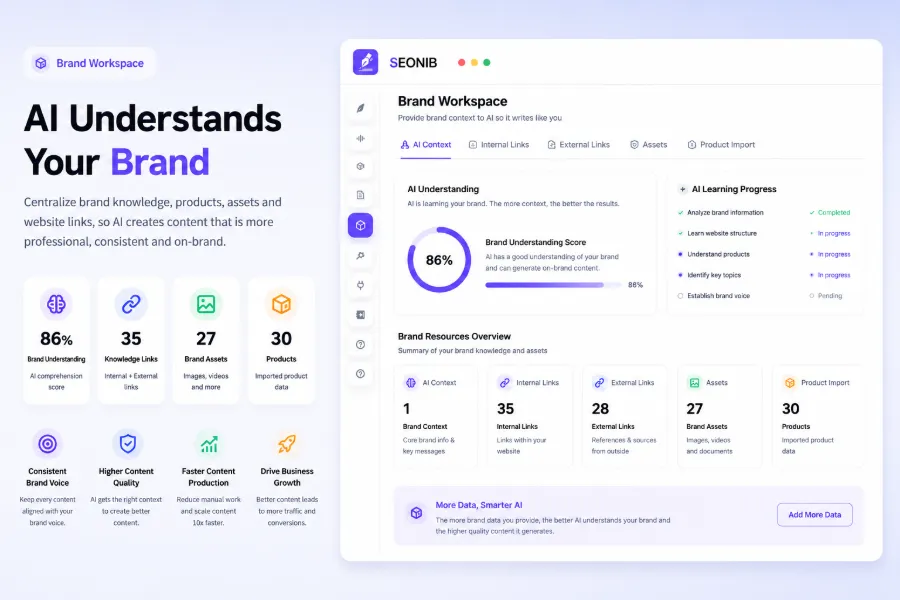
However, manually synchronizing brand naming across dozens of pages is almost impossible, especially for multilingual sites where each page requires manual verification of term translations and brand naming. A more realistic approach is to pre‑populate brand context into the content generation workflow so every output automatically follows the unified entity standard. This kind of workflow‑level synchronization and maintenance is exactly the operational problem that content‑pipeline tools like SEONIB aim to solve—turning brand‑information consistency from “human memory” into “system preset.”
Conclusion: These Three Things Won’t Rescue a Falling Ranking, but They Determine Whether You Enter the Citation Pool
In summary, structured data, citable paragraphs, and entity consistency cannot reverse a stale ranking that has already been lost. Adding schema to a page that fell off the top three pages after an algorithm update won’t bring it back. However, they determine one thing: whether an independent site gets into the AI engine’s citation pool.
From deployment to citation, the real timeline is usually months, not weeks. AI engines need multiple crawls, entity‑consistency verification, and enough trust signals before they start citing. The effectiveness timeline correlates directly with the amount of content accumulated—less content means lower citation probability.
| Tactic | Implementation Cost | Impact on AI Citation | Impact on Traditional Ranking | Can It Rescue Rankings Alone? |
|---|---|---|---|---|
| Structured Data | Medium, requires technical setup | Limited, not guaranteed to be cited | Medium, improves rich‑media display | No, not guaranteed to be cited |
| Citable Paragraphs | Low, just a writing style change | High, directly boosts citation probability | Medium, improves content quality | No, but can get you into the pool |
| Entity Consistency | High, requires cross‑page unification | High, determines entity‑recognition accuracy | Low, little effect on traditional ranking | No, but can consolidate authority |
A practical checklist: Does each page contain at least one self‑contained factual paragraph? Are brand and product names written consistently across all pages? Are numbers and conclusions sourced? Does the page have basic schema markup?
Embedding consistency checks into the publishing workflow is far more effective than post‑hoc fixes. Standardize brand naming, terminology, and paragraph structure during content creation rather than editing each page after publishing. If you use WordPress, consider the WordPress Integration for Automated Publishing Workflows to automate publishing and synchronization, reducing human‑introduced inconsistencies.
A failed case illustrates the point: an independent‑site team spent three months adding FAQPage and Article schema to every page, draining a large budget, yet never got cited in AI Q&A. The reason was that the content remained keyword‑stuffed marketing copy without stand‑alone factual statements. Investment and search visibility were completely mismatched, leading to a complete rewrite.
The value of these three practices lies not in “saving rankings” but in “getting into the citation pool.” Rankings are a thing of the past; the citation pool is the present.
FAQ
After adding structured data, why am I still not being cited by ChatGPT?
Structured data mainly affects rich‑media display and does not have a direct causal link to AI citation. ChatGPT looks for paragraphs with clear factual claims and independent conclusions. If the content is still marketing fluff, no amount of schema will lead to citation. First check paragraph structure, then consider schema configuration.
Are AEO and GEO the same concept? Which should independent sites prioritize?
They overlap but are not identical. AEO focuses on enabling the AI engine to understand and extract content; GEO focuses on how content is cited and presented by generative engines. For independent sites, prioritizing AEO is more practical—first get paragraph structure and entity consistency right, which naturally raises citation probability.
Without a dedicated SEO team, can a small cross‑border team implement these practices?
Yes, but the process must be standardized. Writing citable paragraphs can be codified into content guidelines; entity consistency can be managed through a brand knowledge base. The key is to avoid relying on manual memory for consistency and instead embed the standards into the content generation workflow. Start with paragraph‑structure optimization—it’s the lowest‑cost, fastest‑to‑see‑impact step.
Share Article