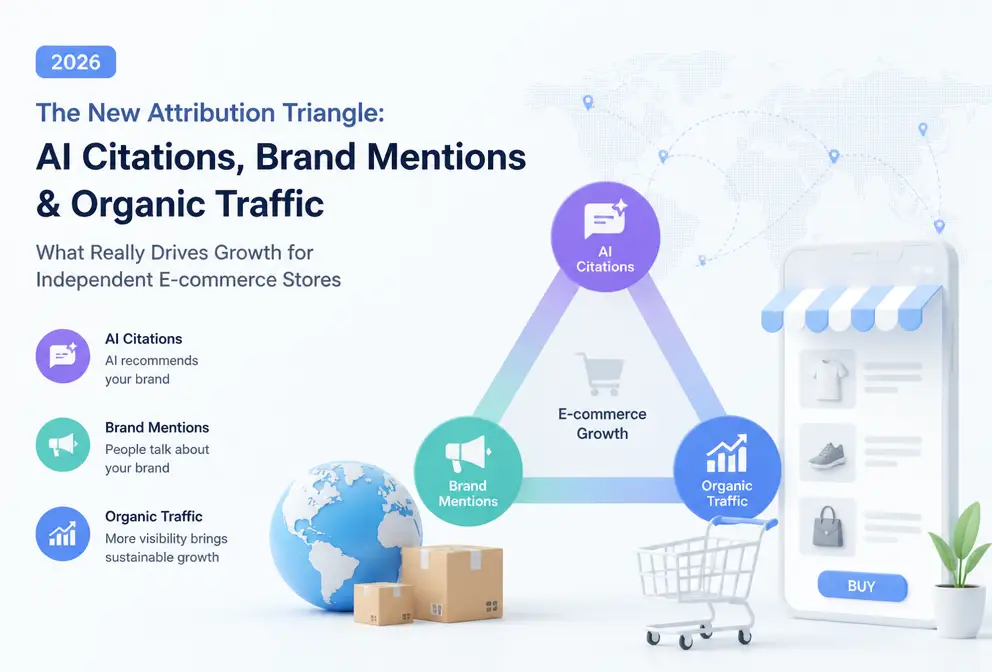
The 2026 Effect Attribution New Triangle: How AI Citations, Brand Mentions, and Organic Traffic Determine Independent Site Growth
An independent‑site operator encountered a puzzling situation in the second half of 2025: organic traffic in Google Search Console rose month over month, but the on‑site conversion rate stayed flat for eight consecutive weeks. A review revealed that a large portion of the incremental traffic came from AI recommendation channels, where users had weak purchase intent, and the SEO spend of the previous three months had actually been misallocated to low‑conversion keywords.
This scenario is becoming increasingly common in cross‑border e‑commerce. Consumers now make decisions not on Google search results pages but in ChatGPT answers, TikTok comment sections, and Reddit discussion threads. Traditional attribution models focus only on direct clicks from on‑site search, systematically missing the two hidden lines—AI citations and brand mentions—that are reshaping traffic quality. This article breaks down the three new coordinates of 2026 effect attribution and shows how to connect them back to actionable monitoring and content strategies.
Why Traditional Attribution Models Failed Across the Board in 2026
The core assumption of traditional attribution is: the user searches, then clicks, then converts. This chain has broken in 2026. Consumers may first see an unboxing video on TikTok, then search for real experiences on Reddit, and finally ask ChatGPT for a recommendation list—without ever visiting a Google search results page.
73 % of modern “search” behavior occurs outside Google, and this traffic is almost never recorded by traditional attribution tools. The organic traffic curve that independent‑site operators see is only a slice of the full decision journey. As AI search tools and social platforms take on more information‑retrieval functions, the correlation between on‑site search ranking and revenue is being diluted.
The “ranking does not equal revenue” gap directly leads to budget misallocation. A seller might see a keyword move from page 8 to page 2, with organic traffic up 40 %, but the conversion rate remains unchanged—because the search intent for that term is informational rather than transactional; users click just to look and then purchase elsewhere. Old attribution models cannot distinguish “visibility growth” from “effective traffic growth,” causing SEO budgets to continue flowing to low‑conversion keywords.
This also explains why more teams are redefining the scope of “effective exposure”: no longer measuring only clicks, but also incorporating AI citations, brand mentions, and social discussions. Moving beyond a single Google dependency is no longer a forward‑looking idea in 2026; it’s an operational reality.
AI Citations: How Being Named by Large Models Becomes a Measurable Asset
AI search engine citations of brand content differ fundamentally from Google’s web crawling. When generating answers, ChatGPT, Perplexity, and Google AI Overviews prioritize pages with complete structured data, clear entity relationships, and content organized according to knowledge‑graph logic. This means “being cited by AI” is a new traffic entry independent of organic traffic—users may not click your page, but the brand name appears in the AI’s answer, which itself is an exposure.
Manually tracking AI citations is not complicated: regularly query major AI search tools using a combination of “brand term + question‑style query,” and record the context, frequency, and recommendation phrasing of each citation. For example, ask weekly “best [category] for [scenario]” and see whether the brand appears in the answer and where.
Citation density shows an observable correlation with on‑site brand search. When a brand is frequently mentioned in AI answers, users tend to verify it via on‑site search, which appears in Google Search Console as an increase in brand‑term search volume. Note that AI citation is essentially a “pre‑search visibility” whose value manifests 2–4 weeks later in on‑site search growth; thus, daily‑level attribution inevitably distorts the picture.
For more on quickly validating product search demand, see How to Validate Product Search Demand Fast.
Content supply is the foundation of AI citations. AI search engines need crawlable, parsable content to cite, and coverage across multilingual markets directly affects citation scope. Content generation and publishing tools that support output in 40 languages provide the basis for AI citation coverage in multilingual markets. While tracking AI citations, the Complete Steps to Check Page SEO Optimization Level Item by Item helps operators confirm whether a page meets the structured conditions required for AI citation. The way AI search tools parse content platforms is also worth referencing, as it shows differing citation preferences across AI platforms.
More functional details are available in doubao:SEONIB Feature Breakdown.
When making product selection decisions, many teams refer to the practical experience in why-i-use-accio-to-select-products-seonib-acquires-customers.
The Coupling Effect of Brand Mentions and Organic Traffic: An Undervalued Indirect Growth Curve
The boost that brand mentions give to independent‑site rankings is nonlinear. Uniform cross‑platform coverage matters more than high‑frequency mentions on a single platform—appearing once on TikTok, Reddit, YouTube, and industry forums often outperforms ten mentions on just one platform. The underlying mechanism is the accumulation of Entity SEO and Topical Authority: search engines confirm a brand’s existence and multi‑source discussion through cross‑platform mentions, elevating its status in the knowledge graph.
A Shopify seller who applied an automated content workflow for three months saw external mentions rise from 12 per month to 47 per month, while brand‑term search volume grew 210 %. However, the organic traffic peak occurred in week 6 rather than week 2. The weight accumulated from external mentions takes 2–4 weeks to propagate to on‑site rankings, creating a lag window that is the most easily missed part of attribution.
How to roughly separate “AI‑driven traffic” from “traditional search traffic”? One practical method is to compare the growth curves of brand‑term versus non‑brand‑term searches: if brand‑term searches rise while non‑brand terms stay flat, the increment likely comes from AI citations and social mentions; if both rise together, it’s more likely traditional SEO impact. External tools that assist product selection and brand decisions provide another approach—validating the link between brand mentions and traffic via third‑party data rather than relying solely on on‑site data.
Building an Observation Framework for the New Triangle: Feeding Three Signals into Daily Monitoring
Integrating AI citations, brand mentions, and organic traffic into daily monitoring does not require expensive new tools; existing tool combos can handle it. The key is establishing a fixed recording cadence and comparative logic.
We recommend recording AI citation frequency weekly and comparing organic traffic changes monthly, forming an attribution comparison table. The process has three steps:
- Every week, at a fixed time, perform brand‑term + category‑term question‑style queries across 3–5 AI search tools, logging citation counts and contexts.
- Use a brand‑term monitoring tool to track cross‑platform mentions, categorizing channels into high‑weight (mainstream media, industry forums) and long‑tail (personal blogs, social media) and recording them separately.
- Monthly, compare brand‑term versus non‑brand‑term search volume changes in Google Search Console, cross‑referencing with AI citation frequency and brand‑mention volume.
The core value of this framework is turning three originally isolated signals into a readable comparison table. When AI citation frequency rises but organic traffic does not change in tandem, the issue may be insufficient content structuring; when brand‑mention volume increases but brand‑term searches stagnate, the channel distribution of mentions may be overly concentrated. The practical method for validating product search demand from scratch can serve as a pre‑framework demand‑confirmation step, ensuring that monitored signals align with actual business goals.
The New Triangle Observation Framework Build and Operation Guide provides more detailed field designs and templates that can be directly applied to daily operations.
From Attribution to Execution: Content Strategy Adjustments for 2026 Cross‑Border E‑Commerce
The output of triangle attribution must ultimately translate into a priority ranking for content production. If data show that AI citations most strongly drive brand‑term search lifts, the content strategy should shift from “product‑page‑centric” to a mix of “FAQ pages + long‑form blogs + multi‑platform distribution.” FAQ pages align with AI search engine preferences—they favor structured content that directly answers questions; long‑form blogs build topical authority; multi‑platform distribution ensures uniform brand‑mention coverage.
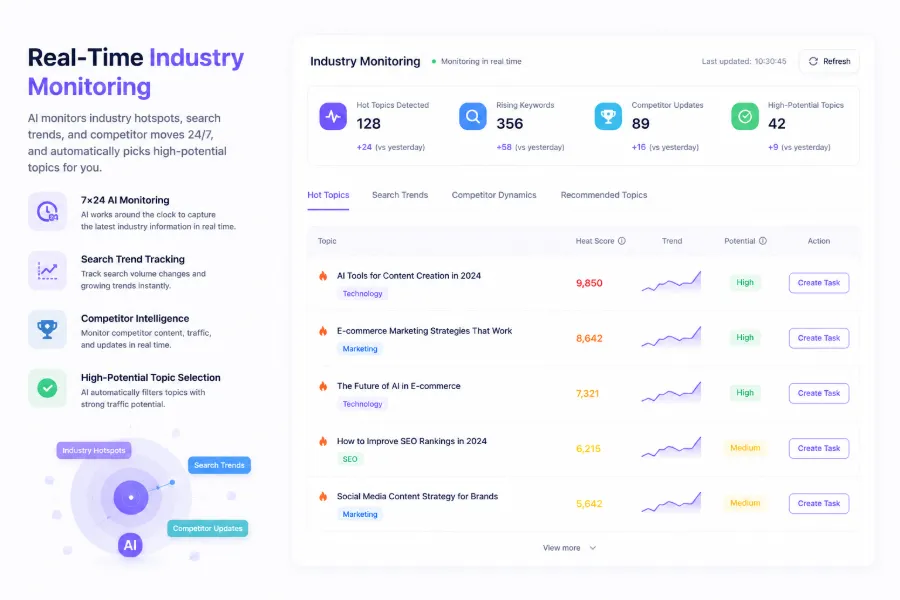
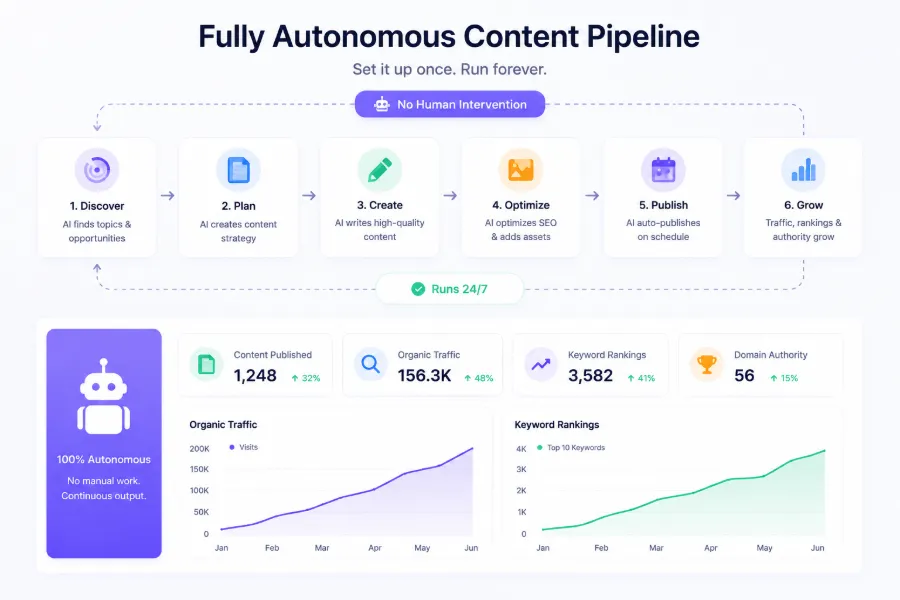
Mass content production and publishing automation need to match the high‑frequency update demand of AI citations. AI search engines’ citation preferences evolve with training data updates, so content must be continuously refreshed to maintain citation density. A conventional content pipeline—from topic selection, generation, to publishing—can run unattended, covering keywords, product links, trending topics, and other inputs. A typical automated workflow: AI real‑time monitors industry trends and competitor dynamics, automatically selects high‑potential topics, generates SEO‑optimized articles, publishes on a set schedule, and syncs to Shopify, WordPress, and other platforms. The operation of cross‑channel traffic engines demonstrates how synchronized multi‑platform distribution creates synergistic effects.
A practical lesson from a real case: the operator mentioned at the beginning reallocated content budget after adjusting attribution scope—shifting 60 % of capacity to FAQ pages and AI‑friendly content, keeping 40 % for traditional SEO long‑form. Conversion rates rose 18 % within a quarter, but total organic traffic fell 7 %—because low‑conversion keyword content was cut. This result shows that attribution adjustments inherently involve a temporary “traffic reduction but quality improvement” trade‑off, rather than chasing double‑digit growth on both metrics.
FAQ
What’s the actual difference between AI citations and organic traffic in attribution?
AI citations are “pre‑search visibility”: users see the brand name in an AI answer without clicking your page. Organic traffic is the immediate conversion signal after a user actively searches and clicks into the site. AI citation value manifests 2–4 weeks later as brand‑term search growth, whereas organic traffic is an instant conversion signal. They should be recorded separately in attribution.
Without a dedicated tool, how can I manually track brand citations in AI search?
Set a fixed weekly time to perform “brand term + category term” question‑style queries in ChatGPT, Perplexity, and Google AI Overviews. Record citation count, surrounding context, and recommendation phrasing. Use a spreadsheet to log weekly data; after four weeks you’ll see a trend. The whole process takes about 30 minutes per week.
How long does it take to see the ranking boost from brand mentions?
Typically there’s a 2–4‑week lag window. The weight from external mentions needs time to propagate to on‑site rankings, and the effect is nonlinear—uniform cross‑platform coverage matters more than high frequency on a single platform. Evaluate on a monthly basis rather than weekly.
Is it still worth investing in traditional SEO in 2026?
Yes, but expectations must be adjusted. Traditional SEO remains the primary source for brand‑term searches and direct conversions, but it is no longer the sole traffic source. A sensible strategy retains the core SEO foundation while allocating new capacity to AI citations and brand‑mention coverage. The two are complementary, not substitutive.
How can I tell if AI‑driven traffic actually converts into orders?
Compare the timeline of brand‑term search volume changes with order growth. If brand‑term searches rise and orders increase 2–4 weeks later, AI‑driven traffic quality is high. If brand‑term searches rise but orders stay flat, users are only seeing the brand name without forming purchase decisions; you’ll need to examine the landing‑page conversion funnel.
Share Article