
Companies that publish content daily are the true winners of search

I ran an independent site for half a year, but the backend data never showed any clear improvement. Looking at Search Console, I found that Google’s crawler visited only once every two weeks, and when it came, it only fetched the homepage and two old articles before leaving. The sitemap contains fewer than 15 pieces of content, and the newest one was posted 42 days ago. This isn’t an isolated case. Most independent‑site operators update their blog weekly or even monthly; search‑engine crawlers keep returning but find no new content to index, so rankings stay stagnant for a long time. However, a certain type of company is completely different—they can consistently produce high‑quality articles every day, and after a few months their search traffic shows a clear gap. The difference isn’t the size of the copywriting team; it’s whether content production has been turned from a “hand workshop” into an “automated assembly line.”
Why “daily publishing” can continuously leverage search weight
Search engines’ preference for fresh content is no secret. Google’s crawler budget is limited; for a site that hasn’t been updated for a long time, the crawler gradually reduces its visit frequency and may even ignore new pages. Conversely, a site that publishes new content every day gives the crawler something new to fetch on each visit, and over time the crawl frequency naturally increases. More importantly, consistently outputting content on the same topic helps build Topical Authority—search engines assess whether a site has deep understanding of a field by analyzing the density and breadth of related content. Daily‑publishing sites often publish more than 30 times the number of articles a monthly‑publishing site does within six months, covering far more related keywords and entities.
Data shows that sites publishing 4–5 articles per week see an average 240 % increase in search traffic over six months, while sites publishing 1–2 articles per month only see a 30 % increase. This gap widens over longer periods. Crawling budget on continuously updated sites is used more efficiently: each crawler visit discovers new content, prompting a quicker return visit and creating a positive loop.
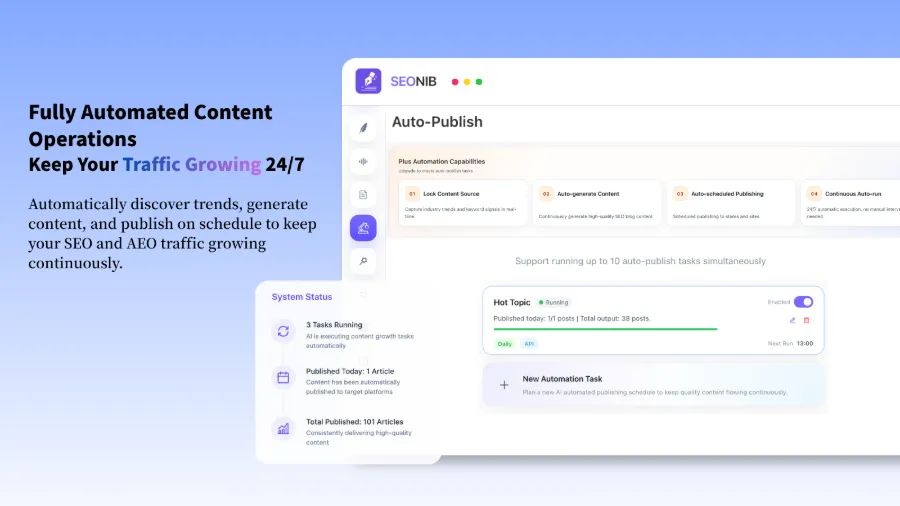
Day‑after‑day updates are not just about volume; they change how search engines perceive a site’s “activity level.” A site with a new article every day, even if each article draws modest traffic, enjoys significantly better overall indexing efficiency and ranking stability than a site that updates only occasionally. This effect applies to independent sites on mainstream platforms like Shopify and WordPress, without needing a high‑authority domain endorsement.
The real challenge isn’t writing, but having a “worthy” topic every day
Many operators hit a wall in the second week of trying daily updates. It’s not that they can’t write; they don’t know what to write about. Manually monitoring industry trends, analyzing competitor content gaps, and mining long‑tail keywords each require 30–60 minutes. One or two viable topics per day already consume most of the work effort, let alone writing and publishing. The biggest bottleneck in content production has never been the text output but the supply of topics.
When the topic pool dries up, the update frequency is forced to drop. Even worse, after a month of no updates, a crawler returning to the site may find uneven content quality or even duplicated content, reducing trust. Maintaining a sufficient daily topic supply requires turning topic discovery from “manual” to “systematically automated.”
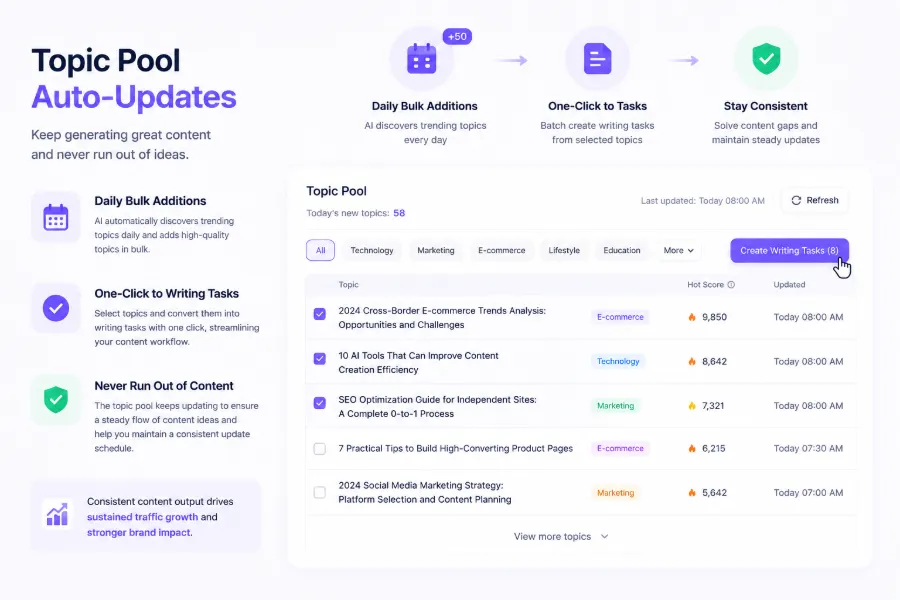
An automated topic system can monitor industry trends in real time, capture competitor content gaps, evaluate keyword search volumes, and batch‑generate topics each day, pushing them to the writing queue. Operators no longer need to scroll Twitter or check competitor blogs daily; they just pick the most suitable few from the topic pool and convert them into writing tasks with one click. Manually discovering a viable topic usually takes 30–60 minutes, whereas an automated tool can shrink this to almost zero. This means the topic‑selection step is no longer a bottleneck, and the upstream of the content pipeline becomes continuous and stable.
From keyword to publishing: a reusable content pipeline
Break content production into clear steps, reducing human intervention at each stage, and daily publishing becomes achievable. The pipeline consists of four stages: input source, AI generation, scheduling & automated publishing, multi‑platform synchronization.
Input sources can be keywords, product links, social‑media posts, competitor article links, etc. For example, a trending Twitter post can be directly turned into an SEO‑optimized blog article. For independent‑site merchants, a product page URL is the most efficient input source—plug in a product link and generate a buying guide, review, or tutorial. If you want to quickly turn more social‑media content into blogs, see this guide: Turning Social Media Links into Blog Posts.
Once the input source is ready, AI generates a fully structured article based on brand context, SEO rules, and industry knowledge. This step can already auto‑add images, optimize meta descriptions, and insert internal links—no manual formatting or image uploading needed.
The video shows the complete flow: just input a keyword, and AI automatically creates and publishes the content. The generated article enters the scheduling queue; set a daily publish time, and the system will automatically post on schedule. If you need to process many data sources in bulk, use the Batch Publishing · Data Sources feature to import multiple keywords or product links at once.
Multi‑platform synchronization is another key capability. After a piece of content is generated, it can be pushed simultaneously to Shopify, WordPress, SHOPLINE, WooCommerce, and other platforms—no need to log into each backend and copy manually. With an automated pipeline, the time from input to publishing shrinks from 2–3 hours to under 10 minutes.
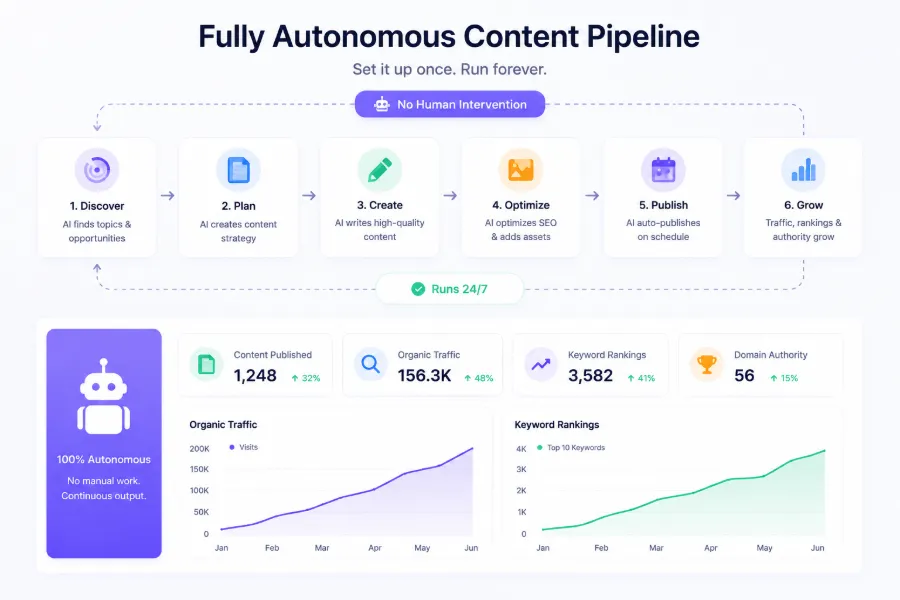
Tools like SEONIB integrate these four steps into a closed loop: auto‑discover trends, generate content, schedule releases, and sync to multiple platforms. The entire process runs automatically, no daily backend logins required. For a new site, even without backlinks, a correct content strategy can win a foothold in search engines—see this case study on How a Zero‑Backlink New Site Can Win at the Starting Line with the Right Idea. For detailed configuration of each input source, consult the full help documentation: View the Complete SEONIB Help Docs.
How daily publishing translates into actual search visibility growth
The first observable change from continuous updates is an increase in indexed pages. An independent‑site operator shared his data: after adopting a daily‑publish strategy, Google indexed pages grew from 20 to 200 within six months, and AI search result citation frequency tripled. This isn’t an isolated case. Once a site’s content density reaches a certain threshold, search engines treat it as an active information source for that field, boosting crawl frequency and improving rankings for long‑tail keywords.
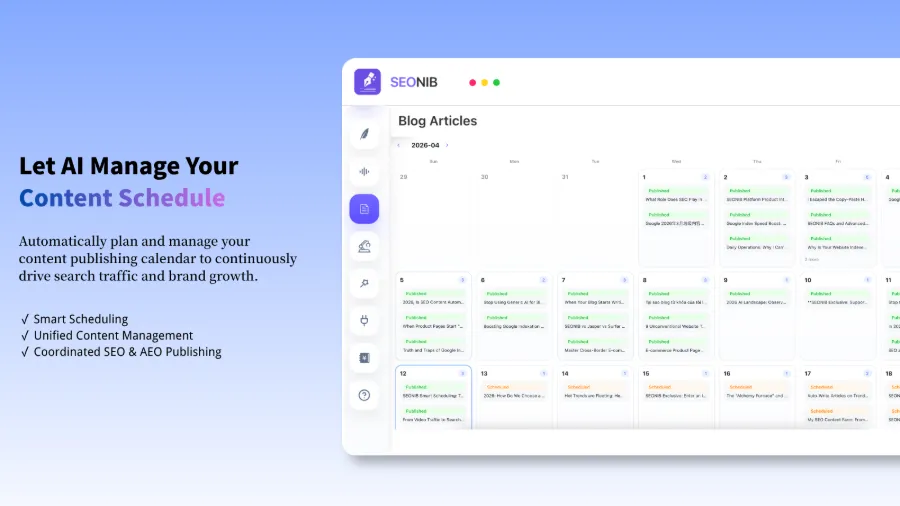
The role of automation tools isn’t just time‑saving. They turn content output into a system capability—no reliance on a single person’s inspiration or stamina; batch generation, scheduling, publishing, and syncing are all automated. SEONIB user feedback shows that after adopting an automated pipeline, continuous updates no longer require a dedicated staff member; a month’s worth of content that previously took a year can now be produced.
Another noteworthy change is the increase in AI‑search (ChatGPT, Perplexity, etc.) citations of the site’s content. AI search engines prioritize citing sites with high authority and clear information structure when generating answers. Continuous updates mean the site has more structured content (FAQs, entity pages, knowledge bases), making it easier for AI search engines to crawl and cite. For analysis on how brand consistency affects AI‑search citations, see Brand Consistency Is the Hidden Ticket to AI Search.
For merchants using SHOPLINE, there’s a dedicated solution to gain AI‑search citations faster—see GEO for Shopline Stores Getting AI Citations. Ultimately, daily publishing isn’t just a tactic for traditional search rankings; it’s foundational infrastructure that gives a site visibility across multiple search modalities (traditional + AI).
FAQ
Will daily publishing compromise quality?
Quality drops are usually not about frequency but about topic and input source selection. If you always pick topics from the same keyword pool, duplication naturally rises. However, with diversified input sources (product links, social media, trending topics, competitor gaps), AI‑generated content will vary in theme, angle, and depth. Additionally, you can preview and fine‑tune content before publishing to ensure quality standards.
I don’t have professional writers—can an average person publish daily?
Yes. The core of an automated pipeline is turning writing from “creation” into “editing.” The system recommends input sources, AI writes the article, and the operator only needs to review titles, adjust examples, and confirm the final version. Someone without SEO background can spend 20–30 minutes each day reviewing and publishing content, following a fixed workflow, and achieve daily updates.
How long does it take for a brand‑zero‑authority new site to see results from daily publishing?
Usually 3–6 months. The first month may show no obvious traffic change, but Search Console will display a steady increase in indexed pages. From months 2–3 onward, long‑tail keywords begin to rank, and around month 6 traffic shows a clear jump. The key is not to interrupt the first 90 days; search engines need that period to build trust in the site.
For cross‑border e‑commerce independent sites, which keywords should be prioritized?
Prioritize long‑tail keywords with clear search intent, such as “Bluetooth headphones recommendation for outdoor activities in the US” rather than just “Bluetooth headphones.” Also focus on product‑related “how,” “what,” and “compare” question keywords. These have low competition, high conversion rates, and can be directly linked from product URLs to purchase pages.
Will daily updates cause duplicate or similar content?
They can if the topic source is singular. To avoid duplication: establish multiple input sources (keywords, competitor articles, social media, customer questions, industry news) and use different templates or angles during generation (buying guide vs. review vs. tutorial vs. Q&A). Regularly audit the topic pool; if the proportion of similar topics becomes too high, adjust the input source configuration promptly.
Share Article