
Publishing 1,000 Articles a Year: How a Content Automation Pipeline Works
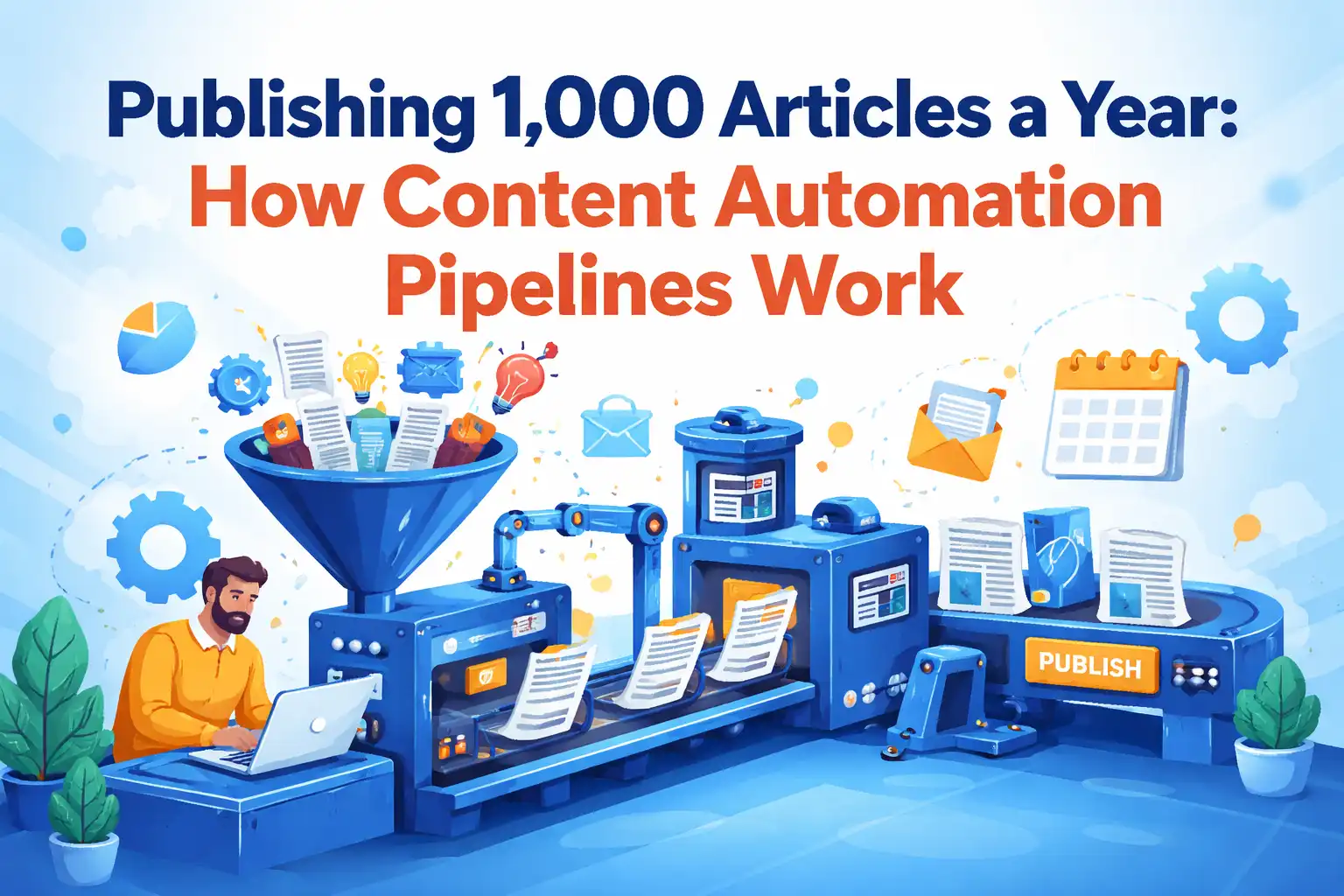
Open the editor, stare at a blank page, and have no idea what to write today—this is probably the most common dilemma for cross‑border sellers when creating content. Producing two or three pieces a week already leaves people exhausted, yet teams that publish over 1,000 articles a year don’t rely on a larger content team; they rely on an end‑to‑end automated pipeline that covers everything from topic discovery to multi‑platform publishing. This article breaks down the specific steps of that pipeline and the real trade‑offs at each stage.
Why You Often Finish Half the Work Before You Even Start Writing
Many operators’ first instinct is to open the editor and start typing. That is precisely the slowest way to produce content. Without a topic direction, keyword strategy, or structural template, the output becomes a series of isolated articles that neither achieve thematic coverage nor accumulate search authority. Data from cross‑border independent sites show a reality: on average, an article starts receiving stable organic traffic about 14 months after publication. If there’s no strategy during those first 14 months, that time is almost wasted.
The real gap appears before you even pick up the pen. First, establish a “topic‑keyword‑structure” system so that every piece of content points in the same direction instead of firing randomly. This system doesn’t need to be complex, but it must operate continuously—extracting search demand from search engines, identifying content gaps from competitor sites, and catching trend signals from social media.

Many sellers fall into a loop of purely manual writing, spending a lot of time each day thinking about “what to write” instead of “how to write”. The former decides whether anyone will see the content; the latter decides how good the content looks. If the direction is wrong, even a massive amount of writing becomes a sunk cost.
Step 1: Bulk Topic Selection Instead of Racking Your Brain Daily
Topic selection isn’t about inspiration; it’s about a pipeline. An efficient topic pipeline can generate over 30 content ideas per week. Operators need to build a workflow within this pipeline: pull rising trends from Google Trends, export keyword lists from Ahrefs or Keywords Everywhere, and analyze which topics bring traffic to competitor blogs on independent sites.
Then comes filtering. Not every topic is worth writing about. The screening criteria are threefold: stable search volume, competitive space (i.e., the top‑10 ranking sites aren’t dominated by big brands), and coverage of a sufficiently specific sub‑need. For example, “Shopify SEO” is too broad, while “Shopify product page title best practices” is a targetable long tail.
If you haven’t set up your own keyword research process, you can refer to this Keyword Research Guide, which covers common practices from data acquisition to topic conversion.
Step 2: Structured Workflow for Content Generation and Bulk Production
The gap between manually copying and pasting from a single site to “one input, multiple outputs” lies in workflow standardization. The core of structured bulk generation isn’t AI; it’s templates, brand guidelines, instructions, and a review loop.
The table below compares the time differences between a purely manual approach and a structured workflow at each stage:
| Stage | Manual Time | Structured Workflow Time | Key Difference |
|---|---|---|---|
| Topic organization | 30–45 minutes | 5 minutes | Automatic keyword pool import |
| Outline drafting | 20–30 minutes | 2 minutes | Template reuse |
| Content filling | 40–60 minutes | 3 minutes | AI generation + rule constraints |
| Formatting & SEO metadata | 15–20 minutes | 1 minute | Automatic title/description/tag generation |
| Review & adjustment | 15–30 minutes | 10 minutes | Only minor fact‑checking and tone tweaks |
Structured bulk generation can compress the preparation time for a single article to under 5 minutes—provided you’ve already set up templates, brand lexicons, and internal‑link rules. Many underestimate this upfront investment, thinking “just use AI and you’re done,” only to end up with generic, sometimes factually incorrect output.
In practice, tools like SEONIB can generate structured drafts directly from keywords or product links, embedding SEO metadata and internal‑link strategies. However, the tool only runs the process; it can’t judge source reliability. A useful rule of thumb: after each bulk generation, randomly sample 20 % of the drafts for manual verification, focusing on data citations and product description accuracy.
The video above demonstrates the full flow from keyword input to automatic content generation and publishing. You can see how the structured process turns vague creative ideas directly into publishable drafts, skipping a lot of repetitive work.
For quick validation of content direction, also check out How to Validate Project Ideas with Free Sites. The approach is similar—low‑cost trial and error before scaling resources.
Step 3: Scheduling and Automated Publishing—Do You Need Human Oversight?
Automation does not mean “set it and forget it”. Many teams set up scheduled publishing and never look back, resulting in articles going live without format checks or index tracking. A content calendar’s role isn’t just “remind to publish”; it’s to “provide review checkpoints”.
Setting up scheduling and review logic follows three steps: first, define content format standards (title length, image ratio, internal‑link count); second, set publishing frequency (3–5 pieces per week is a safe starting cadence); third, define a review cycle (check Google Search Console index status and click‑through changes every two weeks).
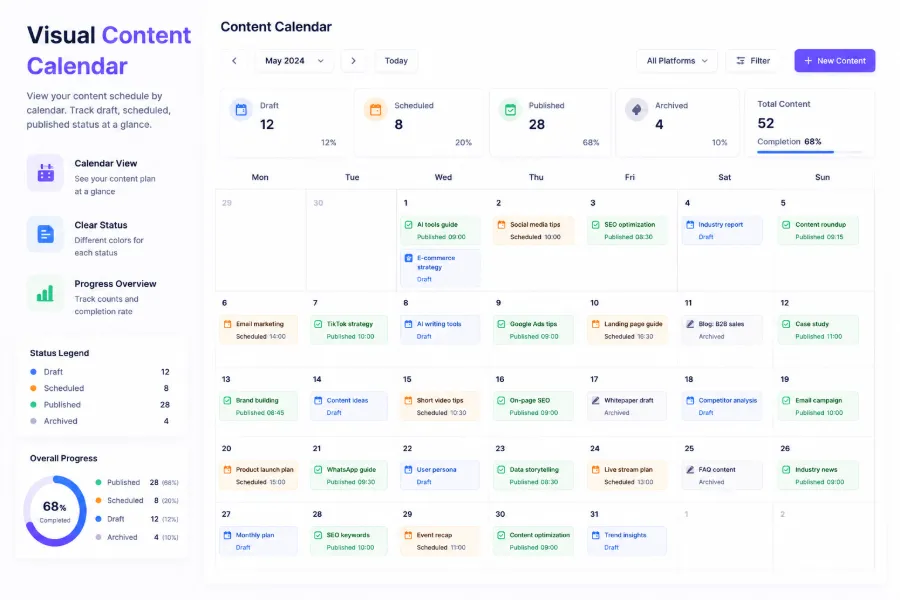
According to operational data, sites that update with a fixed 3–5 pieces per week see an average 40 % increase in Google indexed pages after six months. This assumes the content itself is differentiated, not just duplicated. If you’re using SEONIB or similar tools for automated scheduling, remember to preview each article before publishing to confirm image links work and shopping cards aren’t broken. If you’re unfamiliar with the configuration, consult the SEONIB Help Documentation for platform‑specific publishing rules.
Common failure case: a seller set up automatic publishing of two articles daily but never checked the backend. After three months, the index rate was only 30 % because many articles were flagged as low‑quality duplicates. Automated scheduling must be paired with regular performance audits; otherwise it’s self‑deception.
Step 4: Multi‑Platform Sync—Create Once, Publish Everywhere
Cross‑border e‑commerce often manages multiple sites: a Shopify main site, a WordPress blog, a Shopline sub‑site. Manually uploading the same article to three backends consumes 6–8 hours per week and easily leads to format mismatches (e.g., Shopify’s image cropping rules differ from WordPress).
The engineering logic for multi‑platform sync is “write once, distribute automatically”. Yet three hidden costs remain: format adaptation (different platforms support different HTML tags), internal‑link rewriting (each site has its own link structure), and regional differences (the same product may need different emphasis in different markets).

If you operate cross‑border sites, multilingual publishing is a typical use case for the sync mechanism. Translating a Chinese article into English and Japanese requires keyword substitution and localized phrasing; pure machine translation won’t cut it. A good sync strategy is: core content auto‑sync, peripheral content (comments, FAQs) manually adjusted as needed.
For the broader trend of multi‑platform coverage, read No More Relying Solely on Google: The New SEO Landscape. Content distribution should not bet on a single search engine.
Hidden Costs and Strategic Trade‑offs of High‑Speed Production
Bulk output without quality leads to immediate consequences. In 2019, a major seller published over 200 articles in a single month; six months later, 60 % of those pages received zero traffic because they lacked a thematic strategy, overlapped, and even produced multiple versions of the same keyword competing against each other.
The most common issue in bulk production is “content zombies”: massive publishing with no follow‑up maintenance. Stale content that never gains traffic dilutes a site’s overall thematic coverage and can signal to search engines that the site’s content quality is low. An often‑overlooked observation: high‑frequency publishing teams tend to focus more on “deleting content” than on “creating content”. Regularly cleaning up zero‑traffic old pages reduces crawler waste and prevents low‑quality content from dragging down site scores.
The real bottleneck in a content pipeline isn’t writing; it’s topic filtering. Many teams spend a lot of time generating articles only to find their lifespan short—because the topic was already covered by multiple competitors at the time of publishing, leaving no genuine user‑need gap. Therefore, before investing in generation, add an extra competitive analysis step: search the target keyword, see if the top 10 results already cover it comprehensively; if they do, approach from a different angle.
For how to support AI‑driven search engine optimization with content, see How Content Supports the AEO Framework. AEO (AI Engine Optimization) is reshaping how content is presented; if your content is only designed for traditional search, it may be ignored in AI‑generated summaries.
FAQ
Q1: How many people are needed to publish 1,000 articles a year?
If one person tries to do every step manually, it’s virtually impossible. With an automated pipeline, one person can cover topic selection, generation, publishing, and performance monitoring, provided they invest time upfront to build templates and rules. Publishing 1,000 articles a year translates to about 20 per week; under a structured process, this requires only 2–3 hours of focused work per day.
Q2: Can automatically generated tools guarantee content quality?
No, they cannot guarantee it automatically. Tools only produce drafts that meet formatting requirements; quality depends on the brand guidelines, data sources, and review mechanisms you provide. It’s advisable to audit 20 % of each batch, focusing on factual errors and product description consistency.
Q3: How many articles should be published per day?
Frequency should be driven by quality, not quantity. For most independent sites, 3–5 pieces per week is a safe starting cadence. Publishing more than five per week requires each piece to have distinct value; otherwise, you risk triggering duplicate‑content detection by search engines.
Q4: After publishing 1,000 articles, how should I track performance?
Focus on three metrics: total indexed pages in Google Search Console, click‑through rate changes, and the proportion of zero‑traffic pages. Every two weeks, run a content audit and merge or delete pages that have had zero traffic for over three months.
Q5: When traffic declines, should I delete old content first or keep publishing new?
First, audit low‑quality old content (duplicates, outdated, zero‑traffic) and prioritize deleting or merging them. After cleanup, the site’s thematic clarity improves, and new content tends to get indexed and ranked faster.
Share Article