
From SEO to GEO: How Agencies Can Build AI Search Optimization Services for Clients
In the past year, almost every quarterly review has been interrupted by the same question: “How do we get our brand to appear in ChatGPT’s answers?” Clients’ focus is shifting from Google rankings to AI visibility, and most agencies are not yet ready to respond. 54% of enterprises want their existing SEO partner to handle AI search optimization, which means that if you don’t answer this question proactively, competitors are already knocking on the door with “GEO” solutions.
GEO does not replace SEO; it is a natural extension of SEO capabilities. If your team already knows how to do content strategy and structured data optimization, the underlying logic of GEO is not unfamiliar. The real challenge is: how to fit this new service into the existing delivery system and how to get clients to pay for it.
First, Clarify What GEO Is — and What It Isn’t
GEO (Generative Engine Optimization) essentially makes brand content easier for AI systems to understand and cite. Its core overlap with SEO is obvious: content structure, authority building, E‑E‑A‑T signals, topic depth — the strategies that work for Google also apply to ChatGPT, Perplexity, and Gemini. A study by Writesonic shows that 40.58% of AI citations come from Google’s top‑10 results, indicating a strong link between traditional search rankings and AI visibility.
However, GEO and SEO have several key differences. The metrics differ — you no longer only look at keyword rankings and organic traffic; you must track AI citation counts and the brand’s appearance rate in AI answers. The tool stack differs — Google Analytics and Search Console cannot tell you how often your brand is mentioned in Perplexity. The topic strategy also differs — AI engines prefer citing content that is clearly structured, has complete FAQs, and densely covers entities.
I have seen many clients who, upon hearing “GEO,” think “the money we spent on SEO was wasted.” In fact, GEO is an upgrade to SEO, not a replacement. When explaining to clients, I usually use an analogy: SEO is like getting your book placed on a library shelf; GEO is like the librarian actively mentioning your book when recommending titles. Both are important, but the competitive landscape for the latter is not yet intense.
How to Integrate GEO Into Your Existing Service Package
When I first launched GEO services, I made two mistakes. First, I packaged it as a brand‑new standalone product, and the client’s immediate reaction was “more money again.” Second, I didn’t set a clear expectation timeline, so three months later they asked, “Why is ChatGPT still not mentioning us?”
Later I changed the approach and made GEO an add‑on to the existing SEO package. For existing clients, I do only one thing: add an “AI citation rate” goal to their next quarter’s content calendar. Then, in daily optimization, I take three extra steps: adjust heading hierarchy so AI can more easily parse key information, add FAQ structured data, and strengthen the density of entity mentions.
The method isn’t complicated. Take an existing client blog, check that the H2‑H4 hierarchy is clear — AI engines use heading structure to infer content logic. Then add an FAQ block at the end, turning natural questions around the target keyword into structured data. Finally, ensure that the brand name, product name, and industry terminology appear frequently enough — AI judges authority on a topic by entity density.
I recommend starting with 1‑2 clients for a three‑month pilot. In the small‑step validation phase, you can follow the approach of “zero‑investment market‑fit testing” (https://seonib.com/c/landing-pages/growth/zero-to-one-test-your-product-s-seo-amp-visual-market-fit-without-upfront-investment): optimize a few pages for GEO, compare AI citation changes before and after, and then decide whether to roll out broadly. If the client is a Shopify merchant, their content structure is usually tidy; just follow the product page layout logic on the Shopify website (https://shopify.com) for adjustments.
Pricing and Delivery Boundaries for Stand‑Alone GEO Consulting
Pricing GEO is hard to map directly onto SEO standards. SEO is billed by keyword count and site size; GEO currently lacks mature market reference prices. I have tried two models:
| Dimension | GEO Supplemental Service | Stand‑Alone GEO Consulting |
|---|---|---|
| Pricing method | Fixed monthly fee, about 30%–50% of the SEO package | Project‑based, one‑time fee for GEO audit + strategy report |
| Suitable scenario | Existing SEO clients | New clients or brands focused only on AI visibility |
| Delivery timeline | Ongoing monthly optimization | 2–3 weeks for audit report |
| Core deliverables | Monthly AI visibility report + content optimization | List of AI citation opportunities + structured data recommendations |
The two most common client questions are: “How soon will we see results?” and “How do we prove the new traffic comes from AI search?” I usually set a three‑month initial impact window. As for attribution, there is no perfect tool — GA4 cannot distinguish whether a user came from ChatGPT or Google. My approach is to combine short‑term qualitative feedback with long‑term citation growth rates, showing a curve of the brand’s appearance frequency in Perplexity and ChatGPT.
An interesting observation is that the “top brand” in AI search rotates more than 50% each cycle, meaning GEO is not a one‑time fix and requires ongoing maintenance. For agencies, this is actually an advantage because it creates long‑term service opportunities. If you’re optimizing e‑commerce client stand‑alone sites, consider combining a GEO audit with the analysis of “Factors that make a SHOPLINE store rank higher” (https://seonib.com/c/knowledge/content-marketing/what-makes-a-shopline-store-rank-higher-in-google-2026/index) to produce a dual‑dimension report of “Google ranking vs AI visibility,” which more easily convinces clients to buy.
Standardizing delivery is key to reducing marginal costs. I have compiled a set of GEO delivery templates, including AI visibility audit templates, citation opportunity list templates, and monthly report templates. If you want to further standardize your workflow, refer to the help documentation (https://seonib.com/help) and simply fill in client data.
Supporting GEO Delivery with a New Tool Stack — From Audit to Content Generation
Traditional SEO tools cannot measure AI visibility. You need a new toolchain that covers audit, content generation, and publishing. When building this workflow, I ultimately chose SEONIB (https://www.seonib.com) as a core part of the stack because it handles everything from trend discovery to bulk publishing.
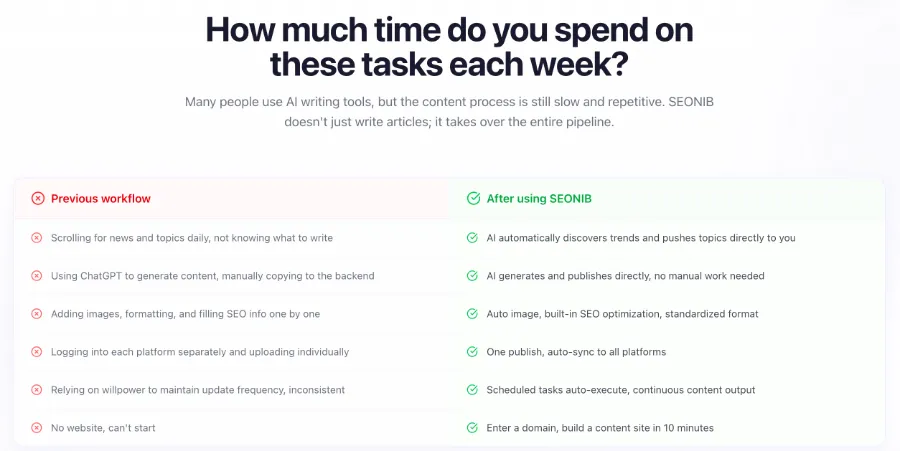
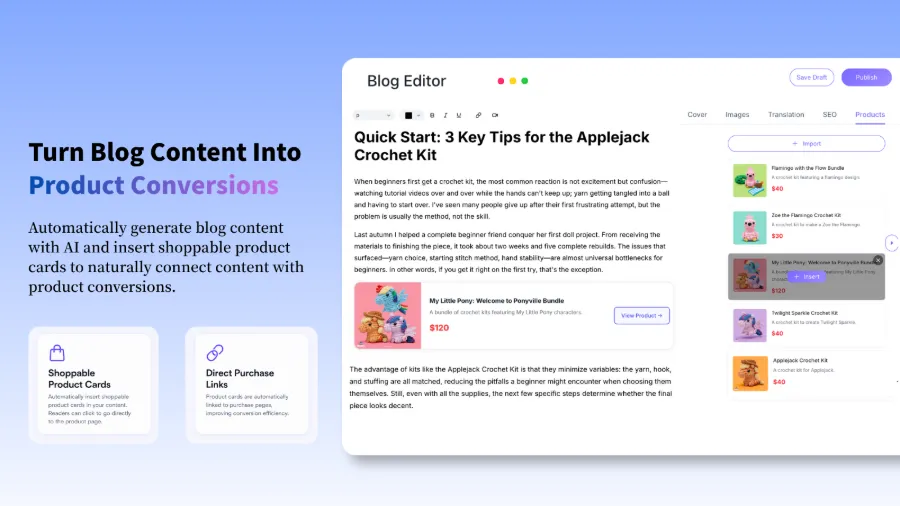
The workflow looks like this: input a product link, SEONIB automatically generates Q&A content — this type of content is naturally suited for AEO (AI Engine Optimization). Then it automatically embeds purchasable product cards into long‑form blogs. Manually creating one blog takes 3‑4 hours; after automation, it shrinks to under 10 minutes.
One important point: don’t hand everything over to AI. Automation tools excel at bulk production, but brand personality, contextual consistency, and the accuracy of internal data references must be manually reviewed. I’ve hit the pitfall of AI‑generated content with misspelled brand names, outdated product specs, and misused industry terms; publishing without checking would actually damage the brand’s trustworthiness in AI engines.
SEONIB’s bulk capabilities let me complete the optimization and publishing of 50 blogs in a week, but if a client demands high content quality, I set the automation ratio to 70% and reserve 30% for human review. If you’re just starting a GEO pilot, the “quick‑website test for market viability” approach (https://juejin.cn/post/7630450023371112475) also works — test AI citation changes on 1‑2 content topics first, then decide whether to scale up.
How to Show Clients the ROI of GEO
Demonstrating GEO ROI is harder than traditional SEO because the attribution chain is incomplete. My current metrics are three‑tiered: AI citation count (brand appearances in ChatGPT/Perplexity/Gemini), monthly change in brand mention rate (via manual sampling or citation monitoring scripts), and AI‑search referral data tagged with UTM parameters (though incomplete, it serves as a reference).
My monthly report template is designed as follows: page one shows the citation growth curve, comparing brand appearance counts to the previous month; page two displays topic coverage changes — which keywords saw increased AI citation rates and which fell; page three provides a competitive comparison, showing the gap in AI answer appearances between the client and main competitors.
Clients worry not about “not appearing in ChatGPT,” but about “competitors appearing in ChatGPT while we don’t.” Therefore, competitive gap data more readily drives sign‑ups. In the report, I include screenshots of competitors appearing in AI answers and list the client’s content optimization opportunities, giving a clear path for improvement.
When discussing efficiency gains from content automation, you can reference the SEONIB bulk publishing to WordPress guide (https://seonib.com/c/guides/seonib-bulk-publishing-to-wordpress-turn-your-blog-into-an-automated-content-factory-2026/index.html) and show a set of comparative data: time to manually publish a blog vs time to publish via automation, proving value with efficiency numbers rather than promises.
For tool‑stack selection, you can use the “2026 Top 10 AI Content Marketing Tools” guide (https://seonib.com/guide/10-hottest-ai-content-marketing-tools) as a benchmark, demonstrating to clients the functional and cost advantages of the tools you’ve chosen.
FAQ
Q1: What’s the real difference between GEO and SEO? Do I just keep doing SEO?
GEO and SEO share many core strategies — content structure, authority building, topic depth are important for both. The difference lies in measurement (AI citation count vs keyword ranking), tool stack (traditional SEO tools can’t track AI visibility), and topic strategy (GEO needs more focus on FAQs and entity coverage). Good SEO gives you a solid foundation, but you must add AI‑visibility optimization actions.
Q2: I have no AI search optimization experience. Does my team need new skills?
No new skills are required, but you need to adjust your existing content optimization workflow: increase structured data coverage, strengthen brand entity tagging, and add more FAQ blocks. If the team already knows SEO, picking up GEO is a gentle curve; they can be up to speed in 1‑2 weeks.
Q3: A client says, “We see competitors in ChatGPT but not us.” What should we do?
Usually this means the competitor’s content structure is clearer, FAQs are more complete, and entity coverage is denser. Conduct an AI citation audit, identify gaps between the client’s content and the competitor’s, then target‑optimize 3‑5 high‑value pages. Typically, AI citation rates show a noticeable boost within 1‑2 months after optimization.
Q4: What does a typical GEO project timeline and pricing range look like?
Supplemental services are billed monthly, roughly 30%–50% of the existing SEO package, with continuous monthly optimization. Stand‑alone consulting is project‑based, lasting 2‑3 weeks, with fees depending on site size—generally a few thousand to tens of thousands of dollars. Results usually start to appear around the three‑month mark.
Q5: Is GEO only effective for big brands? Do small sellers benefit?
Small sellers actually have more opportunity. Large brands have a lot of content but update slowly; small businesses can cover long‑tail topics with high‑frequency content. GEO’s core advantage lies in content density and structured completeness, not brand fame—something small sellers can excel at.
Share Article