
How to Accelerate Research with Perplexity and Automate Publishing with SEONIB
Cross‑border sellers often have a broken content workflow. In the research phase, you open dozens of tabs each morning to browse industry news, competitor blogs, and record hot topics—weekly topic research alone takes about 6 hours. The publishing phase is even more tedious: manually uploading images, filling in SEO titles and descriptions, logging into each platform to copy‑paste. From idea to live blog, it takes several hours, most of which is spent on repetitive tasks rather than on content quality itself. This method—using Perplexity for efficient research and then an automation tool to handle the entire writing‑to‑publishing process—can compress the end‑to‑end time for a single piece of content to under 15 minutes. The key is to make the research specific enough and then hand the execution over to the system.
Trend Discovery & Research: Let Perplexity Replace Repetitive Information Filtering
Traditional research pain points stem from information overload, not scarcity. You open Google Trends, SEMrush, and Ahrefs, see a flood of rising keywords and competitor ranking changes, but turning those into a writeable topic still requires manual cross‑checking and judging whether the trend relates to your category. This step usually consumes the most effort.
Perplexity’s search and follow‑up questioning can dramatically shorten this filtering process. For example, if you sell small kitchen appliances, you can type into Perplexity “fastest‑growing sub‑categories of small kitchen appliances in Europe and America in 2025” and it will return an answer with source summaries, concrete trend data, related articles, and discussions. You can then ask, “Among these trends, which have low competition on Amazon and Google?” and it will give a preliminary judgment based on the search results. The outcome isn’t a generic list of hot topics; it directly points you to 3‑5 specific topics with search demand but insufficient content coverage.
The more focused the research, the greater the efficiency boost in subsequent content creation. Many sellers’ content inefficiencies stem from research topics, not from AI tools being inadequate. When you lock down a concrete question with Perplexity—e.g., “What are alternatives to silicone baking paper for air fryers?” instead of “kitchen product trends”—the subsequent writing already has a clear skeleton.
Content Generation: Rapid Conversion from Research Results to Draft
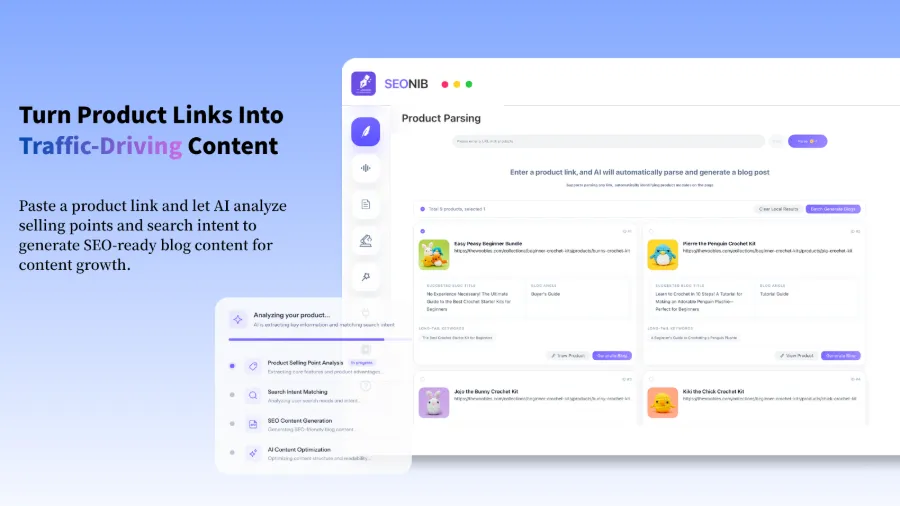
Once you have a concrete topic, the next step is turning the research summary into a content framework. Perplexity’s generated search result summaries can serve directly as the starting point for a blog outline, but there’s a often‑overlooked step: you need to fill in the missing exclusive insights, such as return reasons you’ve encountered, logistics constraints, or frequent customer questions. The core task of human editing is not to write from scratch but to oversee the structure and add first‑hand data.
Using this method, the time from topic selection to first draft drops from 2 hours to 20 minutes. A 1,500‑word draft can be assembled in a few minutes, provided you have already supplied a sufficiently specific topic and reference material in the previous step.
This stage does not require perfection. After the draft is ready, spend 5–10 minutes checking factual accuracy, adding exclusive cases, and adjusting the tone to match brand voice—these editing tasks usually take that long. The rest of the structure and language fluency are already well‑handled by AI.
Automated Publishing: Push Verified Content to All Platforms with One Click
After the content is finished, manually logging into WordPress to upload images, fill SEO fields, then logging into Shopify, SHOPLINE, Medium, and copying‑pasting everywhere would erase all the time you saved. In a traditional publishing workflow, synchronizing a piece of content across multiple platforms requires at least 4–5 repetitions, each prone to errors—broken image links, formatting issues, inconsistent SEO meta descriptions.
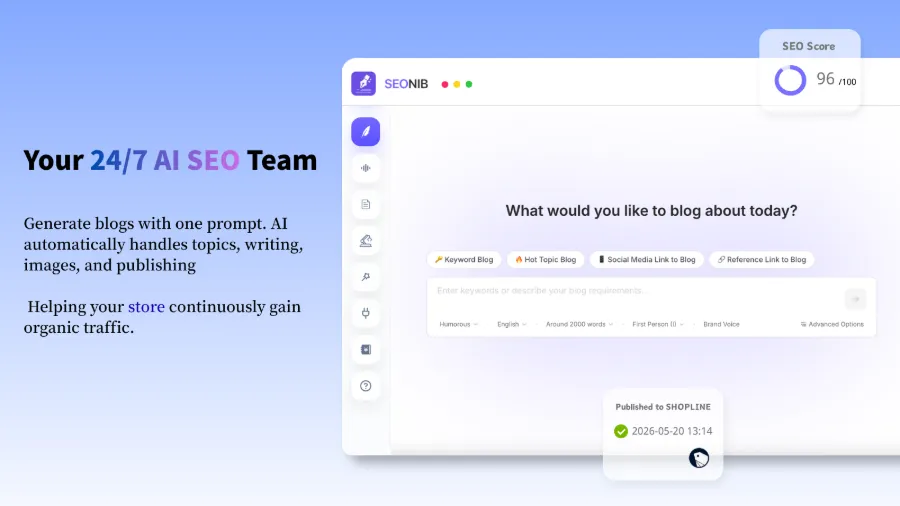
Enter the automation phase: SEONIB pushes the verified content to all bound publishing platforms with a single click. After you confirm publishing post‑verification, the system automatically handles image uploads, SEO field population, and format adaptation. The scheduling feature works like this: set a weekly publishing frequency, and AI executes the plan automatically, eliminating the need to log in daily to trigger publishing. After adopting automated scheduling, the time spent maintaining 30 pieces of content drops from about 4 hours per week to almost zero—only roughly 30 minutes per week are needed for a final verification of the generated content.
The hidden value of automated publishing isn’t just time saved; it removes the psychological barrier of “starting to write.” When the schedule system advances automatically, content output no longer depends on a tired evening decision to write or pause. Many independent‑site sellers keep their content updates not because of willpower but because the schedule is set and the system runs on its own. For specific configuration of this continuous publishing model, see the guide on how independent sites can automatically publish daily SEO content.
In terms of platform integration, SEONIB is now officially listed in the SHOPLINE App Store, allowing users to install it directly from the SHOPLINE backend, further simplifying the binding process. SHOPLINE sellers can view details at SEONIB’s successful entry into the SHOPLINE App Store.
Content Reuse & Expansion: One Investment, Multiple Formats
Using the same set of research material for just one blog is a huge waste. The trend information and user pain points you dig up on Perplexity can be transformed into many content formats.
Example: a blog titled “Portable Coffee Maker Buying Guide” can be repurposed into an AEO Q&A page (answering “Which scenarios are portable coffee makers suitable for?”), a series of LinkedIn short posts (distilling three key buying factors), and a 3‑minute video script (showing unboxing comparisons across price tiers). After reusing the same research material, weekly content output can increase from 5 articles to 15 different assets.
| Content Format | Input Source | Time per Production | Weekly Reuse Frequency |
|---|---|---|---|
| Standard Blog | Keyword/Trend Topic | 15 minutes | 5 times |
| AEO Q&A Page | Existing Blog Content | 5 minutes | 3 times |
| Social Media Short Post | Blog Summary | 3 minutes | 7 times |
| Video Script | Blog Outline | 10 minutes | 2 times |
However, there’s an easy‑to‑make mistake. One independent‑site seller directly reformatted a blog about “Outdoor Tent Buying Guide” and published it unchanged on LinkedIn and Medium, without tailoring it to each platform’s audience habits. LinkedIn professionals found the content too basic, while Medium’s deep‑readers thought the information density was insufficient, resulting in no expected recommendation traffic on either platform. Simply converting format without platform‑specific adjustments leads to inconsistent quality and lower user recognition. The correct approach is to adjust the focus per platform: LinkedIn emphasizes practical decision points, Medium adds data depth, and YouTube/TikTok leans toward visual demonstration.
During reuse, SEONIB supports quickly converting a blog into an AEO Q&A page, reducing manual rewriting. If you have a high publishing frequency, different plans impose various limits on the number of pushes you can generate; consult the detailed SEONIB pricing plans to choose a configuration that fits your operational scale. Additionally, if you use SHOPLINE as your main site builder, follow the complete tutorial for connecting a SHOPLINE site with SEONIB to bind and push content directly from the automation system to SHOPLINE product pages and blogs.
FAQ
Q: How does research with Perplexity differ from Google search?
Perplexity provides more direct information aggregation. Google returns a list of links that you must open, read, and synthesize yourself; Perplexity gives a source‑cited summary answer and lets you ask follow‑up questions to dive deeper. For cross‑border sellers’ trend research, Perplexity eliminates the need to skim 5–10 pages, reducing research time per topic from about 30 minutes to roughly 8 minutes.
Q: Will automated publishing sacrifice the quality of human‑written content?
It depends on where you intervene. If you let AI handle everything from topic to publishing without any human oversight, quality can be unstable. However, if you place human verification before publishing—checking factual accuracy, adding exclusive data, adjusting tone—the output quality can match or even exceed manual writing. Automation saves repetitive formatting and multi‑platform distribution time, not editorial decision‑making.
Q: How can I ensure consistent quality across different formats when reusing content?
The core principle is “customize for each platform.” When converting a blog into a social media post, extract 3‑5 core points rather than copying the opening paragraph verbatim. When turning it into a video script, restructure narrative pacing and visual cues. Consistency comes from using the same research material and core arguments, not from word‑for‑word duplication.
Q: Is this workflow suitable for a solo independent‑site seller?
Absolutely. For a solo operator, the biggest bottleneck is not a lack of ideas but the sustained execution power. This workflow links research, writing, publishing, and reuse into a loop, with the scheduling system advancing automatically. You only need to spend 1–2 hours twice a week on verification and adjustments. Compared to manually writing and publishing a blog every day, this model is far more sustainable.
Share Article