The 11 Cross‑Border Tools I Pay for Every Month
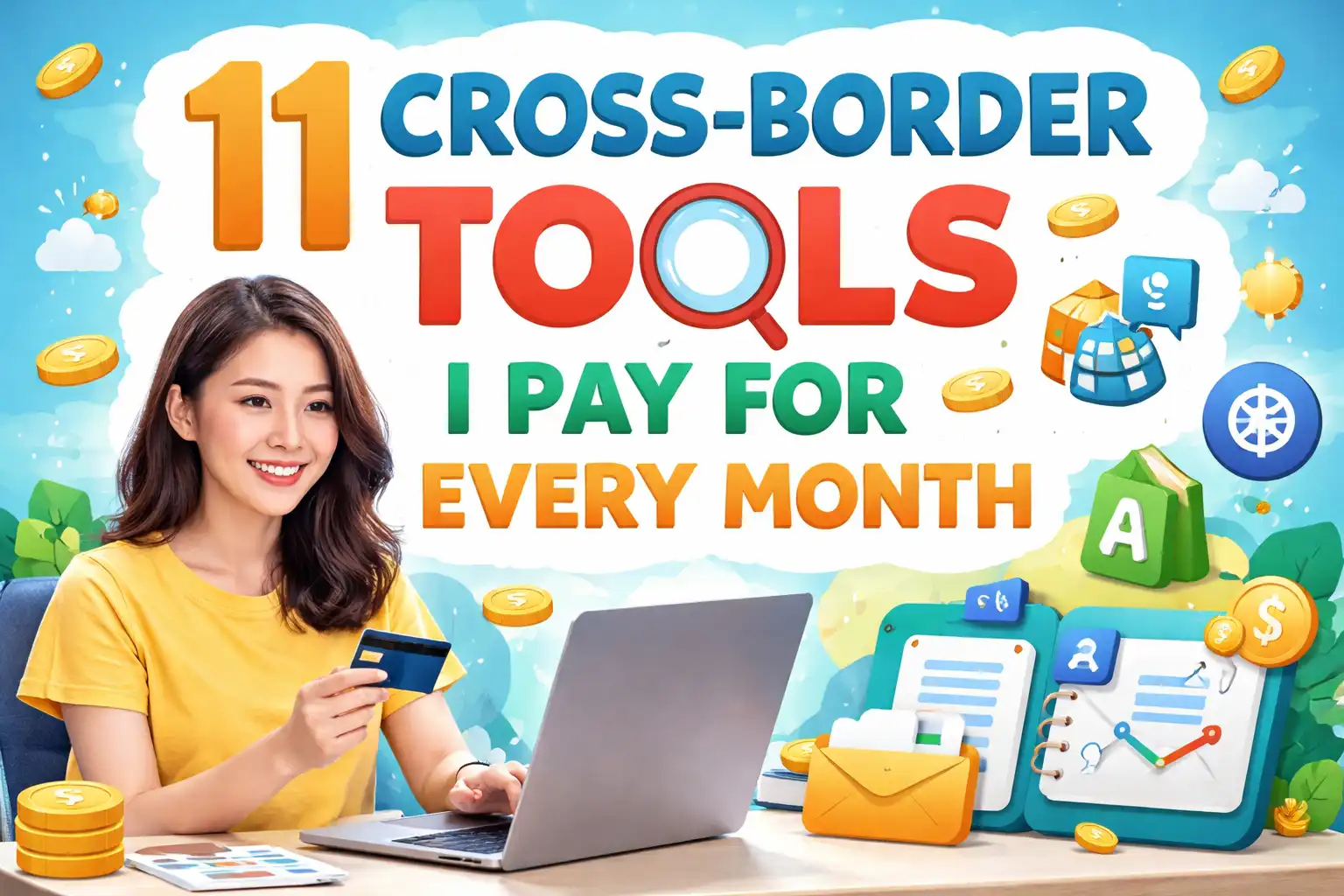
At the beginning of each month I open my subscription bill and always see some tools I haven’t used for several months. Some of them seemed indispensable at the time, yet I renewed them for half a year and barely opened them a few times. Others, although not cheap, have truly shortened my workflow and reduced repetitive tasks, making the ongoing payment worthwhile. In this article I’ll list the tools I pay for every month and focus on the practical choices that save me a lot of manual time.
5 Ways SEONIB Auto‑Generates Blog Articles
The monthly cost for content tools usually ranges from $500 to $2,000, but manual work accounts for more than 60 % of the time. This means most of the budget isn’t spent on efficiency but on semi‑automated tools that still require human intervention. Some tools only solve the “writing” step; the four stages of topic selection, formatting, platform publishing, and scheduled maintenance take far more time than writing itself. I learned this lesson after several missteps.
Free E‑commerce Tools
AI Writing and Content Production Tools
When I first tried AI writing, I used Jasper and Writesonic.
SEONIB has successfully entered the Shopify App Store
These tools are indeed fast at text generation, but the problems quickly became apparent: generating an article takes 10 minutes, but topic selection, format adjustment, image sourcing, SEO optimization, and manual publishing to the backend add up to 40 minutes. Worse, each generated piece has a different format, requiring per‑article adjustments to heading levels, paragraph spacing, and internal linking.
Surfer SEO’s scoring feature once gave me a sense of standards and improved content quality, but manual tweaking and publishing still consumed time. At the start of 2024 I set a goal of publishing three articles per week, yet I barely published three articles per month. High scores don’t guarantee stable frequency; this gap eventually made me realize that the real bottleneck isn’t writing quality but the publishing process.
Below is a comparison of several AI writing tools I’ve used:
| Tool | Core Function | Monthly Cost | Manual Effort |
|---|---|---|---|
| Jasper | General copy generation | Starting at $49 | High: you must choose topics, add images, publish |
| Writesonic | Blog & ad copy | Starting at $20 | High: output format varies, requires per‑article adjustments |
| Surfer SEO | Content scoring & optimization | Starting at $89 | High: after scoring, still need manual edits and publishing |
| SEONIB | AI content automation pipeline | Starting at $39 | Low: discovery, generation, and publishing are fully automated |
The table shows that tools differ greatly in cost and manual effort. The product that truly changed my paying habit is the one that links the entire content pipeline—from topic selection to publishing—without human involvement at each step. With such a tool, I only need to check the daily output for anomalies; there’s no need to copy each piece manually into the backend.
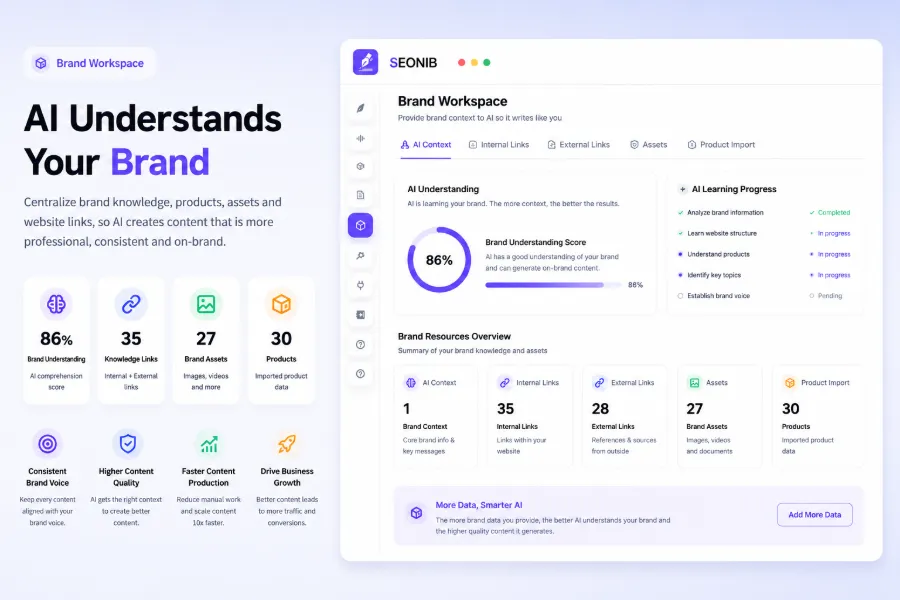
If you’re interested in how this automated pipeline works, check out this article that details content source configuration and the automatic generation method: “5 Ways SEONIB Auto‑Generates Blog Articles.” For a more complete overview of the features, see the SEONIB feature guide.
Help Documentation
SEO and Ranking Growth Tools
In my monthly SEO tool subscription bill, Ahrefs and SEMrush are fixed expenses. Keyword research, competitive analysis, and backlink monitoring are essential for independent site operations. Over the past two years I’ve noticed a problem: traditional SEO tools are optimized for classic search engines, while search behavior is changing.
In 2025, about 73 % of search activity occurs outside traditional search engines, including AI search, social media, and e‑commerce platforms. This means that even if Ahrefs finds a set of long‑tail keywords that rank in Google’s top ten, they might not appear in ChatGPT or Perplexity responses. AI search optimization (AEO) and traditional SEO have fundamentally different logic; the former focuses on providing structured knowledge to AI search engines rather than merely stuffing keywords.
This is where SEONIB (used here as an example of a step in my workflow) shows another value. It can turn product pages directly into Q&A structures and knowledge cards, which are more likely to be referenced in AI search contexts. I tried this logic on a Shopify store: I fed the main product link, and it generated a corresponding FAQ page and category knowledge page. Two months later, AI‑search‑driven traffic started to appear. However, this result still needs a longer period to confirm its stability.
The video above demonstrates how to convert a product link into AEO Q&A content and SEO blogs with a single click; the recorded workflow helps understand the practical execution of AEO.
If you’re just starting SEO with zero backlinks, this article on how new sites can get started offers an alternative approach: entering from a specific niche is more effective than competing directly with big sites on keywords. Additionally, a systematic content architecture plan can be found in this comprehensive SEO guide, which covers everything from keyword strategy to internal linking.
Multi‑Platform Synchronization and Automated Publishing Tools
In cross‑border e‑commerce, managing more than three platforms is the norm. A Shopify store, a WordPress blog, a SHOPLINE shop, plus Medium or other third‑party content platforms—each backend has its own formatting rules, image dimensions, and editor logic. Logging in, copying, pasting, and reformatting manually consumes 1–2 hours per day.
I previously tried Hootsuite and Buffer for social media publishing, but they’re mainly suited for short content; they have limited support for long‑form blog publishing and synchronization. Moreover, they can’t directly integrate with e‑commerce CMSs, so product updates and promotional content still need separate handling.
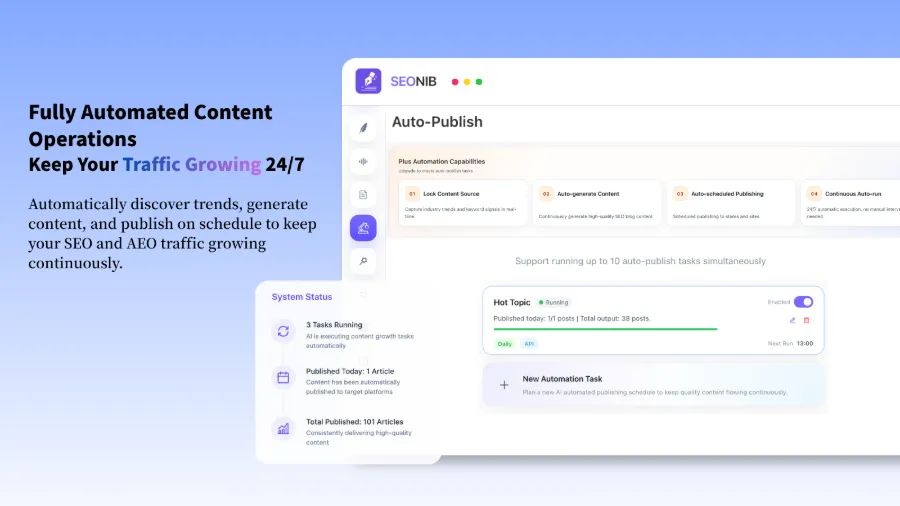
The tool that makes me willing to keep paying is one that automates the publishing workflow. For maintaining content across three platforms, my actual process is: create all content in one backend, set up scheduled publishing rules, and let the system automatically sync to each target platform. As a result, my monthly publishing frequency grew from under four articles initially to more than five per week, no longer relying on willpower. Eighty percent of cross‑border e‑commerce merchants update less than four times per month; breaking that number usually isn’t about writing faster, but about publishing more reliably.
For connecting Shopify stores with a content pipeline, this practical guide shows how to link a Shopify site to SEONIB. If you need to configure multiple data sources for batch publishing, see the batch publishing and data source setup article. Since SEONIB entered the Shopify App Store, subscription and integration have become simpler—Shopify admins can install directly. To understand the pricing structure of different plans, check the SEONIB pricing page.
In the long term, a steady publishing frequency directly impacts SEO authority accumulation. Google’s crawler prefers regularly updated sites, while AI search engine indexing logic places more weight on content entity density and structured data. Consistency beats occasional spikes.
FAQ
Why do I have to pay for so many tools each month? Can’t I just use one substitute?
Because each tool addresses a different stage. Content production tools handle writing, SEO tools handle ranking, and publishing tools handle synchronization. Trying to cover all stages with a single tool usually results in shallow performance at each stage. The market still lacks a perfect all‑in‑one solution that spans content discovery, generation, optimization, and publishing. The most practical approach is to keep 2–3 core tools and replace the rest with automated pipelines.
What is the lowest‑cost content tool combo for a brand‑new independent site?
An AI content automation pipeline plus a lightweight keyword tool. The former solves production and publishing; the latter guides topic direction. Keep the monthly cost under $100 and aim for 3–4 updates per week rather than perfect scores for each article. Frequency matters more than high‑quality single pieces; without enough frequency, even the best content can’t build search authority.
What is the biggest difference between AI Search Optimization (AEO) and traditional SEO?
Traditional SEO aims for content to be indexed and ranked by classic search engines; AEO aims for content to be recognized and cited by AI search engines. The former optimizes keyword density, backlinks, and page load speed; the latter optimizes entity structures, Q&A matching, and knowledge relationships. A single page can’t excel at both simultaneously; you need to design content for each type separately.
Which tools are not worth a long‑term subscription?
Pure content scoring tools experience diminishing returns once content volume stabilizes. Instead of renewing a scoring tool, allocate the budget to tools that increase publishing frequency or expand content coverage. Also, single‑platform social media publishing tools become inefficient and costly when managing more than three platforms.
How do I decide if a tool is worth continuing to pay for?
At the end of each month, glance at the tool’s actual usage logs; if you haven’t used it for two consecutive months in your natural workflow, cancel the subscription. Don’t keep it “just in case.” Another criterion: can the tool replace at least two hours of manual work? If yes, the payment is justified; if not, even if it’s free, the maintenance cost already outweighs the benefit.
Share Article