2026: I did AI search optimization at a SaaS company, then went to Half‑Life

On a Tuesday morning in March, I opened Search Console as usual to check last week’s traffic. The number made me stare at the screen for a while—organic search traffic for one of our main B2B SaaS pages had halved. It wasn’t a gradual decline, not a seasonal fluctuation, it was a straight cut in half.
My first reaction was to update the algorithm; my second was that a competitor had sabotaged us. I told the team on Slack “maybe it’s a statistical delay,” closed the browser, and went to lunch.
That mindset is typical. After eight years in SEO, you develop a conditioned reflex of self‑doubt whenever you see anomalous data. You’d rather believe the tool is broken than admit the problem is real.
Two weeks later I came across a report—WinWithSEO 2026 AI Search State Study—which noted that 17 % of B2B SaaS traffic now comes from AI search, up from 4 % a year ago. Looking at our traffic curve, I thought: we’re probably part of that 13 % that fell behind.
This isn’t an article on “how to rank #1 in AI search,” because I’m not sure such a thing even exists. It’s a rundown of what I’ve been doing for the past few months—some things worked, some wasted time, some I’m still not sure about.
When AI Search Is No Longer Just “A Little Extra Traffic”
At the end of 2025 we were still debating whether to optimize AI Overviews. After Q1 2026, the question no longer needed discussion—not because it’s unimportant, but because it’s no longer purely an SEO issue.
I saw an interview with Jim Yu on Search Engine Land where he said AI search now handles not just answering questions but also discovery, decision‑making, and transactions. I thought that sounded a bit exaggerated. Then I tried it: I asked ChatGPT to find a customer‑success tool suitable for our team. I didn’t click any links and never left the chat window; after about three minutes I had selected a solution. It wasn’t our product; it was a competitor’s.
I’m not saying my search behavior represents all users, but this incident made me feel something was off. As an SEO professional, I ended up choosing a competitor within an AI conversation without ever using a search engine. I didn’t even go through my own site.
The problem that arises is: if users never leave the conversation interface, at what point is our content referenced? Is it mentioned in the first step, or excluded from the answer? If AI search cites three sources on average per answer, how do we make sure one of those sources is “us”?
We ran a test. We took a batch of our best‑performing blog posts and queried various AI search tools for relevant keywords to see if they would be cited. The result: only 32 % of the pages were mentioned in at least one AI search tool. Moreover, most of the citations came from pages on our corporate site that featured real author photos and LinkedIn links. Anonymous or team‑authored content basically never appeared in any answer.
That data made me uncomfortable because we spend a lot of time and budget on content production, yet most of it never reaches this new citation layer.
The Dead End of Content Production
This is a problem I was reluctant to admit: we generate content quickly, but only a tiny fraction makes it into the AI citation pool.
We tried several approaches. Initially we went for volume—publishing six to eight 1,500‑word posts per week covering long‑tail keywords. That worked for traditional search traffic, which grew slowly as expected. Then AI search started eating a portion of the queries, and those articles fell short.
What’s the issue? Those pieces were written for the flow “user inputs keyword → sees page → clicks → reads.” AI search works completely differently—it needs a self‑contained statement that can be extracted and integrated into an answer, not a full‑length article that must be read from start to finish to understand the logic.
It took me a long time to realize one thing: traditional SEO optimizes click‑through rate, AI search optimizes citation rate. These are two metrics that can sometimes conflict.
For example, we used to start articles with filler like “In today’s digital age,” gradually leading into the main point. That’s fine for Google search results, where users read the page themselves. But when AI extracts content for an answer, it strips away the filler and only keeps the third paragraph that contains a concrete numeric statement.
We rewrote a batch of top‑level articles. Each article now starts with a 200‑word independent, extractable definition paragraph that includes a specific number or a contrary viewpoint. For example: “Our data shows that in the B2B SaaS sector, the citation rate of AI search has grown fourfold over the past 12 months, a stark contrast to the declining trend of traditional SEO traffic.” If this paragraph is pulled out on its own, it forms a complete, information‑dense answer.
The changes weren’t massive, but the effect was surprising. Two months later, those pages were cited in ChatGPT and Perplexity roughly twice as often as before the revamp. Of course, I derived this manually from logs; there’s no ready‑made tool to measure citation rates. If someone recommends a tool, I’m probably still using it.
Authorship Matters a Hundred Times More Than You Think
Another lesson from that inefficient period concerns authorship.
We have a peer that builds data‑integration tools whose content strategy seemed ordinary to me—short articles, modest update frequency, limited keyword coverage. Yet they appeared unusually often in AI search results. I initially thought they used some special structured data, but it turned out to be simple: every article had a detailed author page with a photo, LinkedIn link, and full professional bio. Two of their authors even have Wikipedia entries.
The report noted: author pages with by and Schema markup are 2.4 times more likely to be cited than anonymous pages. If the author has a Wikipedia page or a verified sameAs link, that number jumps to 4.1 times.
Most of our articles were authored by “Team Editorial” or a freelance pen name. I pushed the content team to use real names—some resisted, citing inconvenience or not wanting to be tied to certain content.
That tension isn’t fully resolved yet. Our compromise: commercial pages and product‑related blog posts are written by senior team members using real names; tutorial and generic traffic content continue under the team name—half and half.
It’s hard to quantify the impact because SEO doesn’t have a “authorship growth rate” metric. But in the cross‑reference between Search Console and AI search citations, our content with real authors started to appear in answers after about six to eight weeks.
I Tried an Automation Tool—Not Because I’m Lazy, but Because I Was Forced
I have to be honest: most of the changes described above were made between 1 a.m. and 3 a.m. At the time, I was the only full‑time SEO on the team, and the company’s growth targets were tied to traditional search channels. I simply didn’t have enough time to manually check citation rates, adjust authorship, or tweak structured data for each article.
By April, I was numb to the task of “manually checking each AI search tool for citations of our content.” I tried a few content‑automation tools, but most helped little during the writing stage—they could generate content, but the output wasn’t suitable for citation.
Then someone in a SaaS Slack channel mentioned SEONIB, claiming it could automatically capture trends, generate content, and publish across platforms. It sounded a bit too all‑in‑one, like a “one‑click everything” marketing pitch, but I needed to reduce the manual workload, so I gave it a try.
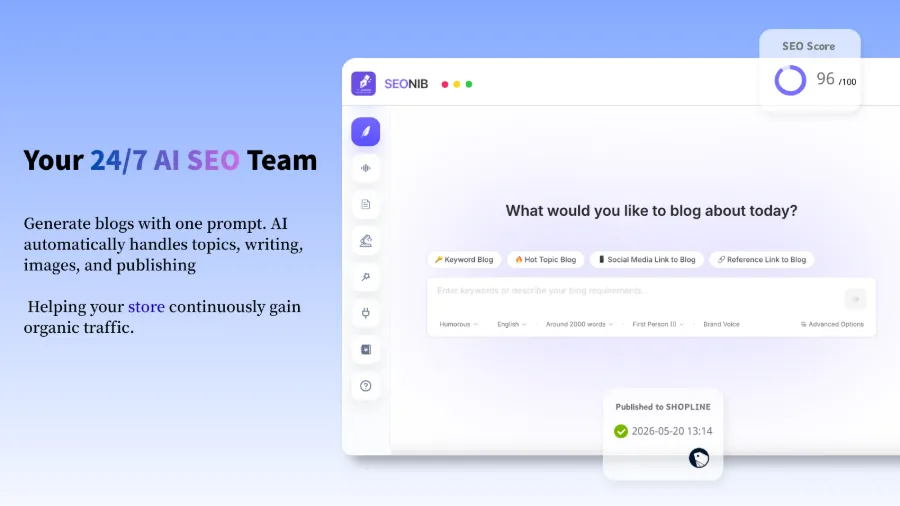
Its workflow is straightforward: it monitors industry trends and keywords, generates SEO‑optimized articles, and publishes them on WordPress or other platforms according to a schedule you set. The truly useful part is its trend‑discovery feature—it analyzes which topics have search demand and pushes them to you. This saved me a lot of time flipping between Ahrefs and Semrush tabs.
I used it in two ways: first, to quickly cover low‑depth, high‑volume topics (e.g., “XX tool usage tips”); second, as an automatic filler for a content calendar. SEONIB doesn’t produce the deep, citation‑worthy pieces, but it turned my workday from “open ten tools, compare keywords, write, publish” into “open one dashboard, pick a few topics, set a schedule, then do the truly valuable work.”
I don’t think this is the ultimate answer to “content automation,” because deep content still requires human writers. But I no longer see any point in manually filling a content calendar; the ROI at that stage had dropped to a negligible level.
AI Search Optimization Has No Right Answer
What I’m doing now can be summed up simply: ensure every commercial page has a real author, include an independently citable statement within the first 200 words of each piece, and regularly check AI search tools for citations of our brand and core keywords. That’s it.
It’s not complicated. The problem is that there’s no clear feedback loop. Traditional SEO gives you rankings and click‑through rates as signals; AI search lacks a corresponding dashboard. You can only guess what’s working, and sometimes you don’t see a subtle change in traffic until three months later.
Another lingering question: when each AI answer cites only three to seven sources, and there are thousands of brands trying to get into that list, how much of the outcome is driven by strategy versus luck?
I’m not sure. Maybe I won’t be next year either.
But so far, teams that started building independent content, real‑author bylines, and structured data in 2025 are already seeing incremental gains in AI search in 2026. The rest of us are catching up.
Frequently Asked Questions
Does AI search optimization conflict with traditional SEO?
Not completely, but priorities differ. Traditional SEO aims to get pages into search results so users click. AI search cares about whether your content can be extracted as a standalone, information‑dense answer. The former optimizes titles and snippets; the latter optimizes the opening paragraphs and modular structure. If resources are limited, I’d prioritize the latter. The changes aren’t huge—adjusting a core paragraph takes about an hour per page.
What if we don’t have real authors?
Find anyone on the team willing to put their name on content, even if it’s just for a specific topic. We had a developer who signed technical articles; he wasn’t a great writer, but his name on LinkedIn and GitHub carried weight. AI search is very sensitive to that information. If no real name is available, at least add a Person Schema markup with a reliable virtual identity.
Will AI search replace all content production?
No, but it will change what’s worth producing. Low‑information, keyword‑stuffed long articles will be phased out faster. Content that requires data, evidence, and verifiable claims will become more valuable. If you write poorly, AI won’t cite you.
How do we track when our content is cited in AI search?
There’s no perfect tool. My current method is to manually check core keywords and brand terms on ChatGPT and Perplexity every two weeks, recording which pages appear, and cross‑reference with internal data. It’s a clumsy, labor‑intensive process, but there’s no better alternative yet. I’m hoping a search‑engine API will eventually expose this metric.
Will there be ads in AI search?
Yes. Google already runs ads in AI Overviews in 12 countries. Perplexity experimented with sponsored questions before stopping. ChatGPT has sponsored shopping results. The trend is almost certain: organic space will shrink. The first half of 2026 still lacks a mature ad‑auction mechanism, meaning teams investing in content now enjoy a temporary monopoly. That window may only last six months.
Finally, I’m not an “AI search optimization expert.” I’ve hit many potholes; some changes I made were later reverted; some experiments never finished. The biggest challenge of AI search isn’t technical—it’s whether you can accept a new workflow with no clear feedback loop.
If you haven’t started yet, don’t rush. I only began in March. But if you’re waiting for a perfect tool or a clear signal, I suggest you just pick one article, add an author, rewrite the opening paragraph, and publish a piece with a concrete, independently citable statement. Then wait two months and see which AI answers quietly keep your midnight‑edited content alive.
Share Article