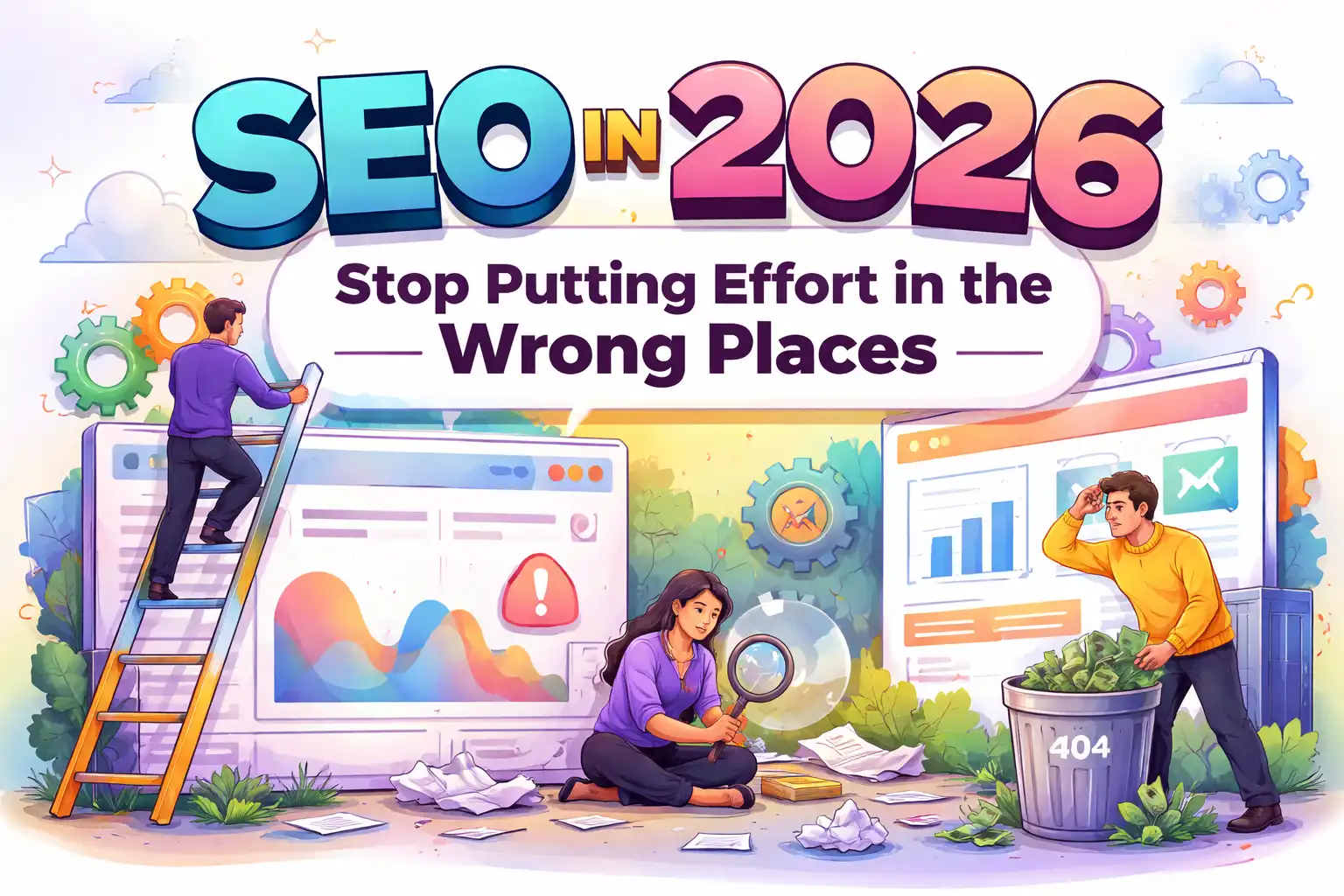
2026 SEO: Stop Working in the Wrong Places
I opened my laptop at a café and searched for a keyword in my industry. Guess what? Google gave me an AI‑generated summary that didn’t mention my site at all. I’d spent three weeks writing that page, added structured data, used three‑level headings, and even wrote alt text for images with more than thirty words. It was useless.
I’ve encountered this scenario at least ten times this year. It’s not the first time, and it won’t be the last. Search in 2026 is no longer the search we’re used to. The “rankings” you pour all your effort into may not even be in the user’s field of view. Users see AI‑generated answers, and whether your content is cited depends entirely on a different set of rules.
Around this time last year I was bragging to a friend that a certain keyword had cracked the top three. This year I noticed a problem: the ranking was still there, but the click‑through rate for that spot had dropped by almost half. It wasn’t that my content got worse; the search results page itself changed. The AI summary now displays most of the information directly in the results, so users don’t need to click any link.
You might think, “Then why bother with SEO? Switch careers.” I’ve thought that too. But I later realized the problem isn’t that SEO as a field is dead; it’s that the old map we’ve been using can’t chart the new road.
AI Doesn’t Want to Read Your Article, It Just Wants Your Snippets
It’s an uncomfortable fact, but it’s true.
AI search systems are essentially fact extractors. They don’t care how literary your article is, or how moving your story is; they only care whether they can pull a clean, concise answer from your text and stitch it into their synthesized response. I once wrote a deep dive on SaaS pricing strategies, about five thousand words, full of metaphors and scenario descriptions. When the AI cited it, it only used the sentence buried a thousand words in: “Usage‑based billing fits data‑intensive products.” That one sentence. The preceding 4,900 words were never read.
So I changed my strategy. Instead of trying to write more “AI‑friendly” content, I started writing content that can be broken down easily. Each paragraph should stand on its own, and each sentence should survive being lifted out of context. In other words, when you write a paragraph, assume the user will only read that paragraph. That’s how the AI works.
It sounds pessimistic, but it isn’t as abstract as you might think. I simply and each of my paragraphs: If someone screenshots and shares just this paragraph, can the reader understand it? If the AI cites only this paragraph, does it make sense on its own? If the answer is no, I rewrite it.
I’ve also tried some automation tools to speed up the process. For example, I used SEONIB for structured content processing. It at least ensures that every article follows the same format, heading hierarchy, and internal‑link distribution. It doesn’t solve quality issues, but it reduces friction when the AI extracts information. Its auto‑publish feature saved me a lot of time, so I no longer have to log in and paste manually every day.
But tools are just tools; the strategy is yours to figure out.
The Direction of Content Strategy Has Changed
In 2024, the SEO community’s mantra was “write what users want to read.” That’s still true, but it’s incomplete. In 2026 the correct phrasing is: “write content that AI can cite and users find trustworthy.”
These two goals sometimes align, sometimes don’t. Users love stories; AI loves definitions. Users enjoy gossip; AI loves data. So my current approach is: give the AI what it needs in the main body, and give users what they want in the margins. For instance, in a recent piece on data privacy I added a short anecdote at the end—“When your CTO stores client data in a shared folder.” That part isn’t cited, but it boosts visitor dwell time.
Ultimately, a well‑structured layout is easier for AI to capture than the content itself. This isn’t a secret; Google’s developer docs already stress “well‑organized content.” Many people misinterpret that as only about heading levels. In reality, it also includes entity relationships, clear definitions, source citations, and contextual consistency.
Last year I fell into a trap: in the same article I mentioned “API rate limiting,” using per‑minute requests in the first half and per‑hour requests in the second half. The content itself was fine, but the AI’s classification got confused and placed my article under “daily‑billing” queries, completely missing the target audience. Traditional SEO tools never flag this; you only notice when precise traffic curves shift.
Don’t Treat Your Site as the Only Entry Point
This may be the most counter‑intuitive lesson of 2026: the premium domain you paid for and the template you optimized aren’t necessarily the main way users find you.
More and more searches happen inside AI chat interfaces, browser sidebars, or voice assistants. Users don’t even open a search results page; they ask a question and get an answer directly. If your content isn’t in the AI’s knowledge base, you disappear from that ecosystem, no matter how perfect your technical SEO is.
I spent an entire month checking how often my content appears in several major AI models—not rankings, but mention frequency. The method is simple: ask a few core questions and see whether the AI’s answer cites your brand or site. The result was more bleak than I expected. A few deep‑dive analyses I considered high‑quality were never cited. In contrast, short, well‑structured articles with clear definitions and data sources were repeatedly extracted.
So my current writing workflow looks like this: pick a topic, write a 300‑word summary that can serve as an answer, then expand it into a full article. This reverse process actually improves content quality because you clarify the conclusion first, then flesh out the discussion—much clearer than writing a lot of filler and later hunting for a conclusion.
The only real value I get from SEONIB’s automatic topic‑discovery feature is saving me the time of scrolling through news every day. It monitors industry trends and pushes topics, but I still manually filter them because AI‑suggested topics are often overly popular, highly competitive, and not always worth writing about.
FAQ
Q: My content is being ignored by AI for a long time. What should I do?
First, check your content structure. Does each paragraph have a clear central sentence? Are you using definitional language? AI prefers paragraphs that can be summarized in a single sentence. If your article reads like prose, add sub‑headings that include “what,” “why,” and “how.”
Q: Is structured data still important in the AI search era?
Yes, but it’s not the top priority. Structured data helps AI recognize entity types and relationships, but the real driver of citation is the semantic clarity of the content itself. In a comparative test, the version of an article with structured data was cited about 17 % more often than the version without it, but that gap is far smaller than the difference between a well‑structured article and a vague one.
Q: Should I create a separate content version just for AI search?
No. One content source is easier to maintain and less error‑prone than multiple versions. The key is to make the same content “multifunctional”—usable both as AI‑snippet citations and as a full read for human users. As long as you make thoughtful structural compromises, you don’t need a dedicated AI‑only version.
Share Article