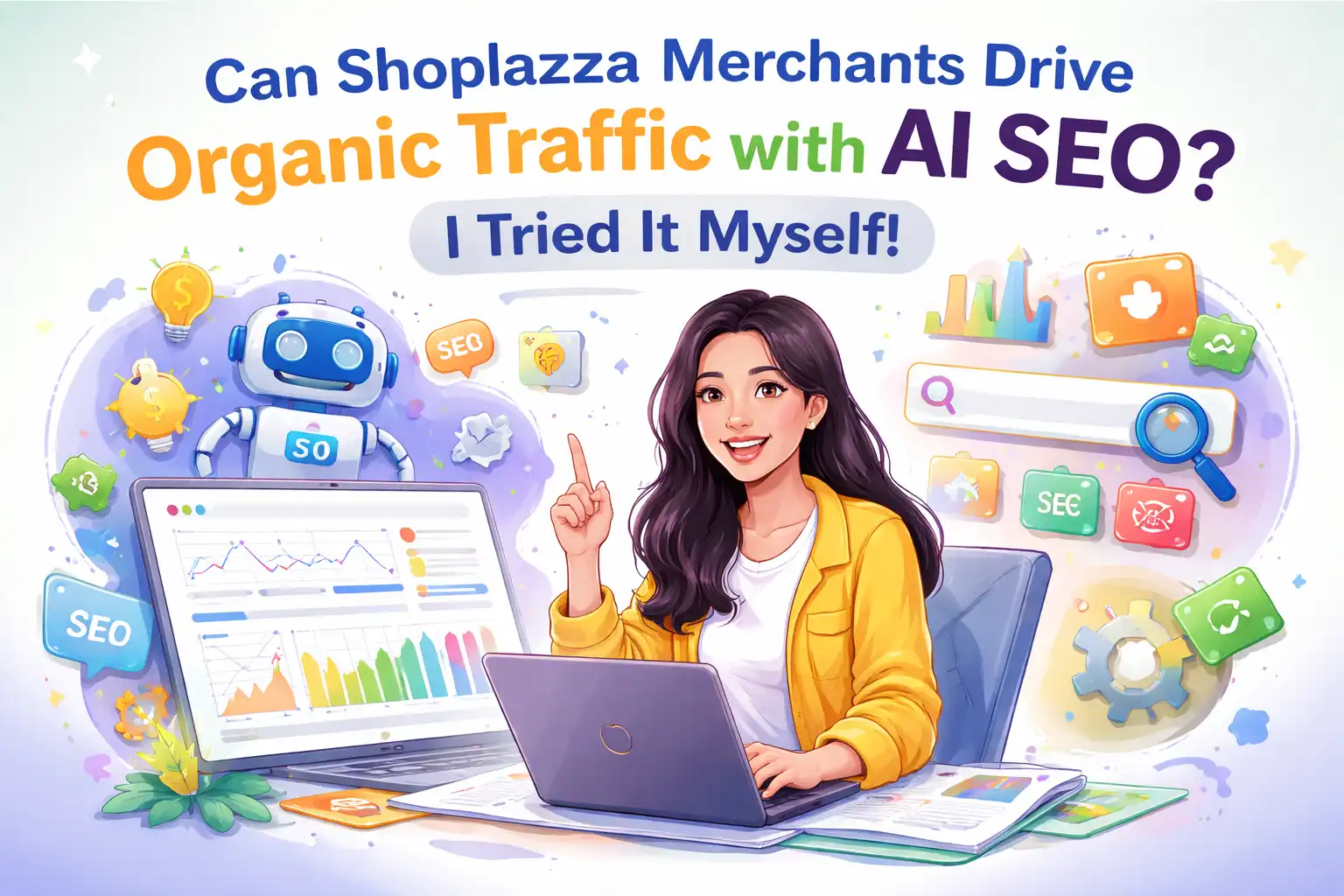
Shoplazza Merchants Using AI SEO for Organic Traffic? I Tested It Personally
I’ve been running a store for two years, spending tens of thousands on ads, and the organic traffic pages showed only single‑digit visits. I also tried writing blogs—full of enthusiasm on day one, managed to push out a post after three days, and by the second week I started making excuses, and by the third week I stopped completely. The few articles I posted in the backend have barely been seen.
Later I started exploring AI SEO. Not because I believed in any “black tech,” but simply out of laziness. I wanted to know: can a machine handle everything from topic selection to publishing while I just focus on shipping?
After a few months, the result was surprising—people actually started finding my store through search.
Why Does Your Shoplazza Store Always Lack Organic Traffic?
Honestly, the Shoplazza platform is easy for building a site, but SEO is almost entirely the seller’s responsibility. It won’t write content for you, it won’t build authority, and it won’t magically generate search rankings.
Most Shoplazza sellers I know get traffic from a single source—paid ads. Facebook ads, Google Shopping—each monthly bill feels like a heart attack. One statistic that stuck with me: 70 % of independent‑site traffic actually comes from organic search, yet over 80 % of sellers are still grinding on paid channels. It’s not that they don’t want organic traffic; they just can’t manage it.
Manually writing a decent blog post—finding images, formatting, adding internal links—takes at least two or three hours. You can keep it up for a day, but two weeks? I never managed that. Even if you persist, one or two posts rarely rank. SEO is a game of quantity and consistency—the very things individual sellers lack the most.
That’s the core paradox for Shoplazza sellers: the platform doesn’t help you, you can’t do it yourself; paid traffic is absurdly expensive; free traffic is a mystery.
What Exactly Did AI SEO Save Me?—From Idea to Automatic Publishing
The biggest difference between manual and AI is not the “write article” step but the automation of the whole workflow.
My old blog‑writing process looked like this: spend half a day browsing competitors and Google Trends for topics, spend half an hour drafting an outline, then write the article, find images, add internal links, fill in SEO titles and descriptions, and finally manually publish in the Shoplazza backend. The bulk of the effort was grunt work; the truly valuable part got little time.
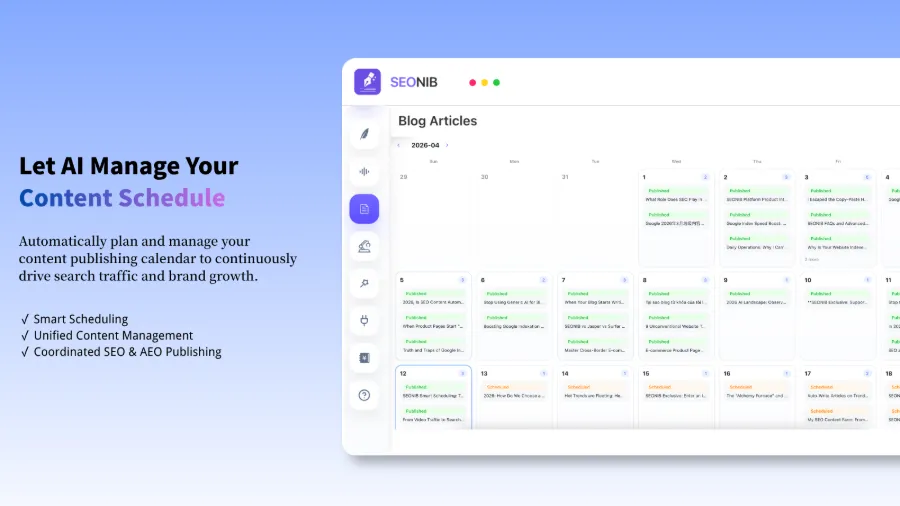
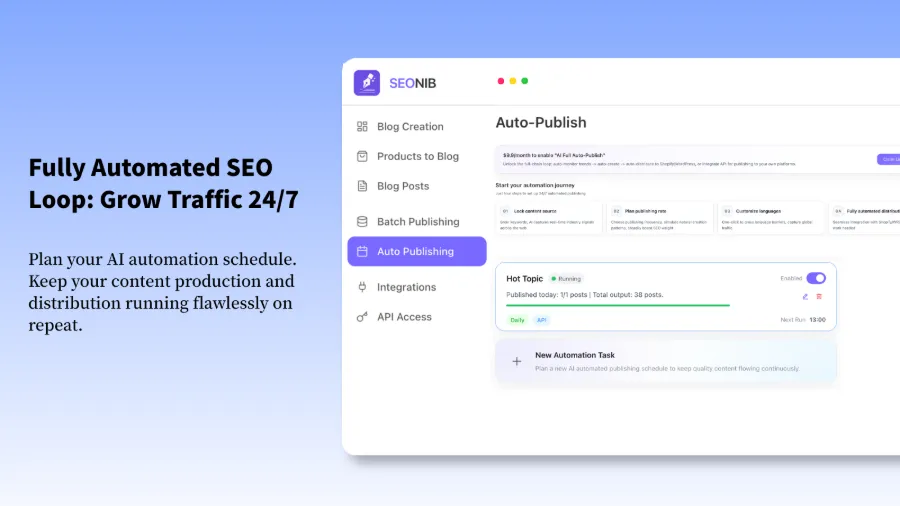
AI SEO compresses this into two steps: set the direction, then let it run. Using my own workflow as an example, the system automatically captures hot topics in my niche and pushes a few ideas to my task list each day. I pick one, input the product link or keyword, and AI instantly generates an SEO‑optimized article—title, description, internal links, images are all arranged. Then I set a publishing frequency, say three posts per week, and it publishes automatically on schedule.
| Stage | Manual Operation | AI SEO |
|---|---|---|
| Topic discovery | Scrape competitors + Google Trends, start after half an hour | Automatic monitoring, daily hot‑topic push |
| Writing | 2–3 hours to produce one article | 2 minutes to generate a complete SEO article |
| Scheduling & publishing | Manually log into backend, publish one by one | Set calendar, auto‑execute |
A friend asked me whether AI‑written pieces can actually rank. The question is a bit off‑target. SEO isn’t about a single article winning; it’s a cumulative process. If you can’t keep writing manually, AI can help you publish a hundred articles a year. The weight gap between a hundred and ten articles isn’t something quality alone can bridge.
People who constantly complain about AI content quality often overlook one fact: the “consistency” component of a content strategy outweighs “single‑post perfection.” If you want a systematic understanding of SEO fundamentals, start with this SEO Ultimate Guide and master the basics before diving in.
How Do Shoplazza Merchants Implement AI SEO? (Lessons from My Own Mistakes)
Now that the theory is clear, let’s get practical. After trying SEONIB, I fell into a particularly stupid trap—ten articles generated in the first two weeks showed no ranking movement. I later discovered the brand context wasn’t set properly.
The correct steps are: first, install the tool with one click in the Shoplazza backend—just find SEONIB on the Shoplazza App Store, installation takes less than a minute. Then configure the brand context: store name, main category, core products, target keywords—more detail is better. Many skip this, resulting in articles that feel template‑filled and lack differentiation.
After configuration, drop your product links in; AI will automatically extract product info and generate articles. I linked three product pages, and a week later Google Search Console started showing sporadic impressions. Detailed steps are in this reference‑to‑blog guide, which clearly outlines the flow from product link to article.
The next critical step is setting a content calendar. My pattern is three posts per week: product‑related articles on Tuesday and Thursday, and an industry hot topic on Saturday. Once scheduled, the system publishes automatically and syncs back to the Shoplazza backend.
How did it turn out? Here’s my data (and the pitfalls I encountered).
After three months, the numbers started to shift. By month three, blog‑driven organic traffic accounted for 45 % of total store traffic. In terms of keyword rankings, seven long‑tail keywords entered Google’s top 20, and two made it into the top 5. For a small Shoplazza shop without a dedicated SEO team, I’m quite satisfied with these results.
But I hit a few more snags worth mentioning.
The first pitfall was the brand context I mentioned earlier. I initially took the lazy route and only filled in the store name. The resulting articles read like a patchwork, with vague product descriptions that even I didn’t want to read—search engines, of course, didn’t give them a friendly rating. I later adjusted SEONIB’s brand context, adding all product details and industry terminology, and the article quality improved dramatically. This taught me that brand consistency is the hidden ticket to AI search—AI lacks industry knowledge unless you teach it.
The second pitfall was expectation management. The first month’s data was essentially flat, with no movement. If I had given up then, the next three months of progress would have vanished. SEO is inherently slow; even with AI accelerating the process, writing, indexing, and ranking still take time.
Another point many overlook: the value of AI SEO isn’t just in “writing articles.” The real time‑saver is the automatic scheduling and continuous publishing that provide persistence. I used to go a month without posting, breaking any momentum I’d built. Now, regardless of how busy I am, content keeps flowing and authority keeps growing. Shoplazza doesn’t restrict external tool integration, but content is the only lever that can give you a search advantage—this is a lesson I learned after burning through my ad budget.
If you want to further refine your content strategy, check out the SEONIB documentation, which contains many configuration details and optimization tips.
FAQ
Q1: Will AI‑generated content be treated as spam by Google?
If you feed only a keyword and let AI hallucinate, it’s likely to be flagged as low‑quality. But with a well‑configured brand context, product info, and industry keywords, the generated articles are essentially indistinguishable from human‑written ones. Google cares about whether the content satisfies user intent, not its origin. All my articles have been indexed normally, with none flagged.
Q2: After articles sync to Shoplazza, can I edit them directly in the store backend?
Yes. Once AI publishes, the article appears in Shoplazza’s blog module exactly like a manually posted one. You can edit, update, or delete at any time with no restrictions. No worries about being locked into the tool.
Q3: My store targets the domestic market—does AI SEO support Chinese content optimization?
Yes. AI supports 40 languages, and Chinese SEO optimization is built‑in. However, Chinese keyword strategies differ from English; it’s advisable to conduct a round of Chinese long‑tail keyword research and add those to your brand context for better results.
Share Article