I Built an AI Content Factory with n8n — An Automated Practice Powered by SEONIB
Spending two hours every day scrolling industry news, repeatedly pasting prompts into ChatGPT, then manually copying the generated articles into the Shopify backend for layout and publishing — this was my real situation when doing cross‑border e‑commerce content marketing. Store performance grew slowly not because of a lack of content, but because the speed of content production couldn’t keep up with the competition. It wasn’t when I linked n8n with an AI content engine into a single automated pipeline that this inefficient loop finally ended. This article is not a theoretical derivation; it is a complete post‑mortem of my journey from manual drafting to fully automated publishing, including the pitfalls I encountered, the directions I corrected, and the details that are still being iterated.
The Real Dilemma of Content Production: Bottlenecks in Manual Processes
First, let me share the genuine feeling of that manual stage. I initially listed a home‑goods product on Shopify, planning to drive traffic through a blog. In the first week I wrote three posts, the second week two, and the third week I stopped publishing — not because I ran out of material, but because my energy was completely drained. Topics were sourced by browsing Google Trends and Reddit, but the ideas often went off‑track; content was generated by ChatGPT, yet each time I had to adjust tone, insert product links, and match formatting; layout was even more frustrating, as each platform’s rich‑text editor behaved differently, and WordPress and Shopify’s block systems each had their own logic. I spent roughly 10 to 15 hours per week on content, and less than half of that time actually produced high‑quality material.
Even more fatal was the instability of the publishing frequency. Search engines favor active sites, and after a pause, the rankings and exposure I had built up began to drop. I tried calendar reminders, but cross‑border businesses encounter so many unexpected issues that content creation is always the priority that gets squeezed. The bottleneck of the manual process isn’t a technical problem; it’s the human willpower and time allocation that can’t sustain continuous content output.
Why I Chose n8n + SEONIB to Build the Automated Pipeline
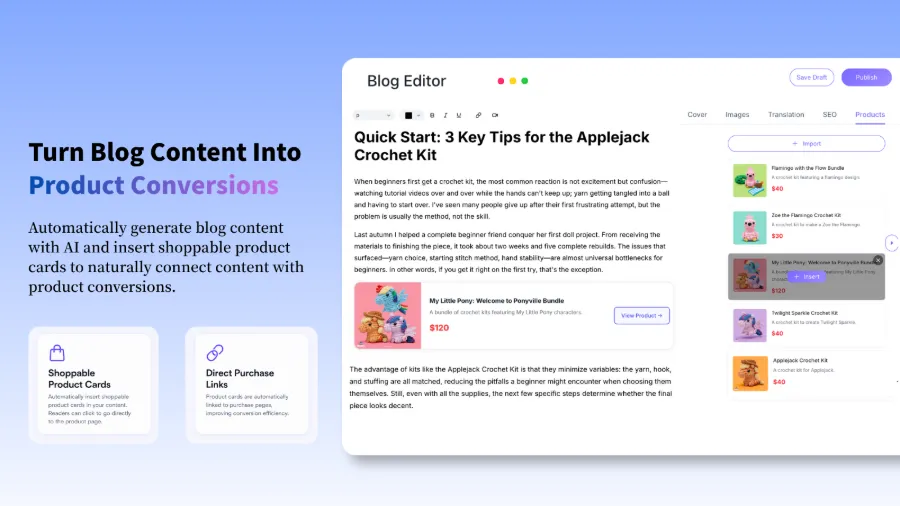
After researching several options, I selected SEONIB as the content generation engine and paired it with n8n to build an automated workflow. n8n’s strengths are visual orchestration, a rich set of triggers and nodes, and support for self‑hosting or cloud hosting. It requires no complex code; you can drag‑and‑drop nodes to connect APIs, databases, notifications, etc. SEONIB solved my core pain point: it isn’t just a writing tool, but a full‑featured content platform that can automatically discover trending topics, generate SEO articles, support 40 languages, and automatically insert product cards and brand information. Generating a single article takes about 2 minutes on average, and the output structure includes title, description, body, keywords, and internal‑link suggestions—metadata that is obviously crucial for search engine rankings.
There’s also a practical reason for this combo: I had previously tried bulk generation with ChatGPT, but the output was highly repetitive, and the manual review cost turned out to be higher. SEONIB provides a brand knowledge base and context configuration, ensuring each generation maintains a consistent tone and information accuracy. If you’re interested in how content builds brand authority, you can look at its underlying logic — that’s exactly why SEONIB’s knowledge‑base feature was designed. Additionally, SEONIB supports article generation from various content sources such as keywords, product links, social media posts, and even reference links. You can read the detailed guide on 5 ways to auto‑generate blog posts; I decided to dive deeper after reading that.
Building the Automated Workflow: Four Core Steps
The entire pipeline is divided into four stages from input to output, with n8n orchestrating the whole process.
1. Scheduled Trigger + Trend Discovery
The Cron node in n8n is set to run daily at 2 AM. Once triggered, it calls SEONIB’s trend‑discovery API to fetch rising topics and long‑tail keywords from the past 24 hours within my predefined keyword domains. Each call returns 10–20 candidate topics; n8n uses a simple scoring node (combining search volume and competition) to filter the top 5 and store them in a generation queue.
2. Bulk Article Generation
n8n iterates over the queue of topics, pushing each one to SEONIB’s article‑generation endpoint. Each topic is paired with a set of parameters: target keyword, language (Chinese/English), and product‑card insertion rules. SEONIB returns the article together with a suggested featured image and SEO metadata. A single workflow run produces about 5–10 articles. If all pass subsequent validation, the pipeline can reliably output 20–30 pieces of content per week, covering multiple product lines.
3. Quality Check & Formatting
This was the step where the first version hit the deepest potholes (more details later). I now added an HTTP node in n8n that sends the generated article to a simple review endpoint I built (based on OpenAI’s moderation API + keyword‑duplicate detection). Articles that pass the check move to a formatting node, which standardizes internal links, image replacements, and table of contents generation; those that fail are sent back to a Slack channel for manual review.
4. Multi‑Platform Automatic Publishing
Formatted articles are pushed via SEONIB’s publishing API. It supports direct publishing to Shopify, WordPress, SHOPLINE, and other platforms. I used SEONIB’s webhook feature; after publishing, it callbacks n8n to record the status in a database. If your target is an independent site like Shopify storefront, this step is almost zero‑manual. For a concrete demo of multi‑platform sync, see this video:
The video shows how to sync a blog to Shopify, exactly matching my multi‑platform publishing flow. After the pipeline is up and running, SEONIB handles content generation and preprocessing, while n8n handles scheduling and distribution. I only need to spend about 15 minutes each day checking the review queue and adjusting keyword sources.
Results and Ongoing Optimization: Data Shows Automation Is Not “Slacking”
After three months of running this automated solution, the data changes are striking. When I was doing everything manually, I could publish at most eight articles per month and often had gaps. Now the monthly publishing volume stabilizes around 40 articles, covering a broader set of long‑tail keywords. Google Search Console shows a 150 % increase in organic traffic over three months. Of course, part of that is due to domain‑level benefits, but the boost in content quantity and the stability of publishing frequency directly reflect in rankings.
However, automation isn’t a set‑and‑forget solution. The initial workflow (launched February 2025) revealed a problem after one week: about 20 % of the articles generated by SEONIB based on trends were highly similar because the underlying topic keywords were too closely related, causing repetitive product description paragraphs. Worse, some articles pulled outdated data from old posts, such as old product prices. I spent two full weeks cleaning up published articles and added a content‑deduplication review node in n8n (March 2025), which finally stabilized the pipeline.
This experience taught me two non‑obvious lessons: - Automation does not equal zero maintenance. The quality of the topic pool determines the ceiling of content output. You need to regularly adjust keyword sources, discard underperforming long‑tail terms, and add new product‑line‑related terms. Otherwise the machine keeps writing “safe” old topics, and traffic growth quickly plateaus. - n8n’s self‑hosted version gives you full control over trigger frequency and concurrency, but it also introduces operational overhead—server crashes, Docker updates, database backups. After weighing the trade‑offs, I migrated n8n to the n8n.cloud hosted solution, saving maintenance time. Although the monthly fee increased, overall production efficiency improved.
When optimizing content quality and search performance, I referenced an interesting case study — How a Zero‑Backlink New Site Can Win at the Starting Line — which confirms the crucial role of content quality and internal‑link structure for new site rankings. Later I also ran through the Technical SEO Checklist (2026), fixing multiple page canonical tags and missing image alt attributes. For a systematic overview of all SEONIB features, the Help Documentation provides detailed configuration instructions and best practices.
FAQ
Q1: Do n8n workflows require coding?
No. n8n is a visual orchestration tool; all nodes are connected by drag‑and‑drop. The only possible code you might write is for custom webhook responses or data‑transformation steps, but most cross‑border sellers never need that. My workflow contains no custom code, relying entirely on n8n’s built‑in HTTP, Cron, and Function nodes.
Q2: Is there a plagiarism risk with SEONIB‑generated content?
SEONIB generates content based on your own brand knowledge base and context, so it doesn’t directly copy from other sources. However, it’s recommended to enable its built‑in originality detection and run a third‑party plagiarism check before publishing, especially for bulk releases. I added a Copyleaks API node in n8n to individually verify high‑value articles.
Q3: Do I need to purchase both n8n and SEONIB?
Yes. n8n handles workflow orchestration (free community edition or paid cloud version), and SEONIB handles content generation and publishing. They are billed separately, but the overall cost is far lower than hiring a full‑time content operator, especially when producing 40 articles per month; the per‑article cost drops to just a few dollars.
Q4: How are multilingual contents handled?
SEONIB natively supports 40 languages. In n8n you can create a branch for each language, passing the appropriate language parameter. SEONIB will generate the article in the requested language using the multilingual content in your brand knowledge base, and automatically adapt product cards and currency symbols for localization.
Q5: What if my store isn’t on Shopify?
SEONIB supports WordPress, SHOPLINE, Medium, and many other platforms, and can publish via webhook to any system with an API. n8n can push the generated article in HTML or Markdown to a custom publishing endpoint. My previous store ran on WooCommerce, and I successfully integrated it via webhook.
Share Article