
What changed after I stopped hiring freelance writers?
For the past three years I was paying freelance writers a few thousand dollars each month, and I worked with at least twenty writers on Upwork and Fiverr. Does that sound extravagant? In reality, that money was not spent comfortably. The communication cycle was too long—writers didn’t understand the brand tone, the quality of submissions varied, and only about 60 % of the pieces were ready to go live. The rest had to be revised or discarded. What bothered me even more was the update frequency: I required four blog posts per week, but almost no writer could deliver consistently for three uninterrupted months. In the second half of 2024 I completely abandoned this outsourcing model.
Why I no longer need freelance writers
The hidden costs of outsourced writing go far beyond the fees. I started by recruiting writers on social media, then moved to Upwork and Fiverr. The process looked normal: writer selection, trial article, outline communication, final draft, revisions, publishing. But each round of communication cost more than expected. A $500 order often required 4–5 days to explain brand background, target audience, and SEO requirements. The worst part was that when a writer left, almost all that knowledge disappeared—new writers had to start from scratch. Learn how to connect your SHOPLINE website to SEONIB](https://seonib.com/help/3/How%20to%20Connect%20Your%20SHOPLINE%20Website%20with%20SEONIB)
Monthly outsourcing expenses were about $3,000, but only 60 % of the delivered pieces were usable. The rest were off‑target or too thin to improve search rankings. I tried to speed things up by running multiple writers in parallel, which made things even worse: three articles on the same topic had completely different styles, and revision time nearly doubled.
Alternatives I tried
When the freelance path proved unworkable, I turned to AI writing tools. I experimented with mainstream platforms such as ChatGPT, Jasper, and Writesonic, using them to “write” article after article. Word count was no longer an issue, and the engine responded quickly. However, I soon discovered an absurd truth: writing itself was no longer the bottleneck; the tasks before and after writing were. SEONIB feature breakdown](https://gemini.google.com/share/66b1192679c7)
After using ChatGPT, I still spent 6–8 hours per week on “post‑writing” tasks—copying generated text into the site backend, manually adding images and formatting, filling in meta titles and descriptions, checking core SEO elements, and then logging into each platform to publish. These operations were essentially as fragmented as the outsourcing era, just with a different source. I tried to simplify with Jasper + a browser plugin, but it still didn’t solve the hassle of multi‑platform publishing. If you’re facing a similar manual SEO‑optimization bottleneck, you might want to read the article that discusses automation directions.
New workflow: fully automated from topic selection to publishing
What really changed my mind was automating the entire production line. When I stopped acting as the “middleman” between writing and publishing, the whole content operation looked completely different. Learn how to boost your SHOPLINE store ranking](https://seonib.com/c/knowledge/content-marketing/what-makes-a-shopline-store-rank-higher-in-google-2026/index)
The core tool that enabled this change is SEONIB. Its operation is unlike any of my previous attempts—it doesn’t just help you type, it takes over the entire content value chain. The AI continuously monitors industry trends and competitor content, automatically identifies topics with search demand and traffic potential, and pushes new topics to a topic pool each day.
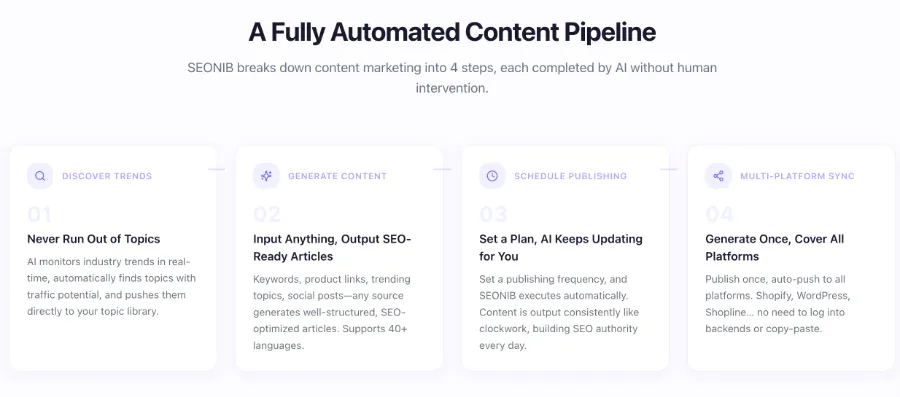
The workflow is broken into four closed loops: trend discovery, content generation, scheduled publishing, and multi‑platform synchronization. In the trend discovery stage, the AI doesn’t need me to manually input keywords; it autonomously identifies hot topics based on my site’s theme and industry data. During content generation, it supports 40 languages, and a single keyword can be fully expanded into an SEO‑optimized article. After I set up templates and brand rules, I rarely need to make adjustments. For SEO details, SEONIB includes a comprehensive optimization logic; related content can reference my detailed overview of its SEO automation features. The publishing stage supports calendar scheduling, allowing me to set how many times per week to publish; the AI automatically produces and pushes the content to the site on time.
What surprised me even more was multi‑platform synchronization. Once set up, a single piece of content can be automatically synced to Shopify, WordPress, or SHOPLINE. In the cross‑border e‑commerce scenario I specialize in, this is incredibly useful—previously, adjusting formats for different platforms took at least half a day. If you run a SHOPLINE store and want to know how to rank higher, this workflow provides perfect support.
Automation solved the most fatal problem of outsourcing: knowledge couldn’t be retained. Once my brand information, terminology library, and content standards are configured in the system, every piece of output remains consistent. Especially after the early‑stage content builds a complete knowledge base, the AI search engine’s citation frequency for the site noticeably increases. To understand this phenomenon deeper, you can read analyses on why certain sites are cited more by AI search engines.
I recommend anyone planning to try this tool first consult the help documentation for detailed setup steps.
Actual results: time, cost, and traffic comparison
After three months of fully automated operation, several metrics convinced me I was on the right track.
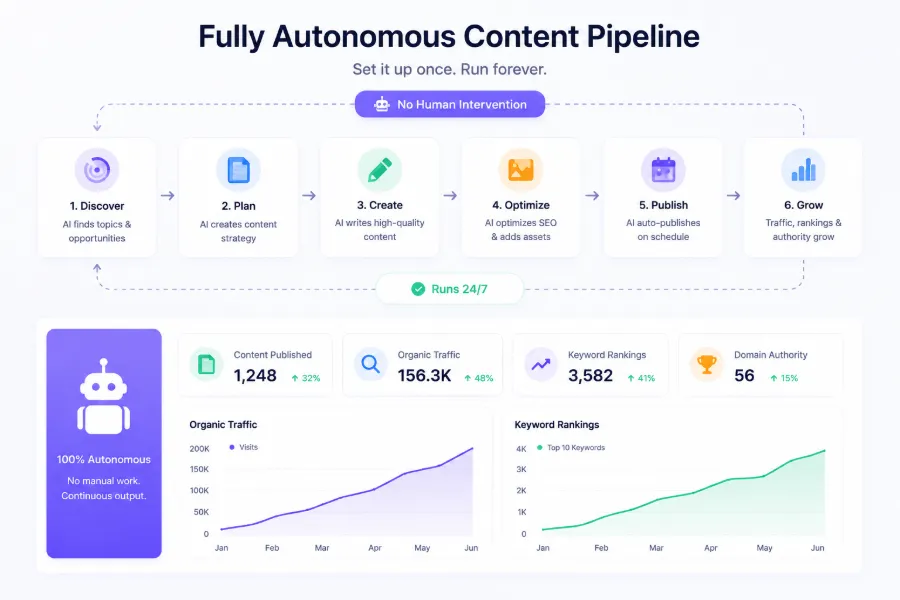
Time: My weekly time spent on content operations dropped from 10–12 hours to less than 1 hour—mainly topic review and occasional article spot‑checks.
Cost: Monthly expenses fell from $3,000 to about $600.
Content volume: Previously I produced 16 articles per month; now the AI automatically generates 3 articles per day, approaching 90 per month—a four‑fold increase.
Traffic: After three months, Google Search Console showed a 150 % rise in organic search traffic.
One point worth highlighting: the real value of AI automation isn’t “writing fast,” but “continuous improvement.” Ongoing output means search engines crawl the site frequently, and the speed of authority accumulation far outpaces intermittent updates. In the previous outsourcing model, there was typically a delivery gap every two weeks; automation completely eliminated that variable. As AI search engines increasingly favor content that is professional and frequently updated, continuous content production becomes the foundational infrastructure for SEO competition rather than an optional extra. If you want to learn more about getting your site recognized by engines like ChatGPT, this external resource offers practical ideas. The discussion also continues the earlier mention of AI search citation mechanisms—see why certain sites receive more AI search engine citations.
FAQ
Did content quality drop after I stopped hiring freelancers?
No, stability actually improved. AI‑generated articles are generally grammatically and structurally sound; with proper prompts and brand‑rule configurations, accuracy and readability stay high. The key is spending two weeks fine‑tuning the system so the AI understands your brand voice and knowledge base.
Will using AI‑automated content get penalized by search engines?
Mainstream search engines like Google do not explicitly forbid AI‑assisted content, provided it offers value to users and complies with E‑E‑A‑T principles. In my three‑month trial, I faced no penalties; organic traffic actually grew. The crucial point is not to publish unreviewed bulk garbage; instead, configure your brand knowledge base and content rules so the AI produces differentiated, valuable content.
What initial setup do I need?
It’s a three‑step process: create an account and connect your site backend (Shopify, WordPress, or SHOPLINE); configure brand rules, terminology library, and content templates inside the system; then set publishing frequency and topic direction. The full configuration takes about 2–3 days, after which you can switch to automatic operation.
Is this automation suitable for all types of websites?
It’s best for sites with high content demand and vertical niches—e‑commerce stores, cross‑border independent sites, B2B sites. For domains that heavily rely on authoritative expert depth (e.g., medical, legal), it’s advisable to use AI only for certain stages while keeping core content under human supervision.
How do I keep AI‑generated content consistent with my brand tone?
The key is building a knowledge base at the system level. Pre‑load brand history, product information, writing‑style examples, keyword preferences, etc., into the knowledge base; the AI will reference these when generating content. Setting content‑review rules—such as prohibiting specific terms or controlling tone—also improves consistency.
Share Article