A High-Quality Piece of Content: How Long Can Its Traffic Last?
Opening Google Analytics, I see that the article I wrote three months ago is still slowly climbing in traffic, while another viral post from last year has dropped from about 8,000 clicks per month to just over 300. I’ve seen this kind of gap far too many times. In the years I’ve run independent sites, the most common question I get is: after I invest a lot of effort into writing a piece of content, will it bring me three months of traffic or can it sustain three years? My own missteps have taught me that the answer is far more complex than “just follow an SEO template.”
Don’t Believe the “One Piece of Content Lasts Three Years” Myth; First, See the Reality of Traffic Decay
Early on, I wrote a Shopify store setup tutorial. One month after publishing, it jumped to the second page of search results; two months later it was in the top three on the homepage. I was pretty proud, thinking I’d cracked the traffic code. Six months later, the traffic had dropped by almost 50%. Competitors released three updated, deeper articles on the same topic during that period, and my old post had neither updated content nor new internal links, so the search engine naturally pushed it down.
Google’s algorithm has a “freshness bias” for existing content—not a deliberate penalty for old pages, but when more new content appears for the same keyword, the old page’s weight gets diluted. This also ties into search intent: if a user searches for “2025 best Shopify plugins,” a 2019 article is naturally destined to be phased out.
For most B2B and B2C content, organic traffic drops 30%–50% after 6–12 months. This isn’t because the article is poorly written; it’s the competitive landscape that changes—new articles vie for the same keyword rankings, and user search behavior evolves. Trendy topics like “building a metaverse site” may cool off in three months, whereas foundational questions like “what is an independent site” still get searches ten years later.
Quality Determines Lifespan—What Kind of Content Stands the Test of Time?
Not all content has the same lifespan. The key distinction lies in search intent: tutorial, definition, and product comparison pieces have clear long-tail advantages; news, trend, and event-driven content sees traffic plummet almost to zero once the hype passes.
But quality isn’t just about word count. I’ve seen a 3,000‑word Shopify theme comparison that stacked feature lists for over a dozen themes, with no real testing, no screenshots, no FAQ section—two years later its traffic was still lower than a 1,000‑word “What is Shopify” piece that remained stable. The latter continuously earned internal links, was cited by other sites, and was incorporated into the search engine’s knowledge graph entity coverage.
Evergreen content that is regularly updated can retain 60%–80% of its initial traffic after two years. The prerequisite is periodic structured updates—adding FAQs, refreshing data, adding new internal links. If you only write and never revise, the article’s half-life is roughly 6–9 months.
I also need to mention publishing efficiency. To build a maintainable evergreen content system, I later used SEONIB to turn keywords and product pages directly into blog posts—input a few target terms, the AI generates formatted content and automatically pushes it to the site. This lets me focus more on updating old posts and creating new internal links rather than starting from scratch every day.
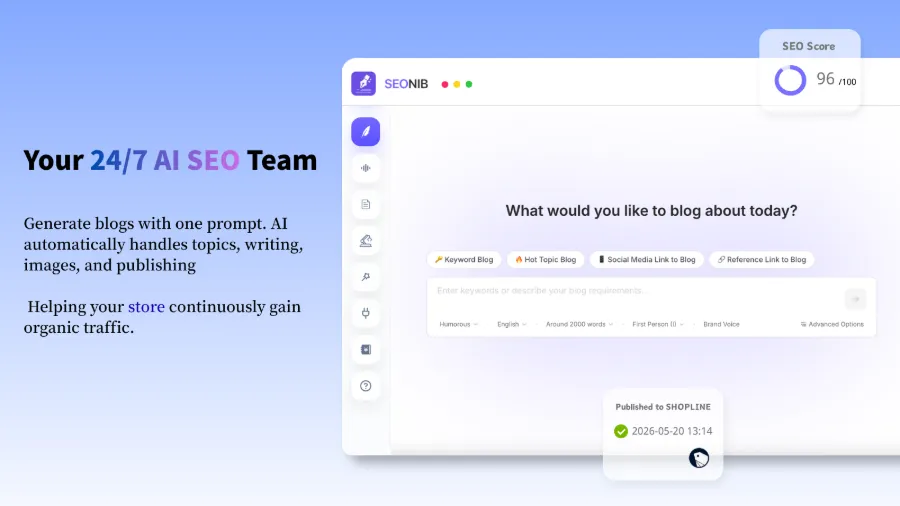
With a systematic content production workflow, you can rhythmically build an evergreen content matrix instead of relying on inspiration and willpower to “write when you feel like it.” If you want to dive deeper into how automation can drive exponential content growth, check out this guide.
From “Writing One Piece” to “Building a System”—Getting Traffic Past the Threshold
No matter how long a single article’s lifespan is, there’s an upper limit. The real game‑changer is the overall topical authority of the site.
It took me a year to grasp this principle: search engines don’t score individual articles; they score the overall site credibility for a given topic. When you consistently produce content around a core subject—guides, case studies, tool comparisons, FAQs about “Shopify SEO”—and interlink the pieces, the search engine gradually recognizes your site as a trusted source on that topic.
Sites that regularly update content see about 40% of their monthly organic traffic growth come from long-tail, backward weighting of older content. This is the cumulative effect of a content matrix: a new article creates fresh internal links to older pieces, and those older pieces funnel traffic back to the new page, creating a loop.
The difference between writing a single article and building a system is essentially fragmented creation versus a systematic process. A practical use case for SEONIB is distributing content across multiple platforms simultaneously—you don’t have to log into each backend manually; one generation pushes to the site and platforms. This is not just about saving time; it enables your content matrix to keep running.
If you’re using a Shopline site, check out this case study to see how a content system can boost site authority.
Hold On, the Optimistic Side Arrives—Good Content Can Indeed Defy Time
I’ve talked a lot about traffic decay, but it’s not all doom and gloom. If your content truly solves a specific problem, its lifespan in search engines may “rebirth” in another form.
I’ve seen a few instances of old articles reviving: a 2022 AI SEO basics guide had slipped far down in Google rankings, but at the end of 2024 it suddenly received a surge of referral traffic from Perplexity and Google AI Overview. The reason was that the article had a clear structure, an FAQ section, and concrete step‑by‑step instructions—AI search engines tend to cite content like that to answer user queries.
Content optimized with AEO (AI Engine Optimization) receives 35% more AI‑search referral traffic after 12 months than unoptimized content. This tells us that a traffic drop doesn’t necessarily mean the content is “dead”; sometimes the search engine’s traffic format changes, and you haven’t tapped into it yet.
The key is whether the content is properly structured—FAQ sections, entity markup, structured data—these are the foundations that AI search engines can recognize and cite. If your old article lacks structured parts, adding an FAQ now could reactivate it.
Another often‑overlooked indicator: if older articles are losing traffic while newer ones are steadily climbing, your site is undergoing a “content rotation”—overall health is actually improving. Instead of anxiously watching each article’s curve, focus on the overall level of your site’s content ecosystem.
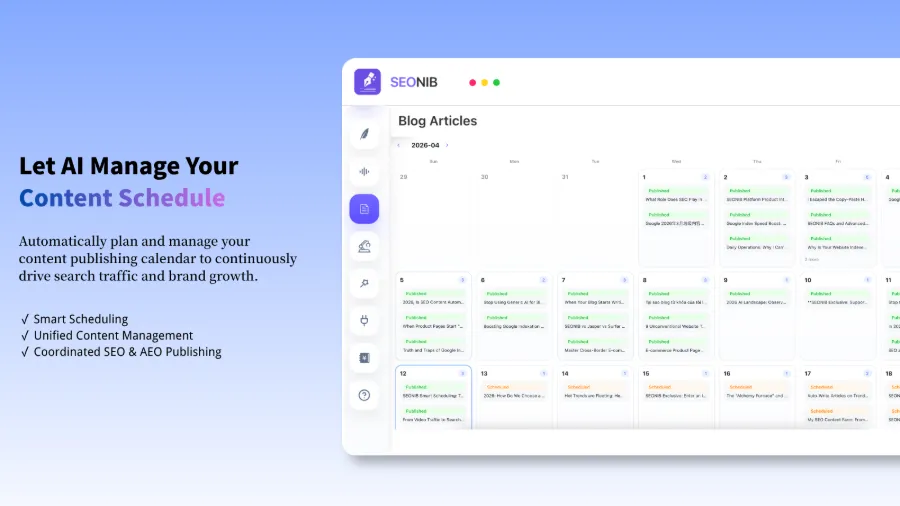
The key here is to have an ongoing content calendar, not just write and abandon. I usually rely on SEONIB’s automated scheduling feature to keep a steady update rhythm—set the frequency, and the AI generates and publishes on schedule without daily logins. This ensures old posts get regular updates and new posts accumulate consistently. The video shows the exact workflow; if you’re a beginner, start with the official help docs and practical guides.
Frequently Asked Questions
Q1: How long can a product review article’s lifespan be?
The lifespan of product review content depends on the product itself. For continuously iterating products, a review can usually sustain 6–12 months—its value drops once a new version arrives. For a cross‑category comparison within a product line, regularly updating prices and features can keep it relevant for 18–24 months. The core is to refresh data and links at least once a year.
Q2: How can I tell which of my articles is “aging”?
Three clear signals: 1) In Google Search Console, the page’s clicks drop more than 30% for two consecutive months; 2) the keyword ranking falls from the first page to the third page or beyond; 3) the number of internal links pointing to the article hasn’t increased for a long time. If all three occur, the article needs an update or a re‑targeted search intent.
Q3: How often should I update old articles to maintain traffic?
There’s no universal schedule, but here’s my approach: factual pieces (e.g., “2025 Shopify pricing”) get a quarterly review; core tutorials are refreshed annually; articles containing statistical data are updated whenever a new industry report comes out. Pure opinion pieces don’t need frequent updates, but adding an FAQ block can extend their lifespan.
Q4: If my site has little content, which type should I prioritize to generate long‑tail traffic?
Prioritize foundational tutorials and definition/comparison pieces—search intents like “what is,” “how to,” “who is best suited for” bring the most stable traffic. Don’t chase trends; their peak traffic fades after three months. Foundational content may have lower search volume, but it can keep pulling traffic from publication through the third year, and a single piece often accumulates more total traffic than a viral hit.
Share Article