Clicks Are Broken: What Metrics Should Measure Content Marketing Effectiveness in the AI Era
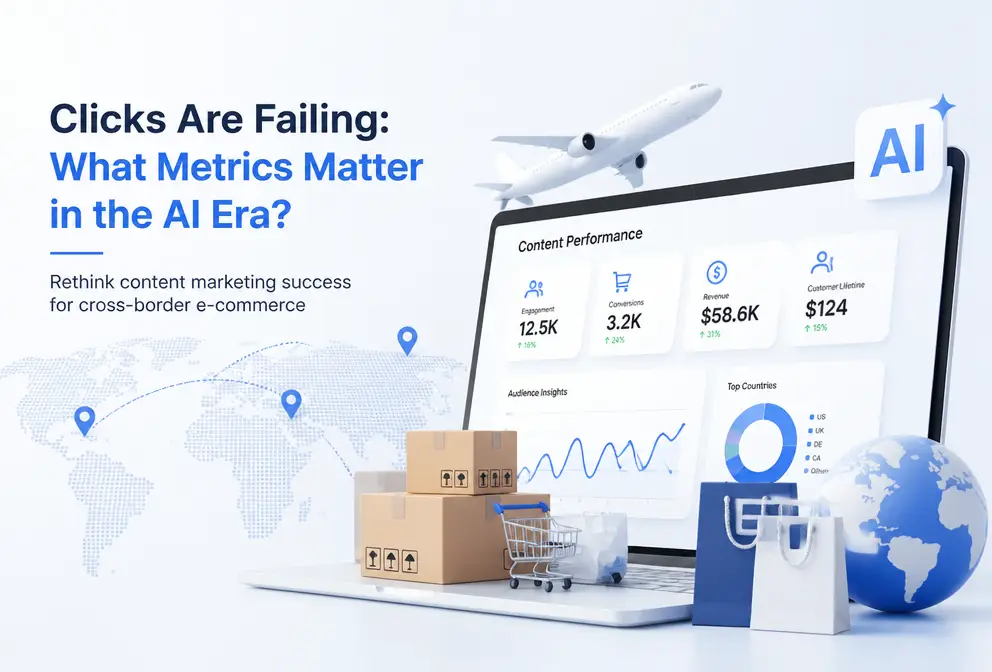
All backend data looks fine. Page views are climbing month‑by‑month, click‑through rates are stable, the content team is delivering on schedule, and the boss nods at the reports. Yet inquiries aren’t moving, orders aren’t moving, and the sales team starts questioning the marketing department’s output. This is the scenario I’ve heard repeatedly over the past year, and it’s the most typical dilemma for content marketing in the AI search era—we’ve been measuring content performance with clicks, but clicks only measure exposure, not results.
When users start getting answers directly from ChatGPT, Perplexity, or even Google AI Overviews, traditional clicks simply don’t happen on your site. Users get the information, make a decision, and your analytics backend remains oblivious. Evaluating content marketing effectiveness must shift from a “traffic logic” to a “citation and conversion logic.”
Three Structural Reasons Clicks Are Distorted
Clicks failing isn’t a statistical error; it’s a structural change in search behavior itself. The first reason is the prevalence of zero‑click searches. When AI search engines generate answers directly, users don’t need to click any link to get the information. After Google AI Overviews launched in 2024, a large portion of clicks that would have gone to content sites were captured on the search results page. ChatGPT and Perplexity push this model to the extreme—users ask, AI answers, and the process has nothing to do with your website.
The second reason is a decline in traffic quality. Click sources are decoupled from purchase intent. Social media brings many clicks but high bounce rates; long‑tail keywords bring stable clicks but low conversion rates. An independent outdoor‑gear site told me that after six months of continuous content investment, organic traffic grew 40% while inquiries stayed flat. Only after checking Search Console did they discover that almost all traffic came from low‑intent informational long‑tail terms, and none of the high‑intent purchase queries were ranking.
The third reason is the mixing of ad and content traffic. Most independent sites run both Google Ads and Meta ads, so paid and organic clicks are blended in the backend data. An increase in clicks may simply reflect a larger ad budget, unrelated to content quality. By 2026, the SEO landscape is no longer limited to Google; search behavior is spread across TikTok, Reddit, Amazon, and various AI tools—industry observations show that 73% of modern “search” happens outside Google. The article “2026 SEO Should Not Only Focus on Google” (https://telegra.ph/Stop-Only-Focusing-on-Google-In-2026-SEO-You-Need-to-Be-Everywhere-06-05) breaks down this trend. Relying only on your site’s backend click data means you’re seeing just a tiny slice of the whole decision chain.
From Clicks to “Citation Volume”: A New Metric System for Content Effectiveness in the AI Era
The replacement for clicks is a set of metrics centered on “citations.” The core logic is simple: in the AI search era, content value isn’t measured by clicks but by being cited by AI, trusted by users, and incorporated into decision processes.
- Brand mention volume – Track how often your brand name and product names appear in answers on platforms like ChatGPT and Perplexity using brand monitoring tools.
- AI citation rate – Whether your content is quoted as a source by AI search engines.
- Entity relevance – Whether AI can accurately recognize the relationship between your brand, product categories, and core selling points.
- Q&A coverage count – How many high‑frequency industry questions your brand provides answers for.
- Conversion path attribution – End‑to‑end tracking from AI recommendation to final transaction.
These data aren’t unattainable. Search Console shows which queries trigger your page impressions; brand monitoring tools capture AI‑platform mentions; a more direct method is to regularly test high‑frequency industry questions on ChatGPT and Perplexity to see if your brand appears in the answers. The key is the evaluation cycle. AI indexing and trust building have a 4‑6‑week lag, so short‑term click fluctuations shouldn’t drive decisions. I recommend a 30‑60‑day evaluation window to observe changes in AI citation rate; any shorter and noise will drown out real trends.
There’s a counter‑intuitive phenomenon worth noting: click data in AI search scenarios suffers from severe survivor bias. Content that generates clicks is often low‑value long‑tail information—high‑value information is already being directly harvested and presented by AI. In other words, higher clicks may actually indicate that your content is more “peripheral.”
The Shift in Content Production: From “Chasing Clicks” to “Building Citable Knowledge Assets”
The metric shift inevitably drives a production shift. The single‑blog‑post model is being replaced by a mix of AEO Q&A pages, knowledge pages, and entity pages. AEO (AI Engine Optimization) pages focus on directly answering user questions with clear structure, complete information, and explicit entities, making it easy for AI search engines to recognize and cite them. This is fundamentally different from traditional SEO articles that chase keyword density and rankings.
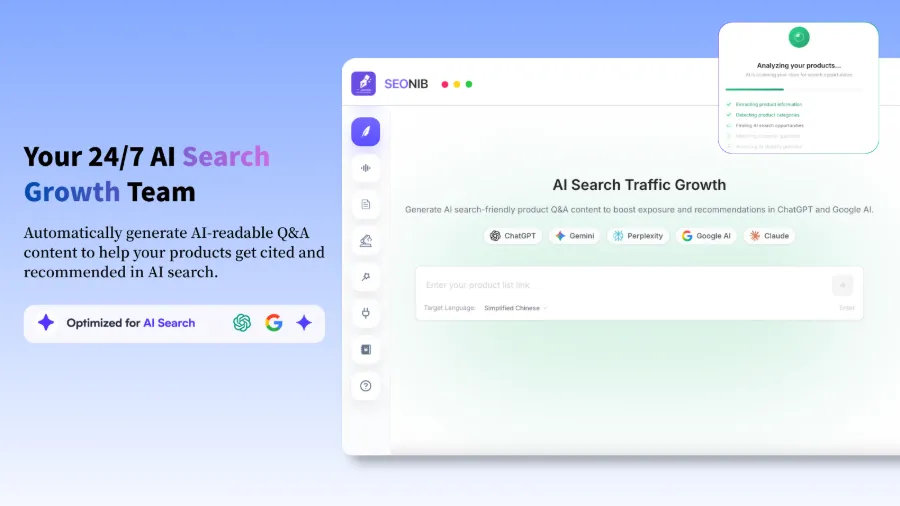
In practice, many teams now turn product links into Q&A‑style content combined with long‑form blogs. A product page can spawn a series of Q&A items such as “How to use this product,” “Suitable scenarios,” and “Advantages over competing products”—the exact material AI search engines cite most often. The demo below shows the full workflow from a product link to automatically generated AEO Q&A content and an SEO blog:
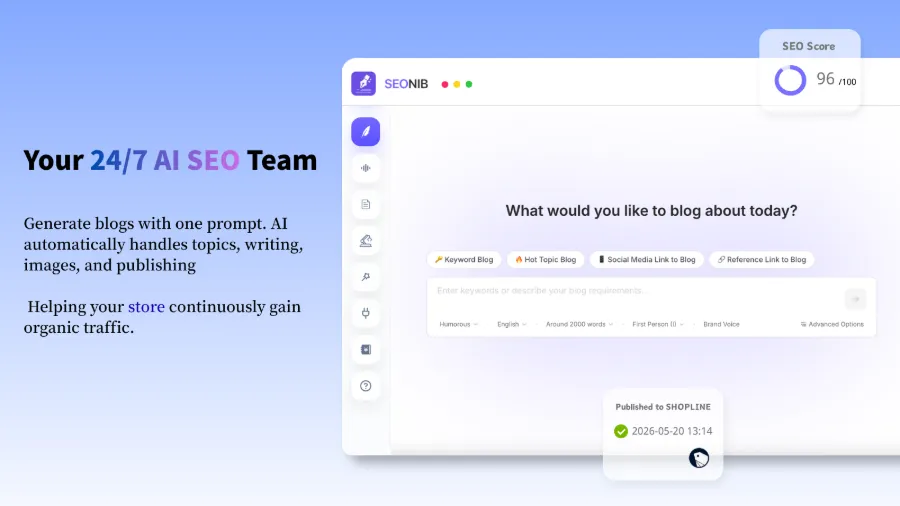
Content distribution logic is also changing. Single‑platform publishing becomes multi‑platform synchronization—Shopify, WordPress, SHOPLINE, etc.—to increase citation chances. Multi‑language publishing is increasingly common; a globally‑targeted independent site typically needs to cover English, German, Japanese, and other major market languages. Doing this manually is prohibitively costly. I’ve seen many teams waste time copying and pasting into each platform’s backend, while content quality suffers.
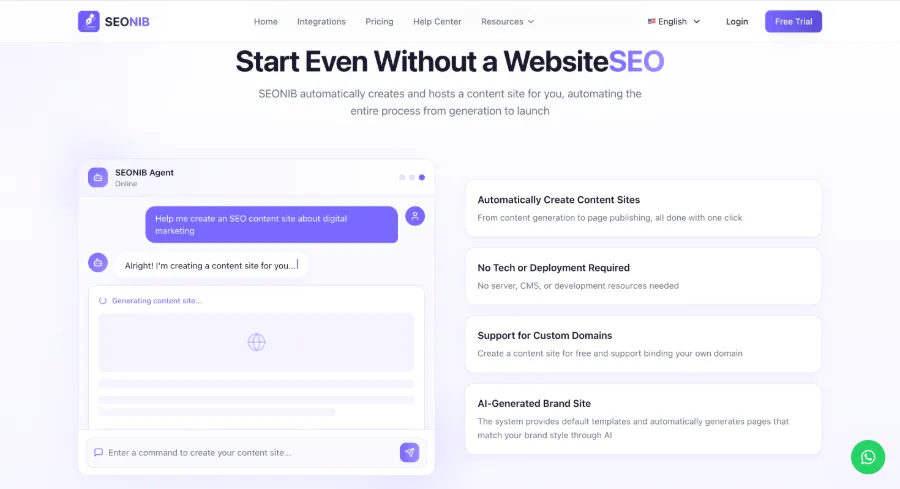
Automated content pipelines therefore become the option for many teams. Set a publishing cadence, let the system automatically generate and publish content, and use continuous output to offset the drop in individual click performance. I previously wrote a practical guide on “Daily Automated SEO Content Publishing for Independent Sites” (https://seonib.com/c/guides/how-independent-sites-publish-seo-content-daily-on-autopilot-2026-playbook/index.html) that details content calendars, batch generation, and scheduled publishing configurations. On the tooling side, platforms like SEONIB (https://seonib.com) break content production into four stages: trend discovery, content generation, scheduled publishing, and multi‑platform sync. By feeding a product link or keyword, the system can automatically produce articles and push them to all platforms. For specific automation setup, see the SEONIB help docs (https://seonib.com/help).
Implementation: A Four‑Step Evaluation Framework for Independent Sites and Cross‑Border E‑Commerce Teams
Theory aside, here’s what you can execute directly.
Audit existing content formats and coverage. Classify your site’s content—blogs, product pages, Q&A pages, knowledge pages—and identify which structures are easily cited by AI search engines. Also check technical foundations: ensure a clear site architecture, normal loading speed, and no indexing issues. The “2026 Technical SEO Checklist” (https://seonib.com/guide/technical-seo) can serve as a reference.
Create a unified brand knowledge base and entity information. This step is often overlooked but is crucial for AI recognition. Consolidate brand name, product lines, core selling points, industry terminology, and FAQs. Inconsistent information across pages confuses AI search engines, leading to no citations. A unified knowledge base lets AI understand your brand from a consistent perspective.
Set an automated publishing cadence and multi‑platform sync. Manual copy‑pasting to multiple platform backends is the most common inefficiency and error‑prone step for independent‑site teams. Choose a reasonable publishing frequency—successful teams I’ve seen produce 3‑5 pieces per week for at least three months—and let automation tools handle the rest. Tools like SEONIB automate the “consistent updating” part, relieving the team from relying on willpower.
- Iterate based on the new metrics. Every 30‑60 days, review AI citation rate, brand mention volume, and Q&A coverage count, rather than obsessing over daily click fluctuations. I fell into a trap where a team relied on click monitoring; after six months of investment, organic traffic rose but inquiries stalled, later discovered the traffic came from low‑intent long‑tail terms with zero AI citations. The budget was wasted and the direction misjudged. If they had used AI citation rate as the core metric, the problem would have surfaced in the second month.
FAQ
Does a drop in clicks always mean content marketing failure?
Not necessarily. A decline in clicks may indicate that AI search engines are directly extracting your content as answer sources, providing users with information without requiring clicks. A simple test: use high‑frequency industry questions on ChatGPT and Perplexity to see if your brand appears in the answers. If it’s cited, your content is working; the effect just isn’t reflected in click data.
How can I tell if my content is being cited by AI search engines?
The most direct method is to regularly ask AI platforms using a combination of your brand name and industry keywords, and check whether your brand appears in the response. Brand monitoring tools can also track mention volume. Additionally, if Search Console shows many “zero‑click impressions,” it signals that AI is extracting your content. I recommend testing every two weeks and recording trends.
What’s the core difference between AEO and traditional SEO?
Traditional SEO optimizes for rankings—getting pages higher in search results, with click‑through rate and position as key metrics. AEO optimizes for citations—getting AI search engines to reference your content when generating answers, with citation rate and entity relevance as core metrics. AEO pages typically use a direct Q&A structure, complete information, and clear entities to facilitate AI extraction and understanding.
My small team lacks a data team; how can we build the new metric system cost‑effectively?
Start with three actions. First, each week test ten high‑frequency industry questions on AI platforms and note whether your brand appears. Second, filter “zero‑click impressions” in Search Console—these are signals that AI is pulling your content. Third, use free brand monitoring tools to track mention volume. Combined, these tasks take less than two hours per week; after 60 days you’ll see clear trends.
Share Article