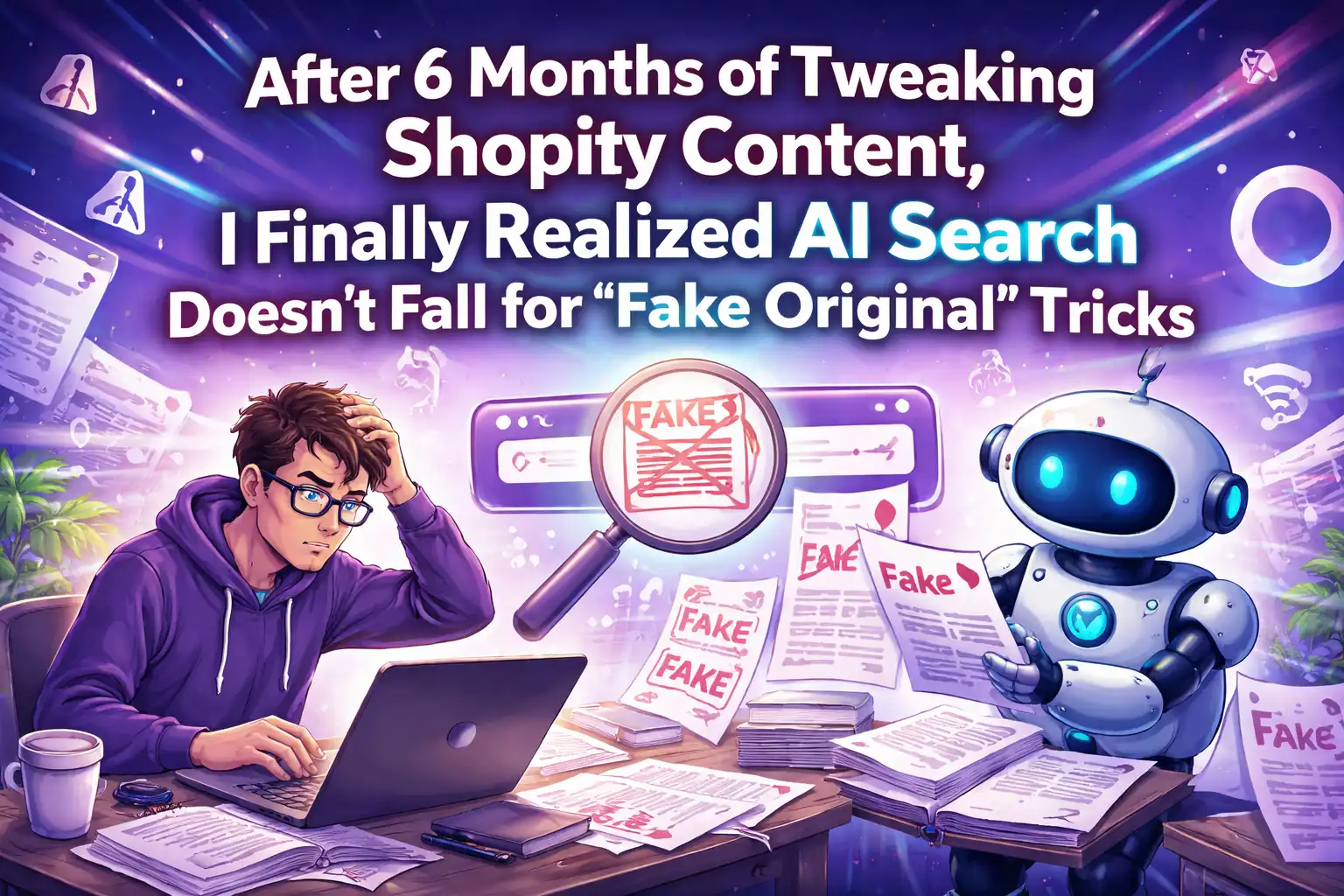
I’ve Been Tinkering with Shopify Content for Half a Year, and Finally Realized AI Search Doesn’t Eat “Pseudo‑Original” Content
Around this time last year, I was staring at the traffic report in the Shopify admin, lost in thought. My store had been open for eight months, and organic search traffic was stuck at just over a hundred visits per day. I installed three different SEO plugins, added Schema, generated a sitemap, and got page speed down to under 2 seconds—impressions in Google Search Console went up a bit, but the click‑through rate stayed flat.
Later I accidentally discovered that the product descriptions and a few “10 Best” blog posts I’d written couldn’t be found at all in ChatGPT or Perplexity. When a friend asked about my brand, the AI replied, “Sorry, I don’t have any information.” It felt like I’d spent half a year decorating a storefront, only for customers to walk in through the back door.
I Realized the Root Cause—AI Crawlers Want Quantity, Not “Perfection”
Traditional SEO plugins help you optimize meta tags, add Schema, compress images—these are certainly useful. But AI search engines—whether it’s ChatGPT, Perplexity, or Google AI Overviews—have a completely different focus. They’re not about “ranking”; they’re about “citing.” If a brand has only three to five pieces of content on the web, the AI model won’t treat it as a trustworthy source during training.
I once outsourced article writing: ten pieces a month, costing $2,000. The quality wasn’t bad, but after three months traffic only rose 15%. The problem was frequency: two or three pieces a week is too few for AI to recognize entities and build topical authority. I needed daily new content, and the pieces had to be linked together, forming a knowledge network.
At the end of last year I started using SEONIB to turn product keywords into blog posts. Its logic isn’t for me to pick topics manually; it automatically monitors industry trends and pushes daily high‑potential topics. I just confirm, and AI generates the article, images, and SEO meta information automatically, then publishes on Shopify at the scheduled time. Compared with manually writing two posts a week before, I now automatically publish one a day, tripling the content volume.
The First Morning a Perplexity Quote Appeared—and the Hidden Cost Behind It
One morning in February this year, I searched my brand name on Perplexity and suddenly saw a passage that directly quoted my blog post, complete with a source link. I almost spilled my coffee on the keyboard. The excitement lasted only half a day—then I noticed that a product link in the quoted article was broken. Because I didn’t check external link validity during automated publishing, the citation pointed to a 404 page.
That lesson taught me that automated content isn’t “set it and forget it.” You need to regularly audit the generated articles to ensure links work, images exist, and there’s no duplicated text. SEONIB’s publishing workflow is solid, but if you don’t maintain up‑to‑date product info in your brand knowledge base, AI‑generated content may reference outdated specs. I now spend ten minutes each week reviewing the previous week’s publishing log to make sure all outbound and internal links are alive. You can also check out our Technical SEO Checklist, which lists checks that are easy to overlook after automation.
The Current Content Rhythm—and a Psychological Trap I Have to Mention
Today my Shopify blog updates at a rate of 1–2 posts per day, all generated and published automatically by AI. Organic traffic has risen from about 100 to over 400 per day, and Perplexity citations have gone from zero to 2–3 times per week. Looks good, right? But there’s a side effect: you start relying on automatically generated content and forget the “quality gate.” Last month an article comparing product materials had the two material characteristics flipped, leading to a customer complaint after delivery. I spent half a day deleting the post, revising the content, and sending an apology email.
Automation can solve “quantity,” but not “mistakes.” My experience is to let AI generate the first draft, then have a human quickly review key facts, especially those involving product specs, pricing, or policies. This process takes only 15 minutes a day but prevents about 80 % of the mishaps.
Frequently Asked Questions
Can automated content actually be cited by AI search engines?
Yes, provided the content is updated frequently, stays on‑topic, and contains verifiable facts. In my experience, after two months of daily posts on related topics, the probability of being cited by Perplexity noticeably increased.
Can SEONIB publish directly to Shopify?
Yes. It supports one‑click sync to Shopify, WordPress, and several other platforms, eliminating the need for manual copy‑pasting. Once you set up the publishing schedule, the content goes live automatically.
Do I still need to manually optimize Schema?
Automation tools generate basic Schema, but if you need more advanced structured data (e.g., FAQ, product reviews), it’s advisable to pair them with a dedicated Schema plugin. At minimum, ensure product pages and blog posts have JSON‑LD; AI engines will trust your content more.
Which is more important: AI search traffic or Google traffic?
They aren’t substitutes. Google search remains the primary source of traffic, but AI search citations bring brand exposure and trust that are rising quickly. I’ve observed that after being cited by Perplexity, direct Google searches for the brand name also increase.
Share Article