The AI Search Era Is Here, but Does Your Content Really Get Understood by AI?
I’ve been doing SEO for over a decade, watching the “keyword ranking” model gradually lose its effectiveness—not because no one searches, but because the answers users want are being eaten by AI. Last week I helped a friend with an independent site diagnose his traffic. His Shopify store had more than seventy product blog posts, consistently ranking in the top five on Google, yet ChatGPT and Perplexity never referenced his content. I skimmed his articles—titles were generic, paragraphs were dense and unstructured, and the whole piece lacked any structured markup. AI doesn’t refuse to grab it; it simply can’t understand it. Today I want to talk about how to make your content pleasing to Google while also being captured by AI retrieval tools like ChatGPT and Perplexity.
First, Let’s Clarify: What Exactly Is AI Search?
The biggest difference between AI search and traditional search isn’t the technical architecture; it’s “how the answer is found.” Google relies on keyword matching: you type “red coat,” it finds pages that contain the exact phrase “red coat,” then ranks them by backlink authority. ChatGPT, Perplexity, and similar tools work differently—they organize answers based on semantic understanding and entity relationships. If you ask “What should I wear outdoors in winter to stay warm,” the AI doesn’t match keywords; it understands the relationship among the entities “winter,” “outdoors,” and “warmth,” then extracts the most logically consistent paragraphs from content and reorganizes them into a single response.
Thus, AI search is fundamentally about “citation,” not “ranking.” Your content doesn’t need to be number one; it just needs to be a candidate source for citation.
A useful statistic to remember: Google processes about 1.64 billion searches per day, while ChatGPT handles roughly 1 billion queries daily. Traditional search remains the main driver, but AI search is growing faster than I expected. 79.8 % of Americans still prefer traditional search engines—data from Higher Visibility’s 2025 survey—meaning SEO isn’t dead, but you need to add an AI‑compatible layer.
How Does AI Search Find Your Content?
AI search works in two phases: model training and inference. During training, large language models crawl publicly available webpages and learn the relationships between entities. During inference, when you ask a question, the AI pulls relevant paragraphs from its training data and assembles an answer.
That means your content must satisfy two conditions simultaneously: a clear structure that tells the AI what the passage is about, and semantic convergence that signals the article focuses on a single topic.
In 2023 I ran a failed test. I saw a viral TikTok video, liked the content, and republished it as ten blog posts. After three months, Google Search Console showed zero impressions, and AI search never cited any of them. The problem? The video script’s language was too scattered—jumping around, lacking a topic sentence, and with no logical connections between paragraphs. AI didn’t reject the content; it couldn’t recognize the structure.
Key lesson: AI search cares more about “semantic convergence” than “keyword density.” If you try to cover three completely different entities—“down jacket,” “outdoor camping,” “winter outfits”—in one article, AI will simply ignore the whole piece. It prefers narrow‑focus content that “covers one thing per article.”
Another hidden rule: AI search favors “semi‑open questions.” If your content aligns directly with question words like “how,” “why,” and “what”—for example, “How to clean a down jacket” instead of “Down jacket cleaning guide”—the chance of being cited is far higher than a generic product description. This is because AI needs “answer paragraphs” during inference, not product blurbs.
How to Revise Your Content So AI Will Choose It for Answers
First, let’s debunk a common myth: longer doesn’t mean more authoritative; a messy structure does not help at all.
Step one is to adapt your content’s structure for AI retrieval. Clear section headings, short paragraphs (no more than five sentences), and FAQ format all help AI locate your material quickly. Step two is to leverage structured data—Schema.org FAQ markup, BreadcrumbList, Article markup—all of which help AI understand entity relationships.
If you want a systematic way to increase the probability of AI citing your content, check out this guide How to Get AI Answer Engines to Cite Your Content, which lists seven proven methods.
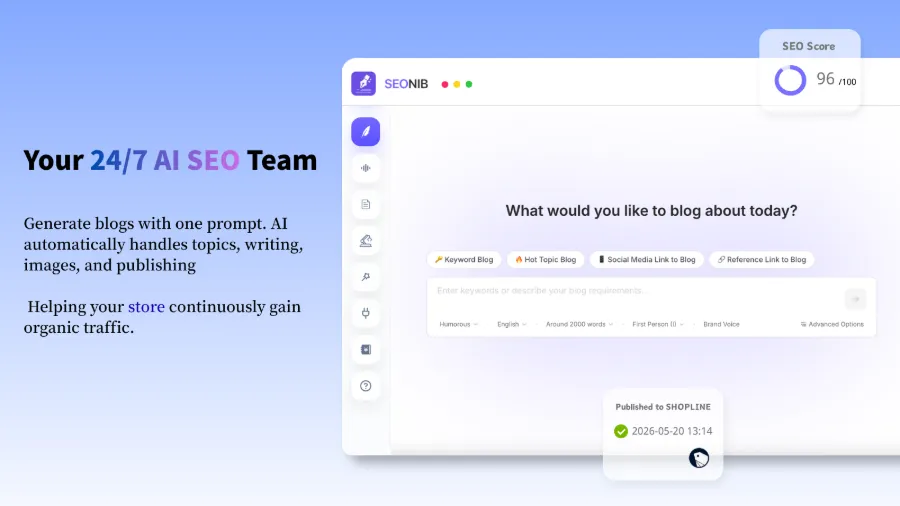
After you have a solid structure, you also need an automated workflow to maintain a regular publishing cadence. I use SEONIB to manage the entire publishing pipeline—from trend discovery and content generation to multi‑platform synchronization—all automated. Especially when doing structured and bulk publishing, manual effort becomes prohibitively expensive, and AI tools shine here: they can scale the structural decisions you make in a draft across every article.
Concrete workflow: define a topic → break it into sub‑questions → write answers → add structure → insert internal links → publish. For example, if you run an e‑commerce store on Shopify selling coats, you start with the topic “How to Choose an Outdoor Winter Coat,” break it into sub‑questions like “Material comparison,” “Warmth rating,” and “Size recommendations,” write answers, add FAQ Schema, and finally let SEONIB automatically publish to WordPress or Shopify. Each step is detailed in the SEONIB Help Documentation.
Even after these revisions, it’s not enough—you must build an internal linking network to signal topical authority to AI. If you’re new to SEO, start by reading What SEO Tools Beginners Should Use to understand the basic toolchain before moving on to automation.
Traditional SEO Isn’t Dead, But It Needs a “New Plug‑In”
There’s been a lot of chatter in the community about “GEO vs. SEO,” with some claiming generative engine optimization will render Google obsolete. Frankly, that conclusion is premature.
79.8 % of Americans still favor traditional search engines, and Google still controls the bulk of traffic. Traditional SEO—keyword research, backlink building, technical SEO—remains the foundation of content. The problem is that many people produce 100 SEO articles whose formats are completely unsuitable for AI citation. They write a bunch of “3 % keyword density” articles, but AI reads them as if they were never written.
My view: GEO (Generative Engine Optimization) isn’t a replacement for SEO; it’s an additional layer on top of SEO. It requires you to maintain solid SEO fundamentals while also paying extra attention to semantic structure, entity relationships, and citation friendliness.
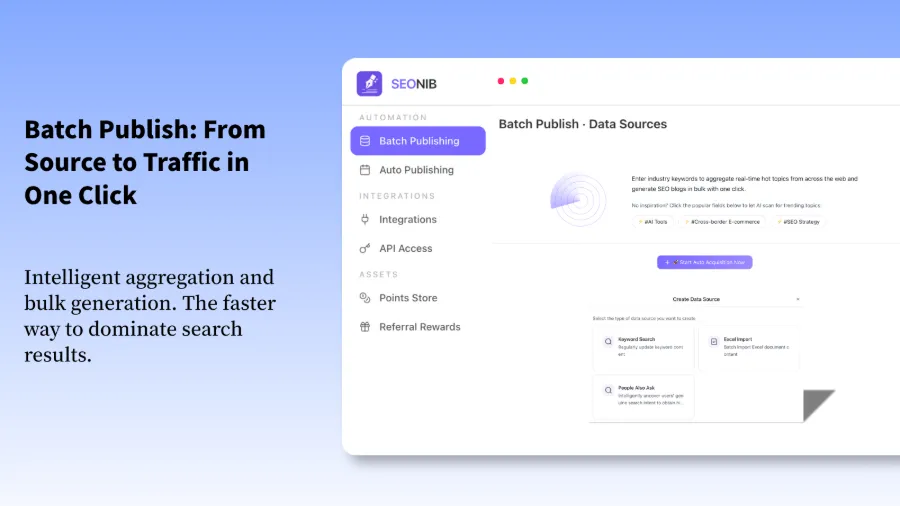
My current solution is: trend capture → content generation → structuring → automated publishing → multi‑platform sync. In this pipeline, maintaining a consistent publishing frequency is key—AI considers a site’s update activity. If you don’t update for six months, AI assumes the site is abandoned and reduces citation weight. I use SEONIB Bulk Publishing to WordPress to publish daily, saving the time of manual backend logins.
For friends running multi‑platform operations, the SEONIB app in the Shopline App Store lets you sync directly from the Shopline backend without switching between tools.
Real‑World Example: Turning an Ordinary Product Blog into AI‑Friendly Content
Take a typical e‑commerce coat as an example. The original content looked like this: title “2025 Winter Coat Recommendations,” body listed ten different styling options ranging from down jackets to trench coats, all in a single article with no sub‑headings, no FAQ, no internal links. After AI read it, it couldn’t tell whether you were talking about warmth or fashion, so it skipped it.
Revised version: title narrowed to “How to Choose a Men’s 800‑Fill‑Power Down Jacket,” body split into four modules—Material Description, Fill‑Power Comparison, Size Advice, Care Guide. Each module gets a sub‑heading, and a FAQ section (using Q&A cards) is added at the end. Internal links point to another article on “How to Wash a Down Jacket.”

Below is a before‑and‑after comparison:
| Dimension | Before | After |
|---|---|---|
| Title | Broad (“Winter Coat Recommendations”) | Narrow (“How to Choose a Men’s 800‑Fill‑Power Down Jacket”) |
| Structure | No sections, one long paragraph | 4 sub‑heading modules + FAQ |
| Entities | Scattered across ten categories | Focused on a single entity: down jacket |
| Internal Links | None | 2 relevant internal links |
| AI Citation | Never cited | Cited 3 times by Perplexity within two months after revision |
Don’t try to cover every topic in one article. AI prefers “single‑point authority”—standing firmly on a narrow topic is far more effective than writing ten generic topics. In my own experiment, I ran three weeks of automated publishing with SEONIB, creating separate articles for different angles of the same product. After three months, the likelihood of AI citation roughly doubled.
FAQ
Q1: Will AI search completely replace traditional search engines?
Not in the short term. 79.8 % of users still primarily use Google, but search behavior is stratified—simple Q&A goes to AI, complex decisions still rely on traditional search. You need to cover both scenarios, not abandon either.
Q2: Why is my well‑written content never cited by AI search?
Most likely a structural issue. Check three things: does the article have clear H2 sections, does it converge on a single entity, and does it use structured data markup? If any of these are missing, AI can’t understand it.
Q3: What’s the difference between GEO (Generative Engine Optimization) and SEO?
GEO is a subset of SEO. SEO solves “how to get search engines to find you”; GEO solves “how to get AI to cite you in answers.” The foundation is still SEO, but with an extra layer of structuring and entity adaptation.
Q4: Do I need to build a separate website just for AI search?
No. If your existing content is well‑structured, topic‑focused, and regularly updated, AI will naturally recognize it. The issue isn’t the number of sites; it’s content quality.
Q5: How much does structured data actually help AI search?
A lot. FAQ Schema can directly present your Q&A as candidate answer paragraphs. BreadcrumbList and Article markup help AI understand page hierarchy. Overall, proper Schema can increase the chance of AI citation by roughly 2–3×.
Share Article