From Search Engines to Answer Engines: The Truth SEO Professionals Must Face
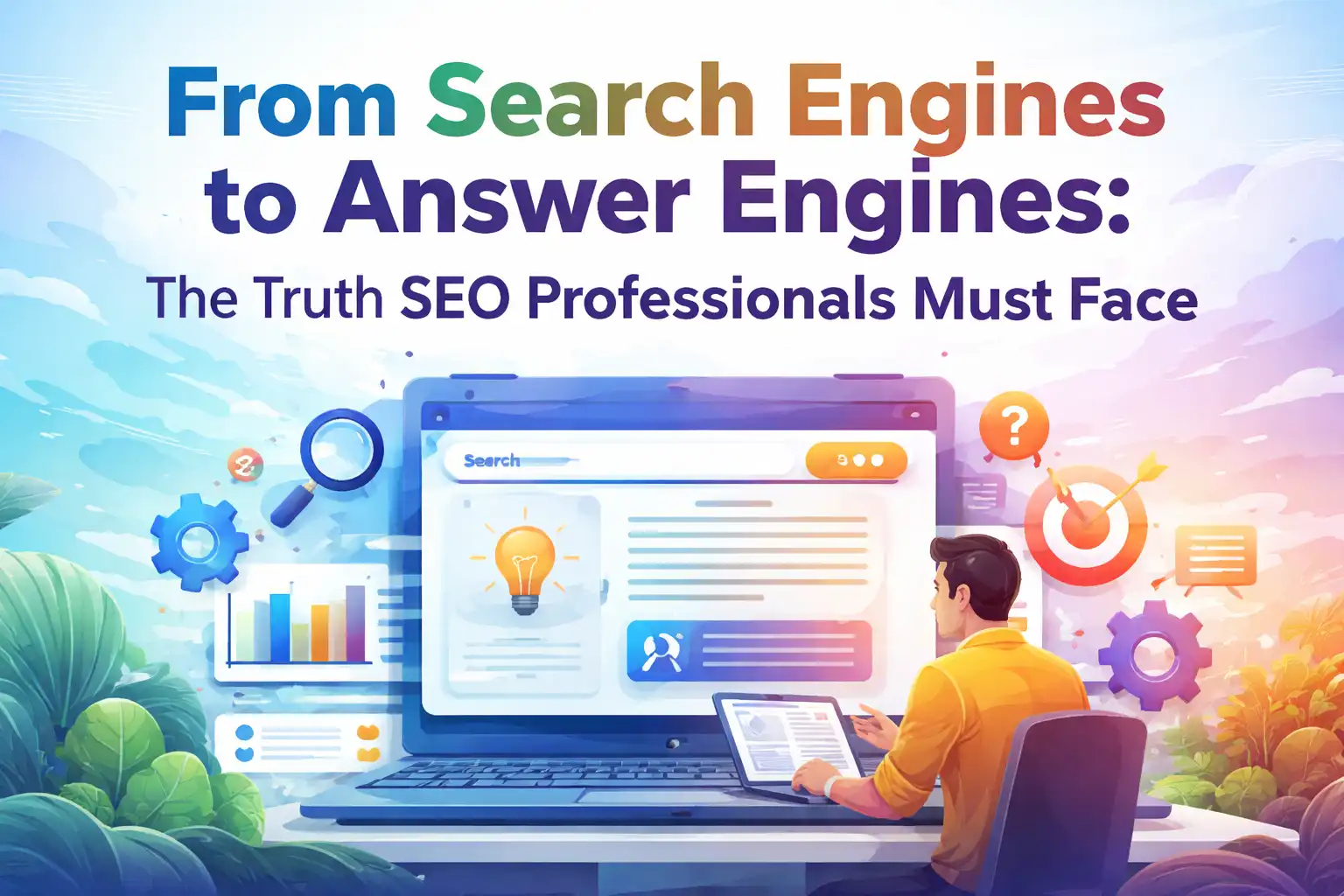
At the start of each month I open Google Search Console and see the same scene: rankings persist, but clicks are as deflated as a leaky balloon. Then I test a newly launched keyword in ChatGPT and discover it can already generate a full answer directly. By 2025 this scenario is no longer a fringe story; it is rewriting the fundamental logic of traffic acquisition.
The fundamental difference between answer engines and search engines is that traditional search gives you a pile of blue links to choose from, while answer engines give you a paragraph and send you on your way. This means that keywords you spent months climbing in rankings may now have no chance of being cited at all. It is not a gradual adjustment but a rupture in the traffic allocation mechanism.
Why the Word “Search” Is Being Redefined
The core logic of traditional search engines is keyword matching — you search “how to fix a pipe,” and it returns a bunch of pages containing “fix a pipe.” Google AI Overviews, Perplexity, and ChatGPT Search, however, are answer engines that perform concept understanding and intent matching. They don’t care whether your page contains the keyword; they care whether your content can fit into their answer puzzle.
I observed a clear shift in user behavior. In the past, users would click a link after searching; now more people read the answer directly on the results page and leave. Gartner’s 2024 forecast noted that by 2026, query volume for traditional search engines will decline by 25%. I initially thought that figure was exaggerated until I realized I, become the person who copies answers from Perplexity without clicking links.
This has a structural impact on content strategy. Previously I would deliberately stuff keywords, control density, and optimize title tags. In the context of answer engines, those actions are rapidly losing relevance. AI cares more about whether your content can answer a complete question, not whether your title contains an exact‑match keyword.
E‑E‑A‑T Is No Longer a Gimmick — It Has Become a Core Ranking Factor
At the end of 2024 I ran a test. I launched two sites with identical content structures; the only difference was that one added FAQPage Schema while the other did not. In Perplexity’s citation performance, the site with the schema received twice as many citations as the other. This made me completely abandon the “just write content, ignore format” mindset.
E‑E‑A‑T has long been treated in the traditional SEO community as a “Google‑made‑up” concept. In answer engine filtering logic, however, it becomes a very concrete mechanism — AI needs structured signals to judge whether a piece of content is reliable. Your schema markup, entity associations, and brand information consistency are all cues for its judgment. If you want to dive deeper into why some sites perform better in AI search, see this analysis of the secret behind higher AI engine citation frequency.
Another point that impressed me is the value of brand continuity. According to a survey from early 2025, over 60% of users prefer to trust content that cites its source in AI‑generated answers. Moreover, answer engine algorithms seem to favor entities that “continuously update content” over sites that have a one‑off burst and then stop maintaining. This involves Knowledge Graph and Entity SEO logic — AI needs to confirm you are a living, continuously producing brand, not a content zombie.
Click‑Through Rates Have Died, but Traffic Structure Is Still Alive — Content Strategy in the AEO Era
Click‑through rate (CTR) is becoming a dubious metric. A page ranking #1 but seeing a 40% drop in CTR does not mean your content is bad; the more likely reason is that AI is feeding the answer directly on the results page. The traffic structure itself isn’t dead; it has just changed its allocation mode — from “being clicked” to “being cited.”
AEO (Answer Engine Optimization) core logic is to make your content easier for answer engines to cite, not to get users to click. This means content structure must shift from “writing articles” to “writing answers.” Q&A format, FAQPage Schema, structured summaries — these were once SEO options, now they are prerequisites. For a detailed breakdown of how to build a complete AEO content system, see this analysis of the AEO content framework, which includes pitfalls I’ve encountered.
Early test data that caught my attention: pages optimized with AEO format are 34% more likely to be cited in AI search than non‑optimized pages. It’s not a huge number, but in an environment where traffic allocation is tightening, a 34% citation rate difference can directly determine whether you appear in an AI answer for a hot topic.
Switching from a “ranking mindset” to a “citation mindset” is painful. You can monitor rankings daily, but citations happen silently. You must accept the fact that your content may be mentioned in an AI answer, and you may never know unless a user tells you.
From Content Craftsmanship to Content Engineering — How Tools Are Changing the Rules
In the past, content production was like a craft workshop — manual topic selection, manual writing, staggered publishing, one person acting as an entire team. Today, an automated pipeline has compressed all that into a few configuration steps. SEONIB is an example of such a tool — it doesn’t write articles; it takes over the entire pipeline.
I recently did a representative test. Previously I could produce at most 3 pieces of content per week, each requiring me to manually handle topic selection, research, drafting, formatting, and publishing. After connecting the automated pipeline, weekly output jumped from 3 to 21 pieces, while human involvement time dropped 80%. Of course, not every piece is perfect, but content marketing’s essence is the product of quantity and stability; the scale advantage above a quality threshold is real.
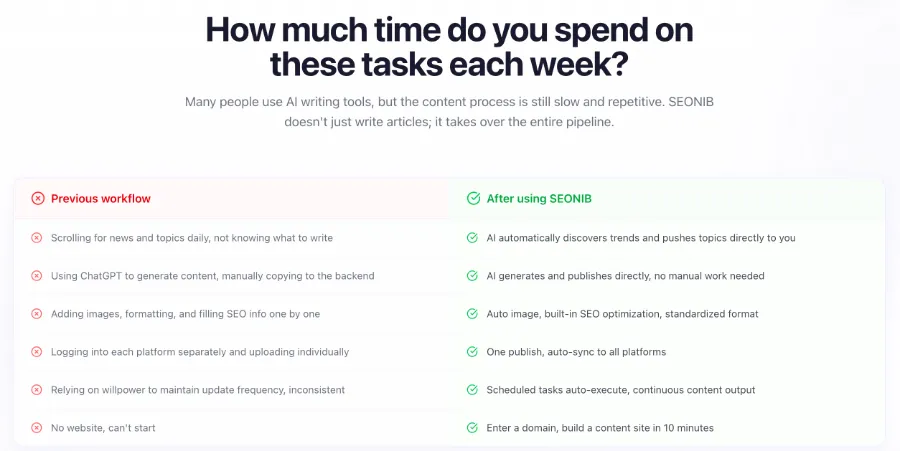
This shift made me realize that SEO professionals must accept a tool‑centric reality. You no longer need to write every sentence yourself, but you must understand the pipeline’s logic — how data sources are ingested, how content is structured, how it syncs across platforms. Even cross‑platform sync, which used to require developer involvement, is now reduced to a few configuration steps, such as pushing newly generated content directly into Shopify product descriptions.
Speaking of cross‑platform, a recent demo video showed how to automatically sync a blog to Shopify; the workflow was far simpler than I imagined — you configure the data source once, and all subsequent content is automatically distributed. This pipeline capability is becoming a foundational skill, not an optional extra.
Of course, tool‑driven production brings another challenge: maintaining content consistency. When you go from a few pieces a week to several per day, the risk of brand voice drift increases. That’s why tools like SEONIB need brand context management features — to let AI know who you are, what tone you use, and which products to reference. Essentially, they turn content production from craft into engineering, and the core of engineering is repeatability, predictability, and control.
One trend is already clear: you can’t just focus on Google’s narrow slice anymore. If you haven’t started looking at other traffic sources, this discussion about stopping the Google‑only focus is worth reading. For more detailed pipeline configuration, see the SEONIB help documentation, which is far more detailed than what I’ve written here.
After 2026: The “Content Bubble” of AI Search and the Endgame of SEO
One unsettling trend I’ve observed is that AI search is forming its own “content bubble.” When ChatGPT Search or Perplexity favor content from large platforms, independent sites’ traffic channels are being silently narrowed. Industry observations show that a major platform is cited twelve times more often in AI search answers than an independent site. This gap cannot be bridged by a few good articles.
YouTube and LinkedIn have become the preferred data sources for AI search for a straightforward reason: their content is highly standardized, entity information is complete, and the data volume is massive. AI’s parsing cost is low and output reliability high on these platforms. In contrast, independent sites have wildly varying content quality, and AI is reluctant to risk citing a structurally messy site.
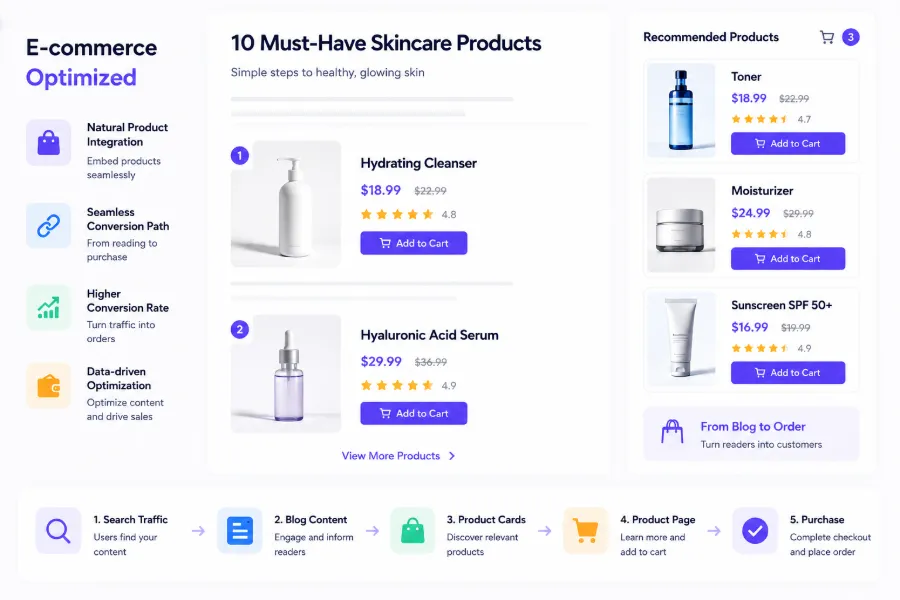
But this does not mean independent sites have no countermeasures. My strategy is threefold: build a proprietary knowledge base (so AI knows you have structured entity data), continuously produce well‑structured authoritative content (so AI has reason to cite you), and use tools’ bulk capabilities to sync content across multiple platforms. No independent site can win AI search favor by publishing two articles a month, but if you output structured, entity‑marked content daily, your citation probability will rise significantly.
The ultimate outcome of this game is still unclear, but one thing is certain: AI search will not disappear, and the content bubble will not vanish on its own. What you can do is become an entity that AI cannot ignore.
Frequently Asked Questions
What Exactly Is an Answer Engine? How Does It Differ From Traditional Search Engines?
An answer engine generates answer text directly instead of returning a list of links. The distinction is that answer engines demand higher “citation value” from your content — they need to extract a complete, independent, trustworthy answer from your page, not merely treat your page as a candidate link.
Does AEO Optimization Require Rewriting All Old Content?
You don’t need to rewrite everything, but you should adjust structures in batches. Prioritize content that previously drove traffic but now shows a clear click‑through decline, adding FAQPage Schema and clear sectional headings. In my experience, revamping 30% of high‑value old content yields noticeable changes in citation rates.
Will Answer Engines Completely Replace Search Engines?
Not in the short term, but the proportion of traffic allocation will continue to shift. Search engines remain suited for exploratory searches, while answer engines excel at definitive searches. Both will coexist, but the pressure from the latter on independent‑site traffic will become increasingly pronounced.
How Much Budget Should I Allocate to Answer Engines?
A pragmatic recommendation: shift 20–30% of your traditional SEO budget to AEO‑related work — structured data, content restructuring, brand entity building. Once you see citation rates improve, consider increasing the investment.
Do Small Brands Still Have a Chance to Be Cited in AI Search?
Yes, but the path differs from that of big brands. Small brands can fill long‑tail vertical niches that large platforms ignore. If you consistently produce clear, well‑structured articles on a niche topic, AI search will still cite you — you just need to be more focused and persistent than larger brands.
Share Article