How I Keep My Shopify Blog Updated Without Writing an Article Every Week
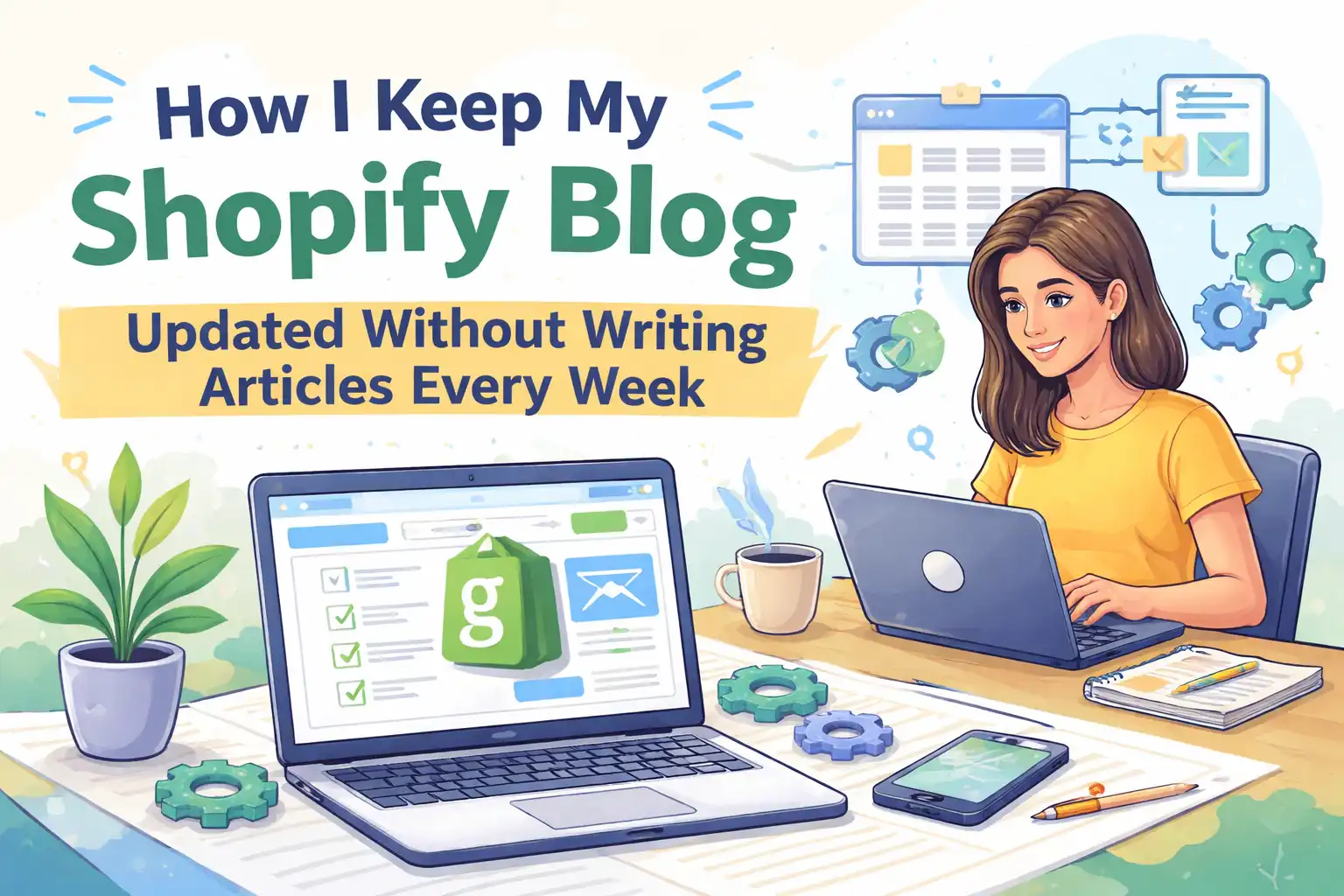
Many Shopify sellers face the same dilemma: they know that a blog is the most stable channel for organic traffic, but keeping a weekly update schedule is exhausting. I once tried using ChatGPT to write articles, but after writing I still had to manually paste the content into the backend, add images, fill in SEO information, and click publish—this whole process took more time than writing the article itself. This post will share an automated pipeline I actually use, so the blog updates like a clock while I only need to glance at the topic selection occasionally.
If the blog isn’t updated, organic traffic won’t come. I came to fully understand this after almost a year of running my first Shopify store. That year I tried various methods, from outsourcing writers to AI assistance, and the conclusion was straightforward: If you can’t maintain a steady publishing rhythm, SEO traffic won’t grow steadily. My current approach is to automate every repetitive step in the content production chain using tools, so I spend no more than 10 minutes a week actually working on the blog.
Manual Update Pain Points for Bloggers: Why Writing an Article Every Week Is Unsustainable
I initially stuck to manual updates for three months, spending at least 5–6 hours each week writing a Shopify blog post. The process included: daily browsing of industry sites for inspiration, reviewing keyword data to select topics, generating a draft with ChatGPT, then spending a lot of time formatting in the Shopify backend, adding images, and filling in SEO titles and meta descriptions. Each individual task isn’t huge, but together they become a heavy time burden.
What happened? After three months, the update frequency dropped from one post per week to one per month. Inconsistent content output made it hard for search engines to build trust in the site, and organic traffic barely improved. A survey showed that independent site sellers spend an average of 4.5 hours per week on blog maintenance, but over 60% can’t keep it up for three months. This matches my experience perfectly—manual effort is good but not sustainable.
The core bottleneck of manual maintenance isn’t the lack of writing ability; it’s the lack of systematic support. You have to manage topic selection, writing, editing, publishing, and ranking monitoring all at once, essentially acting as both merchandiser and content team. When other urgent tasks arise in store operations, the blog is usually the first thing to be abandoned.
If you’re diagnosing your blog’s content performance, start by using a tool for an overall assessment. Refer to this list of 10 Popular Page SEO Analysis Tools (https://seonib.com/guide/2026-top-10-seo-tool) to check the indexing and crawl status of existing pages—this is more useful than blindly adding articles.
Core of the Automated Content Pipeline: From Topic Discovery to Auto-Publish
The only way to solve the manual maintenance problem is to let tools take over the most repetitive part of the content production chain. I built a complete automated pipeline whose core is a workflow built on SEONIB (https://seonib.com). The tool monitors industry trends and keyword search volume in real time, automatically pushes topics with traffic potential; AI generates SEO‑optimized articles based on those topics, automatically adds images, internal links, and meta descriptions; then a single click or scheduled action publishes to Shopify.
The biggest difference between this process and manual operation is the change in time cost. In the manual stage, writing a qualified article from topic selection to publishing took at least 3–4 hours. After automation, I only need to open the backend for 10 minutes each week to confirm topics, and the system handles everything else. Blog update frequency rose from one post per week to one per day.
In practice, one of the features I use most often is source conversion—turning a product link directly into an SEO blog article. Just paste a product link, and AI automatically identifies the product information and generates a buyer’s guide, tutorial, or review around that product.
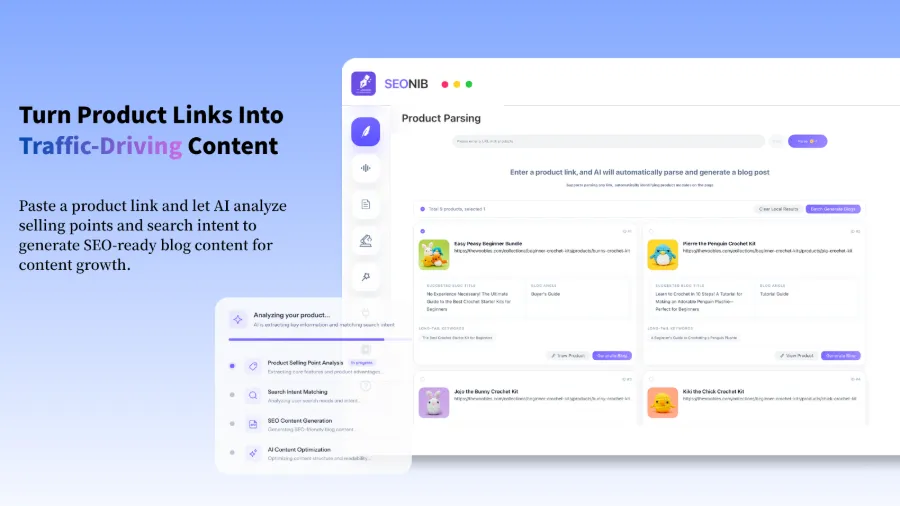
The advantage of this approach is that you don’t have to think of topics yourself; the actual search demand for your products is the best source of topics. For example, if your store sells coffee machines and “how to clean a coffee machine” receives a few thousand searches per month, generating a cleaning guide based on the coffee machine link naturally matches the search intent.
For topic discovery, I habitually let AI continuously monitor industry trends and competitor content changes. Some content creators have shared similar practices, noting how AI‑assisted topic selection changed their publishing rhythm—this creator’s “cheat” record mentioned that a niche topic discovered by AI brought the highest organic traffic in the past three months. This isn’t an isolated case; when the machine handles data filtering, human effort can focus entirely on judging which topics are worth deep diving into.
Shopify integration is the most time‑consuming step in this stage. After building the pipeline, I tried pushing content to multiple platforms. If you’re expanding from a single platform to multiple channels, the SEONIB Bulk Publishing to WordPress Guide (https://seonib.com/c/guides/seonib-bulk-publishing-to-wordpress-turn-your-blog-into-an-automated-content-factory-2026/index.html) mentioned in this article can serve as a reference, especially when handling bulk publishing logic. Also, if this is your first time using such a tool, watch for the announcement that SEONIB is now available in the Shopify App Store—once installed, the integration with Shopify is complete, with no extra development needed.
For detailed steps on turning a product link into a blog, see the more comprehensive guide: Convert Product Links to SEO Blog Posts.
This video demonstrates how, after generating an article from a product link, you can sync the content to the Shopify backend with a single click. I was initially worried about errors during sync, but after a few tests I found that formatting, image placement, and internal links generally required no extra adjustments.
How to Set Up a Continuous Update System: Scheduling and Multi‑Platform Sync
Once the automated pipeline is built, the decisive factor for content output efficiency is the scheduling setup. My approach is simple: set an automatic publish at 9:00 AM every day, accumulating 30 SEO articles per month. Search index volume and organic traffic usually don’t change in the first week but start to climb noticeably around the third month. Search engines need time to evaluate the authority and relevance of new content; consistent publishing is the key signal for building topical authority, not a single viral article.
The core of the scheduling interface is a visual content calendar where you can view all articles planned for the next week to month, with preview, adjustment, and pause options. When needed, I can batch‑review the upcoming content directory a day or two in advance to ensure there are no obvious quality issues.
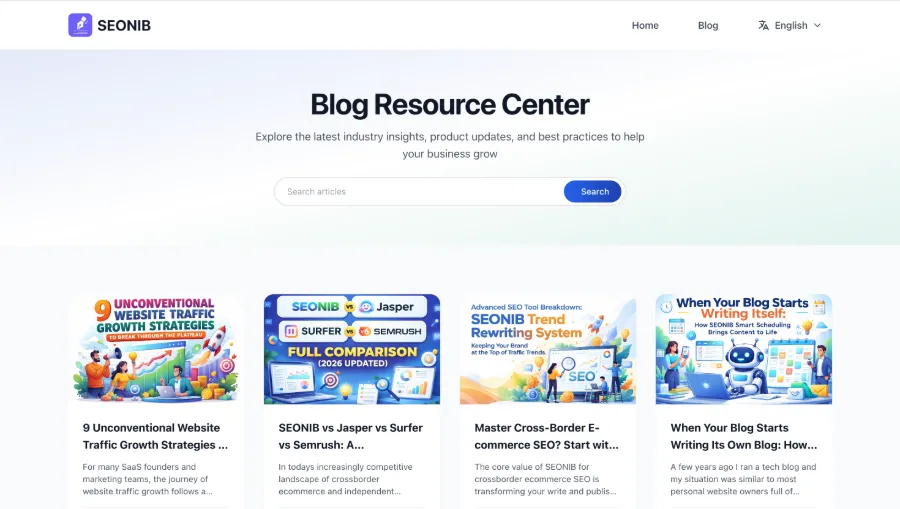
If you run both Shopify and WordPress (or other platforms), the “generate once, sync everywhere” feature further reduces duplicate work. I currently have my main site on Shopify and a secondary site on WordPress, with all content managed by the same scheduling system—no need to log into each backend separately.
Set it and let go—this mindset is the most important after switching from manual to automated. You don’t need to stare at data every day; just check keyword ranking trends once a week to decide whether to adjust topic direction. Meanwhile, the stability of scheduled publishing itself sends a signal to search engines that the site is an actively updated, valuable site worthy of more frequent crawling.
While building the system, also ensure the site’s basic SEO conditions are met. After automated content generation, if the site suffers from slow page loads, missing structured data, or crawl configuration errors, publishing more articles is futile. Use this Technical SEO Checklist (2026) to systematically check for technical issues. The Help Documentation (https://seonib.com/help) provides detailed explanations of time zones, minimum publishing intervals, and content templates—useful when setting up the system.
FAQ
Will automatically generated articles be repetitive or low quality?
If the tool lacks a brand knowledge base, it can indeed produce similar phrasing for related products or topics. The solution is to pre‑configure industry terminology, brand information, internal linking rules, and asset libraries in the automation system, allowing AI to reference different cases and product models across batches, reducing duplication. I’ve been running it for four months without any completely identical articles being indexed.
Do I still need to write or edit articles myself?
Most of the time, no. I spend about 10 minutes each week confirming the topic list and occasionally preview the title for accuracy before publishing. If a topic requires specialized industry knowledge, I add simple writing points during the topic selection stage for AI to reference. Genuine manual editing occurs only once or twice a quarter.
If I do no manual intervention at all, will the blog still get traffic?
Yes, but results depend on tool configuration and industry competition. In my consumer electronics niche, the first three months of fully automated blog posts generated a 30%–40% monthly increase in organic traffic. In highly competitive industries, it’s advisable to intervene manually on keyword strategy—automation handles execution, humans set direction.
Do the automation tools support Chinese or other languages?
Most multilingual‑capable tools can generate Chinese content, provided you configure Chinese as the target language and add the appropriate industry keyword library. I’ve tested automatic generation for both Chinese and English; both languages perform similarly in scheduling and publishing, and search engines index Chinese content at a normal speed.
Will automating blog updates violate search engine rules?
Search engines do not prohibit AI‑assisted content creation as long as the content provides real value and isn’t just keyword stuffing or empty filler. As long as your automated system includes a reasonable knowledge base, references real product data and industry information, and undergoes minimal human quality checks, there’s no risk of penalties. I’ve monitored Google Search Console for six months without any manual action notices.
Share Article