SEO Tools Practical Guide: From Keyword Research to AI Content Automation, Master It All at Once

The time spent daily on keyword research, site audits, and rank tracking often consumes most of an SEO professional’s effort. The most frustrating part is knowing that content must be produced continuously, yet there’s never time to write, no idea what to write about, and even when you do write, results are invisible. This article systematically introduces the selection strategies and practical uses of five major categories of SEO tools, while also introducing the game‑changing AI content automation tools that help you build a more efficient workflow.
Why Do You Need SEO Tools? — Three Key Principles for Choosing the Right Tools
The core value of SEO tools is turning vague problems into objective data. Is the site speed an issue? Which keywords are competitors targeting? Where do your rankings stand? Without tools, these questions are almost always answered by gut feeling. Tools don’t directly boost rankings, but they tell you which direction to optimize—many people don’t realize this distinction at first.
After trying dozens of tools, you’ll find that the number of tools does not equal effectiveness. The pitfalls we’ve encountered show that roughly a dozen tools are sufficient; the key is picking the right types and using them consistently.
Three principles are worth remembering when selecting SEO tools:
- Relative values matter more than absolute values. The same keyword will show different search volumes across tools—Ahrefs may show 5,000, while Ubersuggest may show 9,000. Debating which number is more accurate wastes time; you really need the relative relationship between keyword A and keyword B to find an attack direction.
- Pick one tool per category. Buying Ahrefs, SEMrush, and Moz together often leads to decision paralysis because of differing data sources; ultimately, using a single tool plus free utilities gets the job done—this has happened to us many times.
- Mind regional and language support. Many foreign tools have incomplete Chinese databases, especially for Taiwan, Hong Kong, and Southeast Asian markets, where data bias can be so large it becomes unusable.
For a new site, start with free tools; during growth, subscribe to a single comprehensive tool; in maturity, add a content automation platform to sustain output cadence.
Five Major Categories of SEO Tools at a Glance: Keyword Research, Technical Detection, Integrated Analysis
There are hundreds of SEO tools on the market, but when broken down by function, they fall into a few core categories. The table below summarizes the key differences among four mainstream comprehensive tools:
| Tool Name | Core Advantages | Chinese Support Level | Suitable For |
|---|---|---|---|
| Ahrefs | Strongest keyword and competitor analysis | Supports Traditional Chinese, full database | Teams managing long‑term websites |
| SEMrush | Outstanding competitor research and content templates | Chinese interface, supports Taiwan region | International brands and e‑commerce sellers |
| Moz | Authoritative backlink analysis metrics | Limited Chinese resources, better for English markets | Companies targeting US/UK markets |
| Ubersuggest | Simple interface, low price, free tier available | Supports Traditional Chinese, affordable | Small‑to‑medium businesses and SEO beginners |
Ahrefs’ Site Audit is useful, but it’s recommended to pair it with other site‑checking tools; a single tool may miss some technical issues. Google PageSpeed Insights is a free site‑speed checker; while simple, it is the official standard for Core Web Vitals optimization. Yoast SEO fits WordPress users for basic on‑page SEO, but its capabilities stop at page‑level optimization and cannot help with keyword strategy or competitor analysis.
A common misconception is treating SEO tools as ranking guarantees. No matter how powerful a tool is, it’s only an aid for judgment. The true ranking factors—content quality, site experience, user behavior—are monitored by tools, not replaced.
It’s worth noting that traditional comprehensive tools face new challenges. User behavior is shifting from Google search results to AI summaries, social platforms, and e‑commerce internal search. If you only focus on traditional ranking tools, you may miss this channel migration. This becomes increasingly critical in 2026 SEO planning; see this article on Don’t Just Focus on Google: Full‑Channel SEO Strategy to understand why a single channel’s rank no longer equals visibility.
The Rise of AI Search: GEO Effectiveness Analysis and New AI Content Automation Tools
The proliferation of AI search has fundamentally changed SEO: users no longer rely solely on Google SERPs; many now ask ChatGPT, Gemini, and similar tools directly. Whether your brand is quoted by AI is becoming a brand metric. Traditional SEO tools can’t track this data, so you may not even know if AI answers reference you.
That’s the backdrop for the emergence of GEO (Generative Engine Optimization) tools. They monitor brand visibility in AI tools, citation frequency, and contextual placement in answers. These tools are still early‑stage and relatively limited— they can tell you if your brand is mentioned, but they struggle to help you continuously produce content worthy of AI citation.
Both traditional tools and GEO tools face the same bottleneck: lack of sustained content production capability. You can spend weeks researching keywords, analyzing competitors, and checking technical issues, but without high‑quality content to follow, the earlier work is wasted.
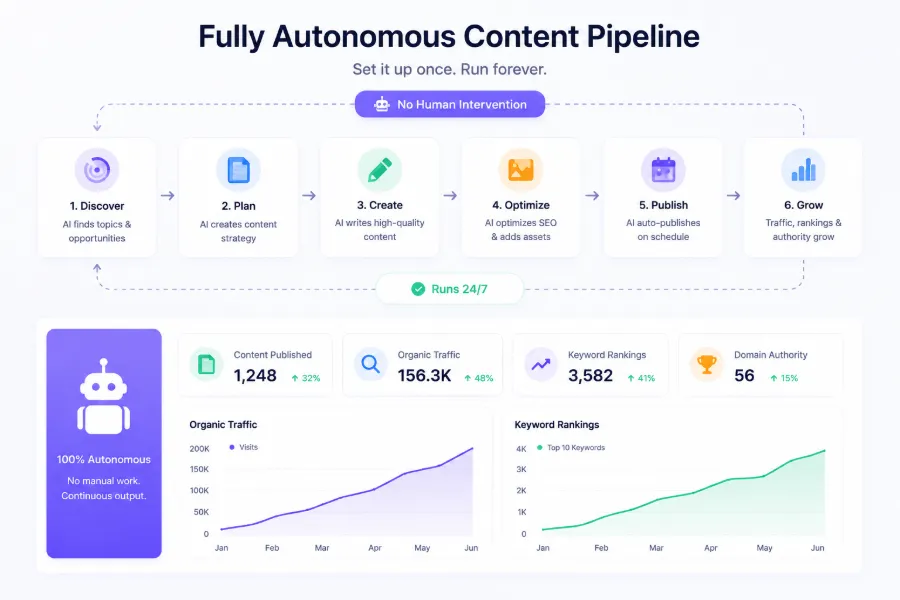
This is where content automation platforms fill the gap. Take SEONIB as an example; it’s not just an AI writing tool but integrates trend discovery, content generation, scheduling, and multi‑platform publishing into a complete automated pipeline. The workflow works like this: AI automatically monitors industry trends, identifies high‑potential topics, and pushes them to a topic pool; article generation supports 40 languages and can produce SEO‑optimized posts from keywords, product links, social posts, etc.; the scheduling feature, when set for daily or weekly publishing, runs automatically without daily manual effort; publishing synchronizes to multiple platforms—Shopify, WordPress, SHOPLINE, Medium, and more—without logging into each backend individually.
For cross‑border e‑commerce sellers, this multi‑platform sync solves a long‑standing pain point: the time cost of publishing the same content across different platforms often exceeds the writing time itself.
For more operational details, see the SEONIB Official Help Documentation.
How to Combine These Tools and Build Your SEO Workflow
Once you have the right tools, the key question becomes: how to stitch them together into a stable workflow? A typical SEO process includes several stages, each matched with appropriate tools.
Keyword Research Stage: Use comprehensive tools like Ahrefs or Ubersuggest to analyze search volume and competition, identifying viable keyword directions.
Technical Detection Stage: Pair Site Audit with PageSpeed Insights for a technical health check, ensuring site structure meets search‑engine requirements.
Content Production Stage: This is the biggest bottleneck in traditional workflows—many teams spend two weeks on keyword research, then stop after writing one article. A content automation platform maintains output cadence, allowing continuous content accumulation.
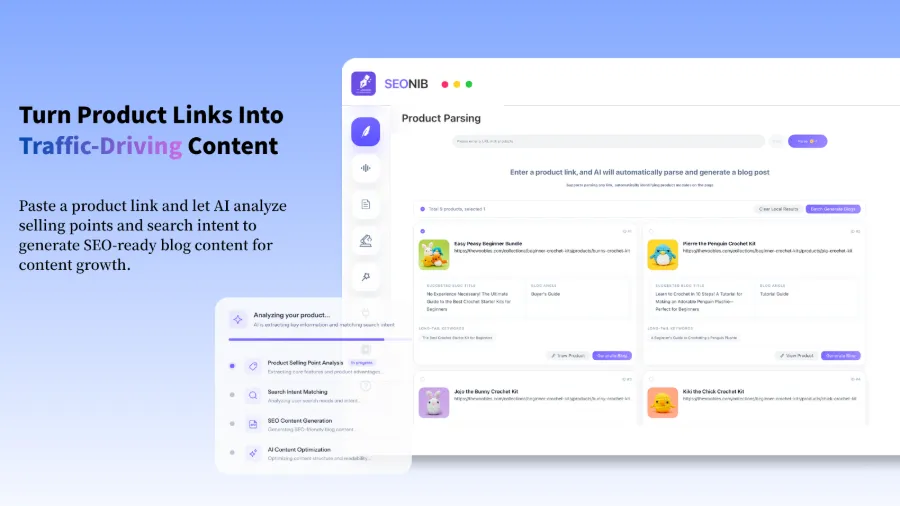
Example: First, use Ahrefs to find a batch of long‑tail keywords with decent search volume and moderate competition. Import those keywords into SEONIB to batch‑generate articles, set a schedule to publish three pieces per day, and let the system automatically produce and sync them to your website and social platforms. The process shrinks from over ten hours of manual writing and publishing per week to thirty minutes of weekly setup and review. Content quality actually improves—your effort shifts to keyword strategy and content refinement rather than typing and formatting.
Another important point is content quality’s impact on AI search. AI tools tend to cite sites with clear structure and complete information. If your content is just keyword stuffing without real value, it won’t rank in traditional search nor be cited by AI. This article discusses How to Make ChatGPT Treat Your Site as a Reliable Source and is worth reading.
Additionally, SEONIB’s content calendar lets you preview a week or month of publishing plans; once set, AI executes automatically without daily logins. For cross‑border e‑commerce sellers, this means multilingual site content can be managed centrally, eliminating the need to hire separate writers for each market.
FAQ
Q1: Are free SEO tools sufficient? Which ones do you recommend?
Free tools are suitable for the early stage. Google Search Console, Google Analytics, and Google PageSpeed Insights are three essential official free tools. Ubersuggest’s free tier allows three keyword queries per day. When the site enters the growth phase and needs competitor analysis and rank tracking, the value of paid tools truly emerges.
Q2: Different keyword research tools show vastly different data— which one should I trust?
Don’t get stuck on which number is “correct.” Data differences stem from varied crawling methods and calculation models. Focus on the relative relationship between keywords within the same tool—higher search volume, lower competition. Choose a trusted tool as your baseline and track trends over time.
Q3: Should I use multiple comprehensive tools like Ahrefs, SEMrush, etc., simultaneously?
Not recommended. Using several comprehensive tools only creates data chaos because the same keyword yields different values across tools, leading to decision paralysis. Pick the tool that best fits your needs and language support, and concentrate on it.
Q4: Can AI content automation tools really help SEO rankings?
AI tools don’t directly boost rankings, but they help you maintain a steady cadence of high‑quality content updates, which is a prerequisite for ranking.
Q5: I’m a cross‑border e‑commerce seller—what type of tools should I prioritize?
First, choose a comprehensive SEO tool that supports multiple languages and regional settings for keyword research and competitor analysis. Next, adopt a content automation platform to handle bulk multilingual content generation and multi‑platform publishing. For technical detection, the free versions are sufficient, as most cross‑border e‑commerce platforms already address basic technical SEO issues.
Share Article