The Third Automation of Content Marketing: From Conversational Generation to Intelligent Agents

Cross‑border e‑commerce teams rarely struggle with “cannot write articles.” Their daily routine often looks like: finding keywords and competitor content in the morning, copying prompts at noon, handling images, alt text, and meta tags in the afternoon, and finally logging into Shopify, WordPress, or SHOPLINE to publish in the evening. If a field is missed, the article must be reworked; a product price update can cause old content to keep circulating.
ChatGPT changed the content creation stage, and AI Agents are now taking over the connections between topic selection, execution, publishing, and maintenance. Whether the third automation truly exists isn’t judged by how many articles are generated per day, but by whether a set of content tasks can keep running with state tracking, reviews, and failure logs.
Content marketing is shifting from “generating a single article” to “having a content flow continuously complete tasks.” This doesn’t mean editors can quit the process; rather, human effort moves from copy‑pasting to fact‑checking, intent analysis, and growth analytics.
The Three‑Automation Revolutions Change Different Things
The three automations experienced by cross‑border teams are not three software versions but three compression points in the content workflow. The first stage handles operations, the second handles generation, and the third handles the connections between tasks.
The first automation relied mainly on rule‑based tools, templates, and scripts. It fixed repetitive actions such as title formatting, table organization, email sending, and CMS field filling, reducing manual effort, while topic selection, writing, and publishing order remained human‑driven. The second stage, represented by ChatGPT, compressed the time from outline to first draft; SEO articles, product descriptions, and social media copy can be produced quickly in a single conversation.
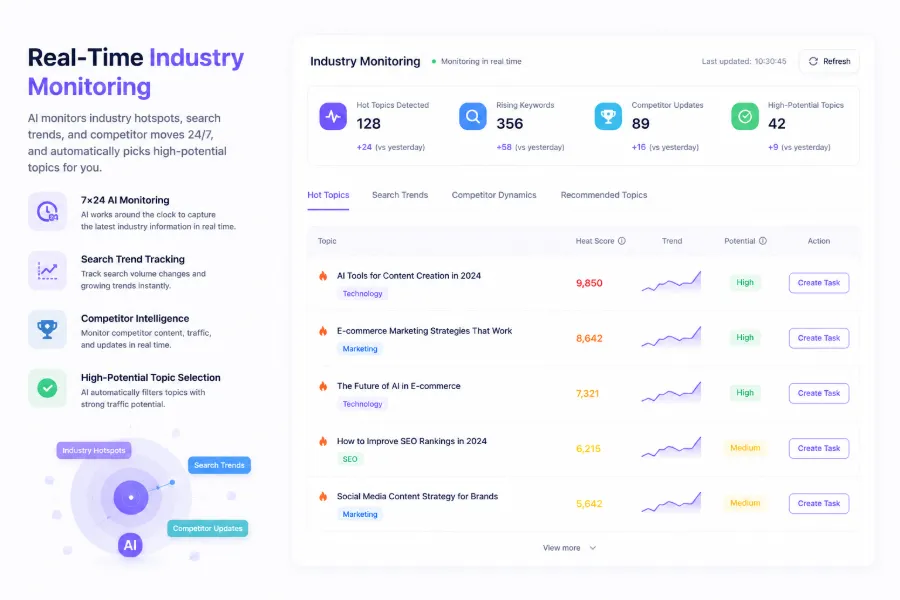
The third stage is driven by AI Agents and handles process automation. The system must know which tasks are completed, which reviews were rejected, which channels failed to publish, and whether a retry is needed. For SEO and AEO, optimizing a single article is just the starting point; content calendars, keyword shifts, product information, and indexing status need to be placed on a continuously running chain. When teams devise search strategies, they still need to implement the SEO fundamentals on pages and content structures rather than handing all judgments over to the model.
| Automation Stage | Primary Focus | Human‑Required Work | Typical Bottleneck |
|---|---|---|---|
| Operations Automation | Formatting, fields, repetitive clicks | Topic selection, judgment, checking | Limited rule coverage |
| Generation Automation | Drafts, titles, summaries | Fact‑checking, rewriting, publishing | Copy‑pasting and context loss |
| Process Automation | Task orchestration, scheduling, syncing | Approval boundaries and exception handling | State tracking and retry logic |
The three stages correspond to operations automation, generation automation, and process automation. Conversational AI still requires humans to issue commands, copy results, check formatting, upload images, and then log into the backend to publish. It speeds up one step but does not automatically resolve waiting and omissions between preceding and following steps.
Therefore, the criterion for the third automation is not “does the model write like a human,” but “can content tasks keep moving forward.” Once a topic enters production from the content calendar, it should leave behind a generated version, review records, publishing status, and subsequent performance; otherwise it is merely a faster way to produce more files that still need manual sorting.
From Prompts to Task Orchestration: Which Steps AI Agents Take Over
A complete automated content pipeline can be broken into four steps: trend discovery, content generation, scheduling & publishing, and cross‑platform syncing. The four steps are not four independent buttons; the output of each step must become a recognizable input for the next.
Trend discovery reads keyword search volumes, competitor content, product links, social media posts, and industry news. Content generation then organizes articles based on brand knowledge bases, target markets, and product facts, rather than simply rewriting the day’s hot topics. Scheduling & publishing handle timing and channels, while cross‑platform syncing deals with differing CMS fields, images, and format variations.
When a human asks a model, the model usually only knows the content provided in the current conversation. A system‑type AI Agent must remember task state: which facts have already been extracted from a product page, whether the German version has been reviewed, which channel returned an error, and whether the article’s canonical tag has been written. The change is not “longer answers,” but the ability to drive the next step.
Topic selection cannot rely solely on hot trends. A high‑search‑volume keyword may be useless if the product is out of stock, the target market lacks delivery capability, or the brand knowledge base lacks reliable product data. Chasing it only creates rework. Cross‑border teams usually evaluate product pages, keywords, competitor content, and market trends together; external sources like product selection & trend research can provide clues but cannot replace the product owner’s confirmation of price, specifications, and supply status.
Multilingual SEO amplifies this issue. The English term “shipping” may need to be translated as “delivery,” “freight,” or “shipping policy” depending on the market; a literal translation may not match the search intent. AI Agents can schedule tasks in different languages but should not automatically decide all localized expressions. When teams connect trends, knowledge bases, search pages, and publishing actions, they can refer to multiple AI growth models, but each task still needs clear input and exit conditions.
Bottlenecks in Content Production Shift from Writing Speed to System Maintainability
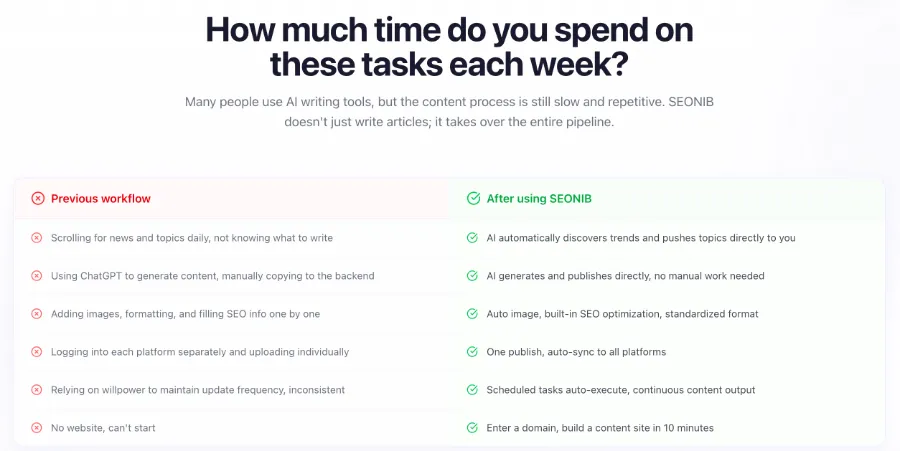
In the first weeks after a cross‑border team adopts generative AI, draft times usually shrink dramatically. Then problems migrate: product links need to be re‑copied, images must be handled separately, alt text and SEO fields need filling, editors compare different versions, and finally the article is pasted into the backend. One team noticed in the third week after rollout that while writing time decreased, the daily time spent on layout and rework increased by about two hours—the saved time was simply shifted elsewhere.
In such a workflow, SEONIB functions more like an observation case: product links, keywords, trends, social posts, and reference links serve as various entry points, which then connect to article generation, SEO processing, and publishing actions. It supports 40 languages, which is handy for market expansion, but also means that fact, format, version, and tone checks increase; “more supported languages” does not directly translate to “less review work.”
The trouble from multi‑source input isn’t just quantity. A price in a product link may have changed yesterday; a social post may contain unverified claims; a reference link may only be suitable as background material. If a team needs to launch tasks from different sources, they should view the five sources of automated content generation as entry design, not as trustworthy facts.
Before generated content goes live, at least a human review is required. Review scope typically includes facts, price, inventory, compliance, brand tone, and localization; for health, finance, children’s products, etc., legal or specialist review is added. The faster content is generated, the scarcer review attention becomes—an unintuitive result: teams often get stuck not on writing but on lacking enough people to verify each version.
A cross‑border team once performed a massive Monday‑night update that unintentionally inserted old product prices into 18 buying guides. The erroneous information propagated to multiple pages by that morning; customer service only discovered it when users inquired in the afternoon. The team rolled back the article versions, re‑crawled the site, and spent two days reconciling inventory and price. The time originally saved on publishing turned into page fixes, customer explanations, and data reconciliation.
These incidents show that content automation does not equal “no review.” Fact‑checking can automatically flag suspected conflicts; alt text and meta tags can be auto‑generated, but product owners must still confirm product facts, editors must assess search intent, and brand teams must handle potentially misleading phrasing.
When Content Enters the Publishing System, Cross‑Platform Sync Becomes the New Automation Frontier
Once an article moves from the editor into Shopify, WordPress, SHOPLINE, or another CMS, the focus shifts from text quality to field mapping. Titles, summaries, categories, featured images, authors, canonical tags, and publish dates have different field names and constraints across platforms. HTML accepted by one platform may become extra blank lines or lost images on another.
When cross‑platform sync spans more than ten platforms, the combination of APIs, fields, and error handling grows quickly. A webhook returning 200 does not guarantee the page is correctly displayed; it may simply mean the request was received, while image processing, page generation, or indexing happen later. If a team only looks at a single “publish successful” status, it can easily mistake technical receipt for online visibility.
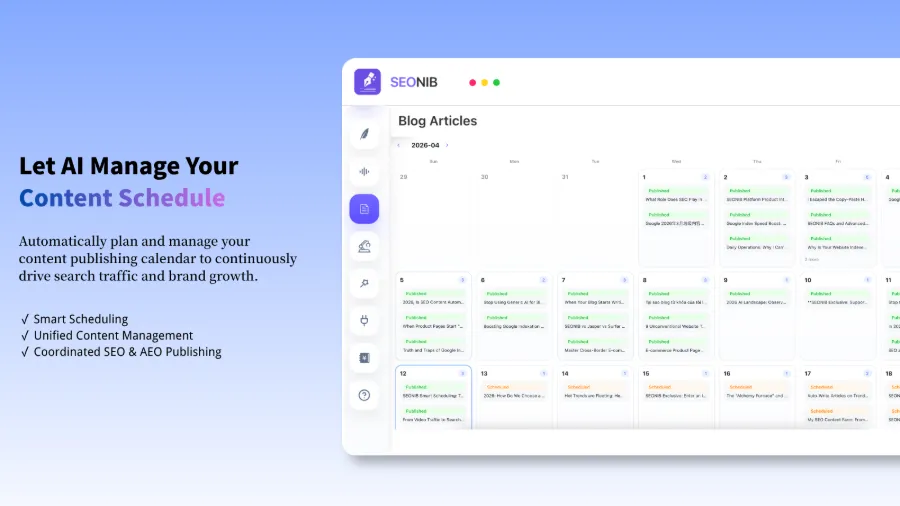
Scheduling & publishing turn “write‑then‑publish” into an observable content calendar, but also introduce retry failures, version management, and error tracking. The operational issues SEONIB presents for these cross‑platform tasks are not solved by a one‑time configuration: platform credentials expire, fields change, image CDNs timeout, and webhooks may enter exception queues due to 4xx or 5xx responses. When batch tasks involve multiple sources, configuration records like batch publishing & data sources are more valuable for troubleshooting than “how many articles were published today.”
Fault isolation can follow event order: first confirm input source and generated version, then check whether review passed, next examine CMS API responses and actual page status, and finally verify Google Search Console indexing and display data. If only a Shopify page fails, the issue may be field mapping; if all channels fail, check the task queue, credentials, or webhook; if a page is live but not indexed, publishing system behavior and search engine behavior should not be conflated.
Indexing also has latency. After a page is published, the display and indexing status in Google Search Console may not change immediately; it’s common for teams to refresh reports repeatedly over hours or days. Rather than merely increasing generation volume, it’s better to track task status, publishing success rate, manual rework count, and indexing delay; platform connections, schedule configurations, and fault diagnostics can be itemized in the content automation help docs.
The Boundary of the Third Revolution: From Automated Output to Controlled Growth
AI Agents still make mistakes in topic bias, factual errors, duplicate content, brand safety, intent misinterpretation, and multilingual context. They may spot a seemingly hot theme but overlook its relevance to the product, or rewrite the same set of specs into ten similar articles, resulting in duplicate content and inefficient organic traffic.
Teams need to define human‑approval boundaries first. Trend discovery, initial clustering, internal linking suggestions, and draft scheduling can be automated under low‑risk conditions; price, inventory, legal statements, medical claims, refund policies, and high‑value product pages should be confirmed by editors, legal, or product owners. Automation execution and automated judgment are not the same; the former reduces clicks, the latter still carries responsibility.
Content systems should also log every action as an event: input source, generated version, review result, publish time, indexing status, and subsequent performance. When traffic drops, the team can determine whether the issue is a changed topic, a template tweak, a publishing failure, or a page mistakenly marked noindex. Ahrefs or Semrush can help observe rankings and competitor shifts, but they show outcomes, not internal task logs.
24⁄7 trend monitoring is suitable for expanding the observation window, not for driving 24⁄7 publishing. Night‑time spikes may be fleeting social noise or unverified events; the system can continuously collect and queue them, but publishing should still obey fact‑checking, brand safety, and content‑quality thresholds.
The value of the third automation revolution lies not in fully autonomous writing but in freeing teams from mechanical operations so they can focus on topic judgment, fact verification, and growth analysis. The closer content is to the production system, the more it needs pause‑able, rollback‑able, and traceable control points.
When natural search traffic, AEO impressions, and topical authority are treated as long‑term metrics, content volume is just one record. A system that publishes 30 articles per week but requires rework on 20 % of pages isn’t necessarily healthier than one that publishes 12 articles per week with stable review and indexing status.
FAQ
What is the core difference between ChatGPT and AI Agents in content marketing?
ChatGPT mainly responds to single prompts, while AI Agents remember state and drive multi‑step tasks. An article workflow may involve trend discovery, generation, review, scheduling, and syncing; the Agent records whether each step is completed instead of just returning a block of text.
Can AI Agents completely replace content editors?
No, especially not for fact‑checking and high‑risk content approvals. After automatic generation, price, inventory, compliance, and localization still need review; mature teams usually keep at least one human review before publishing and check page and indexing status hours to days afterward.
Why do cross‑border e‑commerce teams encounter more content‑automation maintenance issues?
They deal with multiple markets, languages, product versions, and publishing platforms simultaneously. A single price or inventory change can affect dozens of pieces of content, and inconsistent platform fields can cause missing images, misaligned formats, and publishing timing errors; maintenance costs rise with the number of channels.
How should enterprises decide which content tasks are suitable for automation?
Low‑risk, clearly rule‑based, and easily roll‑back tasks are best for automation, such as topic clustering, draft generation, internal linking suggestions, and scheduling reminders. Tasks involving price, legal commitments, inventory, medical or financial information should be handed to editors, legal, or product owners for confirmation.
Beyond article count, what metrics should be tracked for content automation?
At minimum, track publishing success rate, task interruption count, manual rework count, indexing delay, and natural search traffic. You can also compare average time from generation to live, and monitor display, click, and conversion changes 7 and 28 days after publishing.
Share Article