Wake Up, Google Is No Longer the Only Place for Users
It took me about three months to truly accept a fact: users don’t have to find you through Google.
Here’s what happened. Mid‑last year I opened Search Console as usual and saw that a core page’s impressions hadn’t changed much, but its click‑through rate had dropped by almost half. My first reaction was “Google is acting up again,” and I started checking Core Web Vitals, structured data, and any algorithm updates. After two weeks of digging, I found no cause. Then I changed my approach—I searched the keyword myself. The top result on the SERP was an AI Overview, with a YouTube video in the middle, and only then my page appeared. That AI Overview cited research data from another brand.
Users didn’t scroll down. They got the answer from the AI Overview, or clicked the video and left. My page was ranked fourth, but on that page the fourth spot is essentially invisible.
That experience made me take seriously a new reality: users are searching beyond Google. You can be first on Google, but if users don’t click your link, that “first” is just a nice number in an Excel sheet.
What “Search Everywhere” Means
If you haven’t heard this concept, it’s simple: users now initiate searches on multiple platforms, not just traditional search engines. They look for restaurant recommendations on TikTok, tutorials on YouTube, real reviews on Reddit, and products on Amazon. In many scenarios, these platforms have become the starting point for search instead of Google.
Moreover, these platforms are also aggressively taking up space within Google’s own results. For any moderately popular keyword, the results page usually includes Reddit links, YouTube video carousels, and discussion forum entries. You might spend a lot of time optimizing and end up in third place, only to have users’ attention captured by these third‑party platforms. Even more frustrating, many users, once they’re on those platforms, never return to Google. They complete the entire decision‑making process on YouTube or Reddit.
A search‑engine guru once cited a study showing that the keyword “how to fix a leaky sink faucet” receives 15 times more searches on YouTube than on Google worldwide. What does that mean? If you focus only on Google optimization, you’re likely missing the biggest traffic pool.
Another headache is AI. At first I thought tools like ChatGPT and Perplexity had nothing to do with SEO because they drive negligible site traffic. But then I discovered a subtler issue. Research shows that 68 % of B2B buyers now start their research in an AI tool before opening Google for verification. If your brand isn’t referenced in the AI’s answer, you don’t even get a chance to be verified, and you’re eliminated early in the product‑evaluation stage.
AI Layer: You’re Not Invisible, You’re Just Not Cited
I’ve been burned twice by AI search.
The first time was in the second half of last year when I noticed that several core pages of my site never appeared in ChatGPT answers on relevant topics, while a competitor’s blog—clearly lower in quality—was cited. I initially chalked it up to coincidence, but after checking dozens of top‑keyword citations, I found a disheartening pattern: only less than 12 % of the pages that rank in Google’s top five also appear in AI answers. In other words, climbing to first place on Google has nothing to do with being cited by ChatGPT.
The second time was more concrete. I ran an experiment where I fed ChatGPT a handful of keywords and then examined the sources it cited in each answer. Most citations came from news sites, Reddit, and Quora, not from corporate websites. The distribution was almost identical across brands—nearly 90 % of citations originated from third‑party platforms and social media. So if your content strategy revolves solely around your own site, you’re almost guaranteed to be invisible in AI search.
There is a silver lining, though. I later found that brands that are cited by AI actually see an increase in overall clicks. The data is interesting: when an AI Overview appears on a results page, the overall organic click‑through rate can drop by 5 %–30 %, but if you’re cited within that AI Overview, you can gain roughly 35 % more organic clicks. In short, the AI Overview itself isn’t the disaster; the real problem is not being referenced.
How do you get cited? The answer is to have a presence on third‑party platforms. Your content needs to appear on Reddit, YouTube, industry forums, news sites—places that AI models prioritize when training. Only then can you earn citations in the new battlefield of AI search.
Fragmented Content and the SEO Nightmare
I know you might be thinking, “I get the theory, but execution is exhausting.” You’re right—it’s exhausting.
I now have to manage at least the following channels simultaneously: the official website blog, a YouTube channel, LinkedIn articles, occasional product‑related answers on Reddit, and guest posts for foreign industry media. Just reformatting and optimizing each channel is a full‑time job. To make matters worse, each platform has its own SEO rules: YouTube cares about keywords in titles and descriptions, video length, and retention; LinkedIn prefers long posts with tags published by a real person; Reddit requires community approval before you can promote your own links.
I tried a very basic method: recording each platform’s publishing parameters in Notion and manually posting every day. After about two weeks I gave up. I realized I was wasting time copying and pasting formats instead of doing the truly important work.
Later I tried Zapier automation, but because of the huge differences in data structures and publishing APIs, I kept running into formatting breakage and had to manually check and fix things each week. After six months it did cut my publishing workload by roughly 30 %, but the setup and maintenance costs were not trivial.
Then a friend who works in cross‑border e‑commerce sent me a link, saying “You’ll definitely need this.” It turned out to be an AI content platform called SEONIB.
Honestly, I wasn’t particularly impressed at first. The market is flooded with AI content tools that are basically wrapped versions of ChatGPT—just writing articles, with SEO optimization left to luck. SEONIB is different; it doesn’t just write articles, it connects the whole workflow from discovery to publishing.
Automation: From Manual Struggle to “Hello, Robot”
I started using SEONIB at that point because I could no longer tolerate manually adjusting each platform’s format.
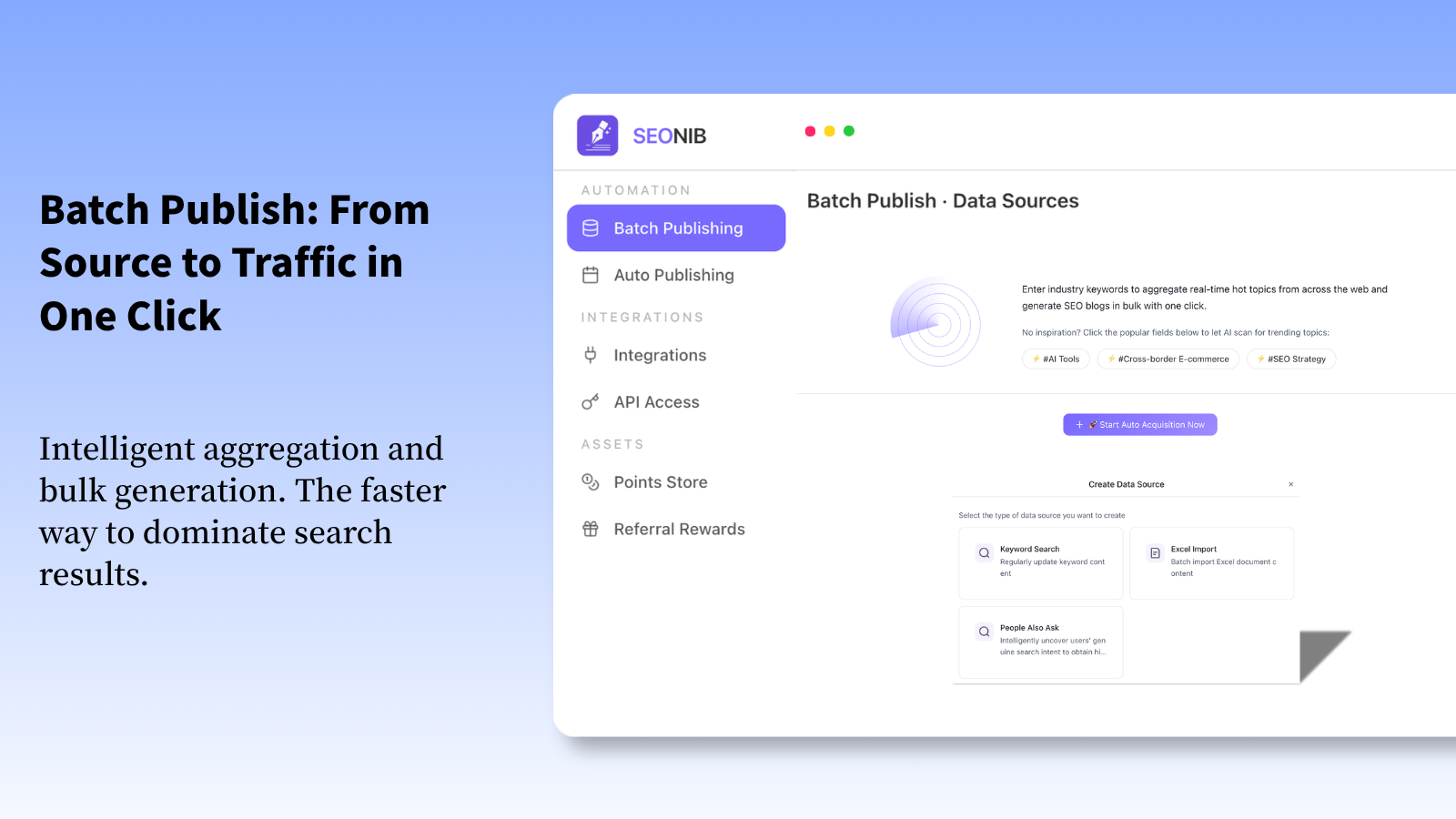
What it does isn’t complicated: it automatically tracks industry trends and keyword changes, pushes hot topics into your editorial calendar, generates SEO‑optimized articles once you approve a topic, and then publishes them to all your linked platforms on a schedule you set.
Yes, it publishes to every platform. It supports mainstream platforms like Shopify, WordPress, Medium, Webflow, Shopline, etc. Write an article once, and it syncs it across all channels, automatically adapting the format.
If you don’t have a website, it can even spin up a quick content site for you. I initially thought this feature was a bit unnecessary, but I later realized it’s handy for independent sellers and personal‑brand creators who don’t want to build a complex site before publishing content.
I have to be honest, though: it’s not perfect. Some topic recommendations don’t match the real hot topics in my industry, so I still need to tweak them manually. And like any fully automated content tool, if your brand tone or expertise level is high, you must ensure the final output doesn’t look like it was generated by AI. I still spend time previewing and manually editing before publishing.
The upside is that I no longer have to open four different sites every day to post. I now review the next week’s content in one batch each week, consolidating scattered weekday tasks into a single management session. This freed up the energy to actually respond to users on Reddit instead of mechanically publishing articles every day.
The Honest Truth: I Still Haven’t Solved Everything
When I wrote this article, it had been over a year since I first noticed the traffic drop on that core page. There isn’t a perfect “everything turned out great” ending.
There are still third‑party platforms whose patterns I haven’t cracked. For example, after four months of activity on Reddit, my follower count barely moved, but a few posts did bring steady traffic. On YouTube, my video views never really took off, but after embedding the video script into a blog post, the page’s dwell time improved a bit. These results aren’t perfect, but they’re certainly better than being completely blind.
Looking back, I’ve accepted one thing: SEO isn’t about ranking; it’s about being discovered. Discovered where? Anywhere users search—Google, ChatGPT, YouTube, Reddit, Amazon. If your content strategy only covers one of those points, your brand may simply not exist in the user’s mind.
Frequently Asked Questions (FAQ)
Will an AI Overview steal traffic from my site?
If the AI Overview doesn’t cite you, it will indeed take away traffic. Data shows that after an AI Overview appears, organic click‑through rates can drop 20 %–30 %. But if you’re cited within the AI’s answer, it can become a traffic amplifier, potentially giving you about a one‑third increase in clicks. The key isn’t the AI’s presence; it’s whether you appear in its answer.
How can a brand become visible in AI search citations?
Relying on your own website’s content is almost never enough. You need to be active on third‑party platforms in your industry: Reddit, YouTube, Quora, industry media, long‑form LinkedIn posts. AI models preferentially pull content from these sources when generating answers. In my experience, consistently answering product‑related questions on Reddit led to one of my answers being cited in a ChatGPT discussion after three months.
Does automatically generated content hurt SEO?
If you publish content without any oversight—focusing only on quantity and ignoring quality—it will certainly have a negative impact. Tools like SEONIB mainly help reduce repetitive labor, but the professional review and adjustment steps can’t be skipped. I spend about one to two hours each week previewing and editing the automatically produced content for the following week to ensure it isn’t just raw machine output. Good automation amplifies the scale you can control, not replaces your thinking.
Is creating content across multiple platforms a waste of effort?
If you simply copy‑paste the same article to every platform without any adaptation, it’s likely a waste of effort. Users have different behavior patterns and expectations on each platform, so you need to tweak the content accordingly. However, if you never appear on those platforms at all, you’re excluding yourself from the user’s search path. Finding a sustainable rhythm—like publishing a generic piece each week plus a specialized version for a weaker platform—is far more sensible than abandoning the effort entirely.
Share Article